
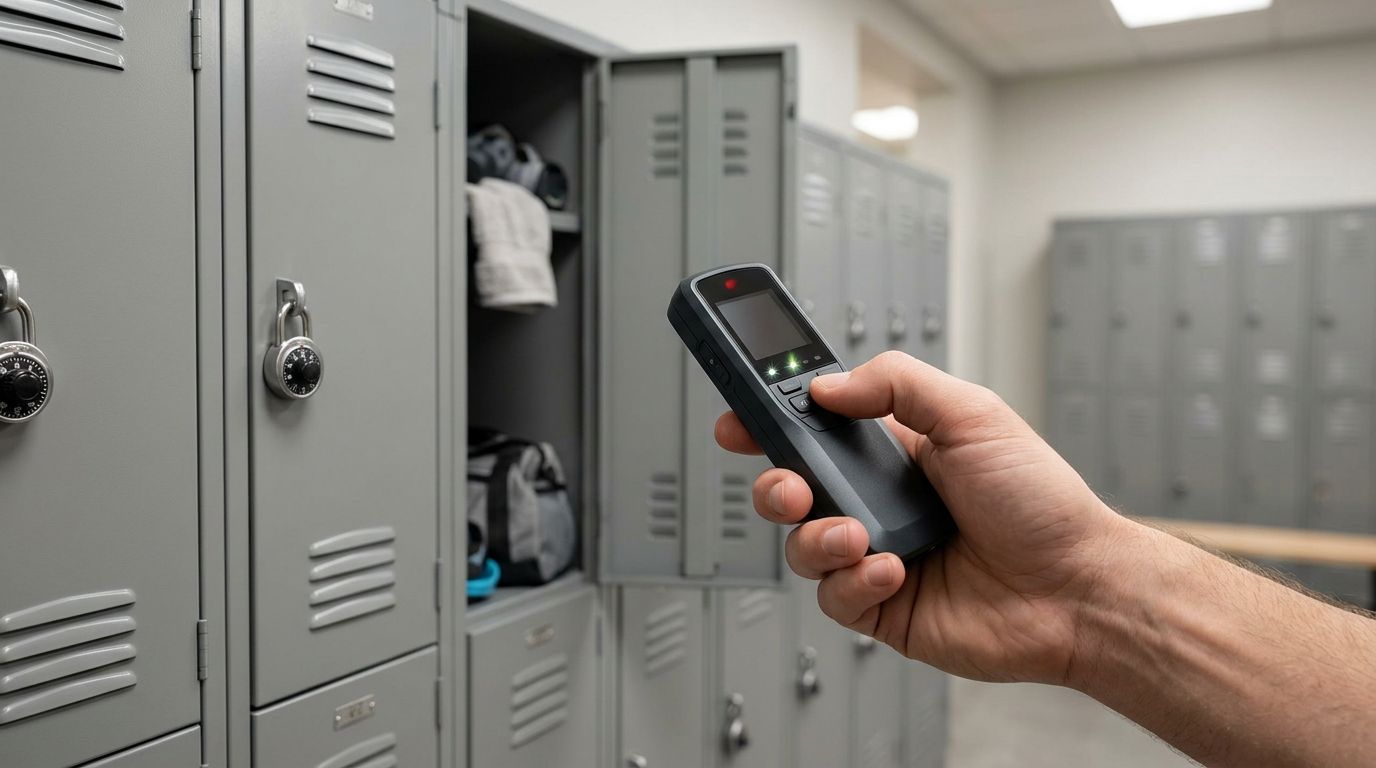
Locker rooms are the hardest place to sweep for hidden cameras because pinhole lenses hide in vents, smoke detectors, hair dryer mounts, and locker vents — and consumer detectors miss non-transmitting cameras entirely. This guide ranks the five real options for finding a hidden camera in a locker room in 2026, from a $30 app to a certified TSCM sweep.
- Best overall for locker rooms in 2026: a professional TSCM sweep, because SD-card cameras don't transmit and RF detectors can't see them.
- RF signal detectors are the best spy camera finders for locker rooms when you need a fast daily staff check between sweeps.
- Smartphone detector apps are the best budget option but only catch reflective lenses in direct light.
- Lens detection flashlights confirm a suspected camera visually but require a slow, methodical sweep of every surface.
- Gym and spa owners face direct liability for cameras found in locker rooms, which is why annual professional sweeps matter more than any single gadget.
Why this matters
A hidden camera in a gym or spa locker room isn't a hypothetical. Local news covers new cases every year — cameras built into smoke detectors, vents, and even shower drains — and the gym or spa operator is the one who ends up named in the lawsuit, not the person who planted the device. Voyeurism recording in a place with a reasonable expectation of privacy is a crime in every US state, and locker rooms sit at the top of that list alongside bathrooms and fitting rooms.
The problem with DIY detection is that most consumer devices only find one category of threat. An RF detector catches a live-streaming camera but goes silent on a camera recording to a local SD card. A lens detector flashlight catches a reflective lens in a mirror or vent but takes 20-30 minutes to work a single locker bay properly. Understanding which finder catches which threat — and where each one falls short — is the difference between a real sweep and a false sense of security.
Hidden camera detection for gym and spa owners covers what a facility-wide program looks like; this guide breaks down the individual tools first.
What makes the best spy camera finder for a locker room
- Detects non-transmitting cameras — SD-card and battery-powered cameras don't emit an RF signal at all
- Works in a wet, high-humidity environment — showers and steam rooms damage cheap electronics fast
- Covers reflective and non-reflective lenses — pinhole lenses under 2mm often don't catch light the way a webcam does
- Fast enough for daily staff use — a tool that takes an hour per room won't get used before every shift
- Produces evidence that holds up — matters if a facility owner needs documentation for a lawsuit or insurance claim
- Doesn't require technical training to operate at a basic level
At a glance: locker room camera finders compared
| Option | Best for | Standout feature | Key limitation |
|---|---|---|---|
| Professional TSCM sweep | Facility owners with legal exposure | Finds transmitting and non-transmitting devices, thermal and physical inspection | Requires scheduling; not a same-hour DIY fix |
| RF signal detector | Fast daily staff checks | Flags active wireless transmissions in seconds | Blind to SD-card cameras and devices in standby |
| Lens detection flashlight | Visual confirmation of a suspected spot | Makes reflective lenses glow under angled light | Slow, misses cameras behind frosted covers |
| Smartphone detector app | Personal spot-checks on a budget | No extra hardware, works with a phone flashlight | High false-positive rate, unreliable in bright rooms |
| Combination RF + lens kit | Facility managers who want one owned tool | Two detection methods in a single device | Still misses cameras with no transmission and no exposed lens |
1. Professional TSCM sweep: best overall for locker rooms
A certified sweep combines a spectrum analyzer, near-field RF probes, a physical inspection of vents and fixtures, and often a nonlinear junction detector that finds electronics even when they're powered off. That last part matters most in a locker room: a camera with local storage and no active transmission is invisible to every consumer detector on this list, but a nonlinear junction detector still flags the electronics inside it.
Professional TSCM sweep pros:
- Catches non-transmitting, SD-card, and dormant cameras
- Covers vents, fixtures, drains, and mounting points a handheld device would miss
- Produces a documented report for liability and insurance purposes
Professional TSCM sweep cons:
- Costs more than a handheld gadget
- Needs to be scheduled rather than run on demand mid-shift
Best for: gym, spa, and fitness club owners who need locker rooms cleared before or after an incident, or on a recurring basis. Verdict: Buy — this is the only option that closes the gap DIY tools leave open.
2. RF signal detector: best for fast daily staff checks
An RF detector scans a frequency range roughly 1 MHz to 6 GHz and alerts on any active wireless transmission nearby — the same principle used by RF detectors in professional bug sweeping, just in a smaller, cheaper form factor for daily use.
RF signal detector pros:
- Fast — a full locker room scan takes a couple minutes
- Simple enough for front-desk staff to run before opening
- Portable and battery-powered
RF signal detector cons:
- Silent on SD-card or hardwired cameras with no wireless transmission
- Can trigger false positives from Wi-Fi routers, phones, and Bluetooth speakers nearby
Best for: staff running a quick daily check between scheduled professional sweeps. Verdict: Buy as a supplement, not a replacement.
3. Lens detection flashlight: best for visual confirmation
This tool shines a ring of LED light and looks for the telltale reflective glint a camera lens throws back, similar to how the best hidden camera detectors for fitting rooms are used in retail changing rooms. It's a visual method, not an electronic one.
Lens detection flashlight pros:
- No signal knowledge needed — you're looking for a visible glint
- Works on cameras that are powered off or not transmitting
- Cheap and durable for repeated use
Lens detection flashlight cons:
- Slow — a shower stall or full row of lockers takes real time to work through methodically
- Misses lenses hidden behind frosted glass, mesh, or angled away from your sightline
Best for: confirming a specific tip or suspicious spot someone already flagged. Verdict: Hold — useful as a second opinion, not a standalone sweep.
4. Smartphone detector app: best budget option
These apps use your phone's camera and flash to look for the same lens-glint effect as a dedicated flashlight, at no added hardware cost.
Smartphone app pros:
- Free or low-cost, no extra device to carry
- Good enough for a gym member checking their own locker
- Instant — no setup required
Smartphone app cons:
- High false-positive rate on shiny hardware, mirrors, and metal fixtures
- Unreliable in bright locker room lighting, which washes out the glint effect
Best for: an individual member doing a personal spot-check, not a facility-wide policy. Verdict: Skip for facility use; fine for personal peace of mind.
5. Combination RF + lens detector kit: best for facility managers who want one owned tool
These bundle an RF scanner and a lens-detection flashlight into a single device, aimed at facility managers who want something they control rather than relying only on scheduled outside visits.
Combination kit pros:
- Two detection methods without carrying two devices
- Reasonable middle ground between a bare RF detector and a full sweep
Combination kit cons:
- Still misses non-transmitting, non-reflective cameras entirely
- Requires someone on staff trained to use both functions correctly
Best for: multi-location gym operators standardizing a self-check protocol. Verdict: Hold — a reasonable staff tool, not a substitute for an annual sweep.
How this ranking works
The ranking weighs detection coverage first — whether a tool catches non-transmitting cameras — then speed, then how much training it demands. That's why the professional sweep sits at the top even though it costs more and takes longer to schedule than a flashlight: it's the only option built to catch the devices the others are structurally blind to.
“A camera with no active transmission and no exposed lens is invisible to every consumer detector on the market — that's exactly the device a professional sweep is built to catch.”
Which locker room camera finder should you choose?
Running a gym, spa, or fitness club with locker rooms in 2026? A professional TSCM sweep is the right call, paired with a cheap RF detector for staff to run between visits. An individual member worried about a specific stall should start with a lens flashlight or app, then report anything suspicious to management immediately rather than trying to remove or tamper with a device.
Get your locker rooms swept
Certified TSCM sweeps for gyms, spas, and fitness clubs nationwide.
FAQ
What's the best spy camera finder for locker rooms in 2026?
A professional TSCM sweep is the best option because it catches non-transmitting, SD-card, and dormant cameras that RF detectors and lens flashlights miss entirely. Consumer tools work as a supplement between scheduled sweeps, not a replacement for one.
Can an RF detector find every hidden camera in a locker room?
No — an RF detector only flags devices actively transmitting a wireless signal. A camera recording to a local SD card or set to record on motion produces no signal for an RF detector to catch.
Is a smartphone app good enough to check a locker room for cameras?
A smartphone detector app is fine for a quick personal spot-check but produces frequent false positives on reflective hardware and struggles in bright lighting. It's not reliable enough for a facility-wide policy.
How often should a gym sweep its locker rooms for hidden cameras?
Most facility owners schedule a professional sweep on a recurring basis and run staff RF checks daily, especially after any maintenance work or contractor access to vents and fixtures.
Is it illegal to have a hidden camera in a gym locker room?
Yes — recording someone in a place with a reasonable expectation of privacy, including a locker room, is a criminal offense in every US state. Gym and spa operators can face civil liability if a camera is found on their property.
What locations should you check first in a locker room sweep?
Smoke detectors, air vents, hair dryer mounts, bench hardware, and shower fixtures are the most common hiding spots because they already have wiring, mounting points, or line of sight into the room.
Do lens detection flashlights work on every hidden camera?
No — they only catch lenses with a direct line of sight to the flashlight beam. A lens angled away, covered by frosted glass, or hidden behind mesh won't produce a visible glint.
Who is liable if a hidden camera is found in a gym locker room?
The facility owner typically faces the legal and financial exposure, not just the individual who planted the device, which is why recurring professional sweeps are treated as a standard operating cost for gyms and spas in 2026.
One last thing
The detail most gym owners miss: a camera doesn't need Wi-Fi to be dangerous. Devices with local SD storage and motion-triggered recording are cheap, widely available, and invisible to an RF detector — which is exactly why the flashlight-and-app combo so many facilities rely on catches only half the problem. Pair a documented professional sweep with a fast daily staff check, and you cover both categories of threat instead of just one.


