A landlord generally cannot lawfully use hidden cameras to watch you in a rental bedroom, bathroom, or another space where you reasonably expect privacy; owning the property does not authorize that surveillance. In 2026, the legal answer depends on state law, the camera’s view, notice and consent, and whether it captures audio—while security cameras covering shared entrances require a different analysis.
- For the landlord hidden camera legal question, private-room surveillance differs from shared-entrance security monitoring.
- Property ownership does not override tenant privacy or authorize recording private conversations.
- Preserve evidence without dismantling suspected devices; separate discovery from proof of who installed them.
- USA Bugsweeps provides residential TSCM bug sweeping; a tenant attorney assesses legal rights and remedies.
Is it legal for a landlord to install hidden cameras in a rental unit?
A landlord’s ownership does not create permission to secretly record a tenant’s private life. Distinguish the location being recorded from the location where the camera is mounted.
| Camera location or view | Central legal issue | What to document |
|---|---|---|
| Bedroom or bathroom | Strong expectation of privacy; state voyeurism and privacy laws | Lens direction and the private activities within view |
| Living room inside your leased apartment | Privacy within your home; consent and recording circumstances | Who controls the space and what the lease discloses |
| Shared entrance or parking area | Security monitoring, applicable notice rules, and camera coverage | Whether the view stays within shared areas |
| Hallway camera aimed through your doorway | Intrusion into the home despite exterior placement | What becomes visible when the door opens |
| Any camera with a microphone | Separate interception and consent rules | Evidence of audio capability or actual recording |
For help identifying suspected equipment, USA Bugsweeps provides professional residential TSCM bug sweeping nationwide. Technical detection and a legal assessment answer different questions.
Why this matters
Finding an unfamiliar object does not establish that it is a camera, that it recorded anything, or that your landlord installed it. Keep those issues separate. A clear record protects your credibility and gives police or an attorney something specific to assess.
This 2026 guide addresses U.S. residential rentals, not a single nationwide landlord-camera rule. State criminal statutes, civil privacy claims, lease terms, and local housing rules can apply together. This is general information, not legal advice for your jurisdiction.
Hidden cameras in bedrooms and bathrooms
Treat suspected surveillance of sleeping, bathing, changing, or toilet use as a serious privacy concern. These activities sit at the center of the privacy interests protected by state voyeurism laws, although each statute has its own elements and exceptions.
A device does not become lawful because the landlord calls it a security measure. The relevant facts include what it captures, whether people consented, and the circumstances specified by the applicable law. Recording a private bathroom is not equivalent to monitoring a building entrance.
For a 2026 legal review, California Penal Code §647(j) and Florida Statutes §810.145 are examples of state provisions addressing specified forms of invasive visual surveillance. They are not interchangeable national rules. An attorney must match the evidence to the statute that applies where the rental is located.
Do not assume a hidden lens proves the landlord’s involvement. Previous occupants, visitors, contractors, or another person with access are possible investigative leads—not established explanations. Document access history without accusing anyone before the evidence supports it.
Cameras inside living rooms and shared housing
A living room inside an apartment rented entirely to you is different from a shared lounge in a building. “Common area” does not mean every room outside a bedroom. The lease, actual use, and control of the space help establish the distinction.
In a room rental, the landlord might live in the same home and share a kitchen or entrance. That arrangement requires a more specific assessment of notice, camera coverage, audio recording, and privacy expectations. It does not erase privacy in your bedroom or bathroom.
Record whether the device faces a seating area, sleeping space, doorway, or corridor. Also note whether visitors, children, or other occupants enter its field of view. Those facts help an attorney evaluate the conduct without relying on a vague description such as “a security camera indoors.”
Cameras at entrances, hallways, and parking areas
Landlords can have legitimate reasons to monitor shared entrances or parking areas. That does not make every installation lawful. Notice requirements, audio capture, intrusive camera angles, and local rules still require review.
A camera mounted outside your unit can raise privacy concerns if it captures the interior through a window or open door. The mounting location alone does not settle the question. Photograph the relationship between the camera and the private space without entering restricted areas.
If you manage a rental, use clearly disclosed monitoring directed at appropriate shared areas rather than concealed monitoring of tenants’ daily lives. Have local counsel review the placement and recording practices before installation. A security purpose is not a substitute for compliance.
Audio recording creates a separate legal question
Permission to record video does not automatically include permission to record private conversations. A camera with a microphone requires an audio-law assessment even when its video coverage appears acceptable.
Under 18 U.S.C. §2511(2)(d), federal law generally permits interception when the recorder is a participant or 1 party has given prior consent, subject to the statute’s exceptions. State law can impose stricter consent requirements. California Penal Code §632, for example, addresses recording confidential communications without all parties’ consent.
In a 2-person private conversation, a landlord who is absent is not automatically a consenting participant simply because the conversation occurs on the landlord’s property. Do not confuse “one-party consent” with permission for an unrelated property owner to listen secretly.
For your 2026 assessment, distinguish audio capability from confirmed audio capture. A product’s microphone opening or specification can support further investigation, but it does not establish that audio recording was enabled. Avoid logging into an account or accessing stored recordings without authorization.
Why the legal answer varies
The same-looking camera can present different legal issues depending on its use. For a 2026 review, organize the facts around these factors:
- Jurisdiction: State recording and voyeurism statutes define prohibited conduct differently; local housing rules can add obligations.
- Privacy expectations: A private bathroom, an exclusively leased apartment, and a shared parking lot are not equivalent spaces.
- Camera coverage: The field of view matters, including views through windows and doorways into private rooms.
- Notice and consent: A disclosed device and a concealed device present different facts, but disclosure alone does not authorize every recording.
- Audio capture: Recording conversations raises legal requirements separate from silent video.
- Access and responsibility: Installation, account control, footage access, and evidence of actual use help establish who did what.
Bring these facts to a tenant attorney rather than asking for a legal conclusion based only on a photograph. A photograph can show placement; it cannot establish every element of a recording offense.
What should you do if you find a suspected hidden camera?
Prioritize safety and preserve the original condition of the discovery. You do not need to confront the landlord or prove an offense before seeking help.
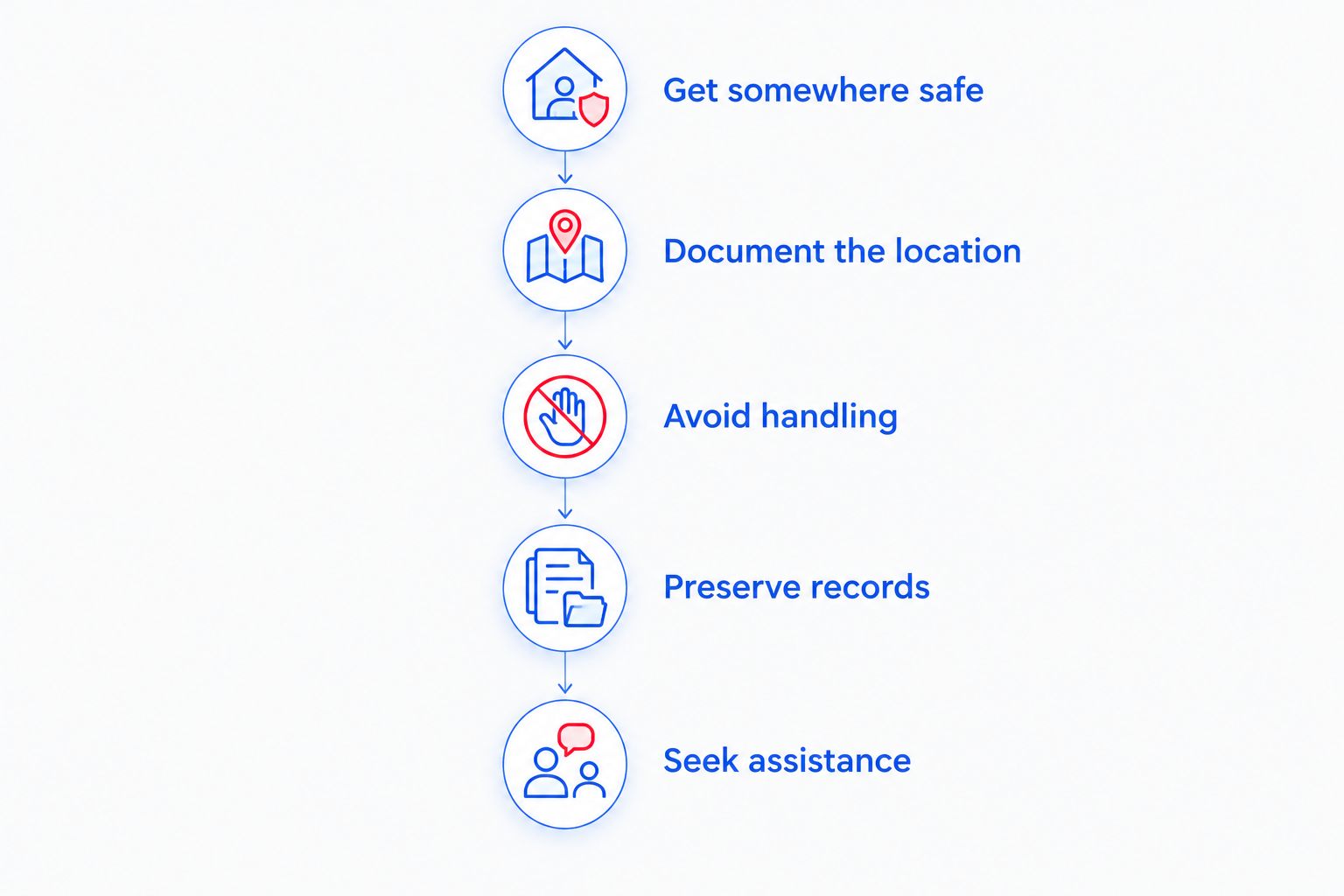
- Get somewhere safe. Leave the affected room if you feel exposed or threatened. Contact emergency services for immediate danger; otherwise, use the appropriate local reporting channel.
- Document the location. If safe, photograph the object in place, its surroundings, and its apparent viewing direction. Keep original files and write down the discovery date and time.
- Avoid handling. Do not dismantle fixtures, remove storage media, reset equipment, or connect the device to your phone. These actions can alter evidence or create electrical and property risks.
- Preserve records. Save the lease, surveillance notices, maintenance messages, entry notices, and relevant communications. Separate what you personally observed from what someone else told you.
- Seek assistance. Ask police about evidence handling, a tenant attorney about legal remedies, and a qualified TSCM provider about identifying suspected surveillance equipment.
If intimate images or children are involved, do not circulate suspected footage to friends, neighbors, or online groups. Ask law enforcement how to preserve and submit it appropriately. Sharing the material creates additional privacy and legal risks.
The hidden camera discovery to landlord complaint workflow provides a related framework for organizing the discovery and complaint. Keep your factual record separate from demands about compensation, lease termination, or prosecution.
When does a professional bug sweep help?
USA Bugsweeps is best suited to renters seeking professional TSCM inspection for suspected hidden cameras or audio bugs. The service addresses technical detection; it does not replace a tenant attorney’s legal analysis or a police investigation.
A professional inspection is relevant when you need help evaluating an unfamiliar device or checking the rental for surveillance equipment. Its limitation is equally important: finding equipment does not, by itself, establish who installed it, who accessed it, or whether a particular crime occurred.
Before authorizing an inspection, ask about the areas covered, permission to inspect, evidence handling, and the form of any findings. Confirm how the provider will distinguish a confirmed device from an unresolved observation. Do not treat the absence of a finding as a permanent guarantee that surveillance is impossible.
Request a residential bug sweep
Discuss suspected hidden cameras or audio bugs in your rental with a professional TSCM service provider.
Does a camera clause in the lease make hidden surveillance legal?
A lease clause does not automatically authorize surveillance that violates applicable law. Its wording, the installation, the notice provided, and the scope of any consent still matter.
Save the exact clause rather than paraphrasing it. A reference to building security cameras is not necessarily consent to recording inside your apartment or capturing confidential conversations. Ask a local attorney to assess the clause against the actual camera coverage.
Can you remove a suspected camera yourself?
Do not make removal your first step. Photograph the discovery and seek guidance about safety, evidence preservation, and your authority to handle the object.
Avoid disturbing smoke alarms, electrical outlets, or other safety equipment. If you need immediate privacy, leave the affected space rather than dismantling a suspicious fixture. Police or a qualified professional can advise on the next action.
Can you break the lease or stop paying rent?
Do not assume a suspected camera automatically authorizes withholding rent or ending the lease. Those remedies depend on local law, the evidence, and required procedures.
Ask a tenant attorney about notice requirements, protective relief, relocation, and potential claims before taking a contractual step. Preserve receipts and communications if you leave temporarily. A technical finding supports an assessment; it does not select the legal remedy for you.
FAQ
Can my landlord put a hidden camera in my bedroom?
A landlord generally cannot lawfully conduct secret bedroom surveillance where you reasonably expect privacy. State voyeurism and privacy laws determine the specific offense or claim, and property ownership does not itself authorize recording.
Are landlords allowed to have cameras in apartment hallways?
Shared-hallway cameras can serve a lawful security purpose, but legality depends on applicable rules, camera coverage, notice, and audio recording. A hallway location does not authorize recording private activity inside an apartment.
Does a security-camera sign make indoor recording legal?
A sign does not automatically make indoor recording legal. The location, what is captured, applicable consent requirements, and state privacy protections still matter.
Can a landlord record conversations in a rental apartment?
A landlord cannot rely on property ownership as consent to intercept tenants’ private conversations. Federal interception law and applicable state consent rules require a separate assessment from video surveillance.
Should I tell my landlord immediately after finding a camera?
Prioritize safety and evidence preservation before confrontation. If you suspect the landlord’s involvement, ask police or a tenant attorney how to report the discovery without compromising evidence or exposing yourself to risk.
Does finding a hidden camera prove my landlord installed it?
Finding a hidden camera does not prove who installed or operated it. Access history, communications, account control, and other evidence are needed to assess responsibility.
Can USA Bugsweeps determine whether my landlord broke the law?
USA Bugsweeps provides technical surveillance detection, not a legal ruling. A tenant attorney assesses legal rights, and law enforcement investigates suspected criminal conduct.
One last thing
Document what the lens can see, not just where the device sits. A camera outside an apartment can face inward, while an unfamiliar object inside a room might not be a camera at all. For a 2026 complaint or consultation, keep three things distinct: confirmed observations, suspected functions, and unanswered questions.
That separation makes your next step clearer. You can request technical identification without accusing someone, seek legal advice without claiming a crime is proven, and protect your privacy without destroying evidence.