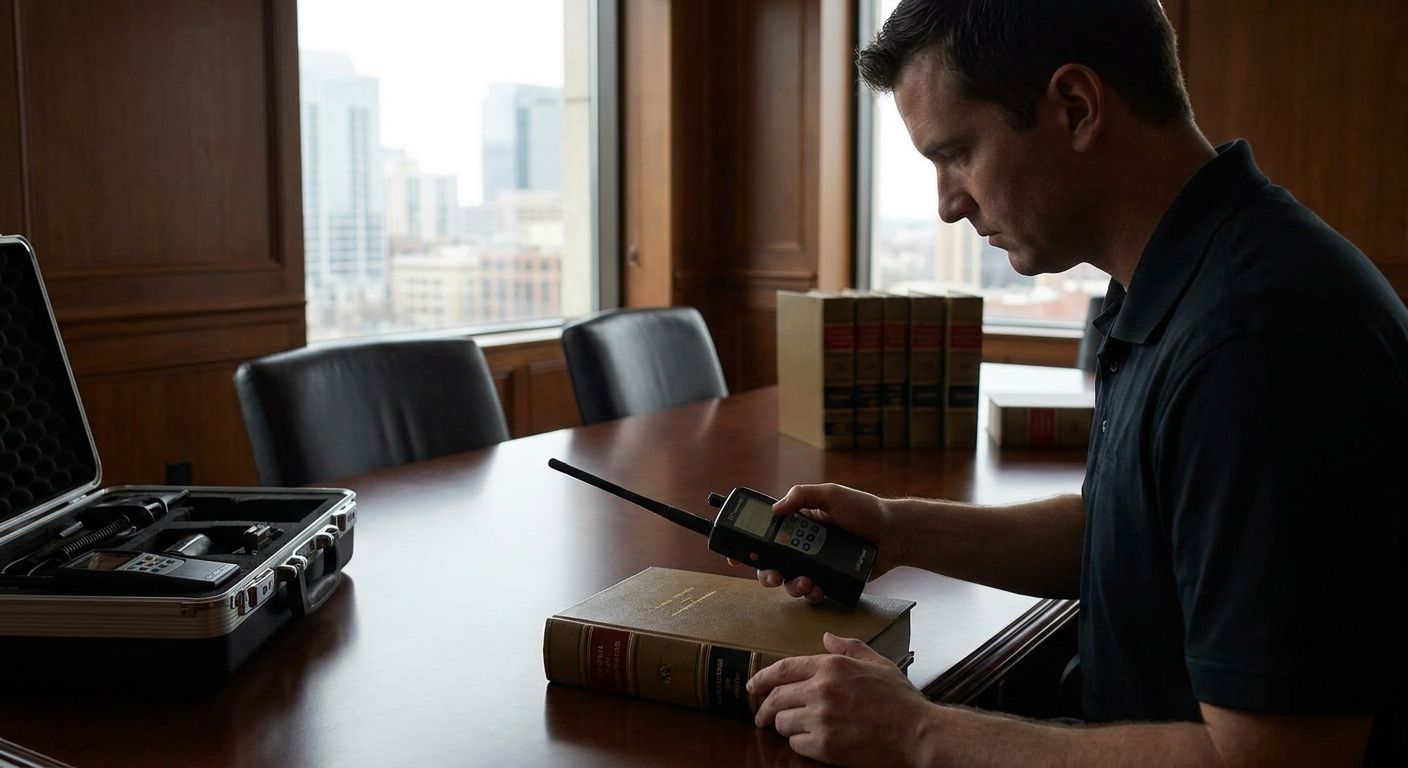
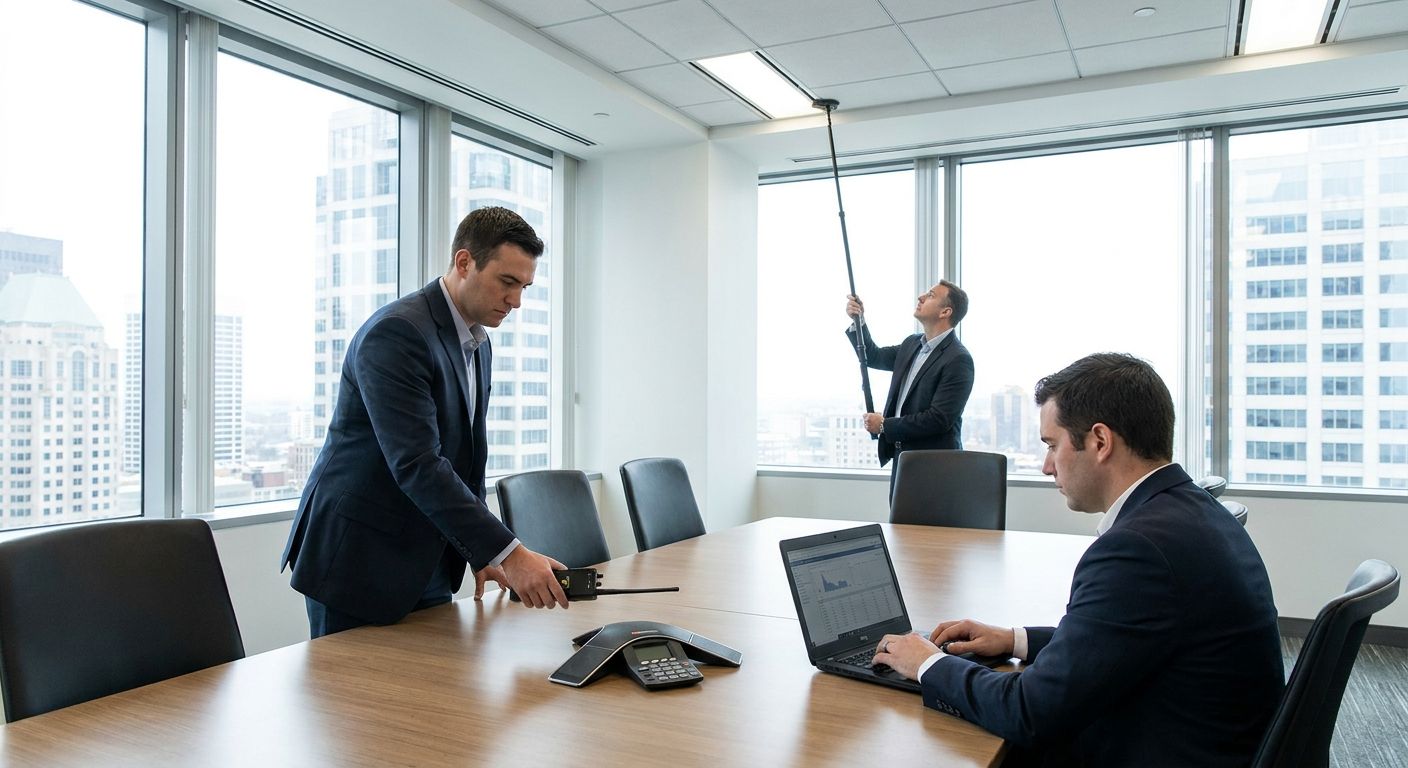
A hidden microphone in a boardroom doesn't announce itself — it just sits there while your M&A terms, litigation strategy, or product roadmap gets relayed to a competitor, a plaintiff's attorney, or worse. Bug sweep for corporate boardrooms means a technical inspection built for rooms where a single leaked sentence can cost seven figures.
- A full RF spectrum plus physical sweep is the standard for any boardroom handling confidential deals in 2026 — Buy.
- Nonlinear junction detection catches dormant, hardwired devices a consumer RF wand will never see — Consider for high-value rooms.
- Quarterly recurring sweeps beat one-time inspections because devices get planted between board meetings — Buy for ongoing risk.
- Consumer handheld bug detectors miss powered-off and wired taps entirely — Skip for boardroom-level stakes.
- USA Bugsweeps runs nationwide TSCM inspections built around board meeting cadence, not generic office sweeps.
Why this matters
Boardrooms get targeted precisely because they're where the decisions with dollar value get made. Earnings calls, acquisition terms, layoffs, litigation posture — all of it gets discussed in one room, usually on a predictable schedule. That predictability is exactly what makes a boardroom easier to bug than a random office cubicle.
USA Bugsweeps runs nationwide TSCM (technical surveillance countermeasures) inspections built specifically for rooms like this, not general office debugging. The difference matters: a boardroom sweep has to account for conference phone systems, video conferencing hardware, smart displays, and HVAC returns that a standard office sweep skips.
A generic electrician with a consumer RF detector will find an obvious Wi-Fi camera. He won't find a hardwired microphone spliced into the conference phone line, or a passive device sitting dormant until the room fills up. That gap is the entire reason TSCM exists as its own discipline in 2026.
Who this is for
This guide is for general counsel, corporate security directors, CFOs, and executive assistants responsible for the room where the board, the audit committee, or the deal team meets. If your calendar includes M&A negotiations, litigation strategy sessions, union talks, layoff planning, or investor briefings, the room itself is a liability you haven't priced in yet.
What to look for in bug sweep services for corporate boardrooms
RF spectrum coverage across the full range
A real TSCM sweep scans from roughly 10 kHz up through 6 GHz in 2026, covering everything from old-school analog transmitters to Wi-Fi 6E cameras and Bluetooth Low Energy trackers. Anything less and you're only checking for the bugs a decade behind current hardware.
Nonlinear junction detection (NLJD)
An NLJD finds semiconductors — the guts of any electronic device — even when the device is powered off or hardwired with no transmitting signal to catch. This is the tool that separates a boardroom-grade sweep from a wand-and-hope inspection, because a dormant device gives off nothing an RF scanner alone will ever pick up.
Physical and thermal inspection
Conference tables, wall panels, ceiling tiles, HVAC vents, and AV equipment all hide devices that no scanner catches without eyes and hands. A thermal camera flags a battery-powered device drawing current inside a wall cavity or under a table where nobody's supposed to look twice.
Confidentiality of the engagement itself
If the sweep gets announced on the internal calendar a week ahead, whoever planted a device has a week to pull it or go dark. A serious TSCM provider treats the engagement date and scope as confidential, often scheduling under a generic maintenance or IT label.
Technician credentials, not just electrical experience
An HVAC tech or an IT contractor can find a visible camera. Finding a wiretap spliced into a phone line, or a GSM bug hidden inside a power strip, requires TSCM-specific training and equipment most electricians never touch.
A written report with remediation steps
A sweep that ends with "you're clear" and nothing else isn't useful in a legal or compliance context. You need a written report documenting what was scanned, what was found, and what changed in the room afterward — the kind of paper trail counsel will want if a leak ever gets litigated.
Top picks for corporate boardroom sweeps in 2026
Full RF spectrum + physical sweep — the standard. Covers 10 kHz to 6 GHz plus a hands-on inspection of furniture, walls, and AV equipment in a single visit. This is the baseline for any boardroom handling anything a competitor or opposing counsel would pay to hear. Buy.
Nonlinear junction detection add-on — the deep dive. Adds semiconductor-level detection for dormant and hardwired devices that RF scanning alone misses. Worth the add for boardrooms running active M&A talks, IPO prep, or active litigation where the stakes justify the extra pass. Consider.
Recurring quarterly sweep contract — the safe long-term pick. A single sweep tells you the room was clean on one day. A recurring cadence — every 90 days is the common industry benchmark — catches devices planted between board meetings, after a contractor visit, or following a personnel change. Buy for any company with a standing board calendar.
Executive off-site and travel debrief sweep — the overlooked one. Board retreats, hotel conference rooms, and rented off-site venues get skipped because nobody thinks of them as "the boardroom." They're just as exposed, often more so since the venue isn't under your control. Consider any time the board meets outside your own building.
Consumer handheld RF detector — the wildcard. Marketed as a quick DIY check, these wands catch active Wi-Fi and Bluetooth transmitters but miss anything hardwired, dormant, or operating outside consumer frequency bands entirely. For a boardroom carrying real financial or legal exposure, this tool gives false confidence. Skip.
“If the sweep is on the shared calendar a week in advance, it already failed.”
What to avoid
- Sweeps scheduled openly on internal calendars. Anyone with access to the calendar — including the person who planted a device — gets advance warning to remove it.
- One-time sweeps with no follow-up plan. A boardroom that gets swept once in 2026 and never again is exactly as exposed the day after the sweep as it was the day before.
- Providers who won't produce a written report. Verbal "all clear" statements carry no weight if a leak surfaces later and legal needs documentation of what was actually checked.
Verdict comparison
| Service | RF spectrum coverage | Physical/thermal inspection | Recommended cadence | Verdict |
|---|---|---|---|---|
| Full RF + physical sweep | 10 kHz-6 GHz | Yes | Per meeting cycle | Buy |
| NLJD deep sweep add-on | N/A (semiconductor-based) | Yes, targeted | High-stakes meetings only | Consider |
| Quarterly recurring contract | 10 kHz-6 GHz | Yes | Every 90 days | Buy |
| Off-site/travel debrief sweep | 10 kHz-6 GHz | Yes | Per off-site event | Consider |
| Consumer RF wand (DIY) | Limited, active signals only | No | N/A | Skip |
FAQ
How much does a bug sweep for a corporate boardroom cost in 2026?
Cost depends on room size, scope, and whether NLJD or recurring service is included, and pricing varies by provider and region in 2026. Request a quote directly rather than relying on a flat industry number, since scope changes the price significantly.
Is a professional TSCM sweep better than a consumer bug detector?
Yes — a professional sweep covers RF spectrum up to 6 GHz plus physical and nonlinear junction detection, while a consumer detector only catches active wireless transmitters. Dormant or hardwired devices go undetected by consumer tools entirely.
How often should a corporate boardroom get swept?
A 90-day recurring cadence is the common benchmark for active boardrooms handling confidential decisions. Rooms used for major deals, litigation, or investor meetings often warrant a sweep before and after each high-stakes session.
Can a bug sweep detect a wiretap on a conference phone line?
Yes, a proper TSCM inspection includes physical tracing of phone and AV lines in addition to RF scanning, which is where hardwired taps get found. RF scanning alone won't catch a wiretap spliced directly into a phone line.
Do hidden cameras in boardrooms still use Wi-Fi in 2026?
Many do, but a growing share use Bluetooth Low Energy or store footage locally with no active transmission at all. That's why physical inspection and thermal imaging matter as much as RF scanning.
Should a sweep be announced to boardroom staff in advance?
No — announcing a sweep gives anyone who planted a device time to remove it before the inspection happens. A confidential engagement scheduled without advance notice is standard TSCM practice.
What's included in a written TSCM report?
A proper report documents the equipment used, the areas inspected, any devices found, and remediation steps taken. This documentation matters if a leak surfaces later and legal counsel needs a record of due diligence.
Is off-site or travel bug sweeping necessary if the main boardroom is already swept?
Yes — board retreats and rented conference venues carry the same exposure as your own boardroom, often more since you don't control who accessed the space beforehand. Off-site meetings involving sensitive decisions warrant their own sweep.
One last thing
The device that actually costs a company money is rarely the obvious Wi-Fi camera sitting on a bookshelf — it's the passive, hardwired tap nobody thinks to look for because it doesn't transmit anything a scanner alone can catch. That's the entire reason nonlinear junction detection exists as a category in TSCM work, and it's the single upgrade most boardroom sweeps skip to save money in 2026.