
Finding a hidden GPS tracker on your vehicle is unsettling, but removing it wrong can tip off whoever placed it — or leave a second device behind. This guide walks through the exact steps to locate, confirm, and safely remove a tracker in 2026, plus when to stop DIY and call a professional.
- Most consumer GPS trackers in 2026 use magnetic mounts and hide near wheel wells, bumpers, or the OBD-II port — check those first.
- An RF detector catches battery-powered trackers but misses OBD-II and hardwired units — use one, but don't stop there.
- USA Bugsweeps recommends a full physical inspection even after an electronic sweep, since GPS loggers with no live signal won't trigger a detector.
- If the tracker is wired into the car's electrical system, stop and call a TSCM professional — cutting the wrong wire can disable safety systems.
Why this matters
A hidden GPS tracker on your car isn't just an inconvenience — it's a real-time record of everywhere you go, who you visit, and when you're home or away. Trackers show up in stalking cases, custody disputes, corporate surveillance, and repossession scares that turn out to be something else entirely. The device itself takes less than five minutes to plant, which is exactly why so many go undetected for months.
Removing it yourself is possible in most cases. USA Bugsweeps handles vehicle bug sweeps professionally when the situation calls for it, but a driver with basic tools can find and pull a standard magnetic or OBD-II tracker without special equipment. The key is knowing where to look and what to do once you find it.
What you'll need
- A flashlight with a strong beam (a headlamp works better — it keeps both hands free)
- A telescoping inspection mirror, or your phone camera on a stick
- Nitrile gloves, if you plan to preserve the device for evidence
- An RF (radio frequency) detector — optional, but useful for battery-powered trackers that transmit live
- 20-30 minutes of uninterrupted time in a well-lit area, ideally with the car on ramps
- The nationwide TSCM sweep team at USA Bugsweeps on standby if you find something wired into the vehicle's electronics rather than a simple magnetic unit
The steps
1. Start with the exterior undercarriage
This is where 2026's most common consumer trackers end up, because magnetic cases stick to any bare metal surface and battery life lasts longer away from engine heat. Run your hand along the wheel wells, the frame rails, and the rear bumper support. Feel for anything boxy or rubberized that doesn't match the surrounding metal — most consumer units are roughly the size of a deck of cards.
Common mistake: people only check the front bumper because that's where movies show trackers going. The rear undercarriage near the spare tire well gets used just as often.
2. Check the wheel wells and fender liners
Pull back the fender liner edges with a flashlight and look for a black or gray plastic case zip-tied or magnetically attached to the frame. Trackers here survive weather better than exposed units and are easy to miss visually — you're feeling as much as looking. Give each wheel 5-7 minutes if you're being thorough.
3. Inspect the trunk, spare tire well, and bumper cavities
Open the trunk and lift the liner and spare tire cover completely. A tracker tucked beside the spare has full metal contact and stays hidden from casual glances. Check inside the rear bumper cavity too, reachable from underneath without removing the bumper. This is the second most common placement after the undercarriage.
4. Scan the OBD-II port under the dash
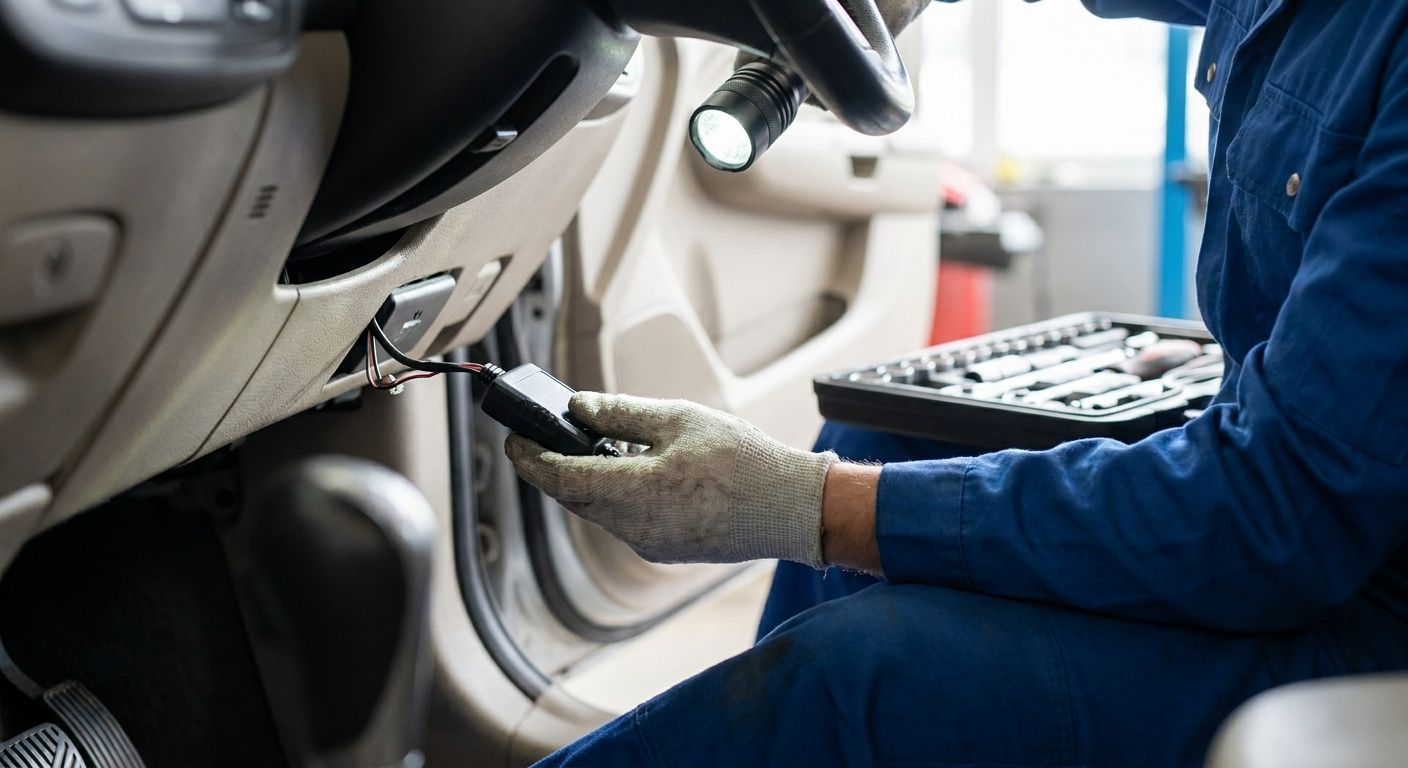
OBD-II trackers plug directly into the diagnostic port, usually under the steering column, and draw power from the car itself instead of a battery. Get on your back with a flashlight and look for a small dongle plugged into that port — it's about the size of a key fob. If the port is empty, this device isn't your problem and you move on.
Common mistake: assuming an OBD dongle is a factory part. If you didn't plug something in, unplug it.
5. Check inside the cabin
Battery-powered trackers with longer runtimes sometimes go inside the cabin rather than outside, especially in shared or fleet vehicles. Slide the seats fully back and forward, run a hand under each seat, and check behind the glovebox liner. Cabin placements are rarer than undercarriage placements, but they're worth 5 minutes.
6. Run an RF sweep if you have a detector
Switch on an RF detector and walk slowly around the vehicle, holding it 6-12 inches from each surface you already checked by hand. A live GPS tracker transmitting location data will spike the detector near its location. This step only catches devices actively transmitting — a logger that stores data locally for later retrieval won't show up, which is why steps 1-5 matter more than the electronic scan.
7. Confirm before you remove
Once you find a suspicious device, photograph it in place before touching it. That matters if you plan to involve law enforcement or an attorney. Check for wires running into the vehicle's harness — a simple magnetic unit with only a battery is safe to pull off by hand.
If the device has wires spliced into your car's wiring, stop here and bring in a professional rather than cutting anything yourself.
8. Remove and secure the device
Pull the tracker free of its mount, bag it in a plastic zip bag if you're preserving it as evidence, and note the date, time, and location found. If you want it disabled immediately rather than kept intact, remove the battery. Once found, removal itself takes under two minutes.
Troubleshooting
- Nothing found, but your phone battery drains fast and data usage spiked — some tracking piggybacks on your phone rather than the car. Check installed apps for anything unfamiliar with location permissions before assuming the vehicle is the source.
- The RF detector spikes everywhere — you're likely reading ambient signals from nearby cell towers or your own phone. Move the detector away from electronics and retest in a garage or covered area away from traffic.
- You found a device with no visible battery or antenna — it may be an OBD-II unit drawing power from the car, which won't have a battery compartment. Recheck the diagnostic port before ruling this out.
- The tracker is zip-tied near a brake line or fuel line — do not cut near these lines yourself. That's a job for a professional; a slipped blade near a brake line is a safety problem, not just a surveillance one.
- The vehicle is leased or company-owned — some trackers are legitimate fleet management devices installed by the leasing company or employer. Confirm with the titleholder before removing anything, since pulling a legitimate fleet unit can violate your lease terms.
- You want to know who placed it — removal doesn't answer that. Preserve the device with photos and, if the situation involves stalking or harassment, involve law enforcement before disposing of it.
“An RF detector only finds the trackers that are talking. The physical search finds the ones that are only listening.”
Tools and resources
- Flashlight or headlamp, inspection mirror, nitrile gloves
- An RF detector, matched to the sensitivity you actually need
- A written log of where and when you searched — useful if you later need to show due diligence
- A repeatable written checklist so you're not working from memory on every sweep
- A professional TSCM sweep when the tracker is wired in, when you can't locate a suspected device, or when the situation involves a restraining order or an active harassment case
What to do next
If your own sweep turns up nothing but you still have reason to believe you're being tracked — unexplained knowledge of your movements, a vehicle left out of your sight for an extended period, or a past relationship involving controlling behavior — a professional TSCM sweep covers ground a visual and RF check misses, including hardwired trackers spliced into the ignition circuit.
USA Bugsweeps performs vehicle bug sweeps nationwide for exactly this scenario in 2026, layering equipment-grade detection on top of the same physical inspection points covered here. GPS tracker removal from a car is straightforward when the device is magnetic and obvious. It stops being a DIY job the moment wires are involved.
FAQ
How do I know if my car has a hidden GPS tracker?
Check the undercarriage, wheel wells, bumper cavities, and OBD-II port for anything that doesn't belong. An RF detector catches live-transmitting units but misses data-logging trackers, so a hands-on physical inspection matters more than the electronic scan.
Is it legal to remove a GPS tracker from my own car?
Yes, if you own the vehicle and the tracker wasn't authorized by a leaseholder or a court order. Confirm ownership status first if the car is company-issued or under a lease agreement.
How much does professional GPS tracker removal from a car cost in 2026?
Vehicle TSCM sweep pricing varies by scope and region, so request a direct quote rather than assuming a flat rate. USA Bugsweeps provides quotes for nationwide vehicle sweeps.
Can a GPS tracker be hidden inside the engine bay?
It happens, mostly with hardwired units powered by the car's electrical system rather than a battery. Check near the fuse box and along wiring harnesses if the undercarriage and OBD port come up clean.
What is the difference between a GPS logger and a GPS tracker?
A GPS tracker transmits location data live over a cellular or radio signal, while a logger stores data locally for retrieval later. Loggers won't trigger an RF detector, which is why a physical search is still required after an electronic sweep.
Will removing a GPS tracker alert the person who placed it?
Some models send a status alert when they lose power or connection. If you suspect an active stalking situation, photograph the device in place and consider involving law enforcement before removal.
Can I use my phone to detect a GPS tracker in my car?
A phone alone can't detect most vehicle trackers reliably. A dedicated RF detector paired with a hands-on physical inspection is the more dependable approach.
Should I hire a professional instead of removing the tracker myself?
Hire a professional if the device is wired into your car's electrical system, if you can't locate a suspected tracker after a full inspection, or if the situation involves harassment or a legal case. USA Bugsweeps handles these vehicle sweeps nationwide in 2026.
One last thing
Most DIY searches fail at the same point: people check the obvious exterior spots, find nothing, and stop before they ever look under the dash. Make the OBD-II port the last thing you check every single time, even when the rest of the car comes back clean — it is the most overlooked placement in 2026, and it is the one placement that requires no tools and no crawling to plant.