
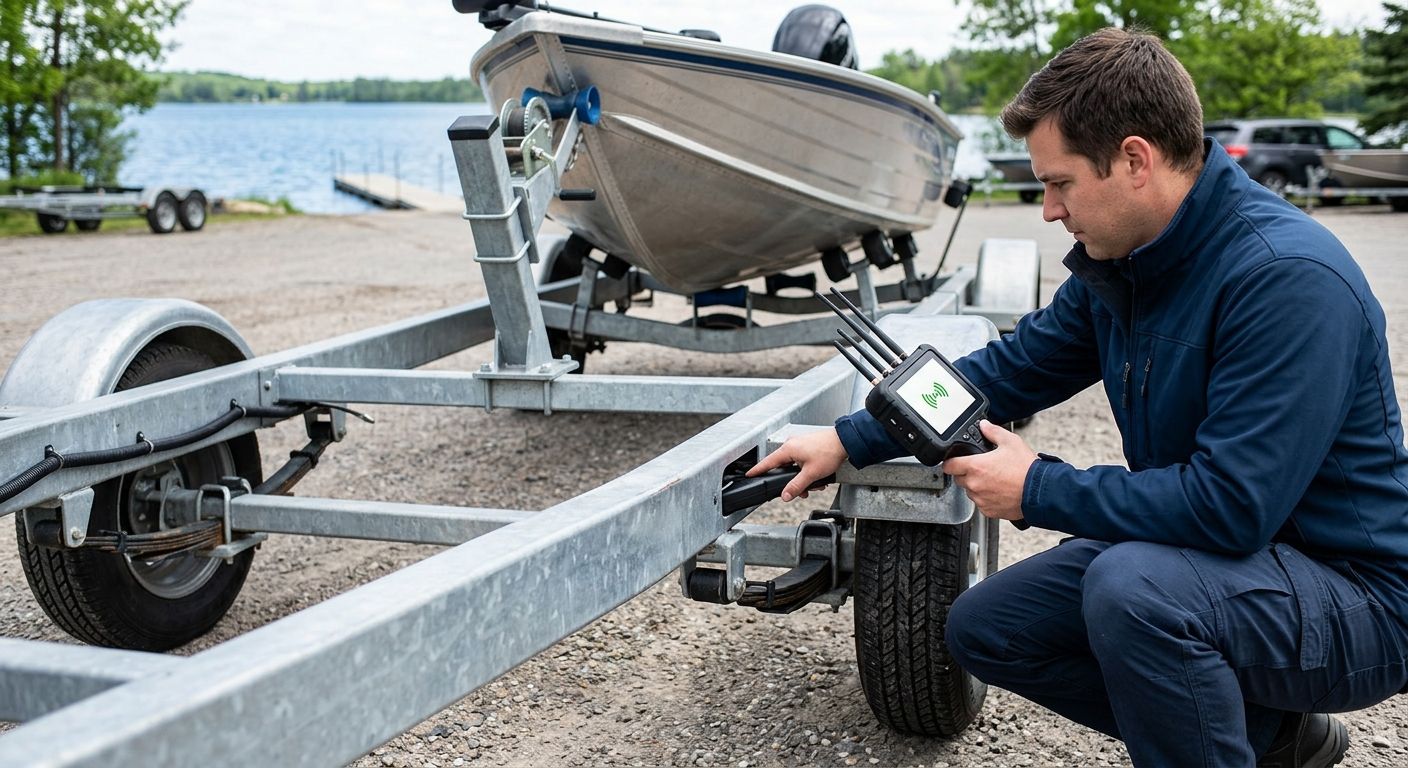
GPS tracker detection for boat trailers and towed equipment means physically and electronically checking the frame, hitch, toolboxes, and wiring of anything you tow for devices planted without your knowledge. Boat trailers, horse trailers, utility trailers, and equipment haulers sit unattended for weeks at marinas, storage lots, and job sites, which makes them easier targets than a daily-driver car.
- GPS tracker detection for boat trailers and towed equipment starts with a magnet sweep of the frame, tongue box, and hitch assembly.
- Active trackers with a cellular uplink show up on an RF detector; passive loggers with no live signal need a physical search.
- USA Bugsweeps recommends a professional TSCM sweep for any trailer stored at a marina or shared lot for more than a few weeks.
- Battery-powered magnetic trackers can run for months, so a device found in 2026 may have been placed the previous season.
Why this matters for boat trailer and towed equipment owners
A car gets driven and parked in your garage most nights. A boat trailer, a stock trailer, or a flatbed equipment hauler often sits in a marina lot, a storage yard, or a job site for days or weeks between uses, unwatched. That gap is exactly when a magnetic GPS tracker gets attached, and it's why sweeps for towed equipment need a different checklist than a quick under-the-bumper look on a personal vehicle.
Theft rings that target boats, ATVs, and construction equipment have used trackers to learn patterns: where a rig gets stored, when it's loaded, and when the owner is out of town. Custody and stalking cases involving shared trailers or a soon-to-be-ex's boat show up regularly too, since a trailer is easy to access in a shared driveway. USA Bugsweeps treats towed equipment as its own category for exactly this reason: the hiding spots are different, and so is the exposure window.
Update your inspection routine before you tow, not after
If a trailer sat at a marina all winter, a job site all week, or a rental lot overnight, the routine below matters more than a five-minute glance before hitching up.
The inspection steps
Inspect the hitch, tongue, and coupler first
Start at the point of contact between tow vehicle and trailer, since it's flat, accessible, and rarely gets a second look.
- Open the coupler shell and check the underside for a magnetic puck
- Run a hand along the safety chain plates and mounting brackets
- Check under the hitch ball mount and inside the receiver tube
- Feel along the tongue jack tube for anything magnetically attached
- Look at the wiring harness plug for splices that don't match factory wiring
Search the frame rails and cross members
Boxed frame rails on boat and equipment trailers have flat steel surfaces that hold a magnetic tracker cleanly, and they're easy to miss from a standing walk-around.
- Run your hand along the top and bottom of every frame rail
- Check inside boxed sections through any factory drain holes
- Inspect axle mounting brackets and leaf spring hangers
- Look for any welded-on bracket that looks newer than the rest of the frame
- Check the underside of the trailer tongue where it meets the frame
Check the wheel wells, fenders, and undercarriage
Fender wells and the space around brake lines are common spots because they're low, dirty, and skipped during a quick pre-tow check.
- Inspect fender wells for magnetic devices tucked against the metal
- Check brake line runs and any conduit for added-on boxes
- Look under mudflaps and behind the spare tire carrier
- Examine jack stands or leveling blocks stored on the trailer bed
- Check the underside of any cargo box mounted low on the frame
The manual search covers most magnetic units, but sealed compartments and wiring need a closer look next.
Open the toolbox, tongue box, and any lockable storage
Battery packs get tucked into gear boxes because they blend in with the clutter that's already there.
- Remove battery boxes and check their underside and back panel
- Check life jacket lockers and rope bins on boat trailers
- Inspect tack rooms and feed boxes on horse and livestock trailers
- Look behind spare parts bins on equipment and utility trailers
- Check under removable floor mats or access panels
Run an RF detector sweep for active transmitters
A handheld RF detector picks up devices that are actively transmitting over a cellular or satellite connection, which narrows the search fast when a tracker is live.
- Sweep the frame, tongue box, and cargo areas methodically
- Watch for signal spikes near battery packs or sealed enclosures
- Retest once stationary and again shortly after towing, since some trackers only transmit on movement
- Isolate any signal source down to a specific compartment before opening it
- Remember that passive GPS loggers with no live uplink won't register on an RF sweep alone
Check the electrical junction box and wiring harness
Trailer wiring is complicated enough on its own that an extra splice can hide in plain sight.
- Open the trailer light junction box and look for wires that don't lead to a light or brake circuit
- Check for extra fuse taps that weren't there from the factory
- Inspect the 7-pin or 4-pin connector housing for added wiring
- Look at brake controller wiring for anything spliced in beyond the factory harness
- Check any auxiliary battery wiring for an unexplained branch
Bring in a professional TSCM sweep when the trailer sits unattended
A DIY search catches most magnetic units, but a professional TSCM sweep covers frequencies and hiding spots the average owner won't find with a store-bought detector.
- Schedule a sweep after any long-term marina or storage-lot stay
- Request a sweep before towing high-value cargo across state lines
- Get a sweep after a breakup, custody dispute, or a repossession scare involving the trailer
- Ask for spectrum analysis covering both cellular and satellite tracker frequencies
- Request documentation of exactly what was found and where it was mounted
USA Bugsweeps handles this exact scenario as part of its bug sweep services for boat and yacht owners, since marina storage creates the same unattended-access window that boats and their trailers both face.
Comparison: options for boat trailer and towed equipment owners
| Option | Best for | Key limitation |
|---|---|---|
| DIY magnet and visual search | Owners who tow occasionally and store the trailer at home | Misses devices inside sealed compartments or spliced into wiring |
| RF detector or spectrum app | Active trackers with a live cellular uplink | Doesn't catch passive loggers that only store location data locally |
| Handheld TSCM-grade RF detector | Frequent haulers checking before every trip | Takes some practice to read spectrum results correctly |
| Professional TSCM sweep | Marina-stored boats, high-value equipment, stalking or dispute cases | Not something most owners do before every single tow |
A professional TSCM sweep wins for any trailer that sits unattended for weeks at a time — DIY checks are the right daily habit, but they won't catch a device wired into the harness or sealed inside a battery-pack enclosure.
Get a trailer sweep scheduled
Request a free estimate for a boat trailer or towed equipment sweep.
Common mistakes boat trailer and equipment owners make
- Checking the boat or equipment but never the trailer itself. The trailer is the part that sits parked and unattended, so it's the more likely target.
- Assuming a tracker needs a live signal to matter. Passive GPS loggers store location data locally and get retrieved later, with no transmission to catch on an RF sweep.
- Skipping the wiring harness because it "belongs there." A splice tucked into factory wiring looks intentional at a glance.
- Sweeping once after purchase and never again, despite months of marina or lot storage between checks.
- Confusing a declared asset-tracking device from a tow or rental company with a hidden one. Check the paperwork before assuming the worst.
FAQ
What's the best way to detect a GPS tracker on a boat trailer?
Start with a hands-on magnet search of the frame, hitch, and toolbox, then follow with an RF detector sweep for anything actively transmitting. A professional TSCM sweep catches passive loggers and spliced wiring that a DIY check misses.
Can a GPS tracker on a trailer be detected with a phone app?
A phone-based RF or spectrum app can flag an actively transmitting tracker, but it won't catch a passive GPS logger with no live signal. Apps work best as a first pass, not a final answer.
How often should you sweep a boat trailer for hidden trackers?
Sweep before and after any extended marina or storage-lot stay, and any time the trailer changes hands, gets serviced by a third party, or you suspect someone had unsupervised access. Frequent haulers often build it into a pre-trip routine.
Do magnetic GPS trackers need a cell signal to work?
No. Many magnetic trackers store GPS coordinates locally and get physically retrieved later, so a device can sit silent for months without ever transmitting a signal an RF detector would catch.
Is it legal to place a GPS tracker on someone else's trailer?
Laws vary by state, but placing a tracking device on property you don't own or co-own without consent is illegal in most jurisdictions. A professional sweep documents what was found, which matters if you pursue a legal complaint.
What's different about sweeping towed equipment versus a personal vehicle?
Towed equipment sits unattended for far longer stretches than a daily-driver car, and trailers have more boxed frame sections, toolboxes, and exposed wiring where a device can go unnoticed for months.
Should I sweep a rented or borrowed trailer before towing it?
Yes, especially for a rental you didn't inspect at pickup. A rented trailer has had unknown hands on it, and a quick frame and toolbox check takes only a few minutes before you hitch up.
How much does a professional GPS tracker sweep cost for a trailer?
Cost depends on trailer size, storage history, and whether the sweep is part of a broader inspection. Details on how professional sweeps are priced are covered on USA Bugsweeps' own pricing breakdown.
One last thing
Battery-powered magnetic trackers built for asset monitoring can run for months on a single charge without needing to transmit anything, which means a device found on a trailer in 2026 may have been placed the season before and simply sat there logging location data the whole time. If a trailer has been parked at the same marina or storage lot since before you last checked it, that's the one to sweep first.


