
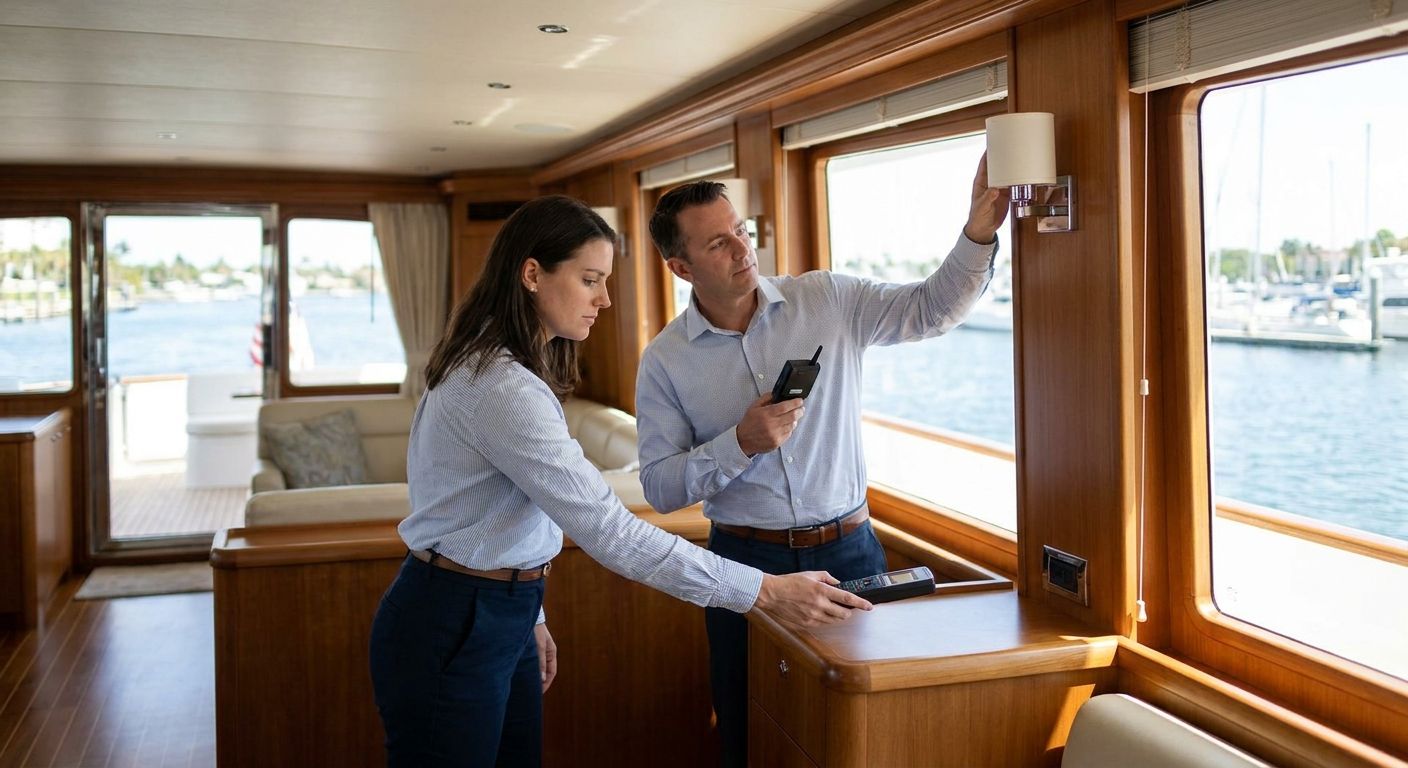
Yacht and boat owner bug sweep services are TSCM inspections built to find hidden cameras, audio bugs, and GPS trackers aboard a vessel before charter guests, crew, or a buyer ever step on deck. Salt air corrodes cheap detection gear fast, marinas share Wi-Fi and shore power across dozens of boats at once, and a yacht's wiring runs give a hidden device far more places to hide than a house wall ever does.
- Bug sweep for yacht owners covers staterooms, helm wiring, and tenders, not just guest cabins.
- USA Bugsweeps runs nationwide TSCM sweeps in 2026, including marinas and dockside vessels.
- DIY RF scanning catches basic bugs; a professional TSCM sweep finds hardwired taps DIY tools miss.
- Re-sweep after every charter, haul-out, or ownership change since old electronics rarely get pulled.
- A $29 DIY guide helps owners check tenders and cars for GPS trackers between professional sweeps.
Why bug sweep for yacht owners matters
A yacht changes hands, crews, and guests more often than a house does. Charter season alone can put a dozen strangers in a stateroom over a single summer, and every one of them had access to outlets, vents, and light fixtures where a hidden camera or audio bug fits without a trace.
Marina Wi-Fi is shared infrastructure. Shore power pedestals sit within arm's reach of the next slip. A device planted by a previous charter guest, a disgruntled crew member, or a competitor doesn't need to be sophisticated to work for months on a boat nobody re-sweeps between trips.
USA Bugsweeps runs TSCM inspections year-round, and 2026 charter bookings are already putting more vessels back in rotation with less downtime between guests than owners had in prior seasons. That turnover is exactly when a sweep gets skipped, and exactly when it matters most.
A yacht that hasn't been swept since the last owner sold it is not a swept yacht - it's an unknown one.
Inspect the vessel visually before every charter
Start with the free option every owner can do without a technician aboard.
- Check smoke detectors, USB charging ports, and clock radios in every stateroom for signs of tampering
- Pull air vents and light fixture covers where a pinhole camera lens hides easily
- Look at outlet cover screws - stripped heads mean someone opened it before you did
- Check under helm consoles and behind chartplotter displays for extra wiring
- Scan the tender and dinghy, not just the main vessel
Check marina Wi-Fi, shore power, and dockside networks
Shared marina infrastructure is a common entry point for wireless bugs and trackers that piggyback on legitimate network traffic.
- Change the vessel's Wi-Fi password every season, not just at commissioning
- Ask the marina office who has physical access to your slip's shore power pedestal
- Avoid leaving a static IP or open network name that identifies the vessel by hull name
- Note any unfamiliar devices showing up on your router's connected-devices list
Scan for RF signals at the helm and in guest cabins
A handheld RF detector is the fastest DIY step toward finding an active transmitting bug, and it's the point where most owners realize they need a faster path than trial and error.
- Sweep slowly across headliners, under mattresses, and around the helm seat
- Test the detector in a quiet cove away from marina Wi-Fi noise before trusting a reading
- Cover the galley, salon, and any cabin used by charter guests, crew, or business guests
- Recognize that consumer RF detectors miss devices that only transmit in bursts or store footage locally
- Know that salt air shortens the working life of consumer-grade detectors faster than land-based use
For GPS specifically, the process for how to find a hidden GPS tracker on your car applies almost directly to a tender, golf cart, or tow vehicle parked dockside - the same magnetic mounts and OBD taps show up in both.
Sweep the helm electronics and chartplotter wiring
Helm electronics are the densest wiring on the boat, which makes them the easiest place to hide a hardwired tap.
- Check behind the chartplotter and VHF radio for splices that don't match factory wiring
- Inspect autopilot and engine monitoring wiring runs for added junctions
- Look for unfamiliar antennas near the helm that don't match your factory electronics list
- Confirm your AIS and radar wiring hasn't been rerouted since the last known-good inspection
Clear staterooms and guest cabins between charters
Every guest turnover is a new opportunity for someone to leave a device behind, intentionally or not.
- Re-check smoke detectors and outlets after every charter, not just at the start of the season
- Ask crew to flag any unfamiliar item left in a cabin, even something as ordinary as a phone charger
- Replace batteries in existing smoke detectors so nobody has an excuse to open the housing
- Log which cabins were occupied by which guests for faster troubleshooting if something turns up later
Bring in a full TSCM sweep before a sale, VIP charter, or ownership change
DIY visual and RF checks catch the obvious cases. A professional TSCM sweep uses spectrum analysis and non-linear junction detection to find devices that are off, dormant, or hardwired into the vessel's own electrical system - the kind of device a consumer detector walks right past.
- Schedule a full sweep before listing the yacht for sale or charter to a new operator
- Sweep before hosting a high-profile guest, since many yacht owners already fall into the same risk category as executives and public figures who get targeted on land
- Treat a multi-vessel charter operation the same way a company treats GPS tracker sweeps for its fleet vehicles - one sweep protocol across every hull in the fleet
- Ask for a written report listing every device checked and every finding, not just a verbal all-clear
- Confirm 24/7 scheduling availability if the sweep needs to happen between back-to-back charters
Re-sweep after haul-out, refit, or major electrical work
Any time a third party has unsupervised access to the vessel's interior or wiring, treat the sweep clock as reset to zero.
- Sweep before and after any yard period where contractors had keys or access codes
- Re-check wiring runs disturbed during a refit, since new bundling can hide an added tap
- Confirm subcontractors on a refit crew were vetted the same way you'd vet permanent crew
- Document the sweep date so insurance or a future buyer has a clear record
Compare your options
| Option | Best for | Starting price | Key limitation |
|---|---|---|---|
| DIY visual inspection | Any vessel, between professional sweeps | Free | Misses RF transmissions and hardwired taps |
| DIY GPS/RF guide | Checking a tender or tow vehicle | $29 | Built for vehicles, not marine-grade RF sweeps |
| Marina security consultant | Marinas managing shared dock infrastructure | Not published | Covers physical security, not electronic bugs |
| Professional TSCM sweep (USA Bugsweeps) | Yachts 40 ft and up, charter fleets, ownership transfers | Not published, 24/7 quote available | Requires a technician scheduled aboard |
Verdict: DIY RF scanning is the right first move for any owner, but a yacht changing hands or hosting VIP charters in 2026 needs a professional TSCM sweep, not a consumer detector.
Common mistakes yacht and boat owners make
- Assuming one sweep at commissioning covers the vessel for its entire ownership life
- Trusting phone apps that claim to detect hidden cameras through magnetometer readings alone
- Forgetting the tender, dinghy, or golf cart during a sweep focused only on the main cabin
- Skipping a sweep after buying a used yacht from a seller you don't know personally
- Storing an RF detector in a salt-air locker where corrosion quietly kills its sensitivity
FAQ
What's the best bug sweep for yacht owners in 2026?
A full TSCM sweep from a professional service covering staterooms, helm electronics, and the tender is the most complete option in 2026. DIY visual and RF checks work as a between-sweep supplement, not a replacement.
Is a professional TSCM sweep better than a DIY GPS/RF scan?
Yes, for hardwired or dormant devices - a professional sweep uses spectrum analysis and non-linear junction detection that consumer detectors don't have. DIY scans still catch active transmitting bugs, which makes them useful between professional visits.
How much does a yacht bug sweep cost?
Professional TSCM sweep pricing isn't published and depends on vessel size and cabin count, so a quoted estimate comes after a technician sees the boat. A DIY GPS and RF guide for vehicles and tenders costs $29.
Do charter yachts need a bug sweep between every guest?
Yes, because each charter turnover is a new opportunity for a device to be planted or left behind. A visual and RF check between charters catches most issues; a full TSCM sweep once a season catches what those miss.
Can hidden cameras survive on a boat in salt air?
Yes, cameras and audio bugs are commonly sealed or waterproofed and hold up fine in marine environments. Salt air is harder on consumer-grade detection tools than on the devices they're meant to find.
Should you sweep a used yacht before buying it?
Yes, a used yacht from an unknown seller should get a full TSCM sweep before closing, the same way you'd treat any ownership transfer. Previous owners rarely remove every electronic device before a sale.
How long does a professional TSCM sweep of a yacht take?
Duration depends on vessel size and the number of cabins, so a technician scopes the time needed after seeing the boat. Larger yachts with more staterooms and denser wiring take longer than a single-cabin cruiser.
Is GPS tracker detection different for a boat than for a car?
The detection method is similar - checking for magnetic mounts, unfamiliar wiring, and OBD-style taps - but boats add hull voids and bilge spaces a car doesn't have. A tow vehicle or tender can be checked with the same vehicle-focused approach used on a car.
One last thing
The most overlooked risk isn't a stranger planting a device on your yacht - it's the electronics the previous owner never removed. Chartplotter Wi-Fi extenders, old baby monitors from a family cruiser, and crew-installed cameras routinely stay active after a sale because nobody thought to ask what's still transmitting. If you bought a used vessel in the last year and haven't had it swept, that's the first call to make in 2026, not the last.


