
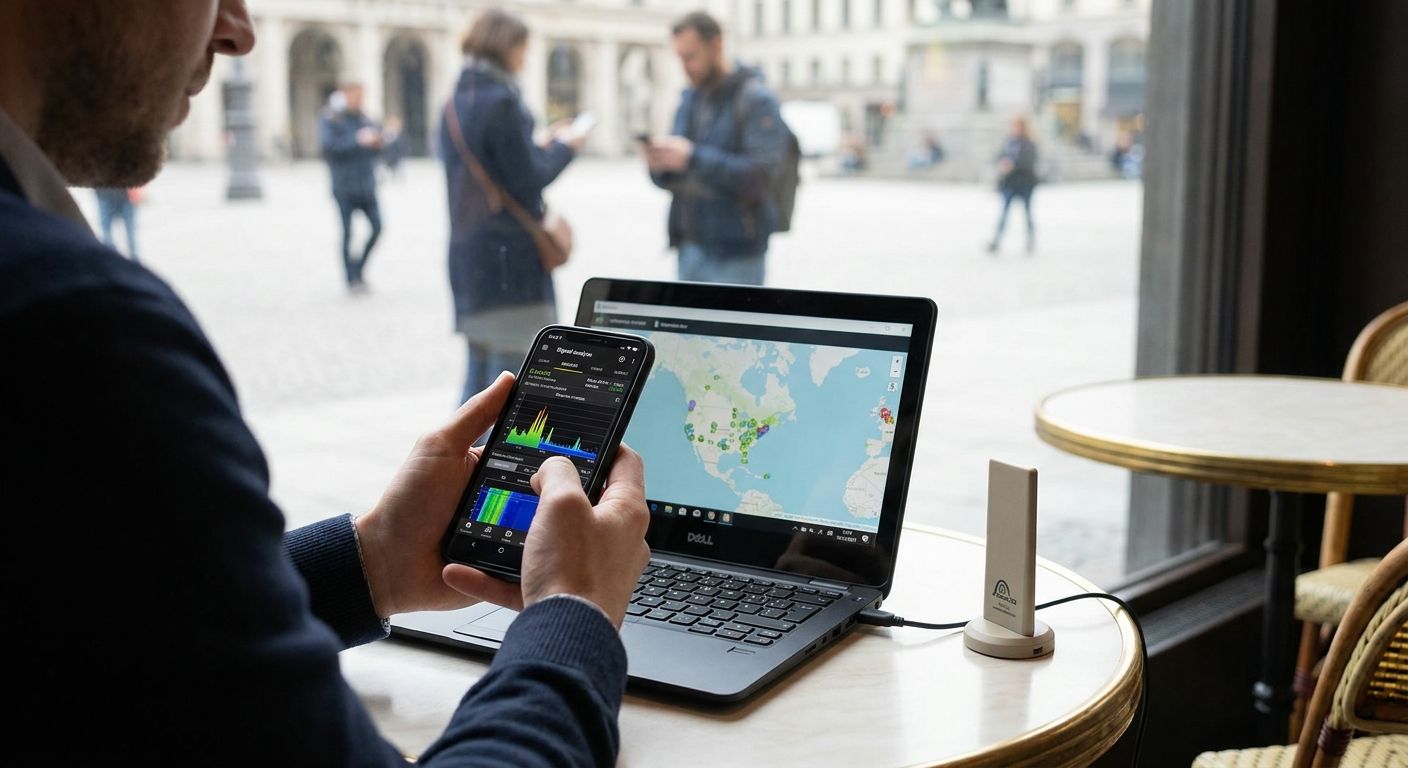
An IMSI catcher (also called a stingray or cell-site simulator) mimics a real cell tower to trick nearby phones into connecting to it, letting the operator log device IDs, track location, and in some configurations intercept calls and texts. No consumer app can prove one is nearby with certainty in 2026 — the warning signs (forced 2G downgrade, dropped encryption, sudden battery drain) are indirect clues that require RF spectrum analysis to confirm.
- No phone app reliably confirms an IMSI catcher — signs like forced 2G downgrade and battery drain are indirect clues, not proof.
- Professional RF spectrum analysis is the only way to detect stingray activity with confidence in 2026.
- Apps like SnoopSnitch need a rooted Android with a Qualcomm chipset and still can't catch every stingray model.
- 5G standalone networks resist classic IMSI catching, but most US carriers still fall back to 4G or 2G in weak-signal areas.
Why this matters
IMSI catchers were originally law enforcement tools, but the hardware has gotten cheaper and less exclusive since the early 2010s. Journalists, executives, domestic violence victims, and political operatives now show up in the threat model too — anyone whose location or communications carry value to someone else.
The problem is that phone manufacturers didn't design consumer devices to expose baseband-layer data. You're locked out of the layer where the deception actually happens, which is why most "IMSI catcher detector" apps on the Play Store are guessing based on secondary symptoms. USA Bugsweeps runs RF spectrum checks as part of a full TSCM sweep specifically because phone-only detection misses too much.
How to detect an IMSI catcher or stingray device
Start with the signal-level clues, then escalate to equipment if more than one shows up at once.
| Warning Sign | What It Means | Reliability As Evidence |
|---|---|---|
| Sudden drop from 4G/5G to 2G with strong signal bars | Stingrays force downgrades to bypass modern encryption | Moderate — also happens from normal network congestion |
| No lock/encryption icon in a network-monitoring app | Call encryption may be stripped by the interceptor | Moderate — some carriers show this during legitimate handoffs |
| Rapid battery drain with no new app usage | Phone is re-authenticating to a rogue tower repeatedly | Weak alone, stronger when paired with other signs |
| Call quality drops or delayed SMS delivery | Signal routed through an intermediate device | Weak alone — common with weather and dead zones too |
| Two different cell tower IDs reported for the same location within minutes | A spoofed tower is competing with the real one | Strong, but requires a rooted device to observe |
None of these on their own is proof. A technician cross-references them against a live RF spectrum analyzer reading, which is the only method that identifies a rogue base station transmitting outside its expected frequency and power profile.
Consumer apps: partial visibility at best
Apps like SnoopSnitch analyze baseband logs on rooted Android phones with Qualcomm chipsets, flagging suspicious cell tower behavior such as forced downgrades or missing encryption. AIMSICD, an earlier open-source project aimed at the same problem, has been effectively discontinued and isn't reliable in 2026.
Pros: free, runs passively in the background, useful as an early-warning trigger. Cons: iPhone is excluded entirely, rooting voids most warranties, and false positives are common in areas with poor carrier infrastructure. Verdict: Skip as a standalone solution — use as a trigger to call in a professional sweep, not as a final answer.
Professional RF spectrum analysis: the reliable method
A TSCM technician sweeps the cellular bands a stingray typically operates on — the 850 MHz and 1900 MHz bands used by 2G/3G, plus the broader LTE range roughly 700-2600 MHz — with a spectrum analyzer that reads signal strength, frequency, and broadcast identity in real time. That data gets compared against known legitimate tower fingerprints for the area.
Pros: confirms or rules out a rogue transmitter with hardware built for the job, works regardless of phone brand. Cons: requires a scheduled sweep rather than instant passive monitoring, and won't catch a stingray that isn't active at the moment of the sweep. Verdict: The only method worth trusting when the stakes are real — a journalist, executive, or stalking target should not settle for app-based guesswork.
Get a professional sweep scheduled
RF spectrum checks are part of a full TSCM sweep, not a standalone add-on.
Why IMSI catcher detection is hard
- No consumer hardware reads the baseband layer where the spoofing actually happens — phones weren't built to expose it.
- Modern stingrays mimic real towers down to the broadcast identity, so the phone has no reason to reject the connection.
- 5G standalone networks include mutual authentication, but most US carriers still fall back to 4G or even 2G in weak-coverage areas, reopening the vulnerability.
- Detection windows are short — a stingray may operate for a few minutes near a target and move, leaving no trace by the time an app catches up.
- Location alone doesn't confirm device type — a phone reporting two tower IDs could be a handoff glitch, not an interceptor.
- Rooting requirements shut out iPhone users entirely, since Apple doesn't expose baseband logs to third-party apps.
Can police use a stingray without a warrant?
The Department of Justice's 2015 policy requires federal agencies to obtain a warrant before deploying a cell-site simulator, though state and local law enforcement rules vary by jurisdiction. Some states have passed their own statutes requiring judicial authorization, while others have no explicit rule at all.
Do IMSI catchers work on 5G?
Most IMSI catchers force a downgrade to 2G or 3G because those older protocols lack the mutual authentication built into 5G standalone networks. Non-standalone 5G deployments — still common across US carriers in 2026 — rely on a 4G core network underneath, which keeps the classic downgrade attack viable.
What's the difference between an IMSI catcher and a stingray?
"Stingray" is a specific product name originally made by Harris Corporation that became the generic term for any IMSI catcher or cell-site simulator, similar to how "Kleenex" became shorthand for tissue. All stingrays are IMSI catchers, but not every IMSI catcher on the market is a Stingray-branded unit.
If you're checking your phone for this kind of interception, it's worth also running through the steps to check your phone for hidden spyware — the two threats often get confused, but spyware lives on the device itself while an IMSI catcher operates over the air.
FAQ
How do I know if a stingray is tracking my phone in 2026?
You can't know for certain from the phone alone in 2026 — forced 2G downgrades, dropped encryption indicators, and rapid battery drain are warning signs, but confirming a stingray requires RF spectrum analysis from a technician.
Can an iPhone detect an IMSI catcher?
No, iPhones can't run the baseband-monitoring apps that flag stingray activity because Apple doesn't expose that data to third-party software, unlike rooted Android devices.
Does turning on airplane mode stop an IMSI catcher?
Yes, airplane mode disconnects the cellular radio entirely, which prevents any IMSI catcher from communicating with the phone, but it also cuts off calls, texts, and data.
Is SnoopSnitch still reliable in 2026?
SnoopSnitch still works on rooted Android phones with Qualcomm chipsets, but it only flags suspicious patterns like forced downgrades and can't confirm a stingray with certainty.
How much does professional IMSI catcher detection cost?
Cost depends on the scope of the sweep and location, since RF spectrum checks are usually bundled into a broader TSCM sweep rather than sold as a standalone service. Check current details directly with a provider.
Do IMSI catchers intercept text messages?
Some configurations can intercept SMS when they force a downgrade to an unencrypted protocol like 2G, though modern encrypted messaging apps that don't rely on carrier SMS are less exposed.
Are IMSI catchers illegal for private citizens to use?
Operating a cell-site simulator without FCC authorization is illegal for private citizens in the US, since it involves transmitting on licensed cellular spectrum without a license.
What's the difference between a bug sweep and IMSI catcher detection?
A bug sweep typically targets planted microphones, hidden cameras, and GPS trackers in a fixed location, while IMSI catcher detection focuses on cellular spectrum activity and requires different equipment entirely.
One last thing
Turning your phone off doesn't erase the risk window — a stingray only needs a few seconds of connection to log your device ID, and that can happen before you notice anything wrong. The gap between "my phone feels off" and "there's a rogue tower nearby" only closes with a spectrum analyzer, not another app download.


