
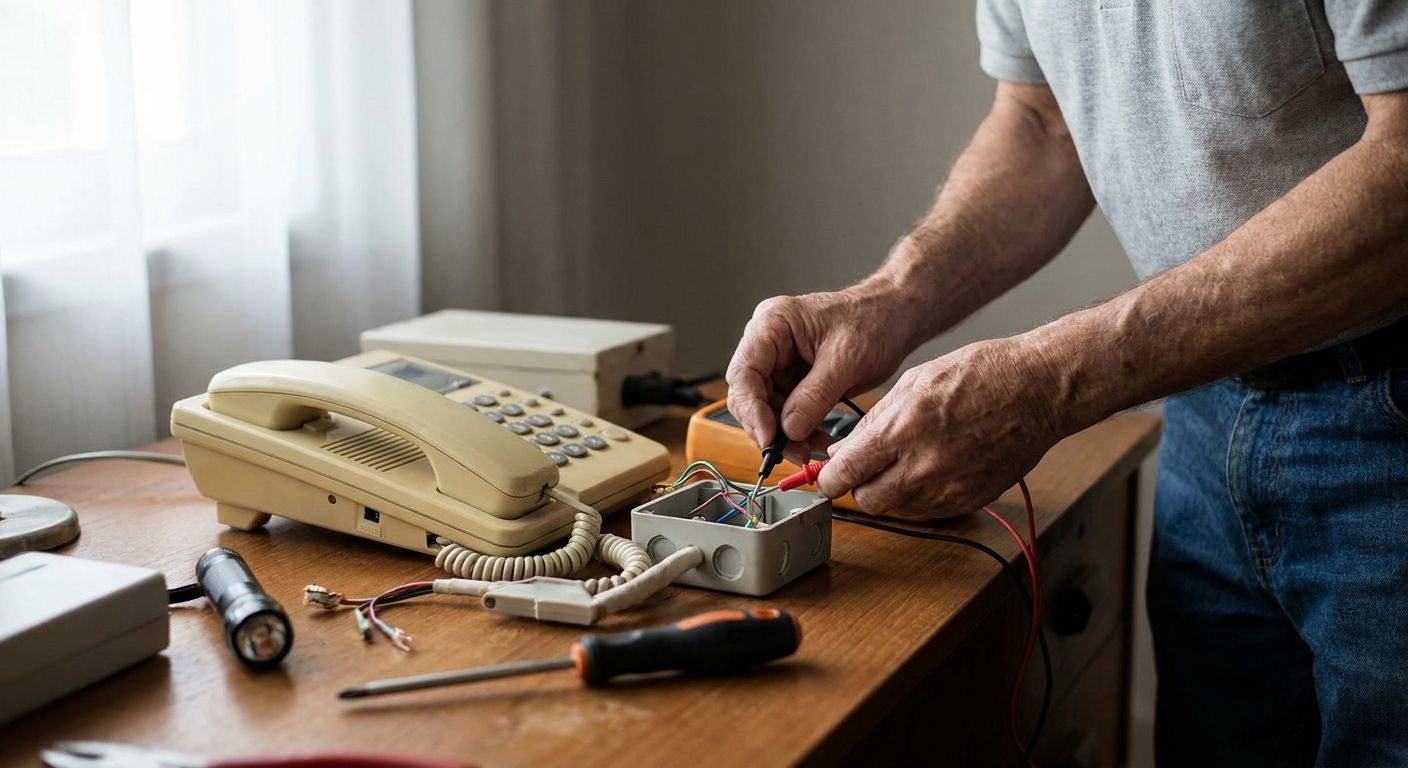
A wiretap on a landline shows up as a voltage drop across the line, faint clicks or static during calls, and unexplained hum or feedback when the phone is on the hook — check for those three signs first, then confirm with a multimeter or a professional TSCM sweep before you assume the worst. The catch: modern wiretaps rarely make noise at all, because inline recorders and VoIP-based intercepts sit passively on the line without the analog artifacts older taps produced.
- A voltage drop below the standard 48V idle reading is the fastest DIY check for how to detect a wiretap on a landline phone.
- Clicks and static are unreliable in 2026 — most modern taps are silent digital intercepts.
- A multimeter test only rules out old-style analog taps, not device-level or central office intercepts.
- USA Bugsweeps runs full TSCM sweeps that check the line, the demarc box, and every jack in the building.
Why this matters
Landline wiretaps still get installed in 2026 — on business lines during litigation, in rental properties before a tenant moves out, and in homes during custody disputes or divorce proceedings. A phone line is one of the easiest targets for anyone with brief physical access to a demarc box, a punch-down block, or an unattended jack, and the equipment to do it costs less than a case of wine. The USA Bugsweeps team gets calls almost every week from people who heard a click, panicked, and needed a real answer instead of a guess.
How to detect a wiretap on a landline phone
Run through these checks in order — each one rules out a different type of tap before you spend money on a professional sweep.
- Hang up every extension and measure idle voltage. A healthy on-hook landline reads roughly 48 volts DC across the tip and ring wires. A reading significantly below that, especially under 40V, suggests something is drawing current off the line — a parallel tap, an inline recorder, or a wired extension you didn't install.
- Pick up the phone and re-measure. Off-hook voltage normally drops to somewhere in the 6-12 volt range as current flows. A tap wired in series will show an unusual load here even when the on-hook reading looked normal.
- Listen for a faint clicking or double-dial-tone effect when you first lift the receiver. This is the least reliable indicator in 2026 because most active taps don't generate it, but it still shows up with cheap analog recorders.
- Inspect the demarc box outside the house and every jack inside it. Look for a second set of wires spliced onto the pair, an unfamiliar small module, or a battery pack tucked near the junction — physical taps need physical hardware.
- Check the phone itself for weight or seams that don't match the original model. A tapped handset sometimes carries a hidden transmitter or recorder inside the base.
- Call the phone company and ask for a line integrity check. Providers can run a resistance and capacitance test remotely that flags line-length anomalies a homeowner's multimeter can't catch.
None of these steps confirm or rule out a tap with certainty on their own — they're screening tools, not proof.
DIY multimeter test vs. professional TSCM sweep
| Method | Detects | Misses | Verdict |
|---|---|---|---|
| Multimeter voltage check | Parallel and series analog taps, unauthorized extensions | Digital/VoIP intercepts, central office taps, RF-based bugs | Good first step, not conclusive |
| Listening for clicks/static | Old inline recorders on copper lines | Nearly everything installed after 2015 | Weak signal only |
| Phone company line test | Line length and resistance anomalies | Physical devices inside the building | Useful supplement |
| Professional TSCM sweep | Physical taps, RF transmitters, recorders, hidden devices at every jack and the demarc | Nothing that meets 2026 detection standards when done by trained technicians | Only method that confirms clean |
A multimeter test tells you something is off. It never tells you the line is clean — that requires spectrum analysis and a physical inspection of every connection point, which is what a TSCM technician actually does.
Why landline wiretaps go undetected for so long
- No noise, no warning. Digital and VoIP-based intercepts don't produce the clicks people expect from movies.
- Homeowners check once and stop. A single voltage reading that looks normal gives false confidence — taps get added or removed between checks.
- Access points are outside, not inside. The demarc box on the exterior wall is rarely locked, so anyone can tap the line without ever entering the building.
- Old copper infrastructure hides splices well. Multi-unit buildings and older homes often have wiring nobody has mapped in years.
- People assume landlines are obsolete and stop worrying. Landlines are actually a favored tap target in 2026 precisely because attention has shifted to cell phones and Wi-Fi.
- Legal disputes create motive with easy opportunity. Divorce, custody, and business litigation cases are the most common reason a landline gets tapped, and the person doing it often already has legitimate access to the property.
“A voltage reading tells you something changed on the line — it never tells you the line is clean.”
Related questions
Does a clicking noise always mean my phone is tapped?
No — a clicking noise during a call is one of the least reliable indicators of a landline wiretap in 2026, since most modern intercepts are silent digital devices that never touch the analog signal path. Clicks are more often caused by line noise, weather, or an aging junction box than an actual tap.
Can the phone company tell if my line is being tapped?
The phone company can run a resistance and line-length test that flags an unusual load on the wire, but it can't detect every type of tap, especially ones installed inside the building past the demarc point. It's a useful supplement to a physical inspection, not a replacement for one.
Is a wiretap on a landline illegal without consent?
Recording or intercepting a phone call without consent violates federal wiretapping law and most state statutes, though consent requirements vary — some states only need one party to consent, others need all parties. A confirmed illegal tap is also evidence law enforcement can act on once documented properly.
Do landline wiretaps still happen in 2026, or is this outdated?
Landline wiretaps are still installed regularly in 2026, particularly during divorce proceedings, custody disputes, and business litigation where one party retains physical access to a shared property. The equipment involved has gotten smaller and quieter, not less common.
One last thing
The voltage drop test catches the taps people installed a decade ago — the ones that clip onto copper wire and draw current. It says nothing about a recorder plugged into a jack inside a wall cavity, a compromised VoIP router, or a device sitting at the central office itself. If the multimeter reading looks normal and you still don't trust the line, that instinct is worth acting on, because the test you just ran was never designed to catch everything.
Get your landline checked properly
Nationwide TSCM sweeps cover the line, the demarc box, and every jack in the building.
FAQ
How can I tell if my landline phone is tapped?
Check idle and off-hook voltage with a multimeter, inspect the demarc box for spliced wires, and listen for static, though the most reliable confirmation comes from a professional TSCM sweep that checks for physical devices a voltage test can't catch.
What voltage should a normal landline read when idle?
A healthy on-hook landline reads around 48 volts DC, dropping to roughly 6-12 volts when the receiver is lifted. A significant drop below those ranges suggests an unauthorized device is drawing current off the line.
Can a TSCM sweep detect a wiretap on a landline?
Yes, a TSCM sweep detects landline wiretaps by combining line analysis with a physical inspection of the demarc box, jacks, and handset for hidden devices. This catches both the physical taps and RF-based devices a homeowner's multimeter can't identify.
Is it illegal to tap someone's landline without consent?
Tapping a landline without proper consent violates federal wiretapping law and most state statutes, with consent rules varying by state between one-party and all-party requirements. Confirmed evidence of an illegal tap can be reported to law enforcement.
Do landline wiretaps still exist in 2026?
Landline wiretaps are still common in 2026, especially in divorce, custody, and business litigation cases where someone already has access to the property. Devices have gotten smaller and quieter compared to the analog recorders used a decade ago.
What's the difference between a wiretap and a hidden bug?
A wiretap intercepts the phone line itself, either at the demarc box, inside the wiring, or at the handset, while a bug is a standalone listening device that captures ambient audio in a room regardless of whether a phone is involved. Both require different detection methods during a sweep.
Does hanging up and re-dialing get rid of a wiretap?
No, hanging up does nothing to remove a physical or digital tap, since the device stays connected to the line or wiring regardless of call activity. Removing a confirmed tap requires physically locating and disconnecting the device.
Should I call the phone company or a TSCM specialist first?
Call the phone company for a basic line integrity test as a first screening step, then bring in a TSCM specialist if anything looks abnormal or if you need certainty the line and building are clean. The phone company's test doesn't check for physical devices inside the property.


