
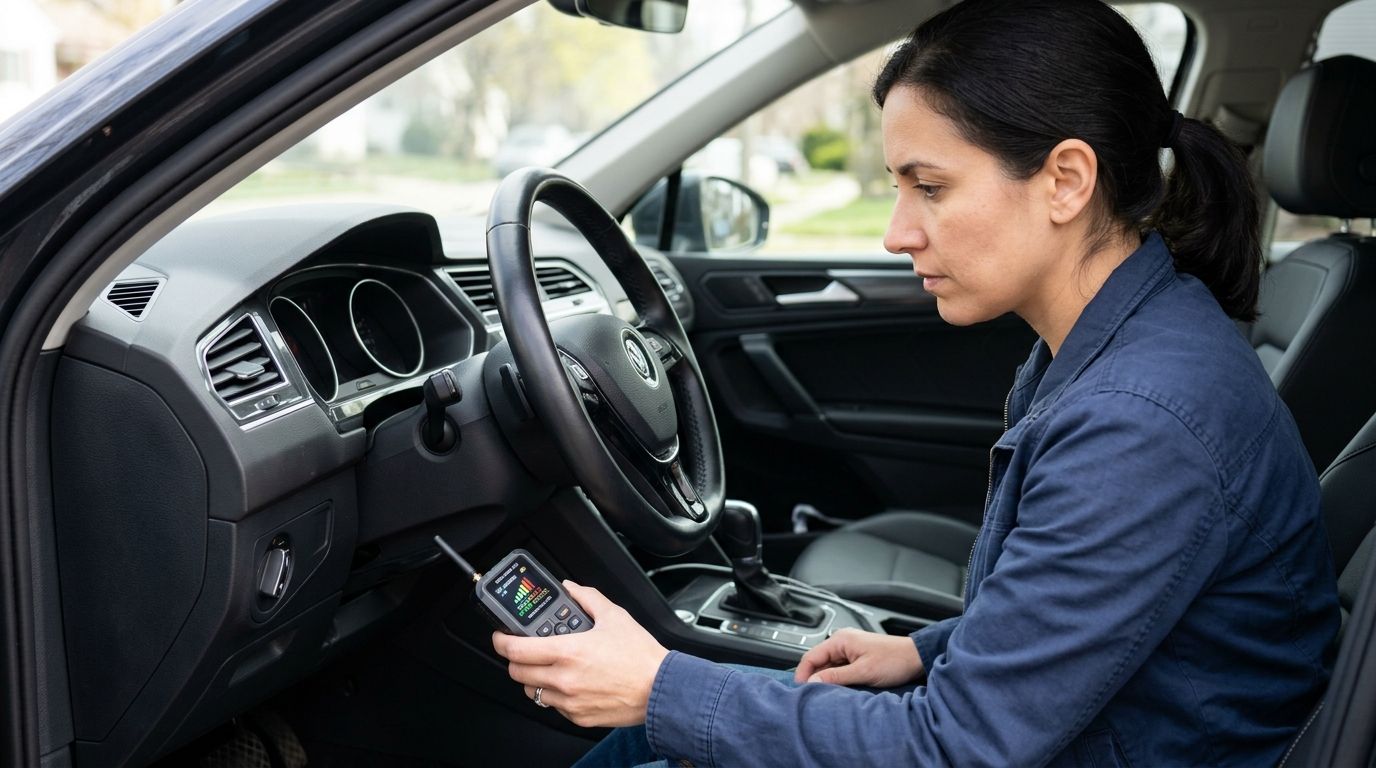
Six ways exist to check a personal vehicle for a hidden GPS tracker in 2026, and they are not interchangeable — a phone app that spots an AirTag will walk right past a hardwired tracker spliced into the fuse box. This ranks the best gps tracker detectors for cars by what each one actually catches, not by marketing claims.
- A professional TSCM GPS tracker sweep from USA Bugsweeps wins overall for confirmed detection of hardwired and dormant trackers in 2026.
- Apple's Tracker Detect and Android's Unknown Tracker Alerts are the best free option for AirTag- and Tile-style Bluetooth trackers.
- Handheld RF detectors only flag devices actively transmitting — a tracker in sleep mode passes right through them.
- Physical inspection of the wheel wells, bumper, and OBD-II port costs nothing and needs zero equipment.
- Non-linear junction detectors are the only tool on this list that finds a tracker even when it's powered off.
Why this matters
GPS trackers placed on a personal vehicle without consent show up in custody disputes, stalking complaints, and domestic violence cases far more often than most drivers assume. A magnetic tracker under a bumper is a five-minute find; a tracker wired into the ignition circuit is not, and the tool you reach for first decides whether you find anything at all.
A full-service TSCM sweep from USA Bugsweeps exists for exactly the cases where a consumer gadget isn't enough — documented findings that hold up for a police report or protective order, not a beep on a $40 detector. That doesn't mean every driver needs a professional sweep every time. It means knowing which method matches the actual risk.
Best overall: professional TSCM GPS tracker sweep. Best for AirTag-style trackers: Apple Tracker Detect / Android Unknown Tracker Alerts. Best budget option: physical and visual inspection. Everything below explains why, and where each method runs out of road.
What makes the best GPS tracker detector
- Frequency coverage — does it flag active signals across GSM, GPS, Wi-Fi, and Bluetooth bands, or just one
- Dormant-device detection — catches trackers that transmit in short bursts or store data instead of broadcasting it
- False-positive rate — doesn't flag your own phone, key fob, or the car's factory telematics as a threat
- Physical access required — whether you can scan from the driver's seat or need to pull interior panels
- Documentation value — whether the result holds up for a police report, restraining order, or insurance claim
- Skill required — whether a first-time user gets a usable answer or just a confusing readout
GPS tracker detectors compared at a glance
| Method | Best for | Standout feature | Key limitation |
|---|---|---|---|
| Professional TSCM sweep | Confirmed detection, legal documentation | Finds hardwired and dormant trackers | Requires scheduling a technician |
| Phone-based tracker apps | AirTag/Tile-style Bluetooth trackers | Free, already on your phone | Blind to hardwired and cellular-only trackers |
| Handheld RF detectors | Fast DIY scan before a trip | Portable, no subscription | Misses sleeping or non-transmitting devices |
| Physical/visual inspection | Zero-cost first step | Catches magnetic-mount trackers | Time-consuming, easy to miss hidden panels |
| OBD-II port check | Plug-in dongle trackers | Takes under a minute with a flashlight | Only covers one attachment point |
| Non-linear junction detector | Hardwired or powered-off trackers | Detects electronics regardless of power state | Requires a trained operator |
1. Professional TSCM GPS tracker sweep: best for confirmed detection
A technician-run sweep uses a combination of RF spectrum analysis, physical inspection, and non-linear junction detection to check a vehicle for GPS units, cellular trackers, and hardwired devices in one pass. It's the only method on this list built to catch a tracker that's been deliberately hidden by someone who knows what a consumer detector looks for.
This matters most in stalking and domestic violence situations where the finding needs to be documented, not just discovered — a category USA Bugsweeps handles directly for vehicle owners nationwide.
Professional TSCM sweep pros:
- Catches hardwired, dormant, and silent-mode trackers consumer tools miss
- Findings are documented for legal or law enforcement use
- Covers the whole vehicle, not one frequency band or one attachment point
Professional TSCM sweep cons:
- Requires scheduling instead of an instant self-check
- Overkill for a driver who just wants to rule out an obvious magnetic tracker
Best for: drivers with a credible, ongoing reason to believe they're being tracked. Verdict: Buy when the situation is serious enough that a wrong answer isn't acceptable.
2. Phone-based tracker detection apps: best for AirTag-style Bluetooth trackers
Apple released its Tracker Detect app in December 2021 so Android users could scan for AirTags traveling with them; Google built the same capability into Android natively with Unknown Tracker Alerts in 2024. Both scan nearby Bluetooth broadcasts for Find My– and Tile-network signatures and alert you if one keeps moving with your car over time.
Tracker detection app pros:
- Free and already installed or a quick download
- Runs passively in the background over hours or days
- Zero equipment beyond the phone you're carrying
Tracker detection app cons:
- Only sees Bluetooth trackers advertising on Find My or Tile networks
- Does nothing for hardwired GPS units, cellular trackers, or silent dongles
Best for: anyone worried about a consumer stalking gadget like an AirTag or Tile rather than a commercial-grade tracker. Verdict: Buy — it's free, so there's no reason not to run it as a baseline check.
3. Handheld RF bug detectors: best for a DIY first-pass scan
Wideband RF detectors marketed to consumers typically scan a range around 10 MHz to 8 GHz, looking for active transmissions from GPS-plus-cellular trackers. If the tracker is broadcasting its location right now, one of these will usually pick it up.
RF detector pros:
- Portable, no subscription or app required
- Immediate readout, no waiting period
- Works on trackers apps and inspections can't see
RF detector cons:
- Misses trackers that only transmit in short bursts or store-and-dump data
- Can flag the car's own Bluetooth or cellular hardware as a false positive
Best for: a quick roadside check before a road trip or after lending the car out. Verdict: Hold as a supplement, not a substitute for a full sweep if the risk is high.
4. Physical and visual inspection: best budget option
Checking the wheel wells, bumper, undercarriage, and OBD-II port by hand catches the most common consumer tracker: a magnetic-mount GPS unit stuck to the frame. Following a step-by-step guide to finding a hidden GPS tracker on your car makes this faster and less likely to miss a spot.
Physical inspection pros:
- Completely free, no tools required
- Catches the single most common tracker placement
- Doubles as a general once-over of the vehicle's underside
Physical inspection cons:
- Time-consuming and easy to miss trackers tucked inside panels or wiring
- No way to check a device that isn't visibly exposed
Best for: the fastest first step before spending money on a tool or a sweep. Verdict: Buy as a starting point, every time.
5. OBD-II port check: best for plug-in dongle trackers
Every gasoline vehicle sold in the U.S. since 1996 has an OBD-II diagnostic port under the dashboard, and it's a common attachment point for plug-in tracking dongles — the same style used on rental fleets and company vehicles. A quick look with a flashlight tells you if something's plugged in that shouldn't be.
OBD-II check pros:
- Takes under a minute
- Requires no tools beyond a flashlight
- Catches a tracker type common on rideshare, delivery, and company cars
OBD-II check cons:
- Only addresses one attachment point
- Does nothing for magnetic, hardwired, or Bluetooth trackers elsewhere on the vehicle
Best for: drivers of rented, leased, or employer-owned vehicles. Verdict: Buy as a 60-second habit before any long drive.
6. Non-linear junction detector: best for hardwired or dormant trackers
A non-linear junction detector (NLJD) finds electronic components by their semiconductor junctions, not by their transmissions — which means it catches a tracker whether it's broadcasting, sleeping, or powered off entirely. This is professional-grade equipment, and it's usually part of a full TSCM sweep rather than a standalone consumer purchase.
“A tracker that never transmits is invisible to every RF detector on the market — it's only visible to a tool that doesn't care whether it's transmitting.”
NLJD pros:
- Detects electronics regardless of power or transmission state
- The only reliable answer for a hardwired or dormant device
NLJD cons:
- Requires a trained operator to interpret results correctly
- Not sold or marketed as a consumer product
Best for: high-value personal vehicles or company fleets that need a definitive, documented clear. Verdict: Buy as part of a professional sweep, not as a DIY purchase.
How we ranked
Each method above was scored against the six criteria listed earlier — frequency coverage, dormant-device detection, false-positive rate, physical access required, documentation value, and skill required. The professional TSCM sweep is the only option that scores well across all six; every other method trades coverage for convenience somewhere on that list.
Which GPS tracker detector should you choose?
Run the free checks first: the phone app, the physical inspection, the OBD-II port glance. Together they cost nothing and take under fifteen minutes combined in 2026, and they catch the majority of consumer-grade trackers on the market.
If those checks come back clean but the behavior that made you suspicious continues — someone always knows where you are, or the car shows up where you didn't drive it — a professional TSCM GPS tracker sweep is the only method built to close that gap. It's the difference between an educated guess and a documented answer.
Not sure if your car is bugged?
A licensed TSCM technician checks for trackers a phone app or RF detector will miss.
FAQ
What's the best GPS tracker detector for a personal car in 2026?
A professional TSCM sweep is the most reliable option in 2026 because it catches hardwired and dormant trackers that phone apps and RF detectors miss. For a quick first pass, free phone apps and a physical inspection cover the most common consumer tracker types.
Can a phone app really detect a GPS tracker?
Apple's Tracker Detect and Android's Unknown Tracker Alerts detect Bluetooth trackers like AirTags and Tile devices, not GPS-only or hardwired trackers. They're a useful free first step but not a complete check.
Do handheld RF detectors catch every hidden tracker?
No — handheld RF detectors only flag devices that are actively transmitting at the moment of the scan. A tracker in sleep mode or one that stores data instead of broadcasting it will pass through undetected.
Is a professional GPS tracker sweep worth it?
It's worth it when the suspicion is serious and ongoing, such as stalking, a custody dispute, or repeated evidence someone knows your location without explanation. For a one-off worry about a rental car, the free checks are usually enough.
How do I check my car's OBD-II port for a tracker?
Every U.S. gasoline vehicle sold since 1996 has an OBD-II port under the dashboard; a flashlight check for anything plugged in beyond the factory connector takes under a minute and catches the common plug-in dongle tracker type.
Can a GPS tracker be hidden where a detector can't find it?
Yes — a tracker wired directly into the vehicle's power system and set to transmit infrequently can pass both RF detectors and casual visual inspection. Non-linear junction detectors, used in professional sweeps, are built specifically to find these.
What should I do if I find a GPS tracker on my car?
Don't remove or destroy it immediately if you suspect a stalking or legal situation — documenting it in place first preserves evidence for a police report or protective order before deciding on removal.
One last thing
The gap most drivers don't expect: a tracker doesn't have to be transmitting to be dangerous, and most consumer tools only look for signals in motion. If the free checks come back clean but the pattern that worried you hasn't stopped, that's the exact scenario a non-linear junction detector and a full TSCM sweep exist for — not a stronger phone app.


