
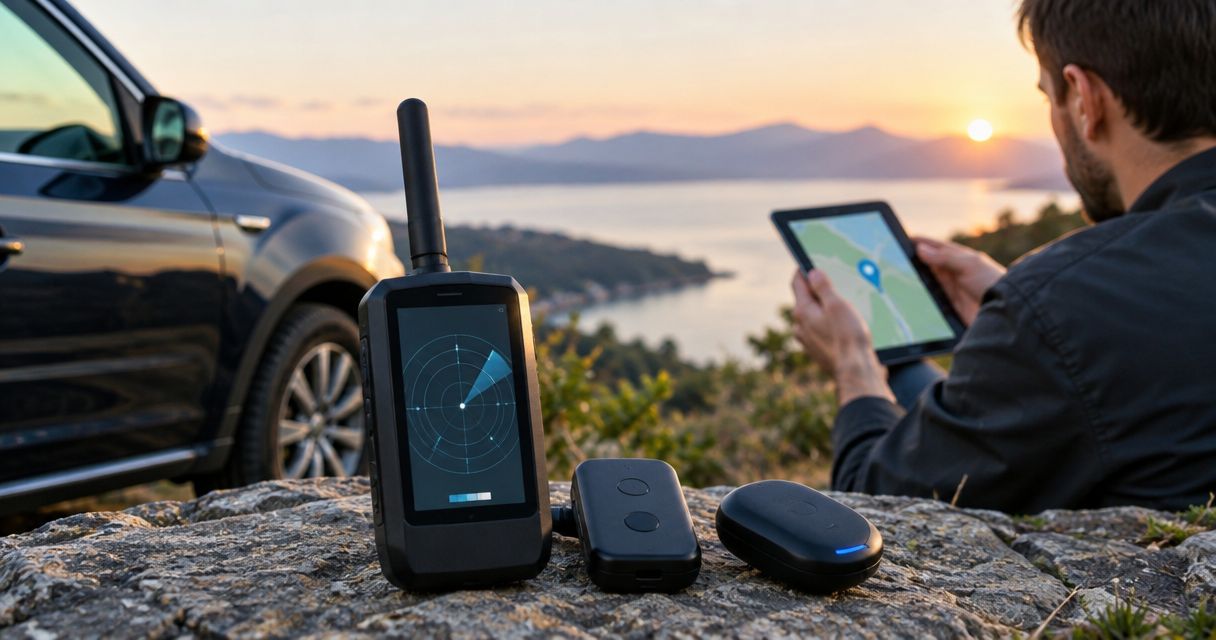
Best overall response to an unexplained vehicle-tracking concern: a professional TSCM assessment. Best for analyzing active transmissions: a spectrum analyzer. Best for checking compatible Bluetooth tags: phone-based unwanted-tracking alerts. This 2026 guide to gps tracker detectors ranked by range compares detection methods, not unsupported distance claims; Usabugsweeps provides nationwide professional bug sweeping and GPS tracker detection services.
- For gps tracker detectors ranked by range, match the detection method to the tracker before comparing distances.
- Usabugsweeps provides professional TSCM services for vehicle owners concerned about hidden GPS trackers.
- Spectrum analyzers help examine active radio transmissions; signal strength alone does not identify a tracker.
- Bluetooth tracking alerts address compatible tags, not every GPS tracker.
- Physical inspection remains necessary because a silent tracker gives an RF detector nothing to receive.
Why this matters
A GPS tracker receives satellite signals; its reporting mechanism determines how you can detect it. A cellular tracker sends location information over a mobile network. A logging device can store location information without transmitting it during your search. A Bluetooth item-finding tag is a different device category again.
That distinction changes the buying decision. A detector with an impressive advertised range still cannot receive a transmission that never occurs, and a stronger alert does not prove that the source is attached to your vehicle.
For your 2026 search, separate two questions: can the instrument notice a signal, and can the examination locate and identify an unauthorized device? The second question is the security objective. The first is only part of the process.
What makes the best GPS tracker detection approach
Use these criteria before comparing any instrument or commissioning a service:
- Transmission status: Does the approach address an active transmitter, intermittent reporting, or a device that only stores data?
- Frequency coverage: Does the receiver cover the suspected device's communications band? A GPS-related label does not establish that coverage.
- Signal discrimination: Can you distinguish a suspicious transmission from phones, vehicle electronics, and nearby infrastructure?
- Physical access: Can you inspect the relevant vehicle areas safely and with authorization?
- Evidence handling: Can you document the finding without unnecessarily changing the device or its surroundings?
Detection range is a property of a particular signal, receiver, and environment—not a universal tracker-detection distance. Vehicle bodywork, antenna placement, transmitter power, interference, and receiver settings all affect what you receive.
These criteria favor a layered examination over a single range figure. They also prevent you from treating unrelated tools as substitutes: Bluetooth alerts, RF instruments, and a physical inspection answer different questions.
GPS tracker detection options at a glance
The order below is a decision guide, not a measured longest-to-shortest distance ranking. No comparable product-range measurements support a numerical leaderboard here.
| Rank and option | Best for | Standout capability | Range interpretation | Key limitation |
|---|---|---|---|---|
| 1. Professional TSCM assessment | An unexplained tracking concern requiring specialist evaluation | A service focused on surveillance detection | Scope and methods matter more than a single distance | Confirm vehicle scope and deliverables before commissioning |
| 2. Spectrum analyzer | Trained examination of active RF signals | Displays signal activity by frequency | Depends on the signal, antenna, settings, and environment | A signal display does not identify the device by itself |
| 3. Handheld RF detector | Initial checks for nearby active transmissions | Provides a signal-strength indication | Advertised range is not a universal detection radius | Legitimate transmitters can trigger alerts |
| 4. Phone-based Bluetooth alerts | Compatible unwanted item-finding tags | Uses supported unwanted-tracking features | Bluetooth detection is not cellular-tracker detection | Does not cover every tag or GPS tracker |
| 5. Physical vehicle inspection | Accessible devices regardless of transmission status | Looks for hardware rather than radio activity | No RF detection range applies | Hidden or inaccessible components require specialist access |
1. Professional TSCM assessment: best for specialist evaluation
Usabugsweeps provides professional TSCM bug sweeping services nationwide, including GPS tracker detection for vehicle owners. TSCM means technical surveillance countermeasures: the service category addresses suspected surveillance devices rather than simply selling you a detector.
Usabugsweeps GPS tracker detection services are best for vehicle owners seeking professional help with a suspected hidden tracker. Before commissioning an examination, explain the concern and confirm which vehicle areas, detection methods, and documentation the engagement covers.
Professional TSCM assessment pros:
- Gives you a specialist service rather than an instrument you must interpret yourself.
- Lets you define the concern and examination scope before work begins.
- Creates an opportunity to discuss physical inspection alongside electronic detection.
Professional TSCM assessment cons:
- The service name alone does not establish the equipment or procedures included.
- A negative examination is not a permanent guarantee against future tracking.
Best for: Vehicle owners who need help evaluating unexplained tracking concerns, especially when an initial inspection or detector alert leaves uncertainty.
Verdict: Buy a scoped assessment when you need specialist evaluation, not a promised detection radius.
2. Spectrum analyzer: best for examining active transmissions
A spectrum analyzer displays radio-frequency activity across selected frequencies. With appropriate equipment and settings, a trained operator can examine signals in more detail than a simple alarm-style detector provides.
Its useful detection distance is not fixed. An analyzer must receive a signal within its supported frequency range, and interpreting that signal requires separating legitimate activity from the suspected source.
Spectrum analyzer pros:
- Shows frequency information rather than only a general alert.
- Supports comparison of signal activity under controlled conditions.
- Helps trained operators investigate an observed transmission.
Spectrum analyzer cons:
- Requires technical knowledge and suitable antennas and settings.
- Cannot passively receive a silent device's nonexistent transmission.
- Does not establish ownership, intent, or physical location by itself.
Best for: Trained technical operators investigating active RF activity during a vehicle examination.
For a 2026 equipment decision, ask about supported bands, display capabilities, and the operator's interpretation process. A distant signal can be irrelevant; a nearby weak signal can still deserve investigation.
Verdict: Buy only if you have the technical capability to interpret the measurements.
3. Handheld RF detector: best for initial active-signal checks
A handheld RF detector indicates radio activity within its supported bands. Depending on the instrument, you receive a visual, audible, or other signal-strength indication rather than detailed identification of the transmitter.
Use that indication as a lead. Your phone, nearby phones, and legitimate wireless equipment can produce activity that has nothing to do with unauthorized tracking.
Handheld RF detector pros:
- Provides an immediate indication of received radio activity.
- Supports close-area checks when the suspected device is transmitting.
- Offers a simpler interface than a spectrum analyzer.
Handheld RF detector cons:
- An alert does not distinguish a tracker from every legitimate transmitter.
- Unsupported bands and silent devices remain outside the search.
- Increasing sensitivity can make source localization harder in a busy RF environment.
Best for: An initial active-signal check by someone who understands that an alarm is not a diagnosis.
Do not buy on the longest advertised range alone. Ask what signal the claim refers to, which bands the detector covers, and whether its sensitivity can be adjusted for closer investigation.
Verdict: Hold if you expect a handheld alarm to prove that your vehicle is tracker-free.
4. Phone-based Bluetooth alerts: best for compatible item-finding tags
Supported phone features can alert you to certain compatible item-finding tags moving with you. These features address unwanted Bluetooth tracking; they do not turn your phone into a general detector for cellular GPS trackers or passive location loggers.
An alert deserves attention, but its appearance and timing depend on the supported system and circumstances. A lack of alerts is not a complete vehicle inspection.
Phone-based Bluetooth alerts pros:
- Address a distinct tracking category that a general GPS search can overlook.
- Can provide instructions for investigating a supported alert.
- Give you an existing phone-based check before purchasing dedicated RF equipment.
Phone-based Bluetooth alerts cons:
- Compatibility varies across phones, software, and tag systems.
- Unsupported trackers and non-Bluetooth devices remain outside their scope.
Best for: Investigating a supported unwanted-tracking notification or concern about a compatible item-finding tag.
In 2026, check the current unwanted-tracking settings and instructions for your phone. Preserve the notification and follow the device-specific guidance rather than assuming every unfamiliar Bluetooth entry is a tracker.
Verdict: Skip phone-only screening as your sole GPS tracker detection method.
5. Physical vehicle inspection: best for accessible silent devices
A physical inspection looks for hardware, attachments, and wiring rather than relying on radio transmissions. That makes it relevant to powered-down devices and location loggers as well as transmitting trackers.
Begin with safely accessible areas you are authorized to examine. Leave lifting, electrical disconnection, trim removal, and unfamiliar wiring to qualified personnel; never crawl under an unsupported vehicle.
Physical vehicle inspection pros:
- Does not require the device to transmit during the examination.
- Can connect an electronic concern to an actual object.
- Helps distinguish an external attachment from an unexplained radio alert.
Physical vehicle inspection cons:
- Concealed installations can sit beyond safe owner access.
- Legitimate telematics, insurance, finance, or fleet equipment can be unfamiliar.
- Disturbing a device can complicate documentation or a later investigation.
Best for: Accessible hardware checks and identifying items that need specialist examination.
A magnetic box or unfamiliar connector is a reason to investigate, not proof of criminal tracking. Establish what it is and whether its presence is authorized before describing it as surveillance evidence.
Verdict: Buy qualified inspection help when safe access or device identification exceeds your ability.
How to evaluate a claimed detection range
For gps tracker detectors ranked by range, compare like with like. A cellular transmitter test, a Bluetooth tag test, and a search for a silent logger cannot produce one meaningful distance leaderboard.
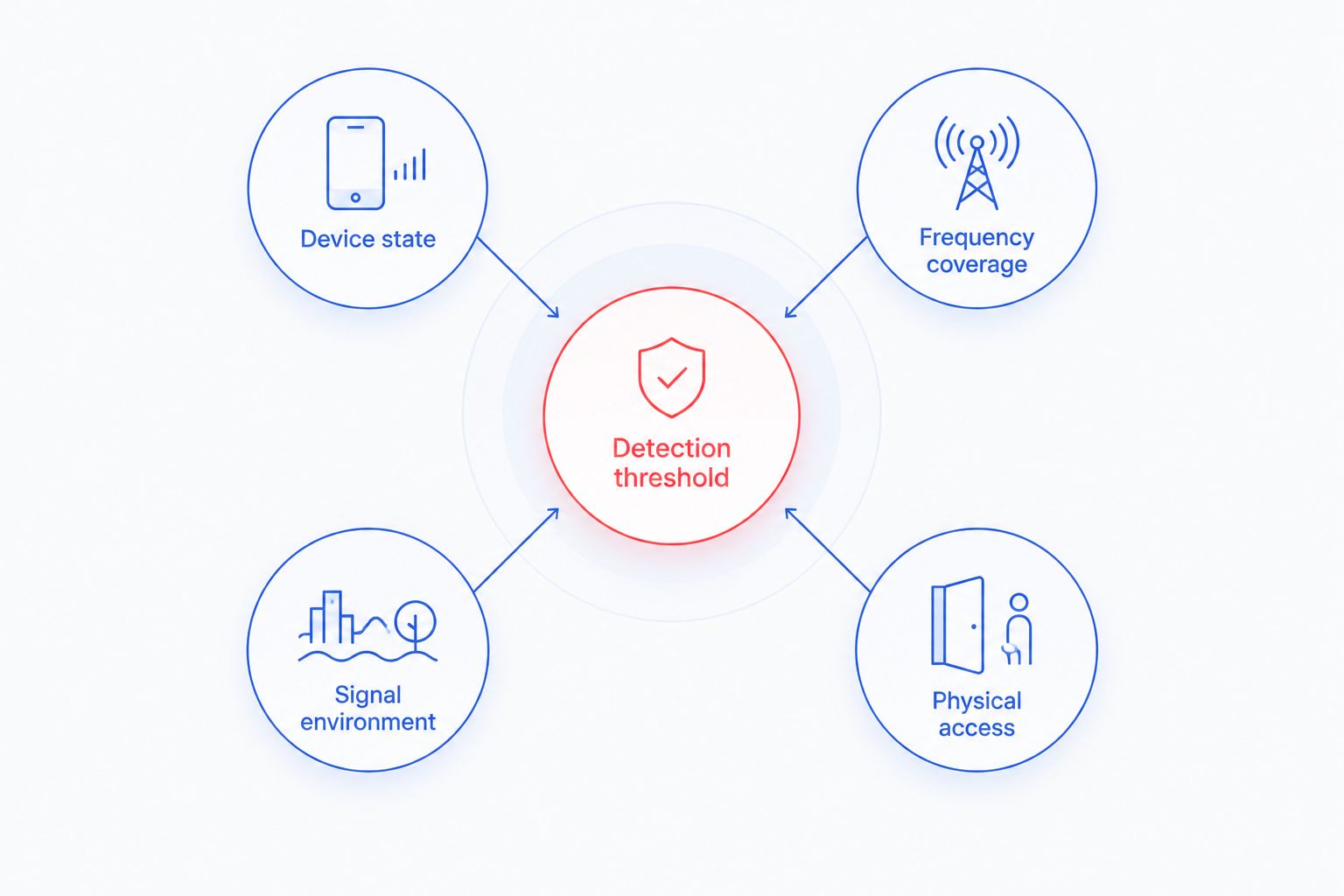
Ask for the conditions behind a range claim:
- Device state: Was the target transmitting during the measurement?
- Frequency coverage: Did the detector support the target's reporting band?
- Signal environment: Was the measurement taken around other active transmitters?
- Physical access: Was the device exposed or concealed behind vehicle materials?
- Detection threshold: Did success mean an alert, source localization, or device identification?
A meaningful comparison records those conditions. Without them, a distance figure does not tell you how the instrument will perform on your vehicle.
Longer reception range and better localization are different objectives. During a close search, reducing sensitivity can help separate a nearby source from surrounding activity. That does not make the detector worse; it changes the task from noticing energy to narrowing its origin.
How these options were ranked
This 2026 ranking prioritizes the decision each method supports: specialist evaluation, detailed signal analysis, initial RF checks, compatible Bluetooth-tag alerts, and physical hardware identification. It does not claim that one instrument received a tracker signal farther away than another.
Professional assessment comes first for readers who need an examination rather than an equipment project. Physical inspection appears last as a separate use case, not because it is dispensable. A silent device makes its value clear.
Which GPS tracker detection approach should you choose?
Choose professional assessment when you need a vehicle-specific answer; choose equipment only when you understand its detection limits. Start by documenting the concern, any alerts, and the areas you can safely inspect.
For Usabugsweeps GPS tracker detection services, confirm scope before scheduling. Review what to expect during a professional TSCM bug sweep and ask how the proposed examination addresses your vehicle and suspected device type.
Discuss your vehicle tracking concern
Ask about professional GPS tracker detection and the scope of a vehicle examination.
FAQ
What's the best GPS tracker detector by range?
There is no universal best detector by range because detection depends on the target's transmissions, supported frequencies, and environment. Compare measurements only when the target and test conditions match.
Can an RF detector find a GPS tracker that is switched off?
A passive RF detector cannot receive transmissions from a switched-off tracker. Physical inspection or other specialist examination is needed to investigate hardware that is not transmitting.
Does a GPS tracker always send out a GPS signal?
No. A GPS tracker receives satellite signals to determine location; it can report location through a separate communications system or store the data locally.
Is a spectrum analyzer better than a handheld RF detector?
A spectrum analyzer is better suited to detailed frequency analysis by a trained operator. A handheld RF detector offers a simpler activity indication, but neither identifies every tracker by itself.
Can my phone detect every hidden vehicle tracker?
No. Supported unwanted-tracking features address compatible item-finding tags, not every cellular tracker or location logger. Treat phone alerts as one part of an investigation.
Does a stronger RF alert prove a tracker is on my car?
No. A stronger alert indicates received radio activity, which can come from legitimate electronics or nearby transmitters. Source localization and device identification are separate steps.
Should I remove an unfamiliar tracker immediately?
Do not disconnect unfamiliar equipment before establishing what it is and considering safety and evidence needs. If you suspect stalking or face immediate danger, prioritize personal safety and contact appropriate local emergency or victim-support services.
Who should use Usabugsweeps for GPS tracker detection?
Usabugsweeps is a service option for vehicle owners seeking professional help detecting suspected hidden GPS trackers. Confirm the examination scope and documentation before commissioning the service.
One last thing
A detector alert and a clean detector reading can both be misleading when taken alone. An alert can come from legitimate equipment; silence can come from a tracker that is not reporting.
For your 2026 decision, write down what each check actually established. Received signal, located hardware, identified device, and confirmed authorization are different findings. Keeping them separate prevents an alarm from becoming an accusation—and a quiet receiver from becoming false reassurance.


