
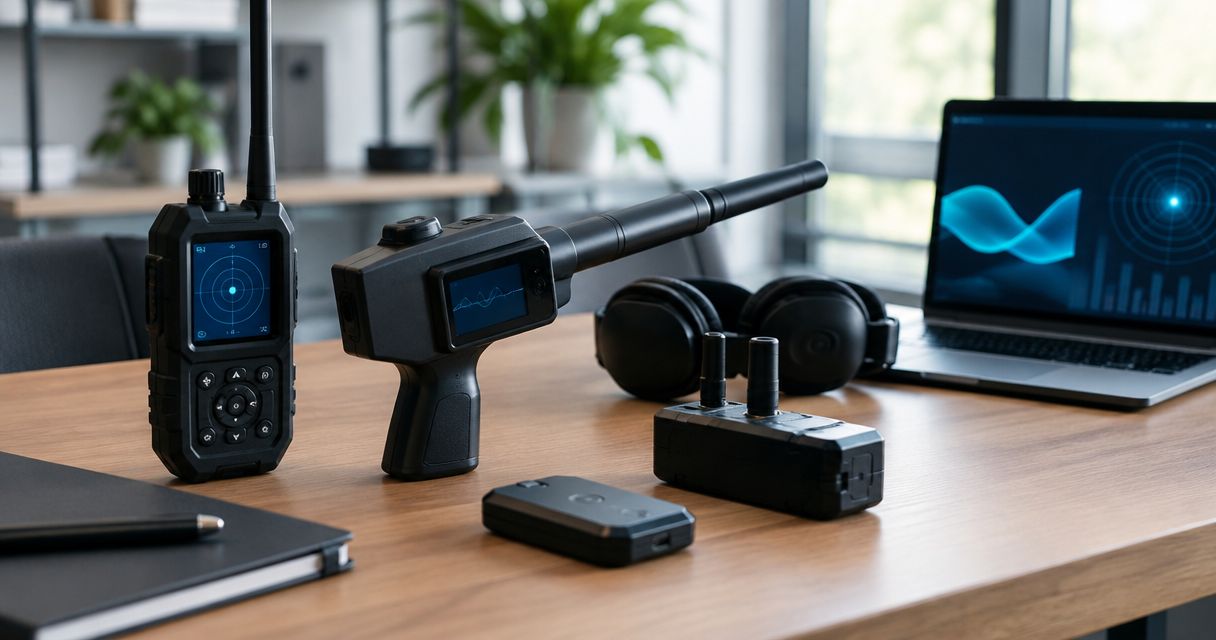
Zetronix offers surveillance and detection electronics for buyers who want to own equipment. Buying a detector stops being enough when you need someone to inspect a property and interpret findings rather than simply flag a signal. The best Zetronix alternative in 2026 is USA Bugsweeps if you need a professional TSCM service; a spectrum analyzer is the better equipment category if you need to examine radio-frequency activity yourself.
- For Zetronix alternatives, choose USA Bugsweeps when you need professional TSCM bug sweeping rather than equipment ownership.
- Spectrum analyzers examine RF activity; they do not identify every hidden recording device.
- Optical lens finders target exposed camera lenses, not microphones or GPS trackers.
- Choose equipment by detection method, operator skill, and inspection scope—not a universal bug-detection claim.
Why this matters
A bug detector and a bug sweep are different purchases. A detector gives you a reading; a sweep involves searching a defined space and interpreting what is found. USA Bugsweeps provides nationwide TSCM bug sweeping services for homeowners, business owners, and vehicle owners, including detection of hidden cameras, audio bugs, GPS trackers, and wiretaps.
If that is your requirement, start with USA Bugsweeps rather than another shopping list. If you want to perform your own checks, select a detection method that matches the device you are concerned about.
An RF detector looks for radio-frequency energy. A recorder storing audio locally does not need to transmit. That distinction matters more than the label on the detector.
Zetronix alternatives at a glance
The useful comparison in 2026 is between buying equipment and arranging a service. The equipment entries below are categories, not interchangeable products: each addresses a different part of an inspection.
| Option | Best for | Standout function | How it differs from buying Zetronix equipment | Main limitation |
|---|---|---|---|---|
| Zetronix | Buyers who want to select and own surveillance or detection electronics | Equipment purchasing | Baseline: choose a specific product and operate it yourself | Capabilities depend on the selected model and your interpretation |
| USA Bugsweeps | Homeowners, business owners, and vehicle owners seeking professional TSCM services | Nationwide bug sweeping and electronic surveillance detection | Choose a service instead of operating purchased equipment | Not an equipment purchase for repeated self-directed checks |
| Spectrum analyzer | Technically skilled operators examining RF activity | Displays signal activity across frequency | Select an RF analysis instrument rather than a general detector category | Does not directly locate a non-transmitting recorder |
| Optical lens finder | Targeted visual checks for hidden cameras | Helps reveal visible lens reflections | Select a camera-focused detection method | Requires an accessible viewing angle to the lens |
| Nonlinear junction detector | Trained operators searching for concealed electronics | Detects responses associated with semiconductor junctions | Select a specialized electronic-search method | A response does not establish that an object is surveillance equipment |
| Structured physical inspection | Accessible rooms, objects, and vehicle areas | Searches for physical evidence without requiring transmission | Use an inspection process rather than another electronic purchase | Limited by access, concealment, and inspection skill |
Choose the detection method first. Switching retailers without changing the method does not solve the method's limitations.
1. USA Bugsweeps: best for professional TSCM bug sweeping
A professional service is the direct alternative when your goal is to have a home, business, or vehicle checked—not to learn how to operate detection equipment. The service described here covers hidden cameras, audio bugs, GPS trackers, and wiretaps nationwide. It changes the purchase from equipment ownership to an inspection engagement.
Where the service shines
- Addresses a service need rather than requiring you to select equipment yourself.
- Serves homeowners, business owners, and vehicle owners.
- Covers multiple surveillance concerns named in the service description.
- Offers nationwide reach rather than restricting the comparison to local equipment sellers.
Where the service falls short
- A service engagement is not a detector you own and can reuse independently.
- You still need to define the property, vehicle, or areas you want examined.
- A physical bug-sweeping requirement is not automatically the same as a smartphone or computer forensic investigation.
Before arranging an inspection, explain what prompted the concern. Distinguish an unfamiliar object from an unexplained detector alarm, and identify who has legitimate access to the space. Ask what the proposed inspection includes and how findings will be communicated.
| Decision | Professional service | Buying Zetronix equipment |
|---|---|---|
| What you choose | An inspection engagement | A specific device |
| Who operates detection equipment | The service provider | You or your assigned operator |
| What remains your responsibility | Define concerns, access, and requested scope | Select, operate, and interpret the product |
| Repeated independent checks | Require a separate plan | Use the equipment you own within its limits |
For the practical questions to ask before booking, read what to expect during a professional TSCM bug sweep.
Best for: People who want a professional TSCM service for a home, business, or vehicle.
Verdict: Buy the service when inspection is the goal; skip it as a substitute for equipment ownership.
2. Spectrum analyzer: best for examining RF activity
A spectrum analyzer displays signal activity across frequency. That makes it a more informative equipment category for an operator who needs to examine RF activity rather than respond only to an alarm or signal-strength indication. It is an analysis instrument, not an automatic hidden-bug identification system.
Where a spectrum analyzer shines
- Shows where RF activity appears within the instrument's supported frequency range.
- Helps an operator compare signals and investigate changes.
- Supports a more deliberate examination of radio activity than treating every alarm as evidence of surveillance.
Where a spectrum analyzer falls short
- Legitimate wireless devices also produce RF signals.
- Interpretation requires technical knowledge and knowledge of the environment.
- A non-transmitting recorder cannot be identified through its transmission when no transmission exists.
- Instrument coverage and settings constrain what the operator observes.
For a 2026 equipment decision, compare the actual instrument's documented frequency coverage, supported measurements, antenna requirements, and operating instructions. Do not infer those capabilities from the words professional or anti-spy.
A strong signal is not a verdict. It can come from an authorized device nearby, while a suspicious device can remain quiet during the observation period. You need a process for investigating the source and checking whether it belongs in the space.
Best for: Technically skilled operators investigating radio-frequency activity.
Verdict: Buy for RF analysis; skip as a stand-alone answer to every surveillance concern.
3. Optical lens finder: best for targeted camera checks
An optical lens finder uses illumination and viewing optics to help reveal reflections from camera lenses. Unlike RF detection, this method does not depend on a camera transmitting. Its usefulness depends on whether you can view the lens from a suitable angle.
Where an optical lens finder shines
- Targets a physical feature of a camera: its lens.
- Supports checks of objects and areas facing a private space.
- Adds a non-RF method to a camera-focused inspection.
Where an optical lens finder falls short
- Obstructions and viewing angles limit visibility.
- Reflective surfaces can create distracting reflections.
- It does not identify audio bugs, wiretaps, or GPS trackers through lens detection.
Move systematically and investigate reflections visually. Do not treat every bright spot as a camera, and do not assume that failing to see a reflection clears the room.
Best for: Focused visual checks for hidden cameras in accessible areas.
Verdict: Buy for camera-focused checks; skip for microphone or tracker detection.
4. Nonlinear junction detector: best for specialist electronic searches
A nonlinear junction detector, or NLJD, searches for responses associated with semiconductor junctions. This gives trained operators a method for searching for electronics without relying on those electronics actively transmitting. It does not tell you, by itself, what the electronic object does.
Where a nonlinear junction detector shines
- Adds a detection method distinct from ordinary RF monitoring.
- Supports searches for concealed electronic components.
- Does not require the target to generate its own radio transmission.
Where a nonlinear junction detector falls short
- Ordinary electronics also contain semiconductor junctions.
- Some material junctions can produce responses that require interpretation.
- A response requires investigation; it is not proof of a hidden camera or microphone.
Best for: Trained operators conducting specialist searches for concealed electronics.
Verdict: Buy only with the skills and inspection process to interpret responses; otherwise, hold.
5. Structured physical inspection: best for accessible spaces
A structured physical inspection searches for objects, alterations, wiring, and attachments that need explanation. It complements electronic detection because not every surveillance device transmits. It also forces you to investigate the object behind an alert rather than stopping at the alert itself.
Where physical inspection shines
- Works independently of whether a device is transmitting.
- Helps connect an electronic indication to a physical source.
- Supports checks of accessible objects and vehicle areas.
Where physical inspection falls short
- Concealment and inaccessible spaces limit what you can see.
- An unfamiliar object is not automatically a surveillance device.
- Dismantling electrical fixtures or vehicle components introduces safety risks.
Inspect only areas you are authorized to access. If you find a suspicious object, document its location without handling it unnecessarily; do not dismantle it simply to satisfy curiosity.
Best for: Accessible areas where you can safely inspect objects and explain unfamiliar changes.
Verdict: Hold off on another equipment purchase until you define the inspection scope; skip unsafe dismantling.
Why people switch from Zetronix equipment
The defensible reasons to consider Zetronix alternatives concern your requirements, not unsupported claims about the retailer. There is no need to assume a product failure to choose a different approach.
- You need an inspection: Owning a detector does not assign someone to search your property.
- You need signal interpretation: An alert needs investigation before it becomes a finding.
- You need another detection method: RF monitoring does not replace optical or physical inspection.
- You need a defined scope: A camera concern, vehicle-tracking concern, and suspected wiretap require different questions.
For your 2026 decision, write the concern as a task: inspect the vehicle for an unauthorized tracker is more useful than buy the strongest detector. A task gives you something concrete to discuss with a provider or compare against equipment documentation.
Choose your next move before choosing equipment
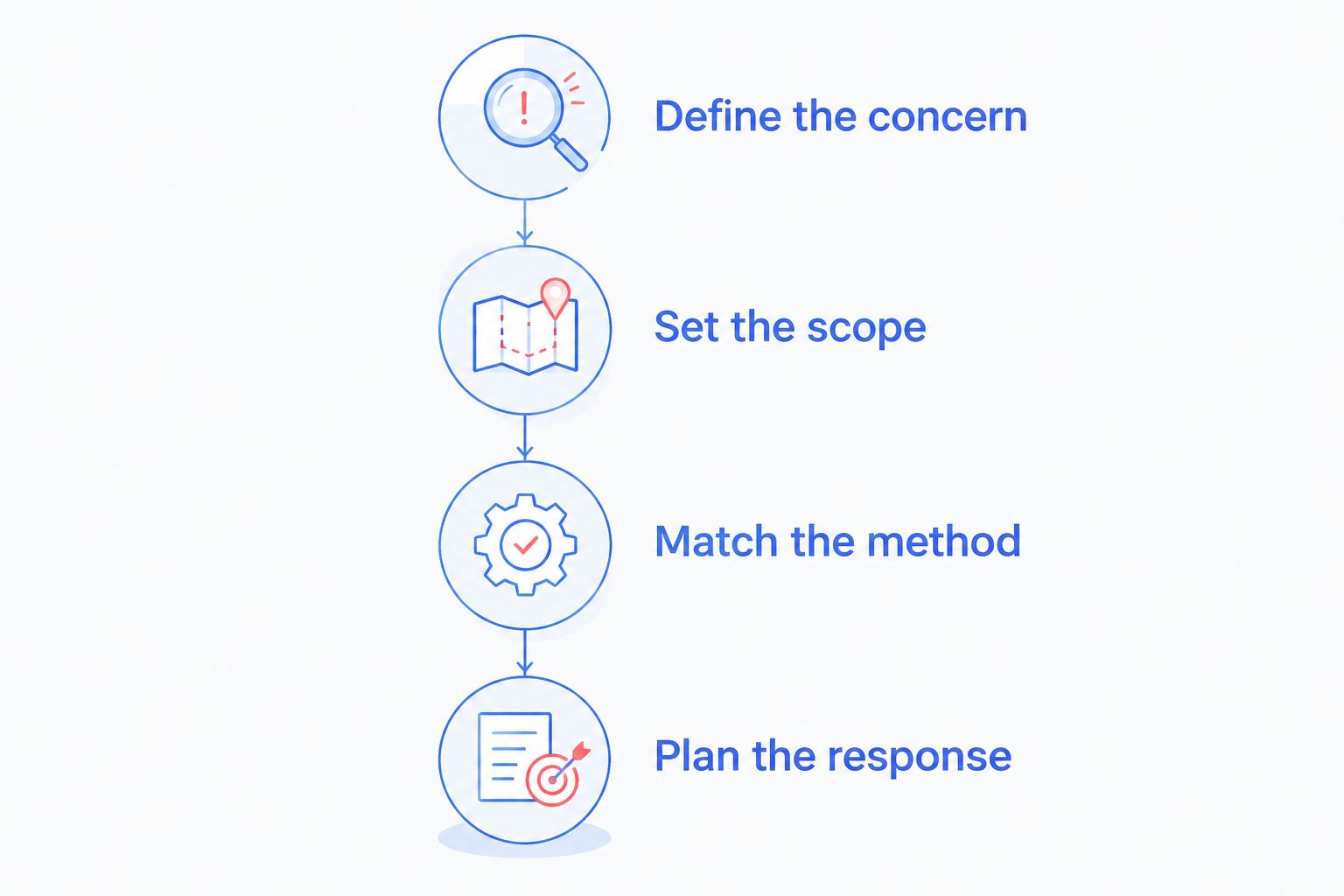
Use this sequence to keep the decision tied to the actual concern.
- Define the concern: Identify the observation that prompted the search. Separate direct evidence from assumptions.
- Set the scope: Name the room, property, vehicle, or system you want checked and confirm authorized access.
- Match the method: Decide whether you need RF analysis, camera-lens checks, electronic searches, physical inspection, or professional assistance.
- Plan the response: Decide how you will document and investigate an unexplained object or reading safely.
If you are considering a service in 2026, describe the concern without claiming that surveillance has already been established. Give the provider the location type, relevant access history, and any observations you can document. Ask which parts of the concern fall within the proposed service.
Discuss your bug-sweeping needs
Describe your home, business, or vehicle surveillance concerns and ask about the inspection scope.
When staying with Zetronix is the right call
Stay with Zetronix when you want to own equipment and a specific product's documented functions match your task. Compare the model, not the retailer name. Read its instructions and understand what a reading does—and does not—establish.
You do not need a different supplier merely because a detector responds to legitimate wireless activity. That is an interpretation issue, not automatically a defect. If the detection method fits, your next move is a better inspection process; if the method does not fit, another device using the same method will not fix that mismatch.
FAQ
What's the best Zetronix alternative for a professional bug sweep?
USA Bugsweeps is the service alternative for homeowners, business owners, and vehicle owners seeking professional TSCM bug sweeping. Its stated services include nationwide detection of hidden cameras, audio bugs, GPS trackers, and wiretaps.
Should I buy TSCM equipment or arrange a professional service?
Choose equipment when you want to operate and interpret it yourself; choose a service when you want a professional inspection. Define the areas and surveillance concerns before comparing either option.
Is a spectrum analyzer better than an RF detector?
A spectrum analyzer is better suited to examining RF activity in detail, but it requires technical interpretation. Neither category establishes that an observed signal comes from unauthorized surveillance without further investigation.
Can an RF detector find a recorder that does not transmit?
An RF detector cannot identify a recorder through a transmission that does not exist. Physical inspection and other detection methods address different parts of that search.
Does an optical lens finder detect every hidden camera?
No, an optical lens finder requires a suitable view of the camera lens. Obstructions and viewing angles limit the method, and reflective objects require visual investigation.
Does a nonlinear junction detector prove that a bug is present?
No, a nonlinear junction detector response does not prove that surveillance equipment is present. Ordinary electronics and some material junctions can produce responses that need interpretation.
What should I do if my detector gives an unexplained alert?
Treat the alert as a reason to investigate, not as proof of surveillance. Record the location and circumstances, check for legitimate sources safely, and seek professional help when you cannot explain the reading.
One last thing
A quiet detector is not proof that a space contains no recording device. Silence tells you about the method and conditions of that check, not every possible device in the space. For 2026, make your final purchasing question: What does this method leave unchecked?


