
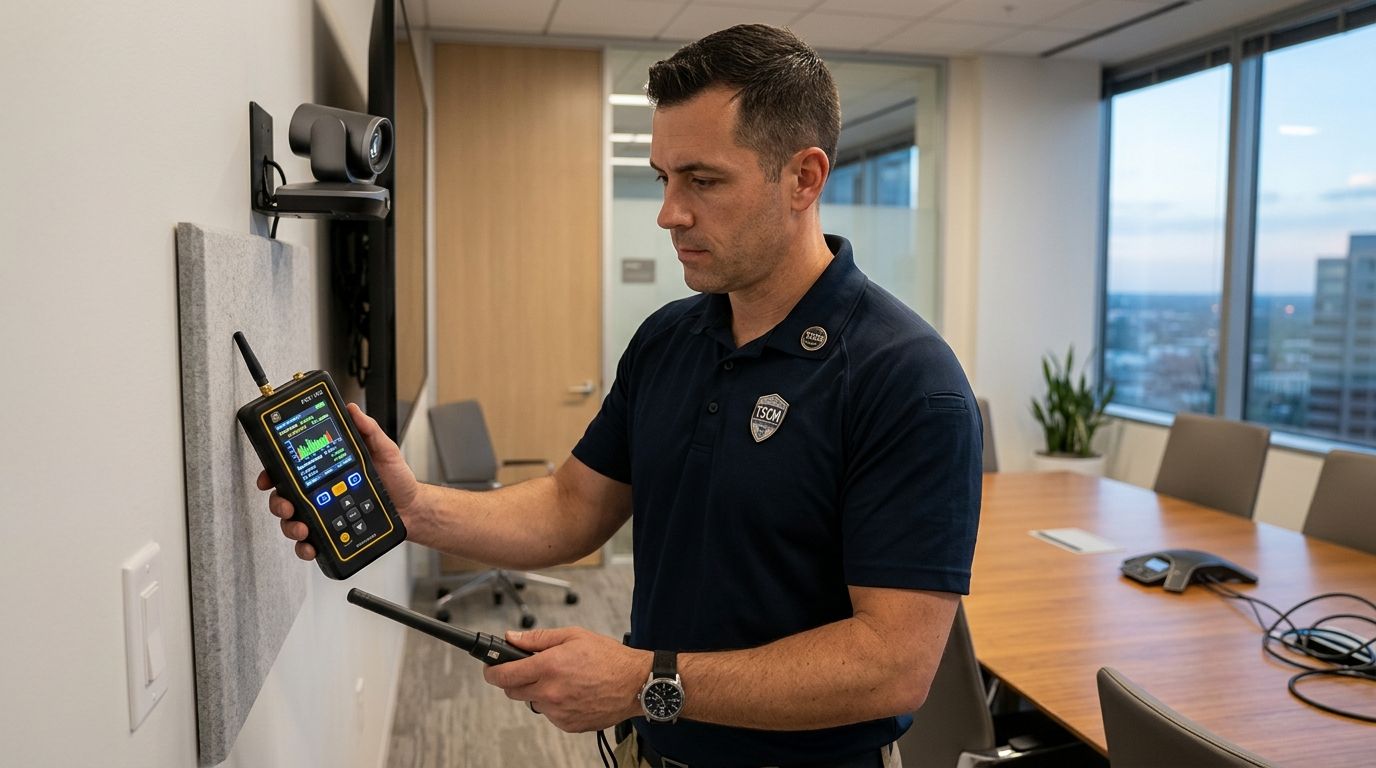
Six RF detector categories cover professional bug sweeping in 2026, from full-spectrum analyzers used by TSCM technicians down to consumer keychain units — and picking the wrong one for the job means missing a device that's actually there.
- REI OSCOR Green wins overall for full-spectrum professional bug sweeping in 2026.
- REI ORION HX is the only category here that finds bugs that are powered off.
- Consumer RF detectors like K18-style units flag Wi-Fi routers as often as they flag real bugs.
- No handheld RF detector replaces a trained non-linear junction sweep for wired or dormant devices.
Why this matters
An RF detector only catches a transmitter that's actively broadcasting at the moment you scan. A GPS tracker asleep in a glovebox, a voice recorder with no radio at all, or a bug wired directly into a phone line won't trigger a single one of these devices. That's the gap between a $50 consumer gadget and a full TSCM sweep, and it's why professional investigators carry two or three different tools instead of one.
Before comparing units, understand what you're actually buying: a broadband RF detector tells you something is transmitting nearby. It does not tell you what the signal is, whether it's a baby monitor or a bug, or where the device is physically hidden. That interpretation step is where DIY searches fail most often — see how a hidden camera actually gets caught with an RF detector for how a technician reads a spike instead of just chasing the needle.
USA Bugsweeps runs full TSCM sweeps nationwide combining spectrum analysis, non-linear junction detection, and physical inspection — the RF detector is one tool in that kit, never the whole kit. Check usabugsweeps.com for how a professional sweep is structured before deciding whether a handheld unit will actually answer your question.
What makes the best RF detector for bug sweeping
- Frequency range — narrow-band consumer units miss bugs operating outside their scan window; professional analyzers scan far wider bands.
- Signal discrimination — the ability to separate a real transmitter from Wi-Fi, Bluetooth, and cellular noise without constant false alarms.
- Non-linear junction capability — detects semiconductors in a device even when it's switched off, which broadband RF units cannot do.
- Portability vs. depth — a briefcase-sized unit for spot-checks trades detection depth for speed.
- Operator learning curve — a device that requires training to interpret is not a fair substitute for one a homeowner can use unsupervised.
- Field use case fit — a hotel-room spot check and a boardroom sweep for planted hardware need different equipment entirely.
RF detectors at a glance
| Detector | Best for | Standout feature | Key limitation |
|---|---|---|---|
| REI OSCOR Green | Full-spectrum professional sweeps | Wide-band spectrum analysis with waterfall display | Steep learning curve, not a solo homeowner tool |
| REI CPM-700 | Room-by-room technician sweeps | Fast, portable broadband signal strength readings | Narrower analysis than a full spectrum analyzer |
| REI ORION HX | Finding powered-off or dormant bugs | Non-linear junction detection of semiconductors | Can't identify signal type or content |
| JMPOSAT DD1206 | Budget-conscious investigation firms | Lower entry cost with decent sensitivity | More prone to Wi-Fi/Bluetooth false positives |
| Anteater | Travel and hotel-room spot checks | Compact, briefcase-portable design | Limited range, no non-linear junction capability |
| Consumer detectors (K18-style) | A first-pass sanity check only | Instant on, no training required | High false-positive rate, misses dormant devices |
1. REI OSCOR Green: best RF detector for full-spectrum professional sweeps
The OSCOR Green is a wide-band spectrum analyzer used across the TSCM industry to visualize every active transmission in a room at once, rather than a single beeping needle. A trained technician reads the waterfall display to separate a planted bug's signature from background Wi-Fi, cellular, and Bluetooth clutter that would send a cheaper unit into constant false alarms.
REI OSCOR Green pros:
- Scans across a far wider frequency range than consumer or single-band units
- Waterfall display flags transient or intermittent transmissions consumer units miss entirely
- Standard equipment on professional TSCM teams nationwide
REI OSCOR Green cons:
- Requires real training to interpret correctly — not a plug-and-scan device
- Doesn't catch devices that aren't currently transmitting
- Overkill and cost-prohibitive for a one-time homeowner check
Best for: licensed TSCM technicians running a full facility or residence sweep. Verdict: Buy for professionals, hire a technician rather than buying one yourself.
2. REI CPM-700: best RF detector for on-site room-by-room sweeps
The CPM-700 is the handheld broadband probe technicians carry from room to room after the spectrum analyzer has flagged a general area of concern. It gives a fast, localized read on signal strength so a sweeper can walk toward the source instead of scanning an entire building with a stationary analyzer.
REI CPM-700 pros:
- Fast, portable, and built for physically walking down a signal
- Widely used alongside spectrum analyzers as the second step in a sweep
- Simple readout for locating the strongest point of a transmission
REI CPM-700 cons:
- Narrower analysis depth than a full spectrum analyzer
- Best used in combination with other equipment, not standalone
- Interpreting spikes correctly still requires a trained operator
Best for: the physical walk-through phase of an on-site sweep after initial detection. Verdict: Buy as a second tool in a technician's kit, not a first or only device.
3. REI ORION HX: best RF detector for finding powered-off bugs
Every detector above only catches something actively transmitting. The ORION HX works differently — it's a non-linear junction detector that identifies semiconductors hidden in walls, furniture, and objects whether or not the device is switched on or transmitting anything at all.
REI ORION HX pros:
- Only detection method here that finds a bug that's dormant or powered off
- Catches devices hidden inside walls, furniture, or fixtures with no RF signature
- Standard for high-security sweeps of boardrooms and legal offices
REI ORION HX cons:
- Can't tell you what frequency or content a device transmits on
- Slower, more methodical process than a broadband scan
- Triggers false positives from unrelated electronics embedded in walls
Best for: sweeping a boardroom, law office, or executive suite suspected of a hard-wired or dormant device. Verdict: Buy for any sweep where wiretaps or wired bugs are a real concern — see how to detect a wiretap on a landline phone for why RF alone won't catch a hardwired tap.
4. JMPOSAT DD1206: best RF detector for budget-conscious investigation firms
The DD1206 is a step above consumer detectors without the cost of a full professional analyzer, making it a common choice for small investigation firms building out a first detection kit.
JMPOSAT DD1206 pros:
- Lower cost entry point into semi-professional detection equipment
- Reasonable sensitivity for common consumer and prosumer bugs
- Simple dial interface with minimal setup
JMPOSAT DD1206 cons:
- Narrower frequency ceiling than REI's professional line
- More prone to false positives from Wi-Fi and Bluetooth than higher-end units
- Works best paired with a trained sweep, not used standalone
Best for: a small investigation practice adding a second-tier detector to its kit. Verdict: Hold — fine as a supplementary tool, not a primary one for high-stakes sweeps.
5. Anteater: best RF detector for travel and hotel-room spot checks
The Anteater is built for speed and portability — small enough for a briefcase, fast enough to run a quick check of a hotel room or rental car before a sensitive meeting.
Anteater pros:
- Compact enough to carry without drawing attention
- Fast spot-check for travel scenarios like hotel rooms and rental vehicles
- Simple operation for a quick pre-meeting scan
Anteater cons:
- Limited range and sensitivity compared to spectrum analyzers
- Can miss bugs shielded or hidden behind furniture and walls
- No non-linear junction capability, so it misses dormant devices
Best for: executives or travelers doing a quick check before a confidential conversation. Verdict: Hold — useful as a travel companion, not a substitute for a full sweep in a location you'll use repeatedly.
6. Consumer RF detectors (K18-style units): best for a first-pass sanity check
These are the cheap, keychain-sized units sold widely online under names like K18. They light up or vibrate near any RF source strong enough to trip their sensor, with zero ability to tell you what triggered them.
Consumer RF detector pros:
- Instant on, no training required
- Cheap entry point for someone with zero equipment
- Portable enough to carry anywhere
Consumer RF detector cons:
- Extremely high false-positive rate against Wi-Fi routers, baby monitors, and Bluetooth speakers
- Can't detect powered-off, dormant, or wired devices at all
- Gives no real analysis — just a beep with no context
Best for: a first sanity check before deciding whether to call a professional. Verdict: Skip for anything you're actually worried about — a false negative here just means the search stops too early.
How we ranked these
The ranking above weighs frequency coverage, signal discrimination against everyday Wi-Fi and Bluetooth noise, non-linear junction capability, and how much training each device demands before the reading means anything. REI OSCOR Green ranks first because it's the only unit here that gives a full spectrum picture instead of a single go/no-go signal. Everything below it trades depth for either speed, cost, or portability.
“An RF detector only finds a device that's transmitting right now — it can't find one that's switched off, wired, or asleep.”
Which RF detector should you choose?
If you're a licensed TSCM technician building a professional kit in 2026, the REI OSCOR Green paired with an ORION HX non-linear junction detector covers both active and dormant threats. If you're a homeowner or small business owner worried about a specific device, a consumer unit only answers half the question — it can't rule out a wired tap or a bug that's currently powered down, which is the majority of what a real sweep is designed to catch.
Not sure a handheld detector is enough?
A full TSCM sweep covers wired taps, dormant bugs, and hidden GPS trackers a detector alone can't catch.
FAQ
What's the best RF detector for bug sweeping in 2026?
The REI OSCOR Green is the best overall RF detector for professional bug sweeping in 2026 because it scans a wide frequency range with a waterfall display instead of a single alert tone. It requires trained interpretation, so it's built for technicians, not a one-time homeowner check.
Can a consumer RF detector find a hidden camera?
A consumer RF detector can find a hidden camera only while it's actively transmitting video, and it will also flag Wi-Fi routers and baby monitors as false positives. It won't find a camera that records to internal storage instead of broadcasting a signal.
Is an RF detector better than a non-linear junction detector?
They solve different problems: an RF detector finds active transmitters, while a non-linear junction detector like the REI ORION HX finds semiconductors in devices whether they're transmitting or switched off. A full sweep uses both.
Why does my RF detector keep giving false alarms?
Most false alarms come from Wi-Fi routers, Bluetooth devices, baby monitors, and cellular signals that consumer-grade units can't distinguish from an actual bug. Professional spectrum analyzers filter this noise far better than handheld consumer detectors.
Can an RF detector find a GPS tracker on my car?
An RF detector can find a GPS tracker only while it's actively transmitting location data, which many trackers do on a delay or schedule rather than continuously. A physical inspection alongside RF scanning catches trackers that stay quiet between transmissions.
Do I need a professional sweep if I already have an RF detector?
Yes, if the concern is serious — an RF detector alone misses wired taps, dormant bugs, and devices hidden behind shielding. A professional TSCM sweep combines RF detection with non-linear junction detection and physical inspection.
How much training does it take to use a professional RF detector correctly?
Interpreting a spectrum analyzer like the REI OSCOR Green correctly takes real TSCM training, since the device shows every transmission in range and the operator has to identify which one is the actual threat. That's why these units are run by technicians, not sold as a standalone consumer product.
One last thing
The detail most people miss in 2026: a bug doesn't have to be transmitting to be dangerous. A voice recorder that stores audio locally, a bug wired directly into a phone line, or a tracker set to transmit only once an hour will pass a full RF sweep with a clean bill of health. That's exactly the gap non-linear junction detection and a physical inspection are built to close, and it's why a real TSCM sweep never relies on an RF detector alone.


