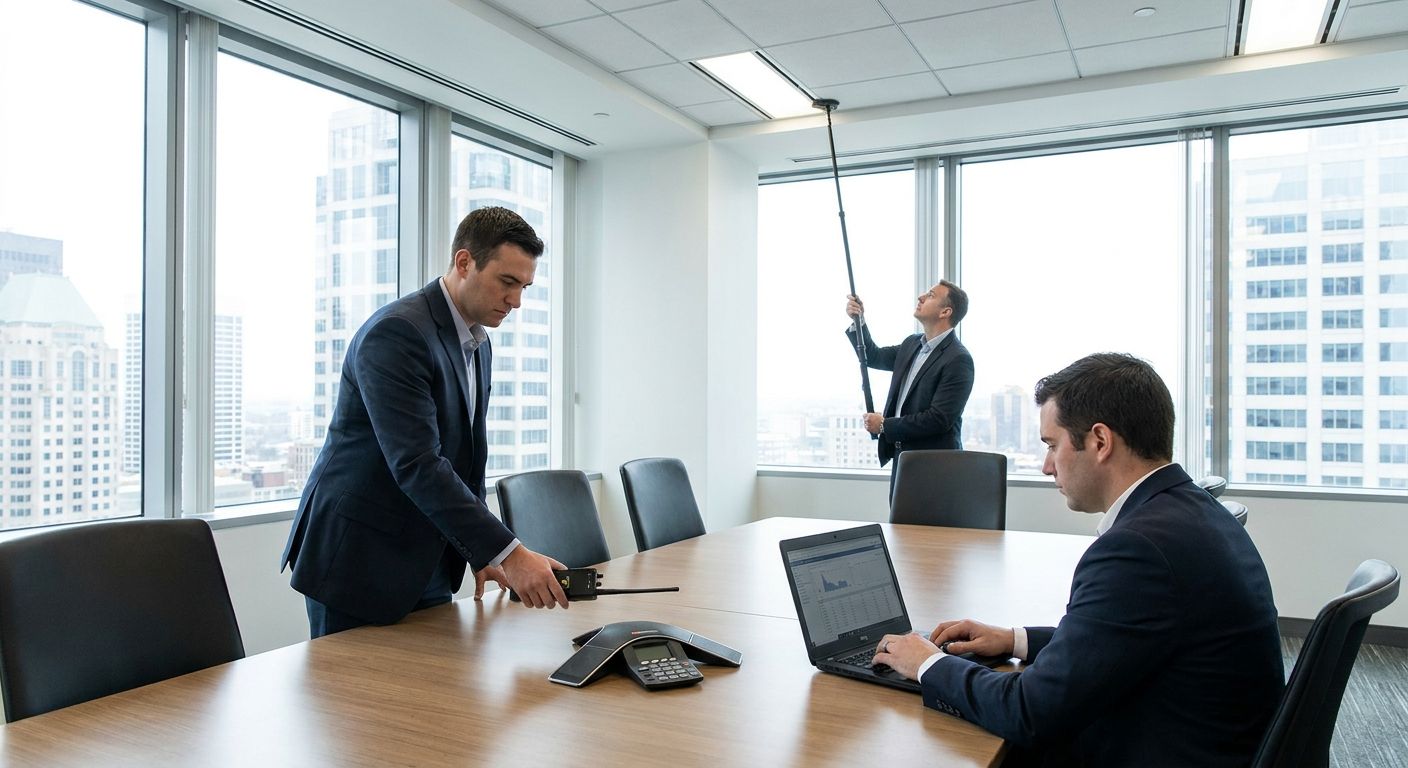
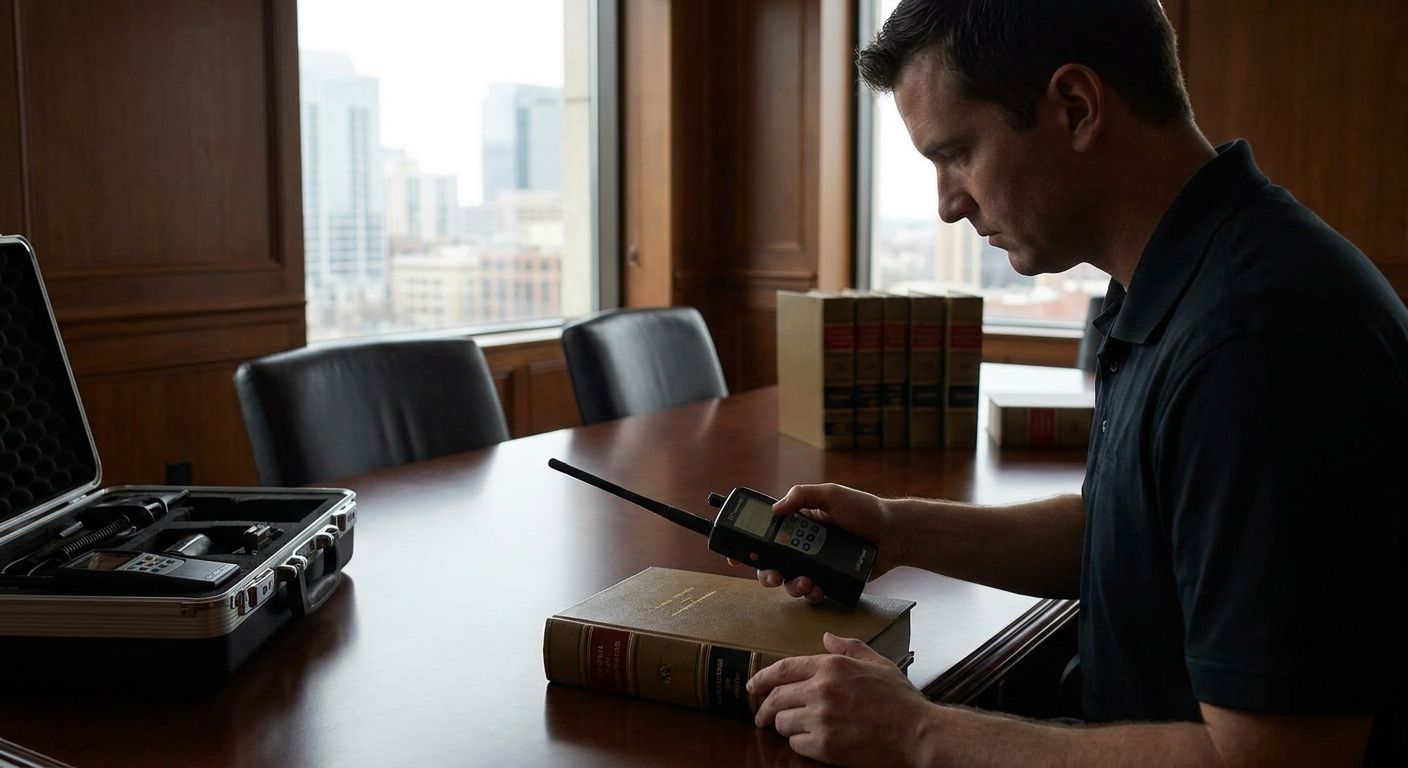
Privileged conversations, settlement numbers, expert strategy, client secrets — a law office generates the kind of information that's worth planting a device to steal. Bug sweep services for law firms exist to confirm nobody already has a live feed into your conference room, your managing partner's office, or the car you drive to depositions.
- Bug sweep services for law firms cover boardrooms, partner offices, and vehicles — not just the reception area: book before trial, not after.
- USA Bugsweeps runs full TSCM inspections nationwide with 24/7 quote availability — Buy as the baseline entry point.
- Corporate boardroom sweeps catch RF transmitters and audio bugs planted during cleaning crew or vendor access.
- Named partners and firms representing public figures need standalone executive sweeps, not a general office check.
- A $29 DIY vehicle guide supplements a professional GPS tracker sweep — it doesn't replace one.
Why this matters
A law firm's exposure is different from a retail business or a startup. The thing worth stealing isn't a customer list — it's a legal strategy, a settlement floor, or a client's confession. Opposing counsel, a disgruntled former employee, or a client's spouse in a contentious divorce all have motive and, increasingly, cheap access to consumer-grade recording hardware.
USA Bugsweeps has been featured on ABC, NBC, FOX, CNN and Telemundo covering exactly this problem — five national outlets reporting on hidden cameras and wiretaps found in professional settings, not just homes. Law offices show up in that reporting more than most people expect, because conference rooms get used by outside vendors, cleaning crews, and visiting counsel who have unsupervised access after hours.
Who this is for
This guide is for managing partners, general counsel, and office administrators at firms handling litigation, family law, corporate transactions, or intellectual property disputes — anywhere a leaked strategy memo or a recorded settlement conversation could cost a client the case. If your firm has hosted opposing counsel in your boardroom, represents a public figure, or has a partner going through a hostile divorce, a sweep isn't optional caution — it's due diligence.
What to look for in bug sweep services for law firms
TSCM technician credentials, not IT staff
A general spectrum analyzer app on a phone won't find a hardwired audio bug or a digital burst transmitter. TSCM (technical surveillance countermeasures) work requires trained technicians using non-linear junction detectors and RF spectrum analyzers built for the job, not consumer gear repurposed by an IT contractor.
Coverage that includes vehicles, not just the office
A sweep limited to the conference room misses the most common surveillance vector for attorneys handling contentious cases: the car. GPS trackers get planted during valet parking, courthouse visits, or overnight street parking, and a firm-only sweep leaves that exposure untouched.
Physical inspection alongside electronic scanning
RF sweeps alone miss passive devices that don't transmit continuously. A real inspection combines spectrum analysis with a physical search of outlets, furniture, light fixtures, and phone equipment — the places where a hardwired bug sits quietly until someone plays back the recording.
Privilege and confidentiality handling
A sweep team walks through spaces holding privileged client files. The provider should operate under a confidentiality agreement and document chain of custody for anything found, since a discovered device may become evidence in a separate legal matter.
Response time and scheduling flexibility
Surveillance concerns don't wait for business hours. A firm that suspects a leak before a Friday trial needs a provider that can move fast — 24/7 quote availability matters more here than in almost any other commercial setting.
Documentation you can hand to a client or a court
A written report listing what was scanned, what was found, and what wasn't matters if the sweep ever needs to support a motion or a malpractice defense. Verbal assurance isn't enough when a client asks what steps the firm took.
Top picks for law firm environments
The boardroom pick. Bug sweep services for corporate boardrooms target the room where opposing counsel, mediators, and outside experts sit across the table from your client. RF transmitters planted in HVAC vents or under conference tables are the most commonly reported device type in shared meeting spaces. Buy if your firm hosts negotiations, mediations, or depositions on-site.
The partner-track pick. Bug sweep services for executives and public figures covers named partners, general counsel, and any attorney representing a client with media exposure. This isn't a general office sweep — it's a standalone inspection of a single office, phone line, and personal workspace. Buy for firms with high-profile clients or partners in the news.
The vehicle check. How to get a hidden GPS tracker removed from your car walks through the manual check most attorneys can run themselves between professional sweeps. It's a reasonable first step before a contentious deposition trip, but it's not a substitute for a technician-run inspection. Consider as a supplement, not a replacement.
The firm-wide baseline. A full nationwide TSCM inspection through USA Bugsweeps is the starting point for any firm that hasn't been swept before. It combines RF scanning, physical inspection, and documented reporting across the whole office. Buy as the first move before anything else on this list.
What to avoid
- Cheap RF detector wands sold online. A $20-40 handheld detector flags basic analog transmitters but misses digital burst devices that only transmit in short intervals — a false sense of security is worse than no sweep at all.
- Sweeps run by general IT contractors. Network security and TSCM are different disciplines. An IT team checking for hacked Wi-Fi isn't equipped to find a hardwired microphone in a wall outlet.
- One-time sweeps with no follow-up cadence. A firm handling a rotating docket of high-stakes cases needs a recurring schedule, not a single inspection from three years ago that nobody's revisited since 2023.

Verdict comparison
| Scenario | Best pick | Coverage | Verdict |
|---|---|---|---|
| Hosting opposing counsel or mediation | Corporate boardroom sweep | RF scan + physical search of meeting space | Buy |
| Named partner or client-facing public figure | Executive and public figures sweep | Standalone office, phone line, personal workspace | Buy |
| Contentious divorce or espionage litigation | Vehicle GPS tracker check | Personal or firm vehicle | Consider |
| No prior sweep on record | Full nationwide TSCM inspection | Whole-office baseline sweep | Buy |
FAQ
What do bug sweep services for law firms actually check?
A professional sweep covers RF spectrum scanning for active transmitters, non-linear junction detection for dormant devices, and a physical inspection of outlets, furniture, and fixtures. Vehicles and personal offices get included when the scope calls for it.
How often should a law firm sweep its offices?
Firms handling active litigation or high-profile clients typically schedule a sweep before major depositions or trials, not on a fixed annual calendar. A one-time sweep from years ago doesn't cover a device planted last month.
Is a hidden camera detector app enough for a law office?
No. Phone-based apps catch basic infrared signatures on cheap cameras but miss hardwired audio bugs and digital burst transmitters entirely. A trained TSCM technician with a spectrum analyzer covers what an app can't.
Can a law firm sweep be done after hours?
Yes, and it's often preferable so the inspection doesn't disrupt client meetings or reveal the sweep to office visitors. Providers offering 24/7 quote availability can typically schedule around a firm's docket.
Do bug sweeps cover attorney vehicles?
A full-scope sweep for law firms should include vehicles used for court appearances and client meetings, since GPS trackers are commonly planted during valet parking or courthouse visits. A vehicle-only check runs separately from an office sweep.
What happens if a device is found during a sweep?
A documented report should log what was found, where, and when, since the discovery may become relevant to a separate legal matter or malpractice concern. Chain of custody matters if the device ever needs to support a motion.
Is TSCM different from cybersecurity for a law firm?
Yes. Cybersecurity protects networks and devices from digital intrusion, while TSCM finds physical surveillance hardware like audio bugs, hidden cameras, and GPS trackers. Firms need both, but they're separate disciplines run by different specialists.
How much does a law firm bug sweep cost?
Pricing depends on square footage, number of vehicles, and scope of the inspection, so a quote should reflect the specific office rather than a flat national rate. Request an itemized estimate before the appointment.
One last thing
Most firms think about surveillance risk after a leak surfaces — a settlement number that shouldn't have gotten out, a strategy memo referenced by opposing counsel who shouldn't have known. By the time that happens, a device could have been recording for months. The firms that stay ahead of it treat a TSCM sweep the same way they treat malpractice insurance: a cost paid before the incident, not after.