
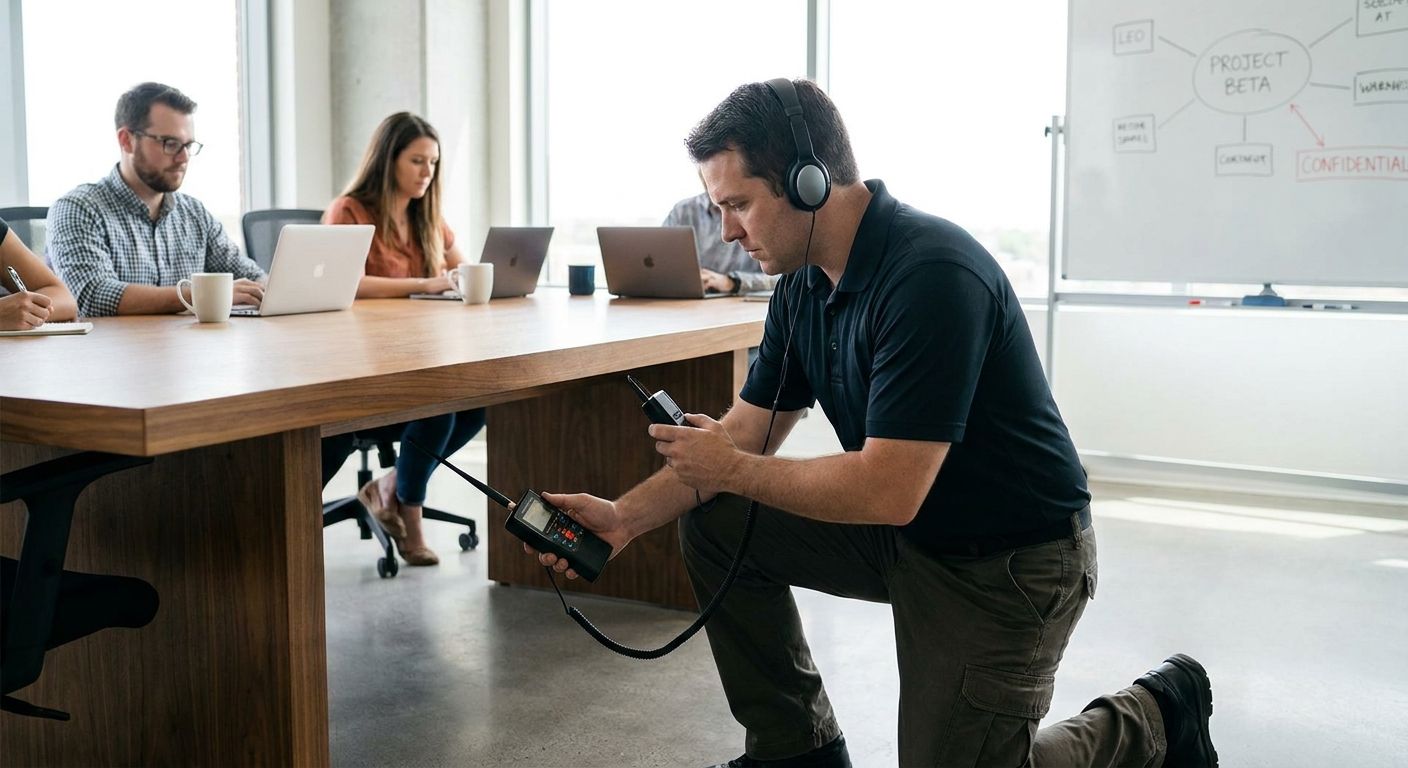
Tech startup bug sweep services find hidden cameras, audio bugs, GPS trackers, and wiretaps inside offices, boardrooms, and vehicles where founders discuss unreleased code, cap tables, and acquisition terms. A startup's biggest asset is information nobody else has yet, and that makes early-stage offices, demo rooms, and pitch spaces a specific kind of surveillance target that a generic office sweep doesn't account for.
- Bug sweep for tech startups covers pitch rooms, demo devices, and founder vehicles, not just the main office.
- USA Bugsweeps runs TSCM sweeps timed around funding rounds, board meetings, and key employee departures.
- DIY RF detector apps miss digital recorders and passive bugs with no active transmission to catch.
- Recurring sweeps beat one-time sweeps for startups because access to your space changes every quarter.
Why bug sweeps matter for tech startups
A startup's exposure is different from a mature company's. You have investors, contractors, coworking neighbors, and a rotating cast of interns and advisors walking through spaces where trade secrets get discussed out loud, on whiteboards, and over video calls. Corporate espionage against startups doesn't need a hacker — a $40 audio recorder taped under a conference table catches a Series A pitch just as well as a network breach does.
Company size doesn't reduce the incentive. If your roadmap, source code, or acquisition talks are worth stealing, someone with physical access to your building has an easier path than someone trying to breach your firewall. A professional TSCM sweep checks for that physical layer of exposure that firewalls and password managers were never built to cover.
Startups also move fast — new hires, new office space, new investors touring the building — and each of those events resets your risk. A sweep done in January doesn't protect a board meeting in September.
Map every room where trade secrets get discussed
Before anything else, identify the physical spaces where sensitive conversations actually happen. Most startups assume it's just the main conference room, but the list is usually longer.
- Conference rooms and pitch rooms used for investor meetings
- Founder and executive offices
- Demo rooms where unreleased product gets shown to partners
- Shared coworking suites where walls and neighbors change monthly
- Home offices founders use for confidential calls
Walk each space and note anything unusual: a smoke detector installed slightly crooked, a phone charger left in an outlet that nobody uses, a picture frame that wasn't there last week. These are the cheap, common hiding spots for pinhole cameras and audio bugs, and a visual pass catches the obvious ones before a technical sweep catches the rest.
Sweep before investor pitches, board meetings, and demo days
High-stakes meetings are the highest-value moments for anyone trying to record your startup without permission. A sweep timed right before these events closes the window when the payoff for an eavesdropper is largest.
- Sweep the pitch or boardroom within 24-48 hours of the meeting
- Check every device brought into the room by outside guests, including gifted swag
- Inspect A/V equipment, projectors, and conferencing hardware for unauthorized add-ons
- Scan for active RF transmissions during a live rehearsal of the meeting
- Re-check the room immediately after the meeting if outside vendors had unsupervised access
A startup pitching a $10 million round has more incentive for someone to bug that room than a company pitching nothing at all. Treat every board meeting and term-sheet negotiation as a sweep trigger, not an annual event.
Inspect company vehicles and fleet GPS units
Founders and sales teams who drive to client meetings, demos, or investor offices carry conversations in the car that never touch a server. A hidden GPS tracker or audio device in a company vehicle exposes travel patterns and in-car conversations without anyone noticing.
- Check under the dash, wheel wells, and bumper for magnetic trackers
- Inspect the OBD-II port for unauthorized plug-in devices
- Look through glovebox and center console wiring for anything that wasn't factory-installed
- Review any company fleet vehicle used by multiple employees for accumulated devices
- Check rental cars used for out-of-town investor trips before returning them
If your team drives a shared vehicle fleet, a GPS tracker sweep for company fleet vehicles covers every unit at once instead of one car at a time. Startups doing their own quick check can start with the free guide on sweeping a vehicle for GPS trackers before calling in a technician for anything that reads suspicious.
Vet cleaning crews, contractors, and coworking neighbors
Anyone with a key or badge to your space after hours is a possible access point, whether or not they mean any harm. Startups sharing a coworking floor or leasing sublet space have less control over who's walked through their office than a company with a dedicated, badge-only floor.
- Confirm background checks exist for cleaning and maintenance contractors
- Log every vendor visit that includes access to the main office or server closet
- Re-sweep after any office renovation, cabling work, or furniture delivery
- Check shared walls and ceiling tiles in coworking or sublet spaces
- Ask your landlord who else has master keys to your suite
Add TSCM to your incident-response and offboarding checklist
Most startups have an IT offboarding checklist for departing employees — revoke access, collect the laptop, disable credentials. Almost none of them include a physical sweep, and that's the gap that matters when a departure is contentious or a co-founder split turns adversarial.
- Sweep the office within a week of a contentious termination or departure
- Check devices and desks that reported employees had unsupervised access to
- Add a sweep step to your incident-response plan alongside password rotation
- Sweep company vehicles handed off between employees
- Document each sweep for your records in case of later legal disputes
Boardroom sweeps and executive protection follow the same logic used for bug sweeps for corporate boardrooms and bug sweep services for executives and public figures — the moment of highest risk is the moment right after trust breaks down, not a random Tuesday.
Train employees to spot the warning signs
A sweep is a snapshot. Employee awareness is what catches problems between sweeps, and it costs nothing but a short briefing.
- Teach staff to report unfamiliar devices plugged into outlets or USB ports
- Flag any gift, promotional item, or piece of swag left unattended in a meeting room
- Ask employees to report battery drain or heat on personal devices during meetings
- Set a policy for guests: phones and bags stay outside sensitive meeting rooms
- Encourage staff to report unusual radio interference on office Wi-Fi or Bluetooth devices
Comparing your options
| Option | Best for | Starting price | Key limitation |
|---|---|---|---|
| DIY RF detector app | Quick checks between sweeps | Free-$20 app | Misses passive, non-transmitting devices and digital recorders |
| General security consultant | Broad physical security audits | Varies by firm | Rarely trained specifically in TSCM equipment or techniques |
| In-house IT/security staff | Ongoing device and network monitoring | Existing salary cost | Physical bug sweeps require different training than cybersecurity |
| Licensed TSCM firm (USA Bugsweeps) | Pre-funding-round and boardroom sweeps | Free estimate available | Requires scheduling ahead of high-stakes meetings |
The verdict for most seed-to-Series-B startups: run a licensed TSCM sweep before every board meeting and funding close, and use employee training to cover the gaps in between.
Common mistakes tech startups make
- Treating one sweep as permanent. Office layouts, staff, and vendors change constantly at a startup; a sweep from six months ago tells you nothing about today.
- Sweeping only the main office. Home offices, demo rooms, and founder vehicles carry the same conversations and get skipped.
- Skipping sweeps to save cash pre-funding. The pitch meeting right before a raise is exactly when the exposure is highest and the sweep matters most.
- Assuming a cybersecurity audit covers physical threats. Firewalls don't detect a recorder taped under a table.
- Not sweeping after a co-founder or executive departure. Contentious exits are one of the most common triggers for planted devices in startup environments.
FAQ
What is a bug sweep for tech startups?
A bug sweep for tech startups is a physical and electronic inspection of offices, meeting rooms, and vehicles to find hidden cameras, audio bugs, GPS trackers, and wiretaps. It targets the spaces where founders discuss product roadmaps, funding terms, and other trade secrets.
How often should a startup sweep for hidden devices?
Sweep before major board meetings, investor pitches, and funding closes, and again after any contentious employee departure. Startups with high-turnover coworking space or frequent office visitors benefit from a recurring quarterly schedule.
Can I sweep my own office with an app?
An RF detector app catches some active transmitting devices but misses passive recorders and hidden storage devices with no signal to detect. It works as a quick check between professional sweeps, not a replacement for one.
Do I need to sweep company vehicles too?
Yes, if founders or sales staff discuss confidential business in the car or drive shared fleet vehicles. A GPS tracker or hidden recorder in a vehicle exposes travel patterns and conversations that never touch a company network.
Is a bug sweep worth it for an early-stage startup?
If the startup is raising funding, developing unreleased product, or negotiating an acquisition, the information at risk is usually worth more than the cost of a sweep. The exposure grows with every investor meeting and new hire.
What's the difference between TSCM and general IT security?
TSCM (technical surveillance countermeasures) covers physical devices like hidden cameras, microphones, and GPS trackers, while IT security covers networks, passwords, and software. A startup needs both, since a firewall can't detect a recorder taped under a table.
Should we sweep before or after a board meeting?
Sweep within 24-48 hours before the meeting to catch anything planted in advance, and re-check the room afterward if outside vendors or guests had unsupervised access. Both passes matter for high-stakes negotiations.
One last thing
The riskiest room in most startups isn't the main office — it's the demo room, because it's the one space outside investors, partners, and vendors get walked through unsupervised while your team is focused on the pitch, not the walls. If your startup has a dedicated demo space, put it at the top of the sweep list, not the bottom.


