
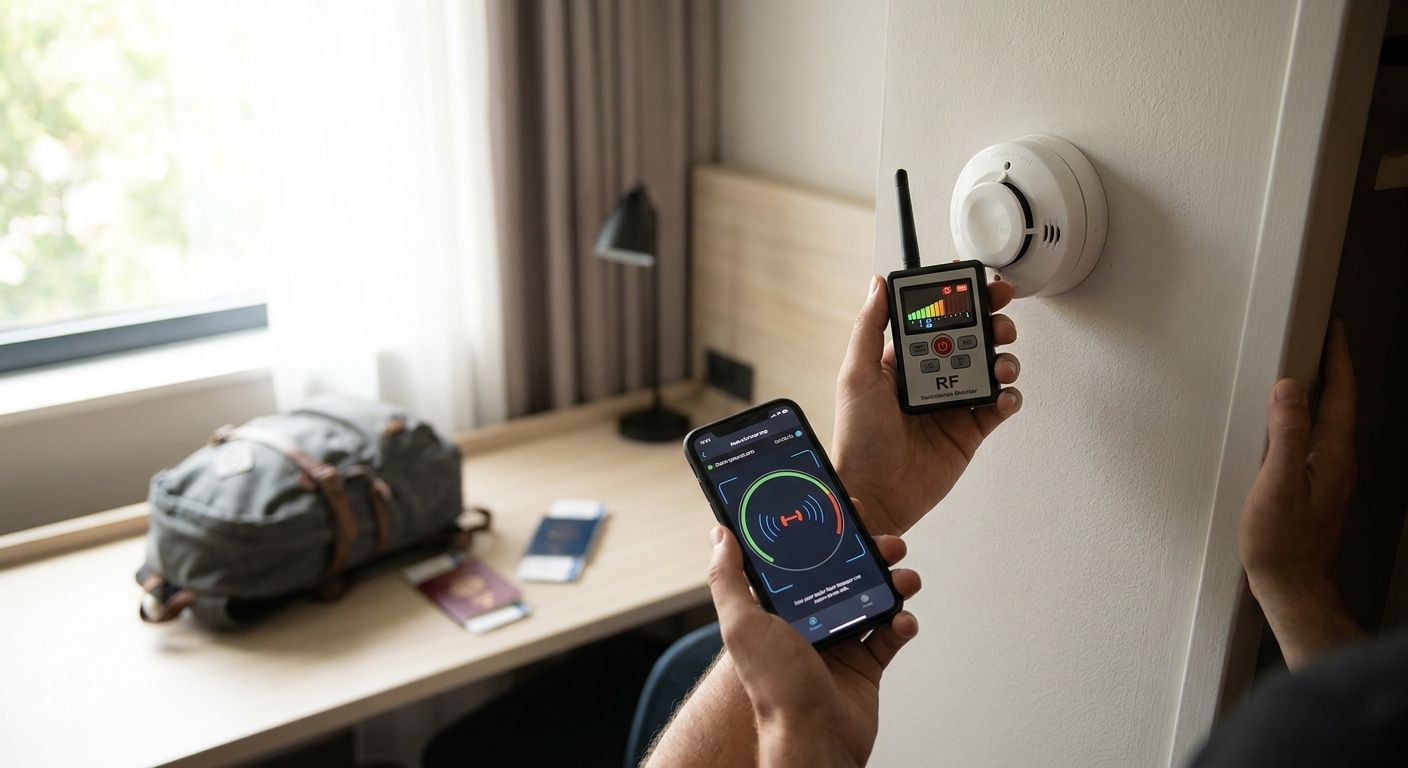
Checking into a hotel room in 2026 means checking more than the mattress and the minibar. Hidden cameras in vents, smoke detectors, and alarm clocks show up in guest complaints at hotels across the country every year, and knowing how to check a room takes ten minutes if you know where to look.
- Hidden camera detection for hotel guests works best when you combine a physical light scan with an RF/lens detector, not either method alone.
- Smoke detectors, alarm clocks, and USB chargers are the top three hiding spots reported in hotel room camera cases in 2026.
- Cheap RF-only detectors miss Wi-Fi based cameras that stay silent until someone views the feed remotely.
- A professional TSCM sweep before a high-profile stay catches lens glare and RF signals a phone app cannot.
- Skip flashlight-only apps as your sole method — they flag reflective surfaces, not confirmed lenses.
Why this matters
A hidden camera in a hotel room isn't a hypothetical. Cases involving cameras planted in guest bathrooms, closets, and bedrooms get reported to hotel chains and local police departments regularly, and the devices used cost less than $50 and fit inside a smoke detector housing without anyone noticing a seam. The tools that catch them are cheap and fast to use, but only if you know what each one actually detects and what it misses.
Most travelers assume a quick glance at the smoke detector and a wave of a phone flashlight covers it. It doesn't. Wi-Fi based cameras — the kind most commonly planted in short-term rentals and hotel rooms in 2026 — don't broadcast on the frequencies a basic RF detector scans, and they don't always have a visible lens glint under room lighting. Detection for hotel guests has to layer methods, not rely on one.
Who this is for
This guide is for travelers booking hotel rooms, extended-stay units, or vacation rentals who want a repeatable room-check routine — business travelers staying in unfamiliar cities, people booking through third-party listing sites, and anyone who has ever felt a room "off" and wanted a way to confirm it instead of guessing. If you're staying somewhere with elevated exposure — a public-facing role, a high-profile negotiation, a contentious personal situation — a professional TSCM sweep before check-in beats any DIY method on its own.
What to look for in hidden camera detection for hotel guests
Lens reflection under low light
Every camera lens reflects light differently than the surrounding material, even a pinhole lens smaller than a pencil eraser. Killing the room lights and sweeping a phone flashlight at a low angle across suspect fixtures — smoke detectors, clock radios, picture frames — catches the glint in under two minutes. This matters because lens-based detection works on cameras that don't transmit any signal at all, including cameras that only record to a local SD card.
RF signal strength across the 2.4GHz and 5GHz bands
Most wireless spy cameras still transmit over standard Wi-Fi bands to stream footage to a phone app in real time. An RF detector that scans both 2.4GHz and 5GHz catches these mid-transmission, which is why timing the sweep matters — a camera sitting idle between viewing sessions won't register on a passive RF scan.
Physical inspection of common mounting points
Smoke detectors, alarm clocks, wall outlets, and USB charging ports are the four most commonly reported hiding spots in hotel camera cases. Unscrewing a smoke detector cover takes ten seconds and either confirms it's a standard unit or reveals a lens where a battery compartment should be.
Network device count on the room's Wi-Fi
If the hotel's guest Wi-Fi allows you to see connected devices, an unusually high device count for a single room is worth a second look. This won't confirm a camera on its own, but paired with a physical sweep it narrows down whether something on the network doesn't belong.
Battery vs. hardwired power source
A device with no visible battery compartment but no cord either is drawing power from somewhere it shouldn't be. Cameras hidden inside alarm clocks or lamps often tap the host device's own power supply, which means there's no battery to check and no obvious tell beyond an extra wire or a slightly bulkier housing.
Time of installation relative to your booking
A camera planted specifically for your stay is rare, but a camera left in a rental unit from a prior guest or a semi-permanent installation in a repeat-booking property is the more common scenario. Checking listing reviews for prior camera complaints before booking is a five-minute step that catches this before you ever arrive.
Top picks for hidden camera detection
The free pick: the physical light-and-unscrew sweep. No purchase needed, takes under ten minutes, and catches lens-based cameras with zero transmission signature. It misses anything mounted flush or disguised inside a device you can't safely open, like a wall-mounted smart TV. Buy — do this on every stay regardless of what else you use.
The wildcard: a dedicated RF detector under $60. These handheld units scan for transmitting signals and beep or light up when they cross a threshold, catching Wi-Fi cameras actively streaming. The catch: a camera sitting dormant between remote viewing sessions won't trigger it, so pair it with the light sweep. Consider for frequent travelers who want a five-minute add-on to the physical check.
The mid-tier: a combined RF and lens detector unit. These run higher than a standalone RF scanner but add a lens-finder mode using an LED ring and viewfinder, catching both transmitting and non-transmitting cameras in one pass. Consider if you travel for work often enough to justify owning dedicated gear instead of renting or borrowing one per trip.
The safe pick: a professional TSCM sweep before a high-exposure stay. Trained technicians use spectrum analyzers and non-linear junction detectors that find hardwired cameras, cameras with no active transmission, and devices hidden inside walls or fixtures no consumer detector reaches. This is the right call before extended executive stays, sensitive negotiations, or any situation where the cost of missing a device outweighs the cost of the sweep — the same standard covered in bug sweep services for executives and public figures. Buy when the stakes justify it.
The one to skip alone: flashlight-only phone apps. These apps use the phone's own camera to flag reflective surfaces on screen, but they generate a high rate of false positives on anything glossy — mirrors, glass, chrome fixtures — and miss matte-finish lenses entirely. Skip as a standalone method; use it only as a supplement to the manual light sweep.
What to avoid
- Trusting a hotel's assurance that rooms are "regularly checked." Few properties run any camera-detection protocol beyond housekeeping, and staff turnover means institutional knowledge of a problem room rarely gets passed along.
- Relying on RF detectors as a complete solution. They're built to catch active wireless transmission, not passive storage devices or hardwired cameras pulling power from an outlet or lamp.
- Assuming a camera has to look like a camera. The devices found in real hotel room cases are built into everyday objects — alarm clocks, smoke detectors, USB wall chargers — specifically so a visual scan without a second look passes right over them.
“If you can unscrew it with a butter knife, it can hide a camera lens.”
Verdict comparison table
| Method | Cost | Catches RF cameras | Catches non-transmitting cameras | 2026 verdict |
|---|---|---|---|---|
| Physical light sweep | Free | No | Yes | Buy |
| Standalone RF detector | Under $60 | Yes (active only) | No | Consider |
| Combined RF + lens detector | Mid-range | Yes (active only) | Partial | Consider |
| Professional TSCM sweep | Highest | Yes | Yes | Buy for high-exposure stays |
| Flashlight-only app | Free | No | Partial, high false-positive rate | Skip as sole method |
FAQ
What's the best way to check a hotel room for hidden cameras in 2026?
Combine a physical light sweep of smoke detectors, clocks, and outlets with an RF detector scan of the room. The light sweep catches non-transmitting cameras; the RF scan catches active Wi-Fi devices, and using both closes the gap either one leaves open.
Do hidden camera detector apps actually work?
Flashlight-based apps flag reflective surfaces but generate frequent false positives on mirrors and glass, and they miss matte lenses entirely. Treat them as a supplement to a manual sweep, not a replacement for one.
Where do hotels most commonly have hidden cameras?
Smoke detectors, alarm clocks, wall outlets, and USB charging ports are the most commonly reported hiding spots in hotel camera cases. All four are worth a direct visual check on arrival.
Is a professional bug sweep worth it for a hotel stay?
For most short leisure stays, a DIY sweep covers the basics. For high-exposure stays involving sensitive business, public visibility, or a contentious personal situation, a professional TSCM sweep catches hardwired and non-transmitting devices consumer tools miss.
Can RF detectors find cameras that aren't transmitting?
No. RF detectors only pick up active signal transmission, so a camera recording to local storage or waiting between remote viewing sessions won't register. Pair RF scanning with a physical inspection to cover both cases.
How much does a hidden camera detector cost?
Standalone RF detectors typically run under $60, while combined RF-and-lens units cost more but add a viewfinder mode for spotting lenses under LED light. Professional TSCM sweeps cost more than either but cover device types consumer detectors can't reach.
Should I report a hidden camera found in a hotel room?
Yes. Contact hotel management and local law enforcement immediately, and avoid touching or removing the device until it's documented, since it may be evidence in a criminal case.
Are hidden cameras in rental cars a related risk for travelers?
Yes — GPS trackers and cameras have both turned up in rental and rideshare vehicles, and the removal process differs from a hotel room sweep; see the dedicated guide on how to get a hidden GPS tracker removed from your car for that scenario.
One last thing
The detail most travelers miss: a camera doesn't need to transmit anything to be a threat. Devices that record to a local SD card and get physically retrieved later never trip an RF detector, no matter how good the detector is. That's the argument for the light-and-unscrew sweep on every stay in 2026, RF detector or not — it's the one method that catches a camera whether it's broadcasting or sitting silent.


