
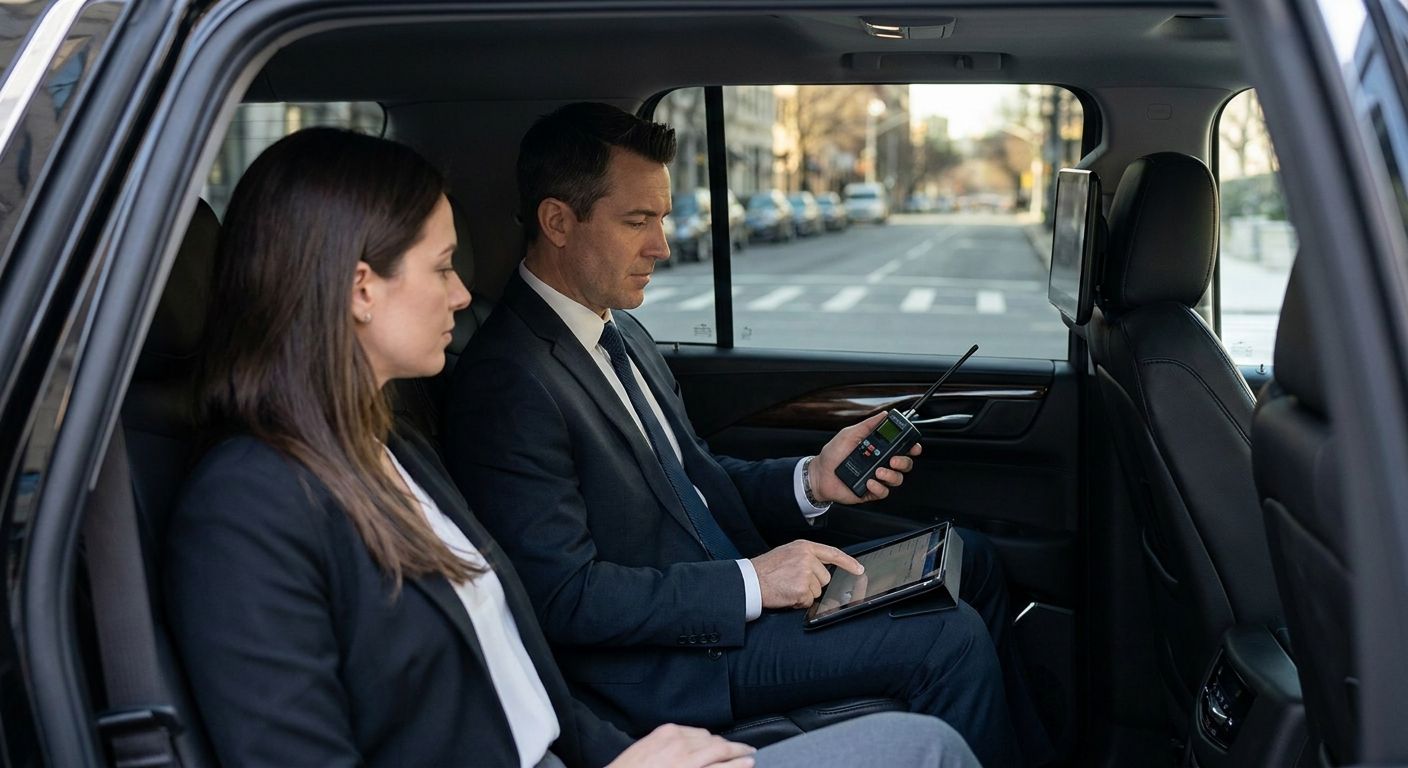
Counter surveillance for celebrities and high-net-worth individuals is a scheduled program of TSCM (technical surveillance countermeasures) sweeps, digital hygiene, and physical security review built around the threat profile of people who attract stalkers, extortionists, tabloid interest, and financially motivated intruders. A single homeowner sweep after a break-in looks nothing like what a public figure needs — the exposure spans multiple residences, vehicles, private aircraft, household staff, and a phone that's a target 365 days a year.
- Counter surveillance for celebrities in 2026 means recurring TSCM sweeps of homes, vehicles, and devices — not a one-time check.
- USA Bugsweeps recommends quarterly sweeps for high-net-worth clients with staff turnover or active security threats.
- GPS trackers and audio bugs are the two most common devices found on celebrity and executive vehicles.
- DIY RF detector apps miss hardwired bugs and passive devices — a certified TSCM sweep catches both.
- Hotel rooms and rented venues need a pre-arrival sweep before any high-profile guest checks in.
Why this matters
A celebrity or high-net-worth client isn't dealing with opportunistic snooping — they're dealing with people who have motive, time, and often money to plant devices. Paparazzi, obsessive fans, ex-partners, disgruntled staff, and business rivals all have reasons to want a live audio or video feed from inside a home, car, or office. The full range of TSCM services covers exactly this gap: detecting hidden cameras, audio bugs, GPS trackers, and wiretaps before they turn into a leaked recording or a stalking incident.
The stakes are different, too. A regular homeowner losing privacy is bad. A public figure losing privacy can mean a leaked recording going viral within hours, a stalker learning a daily routine, or a business deal falling apart because a competitor heard the negotiation. Counter surveillance for celebrities has to be preventive, not reactive — waiting until something surfaces online is too late.
Why counter-surveillance matters for celebrities and HNW clients
High-net-worth households run on staff turnover — housekeepers, drivers, contractors, personal assistants — and every one of them is a potential access point for a planted device. Vehicles get serviced by third parties. Homes get renovated. Private jets sit on tarmacs with ground crews walking through the cabin. Each touchpoint is an opportunity for a bug or tracker to go in unnoticed.
Search behavior around this topic in 2026 skews toward urgency: people looking up counter surveillance for celebrities are usually reacting to a specific event — a stalker incident, a leaked photo, a security consultant's recommendation after a threat assessment. That's different from the general homeowner searching "is my house bugged," and it means the sweep program needs to be built around recurring risk, not a single scare.
Map your exposure before you sweep anything
Start with an honest inventory of every space where a conversation or image could be captured and monetized or leaked.
- List every residence, including vacation homes and rented properties
- List every vehicle, including staff and security detail cars
- Note anyone with unsupervised access — housekeepers, drivers, contractors, assistants
- Flag any recent staff changes, breakups, or public disputes
- Note upcoming high-visibility events (award shows, negotiations, depositions)
Sweep your primary residence for hidden devices
A visual walk-through catches obvious cameras in smoke detectors or clock radios, but it won't find an RF transmitter hardwired into a wall outlet or a passive audio recorder with no active signal. This is the point where a professional TSCM sweep matters most, and it's the core of what bug sweep services for executives and public figures are built to handle.
- Check every room for RF signals using a spectrum analyzer, not a phone app
- Inspect wall outlets, smoke detectors, and light fixtures for hardwired devices
- Physically inspect furniture, vents, and wall cavities for passive (non-transmitting) bugs
- Run a non-linear junction detector pass on rooms used for sensitive conversations
- Document every device found with location and type for any legal follow-up
Sweep vehicles for GPS trackers and audio devices
Vehicles are a soft target because they're serviced, valeted, and parked in public lots constantly. A GPS tracker under a bumper takes less than two minutes to install.
- Check the undercarriage, wheel wells, and bumper cavities for magnetic trackers
- Inspect the OBD-II port for unauthorized devices plugged in
- Check under seats and in door panels for audio recorders
- Have every vehicle in the household or fleet swept on the same visit, not just the primary car
Secure your phone and digital communications
Physical bugs get the headlines, but a compromised phone leaks more information over a longer period. Pair a physical sweep with a digital review.
- Review installed apps for anything with hidden microphone or location permissions
- Check for unfamiliar profiles or MDM configurations on the device
- Use encrypted messaging for anything sensitive rather than standard SMS
- Have a security consultant review call logs and data usage for anomalies
Vet staff and vendors with access to your properties
Most devices found in high-net-worth homes get planted by someone who was already inside — legitimately or otherwise.
- Run background checks on new hires before they get keys or codes
- Limit which staff have unsupervised access to bedrooms and offices
- Require any contractor doing electrical or renovation work to be supervised
- Re-sweep after any staff departure, especially a contentious one
Sweep hotel rooms and rented venues before arrival
Any space you don't fully control — a hotel suite, a rented estate, a green room — is a location someone else had access to before you got there. Hidden camera detection for hotel guests exists for this exact scenario.
- Request a pre-arrival sweep for any high-profile stay, especially press tours or award season
- Check smoke detectors, alarm clocks, and USB charging ports on arrival
- Avoid discussing sensitive plans until the room has been cleared
- Re-sweep after housekeeping or maintenance visits during an extended stay
Schedule recurring sweeps instead of a one-time check
A sweep is a snapshot. Staff change, vehicles get serviced, and threats evolve, so the sweep schedule has to match the risk level.
- Quarterly sweeps for anyone with an active stalker, restraining order, or public dispute
- Sweeps timed before and after any major public event or announcement
- A sweep after every staff departure or vendor visit involving physical access
- Annual baseline sweeps even with no known incident, to catch anything missed
Build a response plan for anything found
Finding a device is only half the job — what happens next determines whether it becomes a legal case or gets ignored.
- Document the device's location, make, and condition with photos before removal
- Loop in legal counsel before removing anything tied to a possible criminal case
- Report findings to law enforcement when stalking or harassment is suspected
- Change access codes, locks, and passwords immediately after any device is found
Comparing your counter-surveillance options
| Option | Best for | Starting price | Key limitation |
|---|---|---|---|
| DIY RF detector app | Quick self-check between professional sweeps | $29.00 (guided guide) | Misses hardwired and passive devices |
| Certified TSCM sweep team | Full residence, vehicle, and office coverage | Custom quote | Requires scheduling and site access |
| In-house security consultant | Ongoing daily protocol management | Custom quote | Doesn't replace specialized RF equipment |
| Hotel/venue advance team | Pre-arrival clearance for travel and events | Custom quote | Limited to the specific stay, not recurring |
The DIY vehicle guide is a reasonable stopgap between professional visits, but it's built for spot-checks, not the full-property coverage a public figure needs. Buy it as a supplement, not a substitute for a certified sweep.

Common mistakes celebrities and HNW clients make
- Sweeping only after something leaks. By the time a recording surfaces, the device has likely been removed already — the sweep needed to happen before, not after.
- Treating vehicles as an afterthought. Homes get swept, cars get ignored, even though a tracker under a bumper is one of the easiest devices to plant.
- Assuming NDAs stop leaks. A signed NDA doesn't stop a hidden microphone from recording the conversation in the first place.
- Skipping re-sweeps after staff changes. A departing employee with grudges and prior access is a common source of planted devices.
- Relying on phone apps as the only detection method. Consumer RF apps can't reliably find passive bugs or devices hidden inside electrical wiring.
FAQ
What's the best counter surveillance approach for celebrities in 2026?
A recurring TSCM sweep schedule covering every residence, vehicle, and device, paired with staff vetting and a response plan for anything found. A one-time sweep after an incident is reactive and misses ongoing risk.
Is a professional TSCM sweep better than a DIY RF detector?
Yes for anything beyond a quick spot-check. A certified sweep uses spectrum analyzers and non-linear junction detectors that catch hardwired and passive devices a consumer app can't detect.
How often should high-net-worth clients schedule sweeps?
Quarterly if there's an active threat, stalker, or public dispute, and at minimum annually as a baseline check even with no known incident.
Do vehicles need to be swept along with the home?
Yes. GPS trackers and audio devices are commonly planted on vehicles during routine service or valet parking, separate from anything found inside a residence.
Should hotel rooms be swept before a celebrity checks in?
Yes, especially during press tours, award season, or any high-visibility travel. A pre-arrival sweep checks smoke detectors, alarm clocks, and charging ports before the guest ever enters the room.
What should you do if a hidden device is found?
Document the device's location and condition with photos, involve legal counsel before removing anything tied to a potential case, and report it to law enforcement if stalking or harassment is suspected.
Does staff turnover increase the risk of hidden devices?
Yes. Departing employees with prior unsupervised access are a common source of planted bugs, which is why a re-sweep after any contentious departure matters.
Can a phone be part of a counter surveillance sweep?
Yes. A digital review checks for apps with hidden microphone or location permissions and unfamiliar device profiles, alongside the physical sweep of rooms and vehicles.
One last thing
The most overlooked location in celebrity counter surveillance isn't the bedroom or the office — it's the vehicle used for the daily commute, because it's serviced, valeted, and parked unattended more often than any room in the house. Anyone building a 2026 security program around a public figure should put the vehicle sweep on the same schedule as the home sweep, not treat it as optional.


