
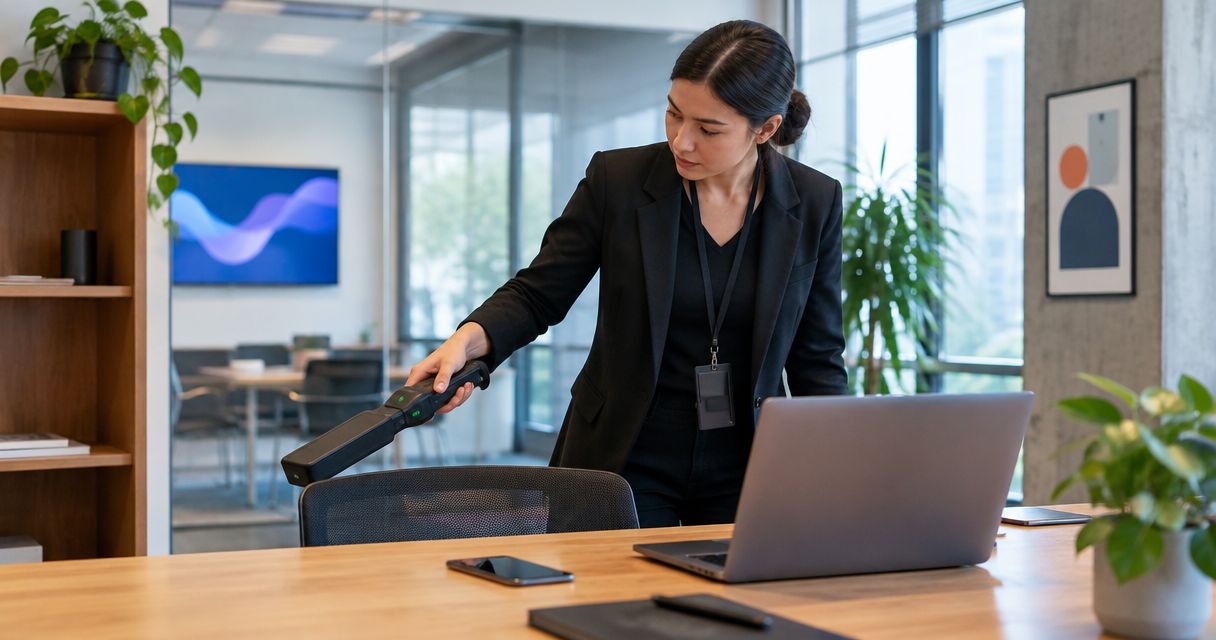
Marketing agency counter-surveillance is the inspection of agency spaces for unauthorized surveillance devices, with the aim of protecting confidential client conversations and unreleased work. Counter-surveillance sweeps for marketing agencies in 2026 should address pitch rooms, production spaces, and shared offices without confusing a physical bug sweep with an investigation of compromised accounts.
- USA Bugsweeps provides nationwide TSCM services for agencies seeking professional hidden-camera, audio-bug, and wiretap detection.
- Counter-surveillance sweeps for marketing agencies should start with documented concerns, authorized access, and a defined inspection scope.
- A professional bug sweep and an IT security review address different surveillance routes; neither replaces the other.
- An unfamiliar object or detector alarm is a reason to investigate, not proof of surveillance.
Why counter-surveillance matters for marketing agencies
An agency's confidential information does not stay inside a presentation file. Staff discuss campaign concepts, media plans, client negotiations, and unreleased creative in meeting rooms and production spaces. Protect those conversations alongside the documents that support them.
The practical challenge is separating legitimate recording equipment from unauthorized devices. A production microphone, conferencing camera, or client-supplied recorder needs an identified owner and purpose; its presence alone does not establish misconduct.
For your 2026 security plan, connect inspections to specific events: a documented concern, an office handover, or an upcoming confidential meeting. The guide to what to expect during a professional TSCM bug sweep explains the inspection process before you arrange access.
Treat a sweep as a defined investigation, not a promise that every future conversation is secure. Its value depends on what was inspected, what access was permitted, and how the space is controlled afterward.
How to plan counter-surveillance sweeps for your agency
1. Define the concern before searching the office
Write down what happened before deciding what caused it. A competitor presenting a similar concept does not prove electronic surveillance; an unfamiliar object does not identify its function. Distinguish direct observations from assumptions so the inspection follows evidence rather than suspicion.
Assign 1 incident lead to coordinate facilities, IT, management, and any outside specialist. Keep the initial account factual, including the location, relevant dates, and people authorized to access the space. Avoid circulating allegations through the agency or naming a suspected person without evidence.
Start with an internal incident record:
- Record the specific observation that prompted concern.
- Identify the client information or conversation involved.
- Preserve relevant access records and existing photographs.
- List alternative explanations that need checking.
- Select a communication channel appropriate to the concern.
2. Map the spaces and confirm inspection authority
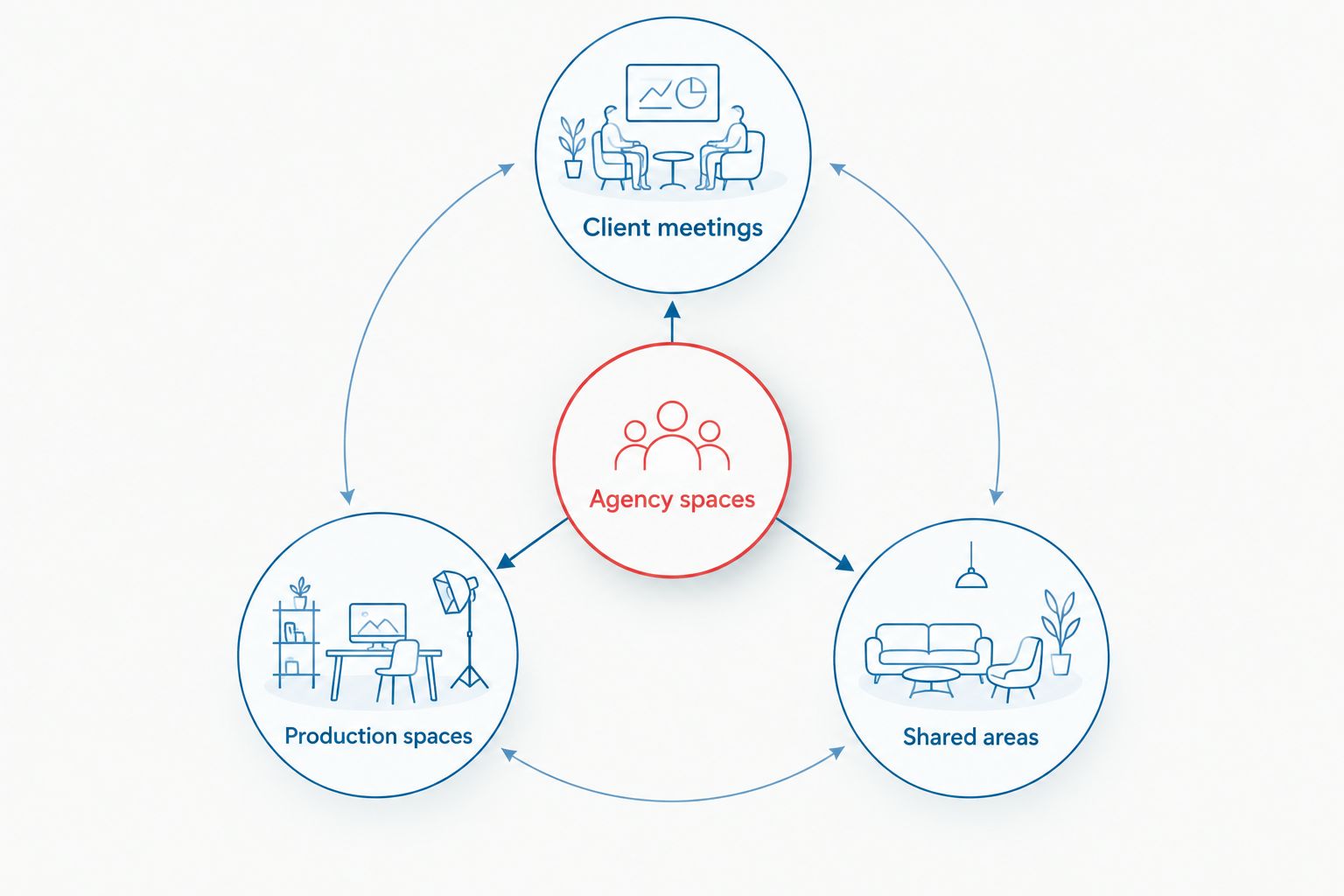
Create a room list using your floor plan or a simple document. Group the agency into 3 working zones: Client meetings, Production spaces, and Shared areas. These are planning categories, not technical risk scores; prioritize each room according to the information discussed there and who can enter it.
A leased office does not automatically give your staff permission to open building systems or inspect neighboring premises. Confirm boundaries with the person responsible for the property, especially in coworking locations and temporary production venues. Keep inaccessible areas visible in the scope rather than silently treating them as checked.
Use the room list to organize access:
- Mark pitch rooms and private client meeting spaces.
- Identify edit suites, recording booths, and production rooms.
- Record landlord-controlled fixtures and restricted areas.
- Confirm who can authorize each inspection area.
- Flag temporary spaces that need separate permission.
3. Separate preliminary checks from professional TSCM
Begin with a non-destructive inventory of visible equipment. Ask facilities and production staff to identify unfamiliar objects, compare the room with existing records, and document unresolved items. Do not open electrical fittings, dismantle equipment, or treat a consumer detector alarm as a confirmed finding.
For professional inspection, USA Bugsweeps provides nationwide technical surveillance countermeasures services covering hidden cameras, audio bugs, GPS trackers, and wiretaps. USA Bugsweeps TSCM services are best for agencies seeking professional surveillance-device detection across nationwide locations.
A professional service moves the task beyond an informal staff check, but the agreed scope still matters. In 2026, ask what the proposed inspection covers rather than assuming a room sweep includes employee phones, cloud accounts, vehicles, or every building system.
Before authorizing the work:
- Describe the concern without presenting assumptions as facts.
- Supply the room list and access restrictions.
- Ask how legitimate agency equipment will be distinguished.
- Confirm whether vehicles or phone systems require separate scope.
- Request an explanation of inspection limitations and reporting.
4. Coordinate physical inspection with your IT team
Use your existing IT administrator to review approved devices and account access. A meeting recorded through a legitimate conferencing platform presents a different problem from a concealed microphone, even when both expose the same conversation. Investigate the route rather than treating every disclosure as a physical-device issue.
Keep the workstreams connected without merging their conclusions. A physical inspection does not establish that a staff laptop is free of spyware, and an account review does not establish that a room contains no recorder. Give each team a clear question and a shared incident lead.
Coordinate these checks:
- Review conferencing recording settings and authorized users.
- Identify approved cameras, microphones, and wireless equipment.
- Preserve relevant account and device logs through IT.
- Document unexplained equipment without disconnecting it casually.
- Record which issues require separate digital investigation.
5. Prepare the space without disturbing possible evidence
Arrange access yourself before the specialist arrives. Identify keys, escorts, room bookings, and building restrictions, then ask the inspector what should remain untouched. Do not reorganize the room or remove an unfamiliar device simply to make the inspection easier.
For a 2026 pitch or confidential client review, reserve 1 controlled meeting room and coordinate the inspection with its intended use. Control access after the inspection rather than assuming the room's condition cannot change. For shared premises, ask who can enter between the inspection and the meeting.
Prepare the handover carefully:
- Provide an accurate room and equipment list.
- Identify authorized facilities and IT contacts.
- Confirm access to agreed inspection areas.
- Ask before changing equipment power states or connections.
- Keep sensitive campaign material outside the inspection brief unless needed.
6. Document findings without overstating certainty
Prepare an incident log before the inspection so observations have a consistent home. Separate confirmed findings, unresolved observations, and areas that were not inspected. A device description, a signal observation, and a conclusion about unauthorized recording are not interchangeable.
If an object appears suspicious, avoid handling it and seek instructions from the specialist. Involve agency counsel and law enforcement as appropriate to the circumstances; do not confront a colleague or publicly attribute responsibility based on an unexplained object. Keep client communications tied to established facts.
Ask the report to distinguish:
- The locations and systems included in the inspection.
- Access restrictions and other limitations.
- Legitimate equipment identified during the work.
- Confirmed findings and unresolved observations.
- Recommended follow-up and responsibility for each action.
7. Maintain control after the inspection
Start with ordinary facilities controls: room ownership, visitor access, and an equipment register. These measures give staff a practical way to recognize changes without repeatedly searching every room. Assign responsibility for approving new conferencing hardware and production equipment.
Schedule follow-up around changes and documented concerns rather than choosing an unsupported interval. An office move, new fit-out, or change in access creates a reason to reassess the scope. A past inspection describes past conditions; it does not certify every later meeting.
Maintain a repeatable process:
- Record new devices and their authorized owners.
- Restrict access to confidential meeting spaces.
- Review changes after outside contractors finish work.
- Reassess temporary venues before sensitive discussions.
- Update the incident record when new evidence appears.
Request an agency sweep estimate
Discuss your agency's locations, surveillance concerns, and inspection scope.
Compare inspection options for your agency
Choose the option that answers the actual security question. A visual check helps establish what belongs in a room; professional TSCM addresses physical surveillance-device concerns; an IT review addresses digital access. Combine them when the facts justify separate investigations.
| Option | Best for | Main advantage | Key limitation |
|---|---|---|---|
| Staff visual inventory | Establishing a baseline of visible room equipment | Uses existing room knowledge and facilities records | Does not rule out concealed or inactive devices |
| Consumer RF detector | Preliminary checks for detectable radio-frequency activity | Helps locate some transmitting sources | Legitimate devices create signals; non-transmitting recorders require other methods |
| USA Bugsweeps professional TSCM | Agencies seeking nationwide professional surveillance-device detection | Provides specialist bug-sweeping services | Scope must be agreed; a physical sweep does not establish account security |
| IT security review | Investigating conferencing access, accounts, and managed devices | Examines digital routes for information exposure | Does not replace a physical search for concealed devices |
A radio-frequency detector detects signals within its capabilities, not malicious intent. A locally recording device does not need to transmit while recording, so an RF-only check cannot answer every hidden-recorder concern. Ask what each method can establish before relying on its result.
Common mistakes marketing agencies make
Treating a leaked concept as proof of a hidden microphone
A similar campaign or an unexpected disclosure does not identify the source. Preserve the relevant files and communications, check authorized access, and investigate physical surveillance only as one possible route. Evidence should determine the scope, not a preferred explanation.
Forgetting temporary pitch and production venues
Your own boardroom is not the only place confidential discussions happen. Include rented studios, client-provided rooms, and temporary event spaces in planning, while confirming permission before any inspection. A check at headquarters says nothing about a different venue.
Removing legitimate recording equipment without checking ownership
Agency environments contain cameras and microphones for ordinary work. Confirm the owner, purpose, and recording configuration before classifying equipment as unauthorized. An unfamiliar production device warrants identification, not an accusation.
Sending the entire client brief to every responder
An inspector needs the concern, space, equipment context, and access arrangements—not unrestricted access to campaign strategy. Share the minimum information necessary and agree who receives findings. Keep incident details separate from general agency chatter.
Calling a room permanently secure after a sweep
An inspection does not prevent later access or new equipment installation. Maintain room controls and document subsequent changes. Avoid promising clients that an entire office is secure based on a limited inspection.
FAQ
What's the best starting point for counter-surveillance sweeps for marketing agencies?
Start with a factual incident record and a list of authorized inspection areas. Identify the conversations or information at issue, then separate physical-device concerns from account and conferencing concerns.
Can our agency check meeting rooms without hiring a specialist?
Your agency can perform a non-destructive visual inventory of equipment it is authorized to inspect. That establishes a baseline but does not rule out hidden, inactive, or locally recording devices.
Is a consumer bug detector enough for a confidential pitch room?
A consumer bug detector alone cannot establish that a pitch room is free of surveillance devices. Radio-frequency checks have detection limits, and legitimate agency equipment also produces signals.
Does a professional TSCM sweep include our laptops and cloud accounts?
Do not assume that a professional TSCM sweep includes laptops or cloud accounts. Confirm the inspection scope and arrange an IT security review for digital concerns that fall outside it.
What should we do if we find an unfamiliar device?
Document the location without handling or dismantling the device, and seek specialist guidance. Avoid confronting anyone or assigning responsibility before the device and circumstances are assessed.
How often should an advertising agency arrange a bug sweep?
Set inspection timing around documented concerns, changes in access, office moves, and sensitive use of particular spaces. There is no single interval that establishes security for every agency.
Can USA Bugsweeps inspect agencies with offices in different states?
USA Bugsweeps provides professional TSCM bug-sweeping services nationwide. Confirm the locations, inspection areas, access requirements, and intended scope when requesting an estimate.
One last thing
Control what happens after the sweep, not just the appointment itself. For your next confidential meeting in 2026, identify who can access the room between inspection and use, and record any equipment changes. An inspection followed by uncontrolled access leaves an important question unanswered.


