
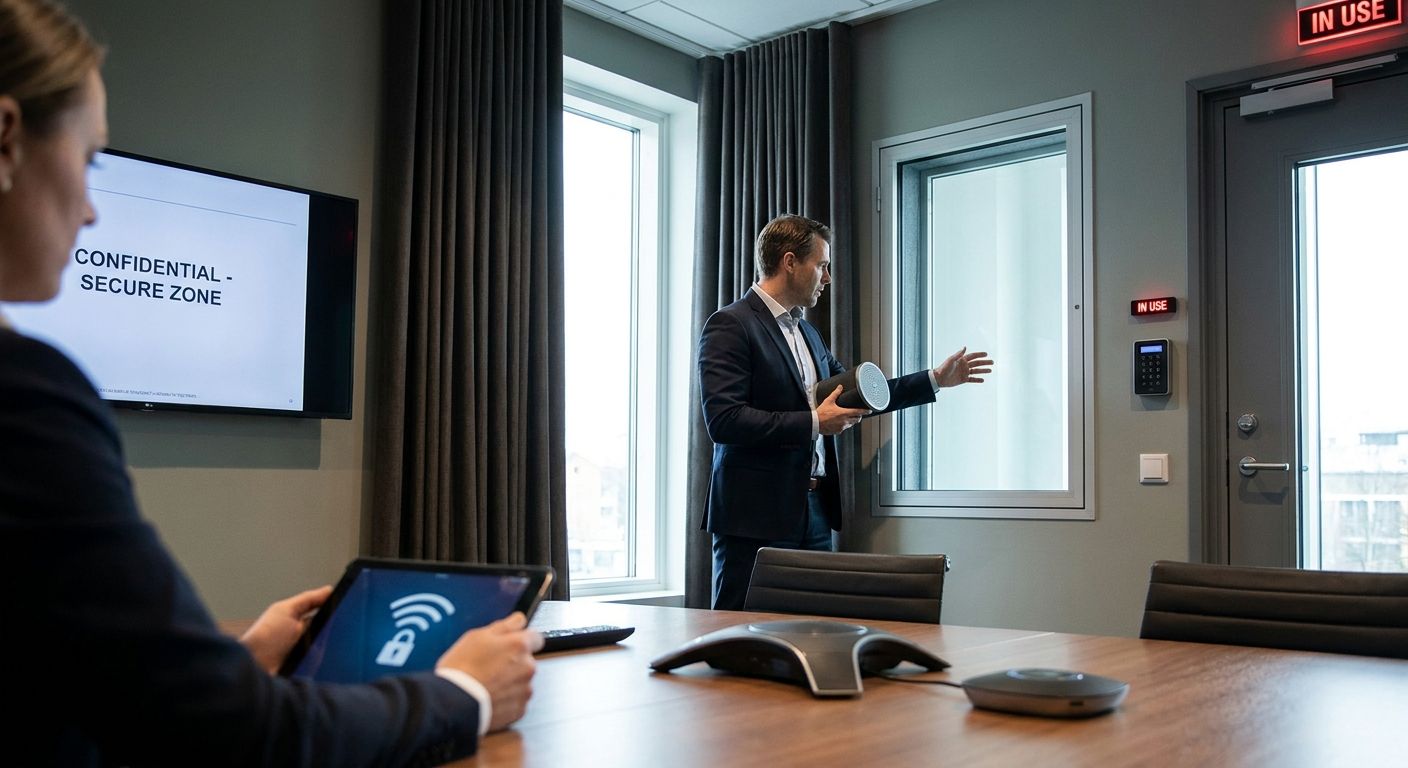
Corporate espionage in a conference room usually comes down to a handful of entry points: a phone or speaker on the table, an HVAC vent, a wall outlet, or a device planted in the furniture during a cleaning shift or vendor visit. Securing the room means combining physical access control with a professional TSCM sweep before high-stakes meetings, not just locking the door.
- Securing a conference room from corporate espionage in 2026 means controlling physical access, auditing phone and network hardware, and running a professional TSCM sweep before sensitive meetings.
- USA Bugsweeps recommends sweeping boardrooms before board votes, M&A talks, and product launches, not just once a year.
- Audio and video bugs are usually planted through vendor access, guest badges, or unattended furniture, not through hacking.
- A written device inventory and a no-personal-device policy for guests close most of the gap that a sweep alone can't fix.
Why this matters
A leaked term sheet, a stolen product roadmap, or a recorded negotiation strategy costs more than a sweep ever will. Boardrooms and executive conference rooms are the highest-value rooms in a building because every sensitive conversation a company has eventually happens there. In 2026, planting a covert audio or video device costs a competitor or disgruntled insider very little compared to what they can extract from one earnings call rehearsal or acquisition discussion.
Most companies assume their IT firewall covers this risk. It doesn't. A bug sweep for corporate boardrooms checks for hardware that never touches the network: hardwired audio taps, GSM-based transmitters, and hidden pinhole cameras that record locally and get physically retrieved later.
How do you secure a conference room from corporate espionage?
Start with the room itself, then the people who have access to it.
| Step | What it covers | Who typically does it |
|---|---|---|
| Physical inspection | Furniture, vents, outlets, ceiling tiles, smoke detectors | TSCM technician |
| RF spectrum sweep | Wireless transmitters in the 900 MHz to 6 GHz range | TSCM technician with spectrum analyzer |
| Phone and network audit | Analog lines, VoIP handsets, conference speakerphones | TSCM technician or IT security |
| Access log review | Who entered the room, when, and why | Facilities or security team |
| Policy enforcement | Guest device restrictions, escort requirements | Office management |
A sweep alone without the access control piece leaves the room vulnerable again the next time a vendor or contractor walks through unsupervised.
Audio bugs: the most common conference room threat
Audio devices are cheap, small, and often battery-powered or hardwired into an outlet for continuous power. Many transmit over cellular networks rather than Wi-Fi, which means a network scan won't catch them. A technician sweeping the 900 MHz to 6 GHz range with a spectrum analyzer, combined with a physical inspection of outlets and furniture seams, catches what a Wi-Fi audit misses. Buy the sweep before assuming the room is clean based on IT logs alone.
Hidden cameras: check before every board vote or product reveal
Pinhole cameras are frequently disguised inside smoke detectors, power strips, or picture frames, and many record to internal storage rather than streaming live. That means there's no network traffic to flag. A non-linear junction detector (NLJD) paired with a physical inspection finds electronics whether they're transmitting or not. Executives handling sensitive announcements should treat this as standard prep, the same way bug sweep services for executives and public figures are treated as routine before major public moves.
Phone systems: the overlooked entry point
Conference room speakerphones and desk handsets are wired directly into building phone lines, which makes them an easy tap point for anyone with brief physical access to a wiring closet. If your office has moved to VoIP but kept legacy analog lines as backup, both need checking. How to tell if your office phone system is tapped covers the specific signs, but a scheduled sweep catches passive taps that show no symptoms at all.
Trade secrets and IP: why startups and R&D teams are common targets
Boardrooms aren't the only rooms at risk. Product strategy sessions, engineering syncs, and investor pitches all happen in smaller conference rooms that get less security attention than the executive suite. Companies protecting unreleased technology or patent-pending work should treat every meeting room the same way, which is why bug sweep services for tech startups protecting trade secrets exist as a distinct service rather than a boardroom-only offering.
Why conference room risk varies by company
- Vendor and contractor access — cleaning crews, IT contractors, and furniture installers get unsupervised time in the room.
- Meeting sensitivity — M&A talks, litigation strategy, and earnings previews carry more risk than routine staff meetings.
- Building type — shared or co-working spaces have more foot traffic and less control over who's been in the room.
- Device turnover — new furniture, new phone hardware, or a recent renovation are common windows for planting devices.
- Prior incidents — a leak that already happened once increases the odds a device is still active.
- Industry — legal, financial, and biotech firms handle information competitors and adversaries specifically target.
Get your conference room swept
Nationwide TSCM sweeps for boardrooms, executive offices, and shared meeting spaces.
How often should a conference room be swept?
Most security teams schedule a sweep quarterly for high-use executive rooms and before any board vote, acquisition talk, or product launch in 2026. Companies with no prior incidents can sometimes stretch to twice a year, but any renovation, new hire in facilities, or vendor change resets that clock.
Can a conference room be bugged even with no Wi-Fi network in it?
Yes, most planted devices don't rely on the building's Wi-Fi at all. GSM-based bugs use cellular data to transmit audio, and many hidden cameras record locally to an SD card for physical retrieval later, so a network-only security audit misses both.
Do shared or co-working conference rooms need different protection?
Shared conference rooms carry higher risk because dozens of unrelated companies rotate through the same physical space every week. Bug sweep services for co-working and shared office spaces typically run more frequently than single-tenant offices for exactly this reason.
FAQ
What's the best way to secure a conference room from corporate espionage in 2026?
The best approach combines a professional TSCM sweep before sensitive meetings with strict access control for vendors and guests. A sweep alone doesn't stop a device from being replanted the next week if room access stays unmanaged.
How much does a conference room bug sweep cost?
Pricing depends on room size, the number of devices checked, and how urgent the request is, so get a quote directly rather than relying on a flat number. USA Bugsweeps offers a free estimate before scheduling.
Is a network security audit enough to catch conference room bugs?
No, a network audit only catches devices that transmit over Wi-Fi or the corporate network. Many audio bugs use cellular transmission and many hidden cameras record locally, so neither shows up in network traffic.
What rooms besides the boardroom need sweeping?
Any room where strategy, financials, legal matters, or unreleased product details get discussed needs the same attention as the boardroom. Smaller huddle rooms and shared conference spaces are frequently overlooked and just as exposed.
Can hidden cameras record without connecting to the internet?
Yes, many hidden cameras record to internal SD storage and get physically retrieved by whoever planted them. This is why a Wi-Fi scan alone won't find them, and a physical inspection with an NLJD is necessary.
How do I know if my office phone system is already tapped?
Signs include unusual static, echo, or call quality drops on lines that never had issues before, though many taps show no symptoms at all. A dedicated phone line audit is the only reliable way to confirm.
Should I sweep before or after a board vote?
Sweep before, since the goal is to confirm the room is clean before the sensitive discussion happens, not after information has already leaked. Scheduling it 24-48 hours ahead of the meeting is standard practice.
One last thing
The device that causes the most damage in conference rooms isn't a sophisticated transmitter, it's a smartphone left recording in someone's jacket on the back of a chair. Physical access control and a guest device policy stop more leaks than any piece of TSCM equipment, and the two together are what actually close the gap in 2026.


