
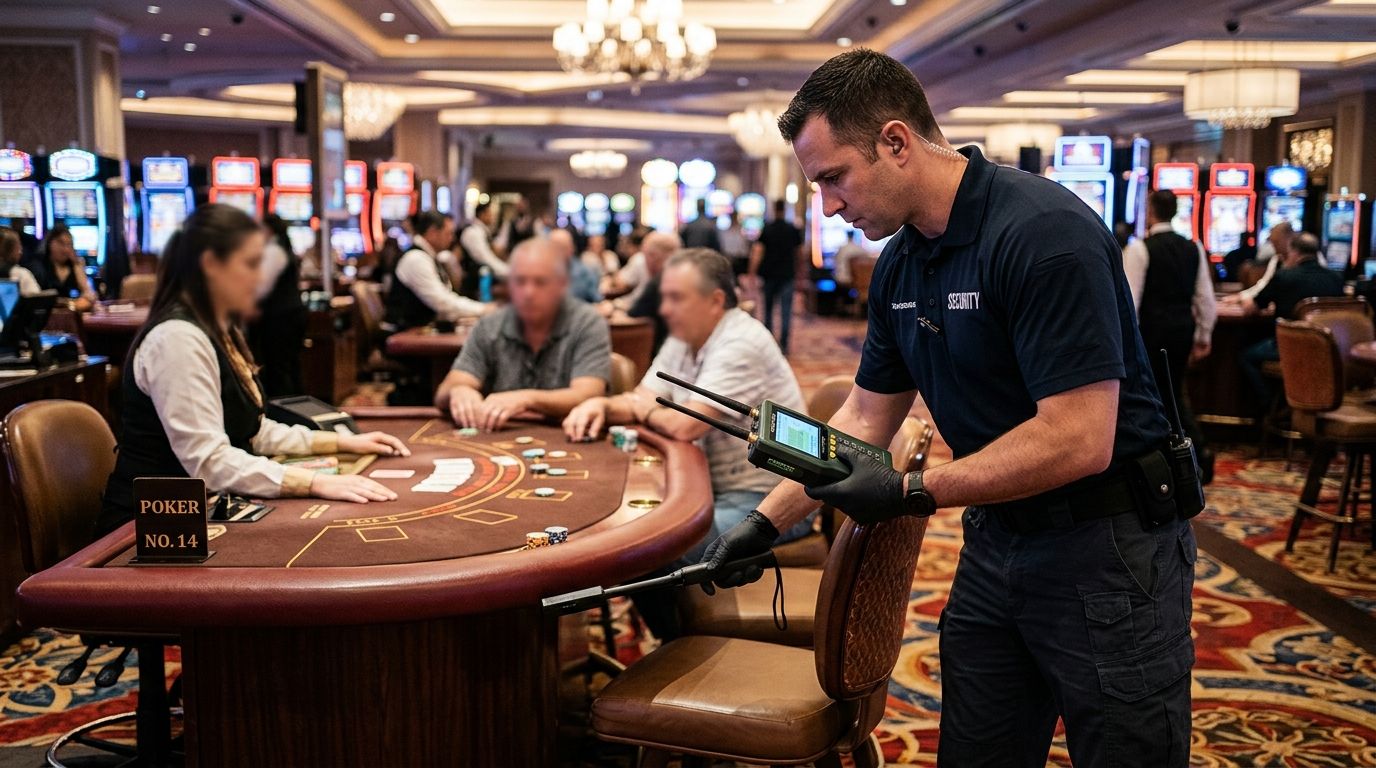
Counter surveillance sweeps for casinos check the gaming floor, cage, count room, surveillance control room, and VIP suites for hidden cameras, audio bugs, GPS trackers, and wiretaps that standard eye-in-the-sky systems were never built to catch. Casinos carry a risk profile no office building shares: cash-heavy operations running 24/7, dealer and pit staff turnover, and VIP guests who expect total privacy the moment they step into a private gaming suite.
- Counter surveillance sweeps for casinos cover the cage, count room, pit offices, VIP suites, and the eye-in-the-sky control room, not just the floor.
- USA Bugsweeps runs full-spectrum TSCM sweeps built for cash operations; handheld RF detectors catch wireless signals but miss wired and passive devices.
- Sweep VIP suites between every high-roller booking, since a missed device compromises the next guest too.
- Recurring sweeps tied to your gaming commission audit calendar catch what one annual visit misses, especially with high pit staff turnover.
Why counter surveillance sweeps matter for casinos
A casino floor already runs one of the densest legal camera networks in commercial real estate — an eye-in-the-sky system watching every table and slot bank under state and tribal gaming commission oversight. That density is exactly why unauthorized devices go unnoticed: a hidden camera taped inside a chip tray or a bug wired into the count room blends into a floor already covered in visible surveillance hardware.
Add cash-heavy count rooms subject to federal Title 31 recordkeeping rules, dealer and pit turnover that runs higher than most office environments, and VIP suites hosting high-roller guests who expect absolute privacy, and the cost of missing one device climbs fast. A TSCM sweep from USA Bugsweeps is built around exactly this profile: cash rooms, private suites, and the control room that watches everything else.
Most gaming commissions require documented surveillance system integrity but don't mandate TSCM sweeps by name — casinos that run them do it voluntarily to close the gap between the cameras they're legally required to have and the devices nobody authorized. In 2026, that gap is the single biggest liability point on a gaming floor.
How to run a counter surveillance sweep for a casino
Map the RF baseline before shift change
Sweep the floor with a handheld RF detector during a quiet midweek period, then compare that baseline against readings taken at peak weekend hours.
- Log baseline RF readings during a slow shift, then compare against weekend peak-hour readings
- Note every wifi access point, POS terminal, and slot machine radio the floor legitimately runs
- Flag any 2.4GHz or 5.8GHz signal that doesn't match your registered device list
- Repeat the baseline monthly, since new IoT devices shift what counts as normal
- Run a full spectrum analyzer scan if one pit area keeps producing unexplained spikes
Inspect chip trays, slot banks, and dealer stations
Walk the floor during downtime and physically check equipment for tampering, added wiring, or foreign objects that don't belong.
- Check chip trays and drop boxes for altered seals or added components
- Inspect bill validators and card readers on slot machines for skimming or recording attachments
- Look under dealer podiums and pit stations for taped-on devices
- Cross-reference any new hardware against your last maintenance log
Sweep the cage and count room with full-spectrum equipment
This is where a floor walk-through hits its ceiling. Cash-handling rooms need coverage for wired taps and passive audio devices that a consumer RF detector never sees, which is the point where a property brings in a professional team rather than relying on staff with a handheld unit.
- Sweep phone lines and network drops entering the cage and count room for taps
- Check ceiling tiles, vents, and light fixtures with a nonlinear junction detector that finds powered-off devices
- Physically inspect count room furniture, safes, and cash counters for hidden microphones
- Verify any recording device in the count room is the property-authorized system and nothing added
Casinos share this exact problem with trading floors — cash and information density in one small physical space, which makes the room a target for both employee collusion and outside recording.
Book a casino floor sweep
Schedule a TSCM sweep of your cage, count room, and VIP suites before your next audit.
Screen VIP suites and private gaming rooms between every booking
A private suite that hosted one guest last week can still hold an active device this week. Sweep between bookings, not just when a complaint comes in.
- Physically check smoke detectors, alarm clocks, and USB charging ports for camera lenses
- Sweep for transmitters that only power on when a guest checks in, since some devices sit dormant between bookings
- Inspect in-room phones and minibars for altered wiring
- Log every sweep with a timestamp so any future complaint ties to a documented clean check
The privacy stakes here mirror what public figures and executives demand from a sweep — high-profile guests, low tolerance for a single missed device.
Audit the surveillance control room itself
The room that watches every table and slot bank is a target in its own right. A device planted here doesn't just record conversation — it sits inside the room that stores and reviews your incident footage.
- Sweep the control room the same way you'd sweep a corporate boardroom, since it holds equivalent competitive value
- Check monitors, keyboards, and comms equipment for added transmitters
- Restrict and log physical access to the room during and immediately after any sweep
- Confirm archived footage servers aren't mirrored to an unauthorized second location
Test phone systems feeding the cage and executive offices
A live tap on a landline or VoIP extension often drops line voltage measurably, and it's a check most floors skip entirely.
- Check line voltage on cage and executive phone lines against expected baseline
- Physically trace lines from the wall jack to the demarcation point looking for splices
- Confirm PBX or VoIP logs match actual phone activity with no unexplained extensions
- Apply the same check to any room used for internal investigations
Screen valet, fleet, and executive vehicles for GPS trackers
Vehicles used for VIP transport and cash movement get checked for damage constantly and swept for trackers almost never.
- Check wheel wells, undercarriage, and trunk liners on VIP transport vehicles
- Sweep armored cash-transport vehicles on a fixed schedule, not just after an incident
- Cross-check any tracker found against your own authorized fleet-management devices before assuming it's hostile
- Repeat the check after a vehicle returns from an outside detailer or maintenance shop
Put sweeps on a recurring schedule tied to your compliance calendar
One sweep a year misses far more in 2026 than it did a decade ago, given how much cheaper and smaller consumer-grade recording devices have become.
- Align sweep frequency with your gaming commission audit calendar, not just the calendar quarter
- Increase frequency at properties with pit staff turnover above your historical average
- Document every sweep, including the device inventory used, for compliance and insurance purposes
- Re-sweep any area after a major renovation, IT upgrade, or new POS rollout
Comparing your sweep options
| Option | Best for | Key limitation |
|---|---|---|
| Handheld RF detector walk-through | Daily floor checks between shifts | Misses wired taps, passive bugs, and devices powered off during the sweep |
| In-house security or surveillance staff | Properties with a dedicated surveillance department | Rarely trained on nonlinear junction detection or physical wiretap tracing |
| Professional TSCM sweep (USA Bugsweeps) | Cage, count room, VIP suites, and compliance-driven audits | Needs scheduling ahead of a specific event or audit window |
| Network and wifi monitoring software | Detecting IP-based cameras and wireless transmitters on your network | Blind to analog devices and anything not connected to your network |
Verdict: no single option covers a casino floor alone. A handheld detector handles daily wireless checks; a full TSCM sweep from USA Bugsweeps is the only option that reaches wired taps, passive devices, and the cage in one pass.
Common mistakes casinos make with counter surveillance
- Sweeping the gaming floor but skipping the surveillance control room itself, leaving the eye-in-the-sky system exposed
- Treating one annual sweep as sufficient when pit and dealer turnover outpaces office-industry norms
- Assuming network monitoring software that watches IP cameras also catches analog or passive devices — it doesn't
- Skipping VIP suite sweeps between high-roller bookings because the guest list looks clean
- Forgetting valet and fleet vehicles used for VIP transport, which get inspected for damage but rarely for trackers
FAQ
What's the best way to sweep a casino gaming floor for hidden cameras?
Combine a handheld RF detector walk-through of the floor with a physical inspection of chip trays, slot banks, and dealer stations, then follow with a full TSCM sweep of the cage and count room. RF detectors alone miss wired and passive devices.
How often should a casino run counter surveillance sweeps in 2026?
Tie sweep frequency to your gaming commission audit calendar and increase it at properties with above-average pit staff turnover. A single annual sweep misses more today than it did years ago, given how small and cheap consumer recording devices have become.
Do casinos need to sweep VIP suites separately from the main floor?
Yes, VIP suites need their own sweep between every high-roller booking. A device left active from a previous guest compromises the privacy of whoever checks in next.
Can a handheld RF detector replace a professional TSCM sweep?
No. A handheld RF detector catches active wireless transmitters but misses wired taps, passive audio devices, and anything powered off during the walk-through, which is why cage and count room sweeps need full-spectrum equipment.
Is the surveillance control room itself a target for bugging?
Yes. The control room that reviews and archives incident footage holds the same competitive value as a corporate boardroom, making it a target independent of the gaming floor it monitors.
Do gaming commissions require counter surveillance sweeps?
Most state and tribal gaming commissions require documented surveillance system integrity but don't mandate TSCM sweeps by name. Casinos add sweeps voluntarily to close the gap between legally required cameras and unauthorized devices.
What's the difference between TSCM sweeps and normal casino surveillance systems?
Casino surveillance systems are the legally required cameras watching tables, cages, and slot banks. A TSCM sweep hunts for unauthorized devices — hidden cameras, bugs, wiretaps, and GPS trackers — that exist outside that authorized system entirely.
One last thing
The most overlooked sweep point on any property isn't the VIP suite or the cage — it's the surveillance control room itself. A device planted there doesn't just capture conversation; it sits inside the room that stores the incident footage a casino would need for an insurance claim or a gaming commission audit in 2026, which means a compromised control room can undermine the one piece of evidence a property counts on most.


