
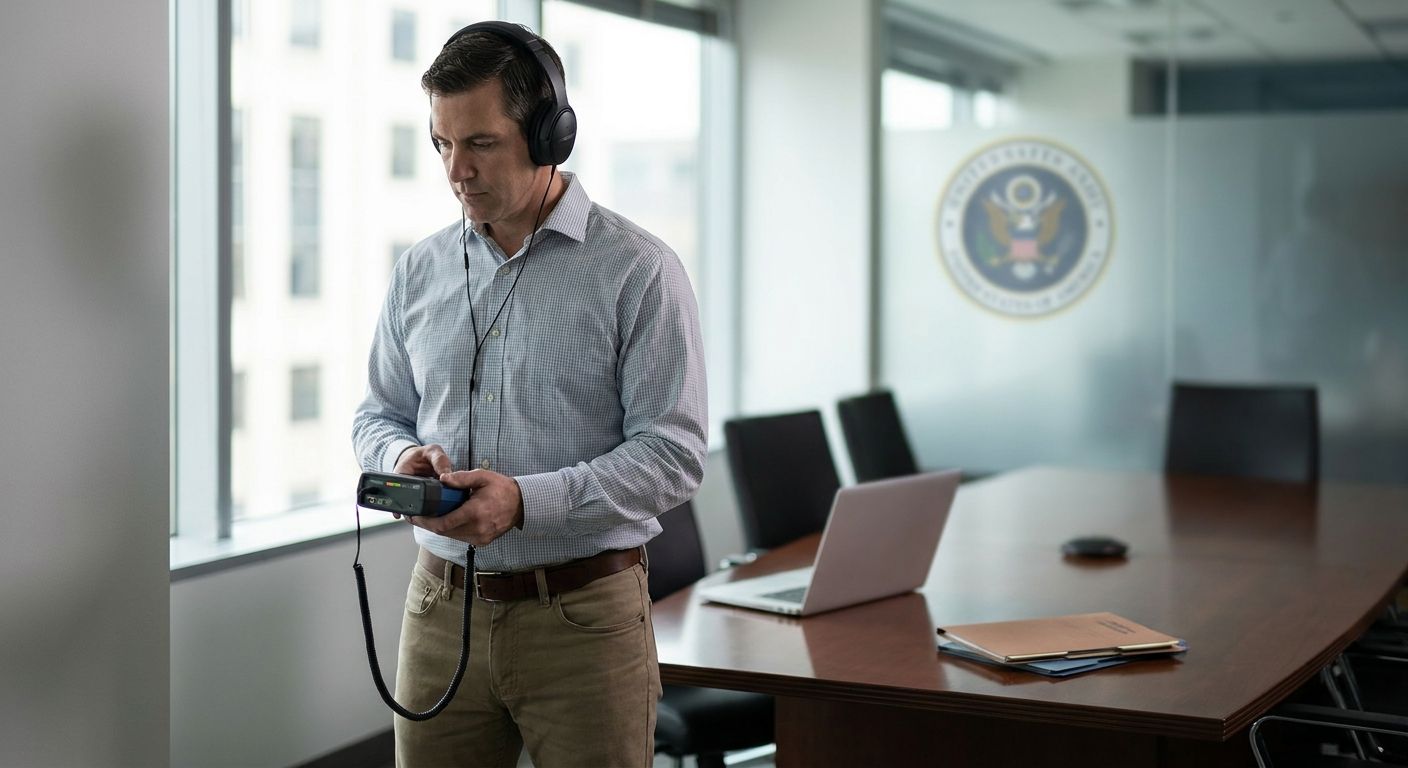
Counter surveillance for government contractors means running scheduled TSCM sweeps of offices, SCIFs, vehicles, and devices to catch hidden microphones, cameras, GPS trackers, and network exfiltration tools before they compromise a cleared contract. Contractors carry a different risk profile than a typical business: the target isn't just proprietary pricing, it's classified or controlled unclassified information (CUI) tied to federal contracts, and a single compromised conference room can trigger a facility clearance review.
- Counter surveillance for government contractors requires sweeps aligned to NISPOM (32 CFR Part 117) and ICD 705 SCIF standards, not a generic office check.
- RF sweeps should cover roughly 1 MHz to 6 GHz to catch both legacy bugs and modern GSM-based transmitters.
- Usabugsweeps runs nationwide TSCM sweeps for contractor facilities, vehicles, and devices as the professional layer after internal checks.
- Recurring sweeps tied to contract award cycles catch threats that a one-time sweep in 2026 will miss by 2027.
- DIY RF detectors flag consumer-grade bugs but miss burst-transmission and passive devices used against cleared facilities.
Why counter-surveillance matters for government contractors
A cleared facility is a higher-value target than a typical small business, and the consequences of a breach go past financial loss. Losing CUI or classified material during an active contract can trigger a Defense Counterintelligence and Security Agency (DCSA) review, jeopardize a facility clearance, and end a prime contract relationship outright.
Contractors also face a specific threat pattern that consumer-grade security misses: foreign intelligence entities and competing bidders target proposal rooms, executive offices, and vehicles used for site visits, not just server rooms. A nationwide TSCM sweep covers all three, which is why sweep scope matters more here than in most industries.
The compliance backdrop reinforces this. NISPOM, codified at 32 CFR Part 117, sets the baseline for how cleared contractors protect classified information, and ICD 705 governs the physical and technical security standards for SCIFs. Neither document mandates a specific sweep vendor, but both assume the facility is actually checked for electronic intrusion, not just locked doors and badge readers.
Map your classified and controlled work areas
Start by identifying every room and asset that touches classified, CUI, or export-controlled (ITAR/EAR) information before scheduling anything.
- List every SCIF, secure conference room, and proposal war room in the facility
- Flag executive offices where contract negotiations or pricing discussions happen
- Identify shared or co-located spaces where cleared and uncleared staff overlap
- Note any remote or telework spaces used for CUI-related calls
- Mark vehicles used to transport equipment, prototypes, or cleared personnel
This map becomes the sweep scope. Skipping it means paying for a sweep that misses the room where the actual conversations happen.
Audit your facility's physical security baseline
Before any electronic sweep, check whether the physical controls match ICD 705 expectations for the sensitivity level of the space.
- Confirm sound attenuation on walls shared with uncleared tenants or hallways
- Check that HVAC ducts and cable runs into secure rooms are visually inspected, not just alarmed
- Verify visitor logs actually match who entered SCIFs or war rooms in 2026
- Look for unauthorized furniture, gifts, or equipment introduced since the last inspection
- Review whether construction or maintenance crews had unsupervised access recently
Facilities that also run corporate boardroom sweeps alongside SCIF checks tend to catch devices planted in the informal spaces where deals actually get discussed, not just the certified secure room.
Check devices and networks for spyware and exfiltration risk
Electronic surveillance against contractors increasingly rides on compromised phones, laptops, and IoT devices rather than standalone bugs.
- Run mobile device management (MDM) audits on all phones with CUI access
- Check for unauthorized Bluetooth or Wi-Fi peripherals in secure rooms
- Inspect smart TVs, conferencing hardware, and IoT devices for unapproved firmware
- Review network logs for unusual outbound traffic from secure segments
- Confirm removable media policies are actually enforced, not just written
This is the same discipline pharmaceutical and biotech companies apply to protect trade secrets, and it maps directly onto contractor IP and technical data protection.
Sweep company vehicles and equipment for GPS trackers
Vehicles used for site visits, deliveries, or executive travel are an easy target because they leave secure perimeters daily.
- Check undercarriage, wheel wells, and bumper cavities for magnetic GPS units
- Inspect OBD-II ports for unauthorized dongles
- Review fleet management software for trackers nobody on staff installed
- Check trunk liners and spare tire wells on vehicles used for equipment transport
- Confirm rental or leased vehicles are swept before use on cleared projects
Bring in a professional TSCM sweep team
Internal checks catch obvious problems, but RF spectrum analysis, non-linear junction detection, and thermal imaging require calibrated equipment and trained technicians. This is where a manual walkthrough stops being enough for a cleared facility.
A professional TSCM sweep typically covers RF frequencies from roughly 1 MHz up to 6 GHz, which catches both older analog bugs and modern GSM or Wi-Fi-based transmitters that consumer detectors miss. Usabugsweeps runs full TSCM sweeps nationwide, covering SCIFs, offices, and vehicles as one engagement rather than piecemeal checks.
Schedule a facility TSCM sweep
Nationwide coverage for offices, SCIFs, and fleet vehicles.
Set a recurring sweep schedule tied to contract cycles
A single sweep in 2026 tells you the facility was clean on that date, nothing more. Threats introduced afterward, during renovations, new hires, or a subcontractor visit, go undetected until the next check.
- Schedule sweeps at contract award and at each option-year renewal
- Add a sweep after any facility renovation or furniture replacement
- Sweep immediately after any employee termination with facility access
- Run a check after hosting external vendors, auditors, or government inspectors
- Keep sweep records on file for DCSA facility clearance reviews
Train staff on physical security discipline
Technology catches devices; trained staff prevent easy plants in the first place.
- Brief cleared employees on reporting unfamiliar devices or cables
- Restrict gift acceptance policies for items entering secure spaces
- Require escort protocols for all non-cleared visitors near SCIFs
- Train front-desk staff to log every piece of equipment brought into the building
Comparing sweep options for government contractors
| Option | Best for | Key limitation |
|---|---|---|
| DIY RF detector | Quick checks between scheduled sweeps | Misses passive devices and non-linear junction threats |
| In-house security team | Daily physical monitoring and visitor control | Lacks calibrated TSCM equipment and RF training |
| Professional TSCM firm | SCIF, office, and fleet sweeps tied to contract cycles | Requires scheduling around cleared facility access |
| Government-provided sweep (cleared facilities only) | Facilities already under agency oversight | Not available to all contractor tiers or subcontractors |
Verdict: a professional TSCM sweep scheduled at contract milestones is the only option that covers SCIFs, offices, and vehicles with equipment capable of detecting both active and passive devices.
Common mistakes government contractors make
- Sweeping the SCIF but skipping the parking lot. Vehicles used for site travel carry as much exposure as the secure room itself.
- Treating one sweep as permanent clearance. A clean sweep in 2026 says nothing about what happened after the next renovation or vendor visit.
- Ignoring subcontractor spaces. Prime contractors often sweep their own offices but skip subcontractor facilities handling the same CUI.
- Confusing IT security audits with TSCM sweeps. A cybersecurity assessment doesn't catch a physical RF transmitter hidden in a wall outlet.
- Skipping documentation. Sweep records matter during a DCSA facility clearance review, and undocumented checks don't count as evidence of due diligence.
FAQ
What is counter surveillance for government contractors?
It's a scheduled TSCM sweep of offices, SCIFs, and vehicles used by cleared contractors to detect hidden cameras, microphones, GPS trackers, and network exfiltration tools. It goes beyond standard IT security because it targets physical and RF-based threats, not just software.
How often should a government contractor run a TSCM sweep?
At minimum, at contract award and each option-year renewal, plus after any renovation, staff termination, or external vendor visit. A single sweep only confirms the facility was clean on that date.
Does NISPOM require electronic sweeps?
NISPOM (32 CFR Part 117) sets baseline security requirements for cleared contractors but doesn't mandate a specific TSCM vendor or sweep frequency. Facility security officers typically set sweep schedules to satisfy DCSA review expectations.
Can a DIY RF detector replace a professional sweep?
No. Consumer RF detectors catch obvious active transmitters but miss passive devices, burst-transmission bugs, and threats requiring non-linear junction detection. Professional sweeps use calibrated equipment covering a far wider frequency range.
What does a SCIF sweep check that a regular office sweep doesn't?
A SCIF sweep checks alignment with ICD 705 physical and technical security standards, including sound attenuation, HVAC penetration points, and construction integrity, on top of the standard RF and device checks.
Should contractor vehicles be swept separately from the office?
Yes. Vehicles used for site visits or equipment transport are a common GPS tracker target and require a separate undercarriage and OBD-II port inspection.
Who pays for TSCM sweeps on a government contract?
This depends on the contract terms and whether security costs are allowable expenses under the specific agreement; check with the contracting officer or facility security officer for guidance.
What happens if a bug is found during a contractor sweep?
Findings typically get reported to the facility security officer, who determines whether DCSA or the contracting agency needs notification based on the sensitivity of the compromised space.
One last thing
The most overlooked risk for government contractors isn't the SCIF, it's the rental car used for a site visit. Cleared personnel routinely travel with laptops and documents in vehicles that never get swept, while the certified secure room back at the office gets checked every quarter.


