

Eye Spy Supply gives you an equipment-shopping route when you want to conduct your own surveillance checks. Buying a detector stops being enough when you need a professional assessment of a home, business, or vehicle rather than a signal you must interpret yourself. The best Eye Spy Supply alternative in 2026 is Usabugsweeps if you need professional TSCM bug sweeping; an optical lens finder is the better starting point if you only need a focused visual camera check.
- For eye spy supply alternatives, Usabugsweeps is best for professional TSCM bug sweeping of homes, businesses, and vehicles.
- An RF detector checks radio activity; an alert alone does not identify a surveillance device.
- An optical lens finder supports visible-lens searches, not audio-bug or GPS-tracker detection.
- Choose a cybersecurity specialist for suspected account or device compromise, not a physical detector alone.
Why this matters
Searching for Eye Spy Supply alternatives mixes two different decisions: where to buy equipment and who should investigate your concern. Those decisions are not interchangeable. A detector supplies an observation; a professional service addresses a defined inspection task.
Start with what you need checked. A suspected camera in a bedroom, an unfamiliar object beneath a vehicle, and unexplained account access require different methods. Buying more equipment without defining the problem leaves you with more readings, not necessarily a clearer answer.
For a service-led comparison, review what to expect during a professional TSCM bug sweep. Use that scope discussion to separate physical surveillance detection from cybersecurity work before choosing your next move.
Eye Spy Supply alternatives at a glance
The useful comparison in 2026 is not simply retailer against retailer. It is equipment ownership against professional inspection, with narrower tools for narrower questions. This table compares those routes without treating them as equivalent services.
| Option | Best for | Standout function | Difference from Eye Spy Supply | Main limitation |
|---|---|---|---|---|
| Eye Spy Supply | Choosing equipment for self-directed checks | Equipment-shopping route | Baseline option: you choose and operate equipment | Equipment selection does not replace interpretation |
| Usabugsweeps | Professional TSCM bug sweeping | Nationwide services for homeowners, business owners, and vehicle owners | You engage a service rather than conduct only your own equipment checks | A service engagement does not give you a detector for ongoing personal use |
| Standalone RF detector | Preliminary checks for radio activity | Detects signals within its supported frequency range | A specific detection method rather than a retailer choice | A signal does not establish that a bug is present |
| Optical lens finder | Focused visual searches for camera lenses | Helps reveal lens reflections | A camera-focused method rather than a broader equipment-shopping route | Requires a visible optical path to the lens |
| Cybersecurity specialist | Suspected account, phone, or computer compromise | Investigates digital systems within an agreed scope | Addresses a different surveillance route | Does not substitute for a physical room or vehicle inspection |
Choose the investigation method before choosing the supplier. None of these routes answers every surveillance question, and a purchase alone does not establish that a space is clear.
1. Usabugsweeps: best for professional TSCM bug sweeping
Usabugsweeps provides professional TSCM, or technical surveillance countermeasures, bug sweeping services nationwide. Its stated service covers helping homeowners, business owners, and vehicle owners detect hidden cameras, audio bugs, GPS trackers, and wiretaps. This is the service alternative when your goal is an inspection rather than equipment ownership.
Where the professional service shines
- Service-led approach: You engage a provider for surveillance detection instead of relying only on your own detector readings.
- Relevant inspection settings: The stated service covers homes, businesses, and vehicles.
- Multiple surveillance concerns: The service description includes cameras, audio bugs, trackers, and wiretaps.
- Nationwide reach: You can consider the service without limiting your search to an equipment retailer.
Where the professional service falls short
- A service engagement does not replace a portable tool you want to keep and operate yourself.
- An inspection concerns its agreed setting and scope; it is not proof against devices introduced afterward.
- Physical surveillance detection is not the same task as investigating compromised online accounts or phone software.
Ask what the proposed inspection includes before you commit. Specify the rooms, vehicle, devices, or telephone equipment involved, and ask how findings and limitations will be explained. Do not assume documentation, tracker removal, or cybersecurity analysis is included unless it is expressly agreed.
| Dimension | Professional TSCM service | Eye Spy Supply equipment route |
|---|---|---|
| What you obtain | A surveillance-detection service | Equipment you select |
| Your main responsibility | Define the concern and authorize access | Select, operate, and interpret the equipment |
| Appropriate objective | Have a home, business, or vehicle assessed | Carry out your own equipment-assisted checks |
| Continuing use | Arrange further inspection when needed | Reuse equipment within its capabilities |
Best for: You want professional TSCM bug sweeping rather than responsibility for an equipment-only search.
Verdict: Buy the service when professional inspection is your objective. Confirm the scope first; do not treat a service booking as a promise to detect every possible surveillance method.
2. Standalone RF detector: best for preliminary radio checks
A standalone radio-frequency detector checks for radio activity within the frequencies and sensitivity supported by that device. It is a method-level alternative, not a claim that a different retailer is better than Eye Spy Supply. Your decision depends on whether radio detection matches the suspected device.
Where an RF detector shines
- Gives you a way to investigate transmitting equipment within its supported range.
- Supports repeat checks when you understand the instrument and the surrounding radio environment.
- Helps narrow a search when changes in a reading correspond to location or a known transmitter.
Where an RF detector falls short
- Ordinary wireless equipment also produces radio signals.
- A recorder that stores information locally need not transmit while recording.
- A device that transmits intermittently need not be active during your check.
- An alert does not tell you who owns a device or whether its use is unlawful.
In 2026, the correct question remains: what does this instrument actually detect? Read the operating instructions and supported frequency information. Do not interpret a stronger reading as automatic evidence of a hidden microphone.
| Dimension | Standalone RF detector | Eye Spy Supply equipment route |
|---|---|---|
| Decision being made | Whether RF detection fits the concern | Which equipment to obtain |
| Search method | Radio-signal detection | Depends on the equipment selected |
| Interpretation | Your responsibility | Your responsibility when conducting the check |
| Important limitation | Non-transmitting devices need another method | The selected equipment determines the limits |
Best for: You understand radio-detection limitations and want a preliminary check for transmitting equipment.
Verdict: Hold until you have matched the detector's capabilities to the concern. Skip an RF-only approach when you need to rule out recording devices that do not transmit.
3. Optical lens finder: best for focused camera searches
An optical lens finder illuminates an area and helps you look for reflections from camera optics. It addresses a different question from RF detection: whether a visible lens is present. That makes it useful for a focused visual search, not a complete bug sweep.
Where an optical lens finder shines
- Supports a camera search without requiring the camera to transmit a radio signal.
- Directs your attention to possible lenses in objects or openings.
- Provides a focused method when your concern is hidden video recording.
Where an optical lens finder falls short
- An obstructed lens or unsuitable viewing angle limits the search.
- Reflective surfaces require inspection; a reflection alone does not confirm a camera.
- It does not identify audio-only recorders, wiretaps, or GPS trackers.
| Dimension | Optical lens finder | Eye Spy Supply equipment route |
|---|---|---|
| Objective | Look for camera optics | Select equipment for your intended checks |
| Method | Illumination and visual observation | Depends on the equipment selected |
| Operator task | Inspect suspicious reflections | Operate and interpret the chosen tool |
| Boundary | Camera-focused, with line-of-sight limits | Boundaries vary by tool |
Best for: You want a focused visual camera check in an area you are authorized to inspect.
Verdict: Buy only for that narrow camera-search task. Do not use a lens search as evidence that a room contains no listening devices.
4. Cybersecurity specialist: best for suspected digital compromise
A cybersecurity specialist is the appropriate alternative when the concern is unauthorized account access, spyware, or compromised digital systems. A physical detector cannot establish whether someone has your account password. Digital investigation needs a separate scope.
Where cybersecurity assistance shines
- Addresses accounts, software, and digital access rather than only physical objects.
- Helps distinguish a device-security concern from a room-inspection concern.
- Supports investigation of systems you own or are authorized to administer.
Where cybersecurity assistance falls short
- It does not replace a physical search for cameras, recorders, or vehicle trackers.
- Access permissions and the agreed investigation scope determine what can be examined.
- Digital findings do not automatically establish who placed a separate physical device.
Best for: Your concern centers on account access, a phone, a computer, or network activity.
Verdict: Buy the relevant digital investigation, not another physical detector, when the evidence points to digital compromise. If physical and digital concerns overlap, define both tasks explicitly.
Why people switch from Eye Spy Supply
The practical reason to consider alternatives is a change in the task, not an unsupported claim about the retailer. Equipment purchasing and professional investigation serve different needs. Use these distinctions to decide whether switching routes makes sense.
- You need interpretation: A detector reading leaves you unsure what produced it and what to inspect next.
- Your concern spans device types: A camera-only method does not address an audio recorder or vehicle tracker.
- You need an inspection: Your goal is to have a defined space checked, not to learn another instrument.
- Your concern is digital: The suspected access involves accounts or software rather than a hidden physical transmitter.
These are reasons to choose a different method in 2026, not evidence that Eye Spy Supply equipment is defective. The useful question is whether self-directed equipment checks still fit your objective.
Define the scope before arranging help
Use this sequence to make the service request specific. Describe observations separately from conclusions: an unfamiliar object is an observation; calling it a tracker requires identification.
- Define concern: State what you observed and where it occurred.
- Identify setting: Specify the home, business, vehicle, or digital system involved.
- Confirm authority: Establish that you can authorize inspection of the property or system.
- Agree scope: Ask which areas, device types, and reporting tasks the engagement covers.
- Plan follow-up: Decide how findings and unresolved questions will be handled.
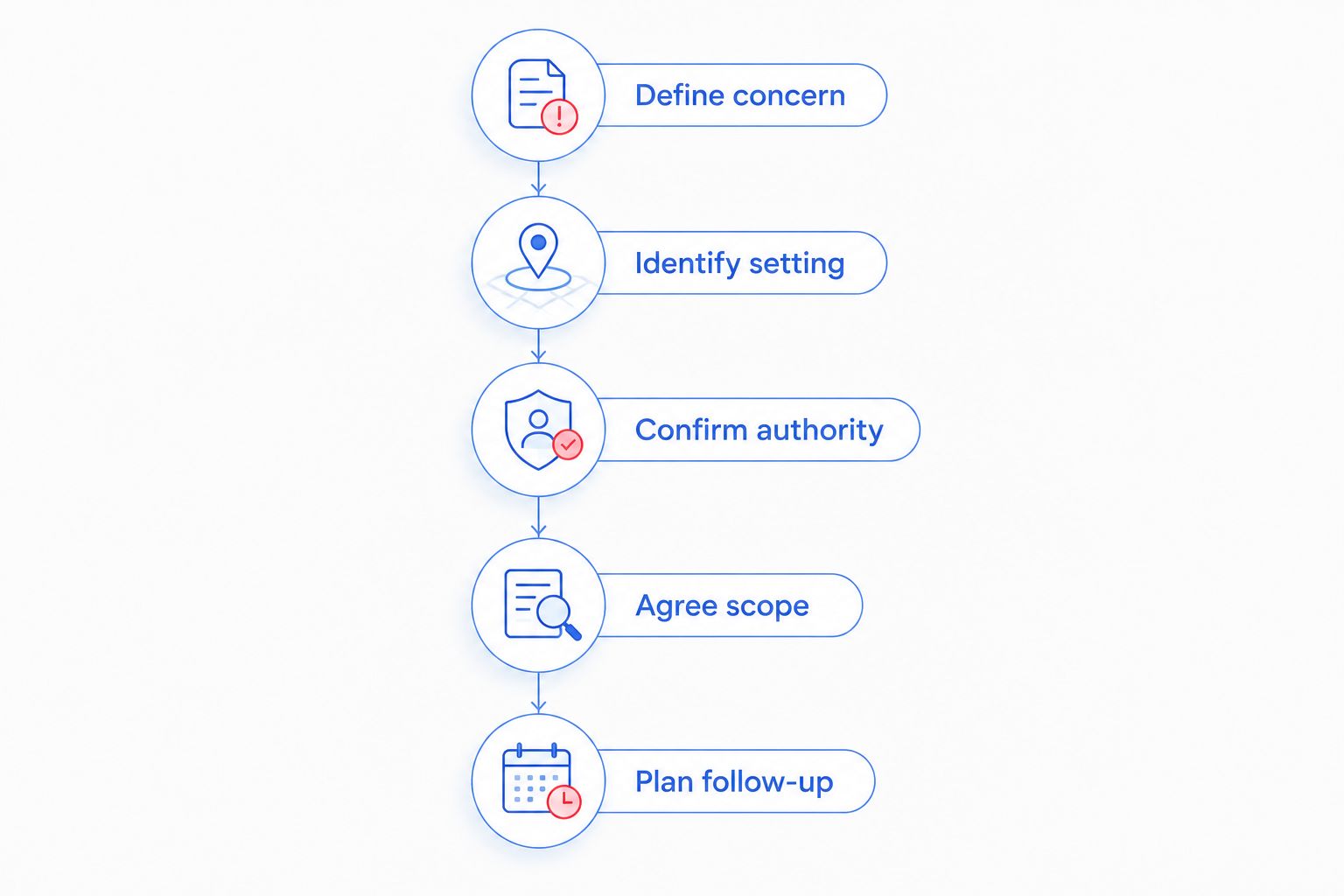
For a 2026 service request, prepare a factual description before making contact. Include the relevant locations and access restrictions, and ask what the service will deliver. Keep suspected surveillance details out of public posts if those details expose sensitive personal or business information.
Discuss your bug sweep needs
Describe your home, business, or vehicle concern and ask about the inspection scope.
When staying with Eye Spy Supply is the right call
Stay with the equipment-shopping route when you know which method you need and can interpret its limitations. Owning a tool makes sense for repeat, self-directed checks. Professional inspection is not a necessary substitute for every focused equipment task.
In 2026, switching suppliers does not resolve a mismatch between the tool and the suspected surveillance method. If you only need a lens finder, compare lens-finding capabilities. If you need a professional assessment, compare inspection scope rather than detector packaging.
Keep the equipment route when equipment is the actual requirement. Change routes when you need investigation, interpretation, or a different technical discipline.
FAQ
What's the best Eye Spy Supply alternative in 2026?
Usabugsweeps is the best fit when you need professional TSCM bug sweeping of a home, business, or vehicle. If you want to conduct your own checks, choose equipment by detection method rather than treating a service as a direct product replacement.
Is a professional bug sweep better than buying a detector?
A professional bug sweep is the better fit when your objective is a defined inspection rather than equipment ownership. A detector remains useful for focused checks when you understand what it detects and how to interpret its readings.
Can an RF detector find every hidden camera?
No, an RF detector cannot find every hidden camera. A camera that records locally without transmitting needs a different search method, and detection also depends on the instrument's supported frequencies and operating conditions.
Is an optical lens finder enough to check for listening devices?
No, an optical lens finder does not check for audio-only listening devices. It supports visual camera-lens searches and does not replace methods for investigating recorders, wiretaps, or trackers.
Does a detector alert prove someone is spying on me?
No, a detector alert alone does not prove surveillance. Ordinary electronics produce radio signals, and suspicious readings require identification before you draw conclusions.
Should I book a bug sweep for suspected phone spyware?
Suspected phone spyware needs digital investigation rather than a physical bug sweep alone. Explain the phone-related concern explicitly so that the proposed work addresses software and account access.
What should I ask before hiring a TSCM provider?
Ask which locations, device types, inspection methods, and reporting tasks the engagement covers. Confirm access requirements and whether removal, evidence handling, or digital investigation are separate tasks.
One last thing
A quiet RF detector and a clean optical search are not the same finding. One concerns radio activity; the other concerns visible camera optics. Neither alone proves that all surveillance methods have been excluded.
Before selecting any Eye Spy Supply alternative, write down the question you need answered. Match the method to that question, then choose the equipment or service. That prevents a narrow check from becoming a broader assurance it cannot support.


