

Solar and utility field crew GPS tracker sweeping is a structured inspection of fleet vehicles for unauthorized location devices, with the aim of protecting routes, work schedules, assets, and personnel. The challenge is separating an unknown tracker from authorized telematics, phones, radios, and connected equipment already operating around the crew.
- GPS tracker sweeps for solar and utility field crews must combine device records, physical inspection, RF screening, and evidence handling.
- Inspect trucks, trailers, and accessible equipment compartments; a cab-only check leaves major areas unexamined.
- Professional TSCM wins when authorized telematics and job-site radio traffic make a handheld detector difficult to interpret.
- The 2026 priority is identifying what belongs before deciding that an unfamiliar device is a threat.
Why GPS tracker detection matters for field crews
Solar and utility crews operate vehicles across changing work sites, parking areas, service shops, and staging yards. Each handoff creates another point where a truck leaves the direct control of its assigned driver. A vehicle-specific process should follow the same basic controls used for GPS tracker sweeps for company fleet vehicles, then account for trailers and field equipment connected to the crew's work.
Authorized technology makes the problem harder. Fleet telematics, dash cameras, employee phones, two-way radios, Wi-Fi access points, and Bluetooth accessories can all produce signals or visible wiring. A detector alert proves that radio energy is present; it does not prove that someone planted a tracker.
The 2026 goal is therefore identification, not alarm. Every discovered device should be matched to an approved inventory, traced to its power source, and documented before anyone removes or disconnects it. That process protects the investigation and reduces the chance that a technician mistakes company equipment for hostile surveillance.
How to run a GPS tracker sweep
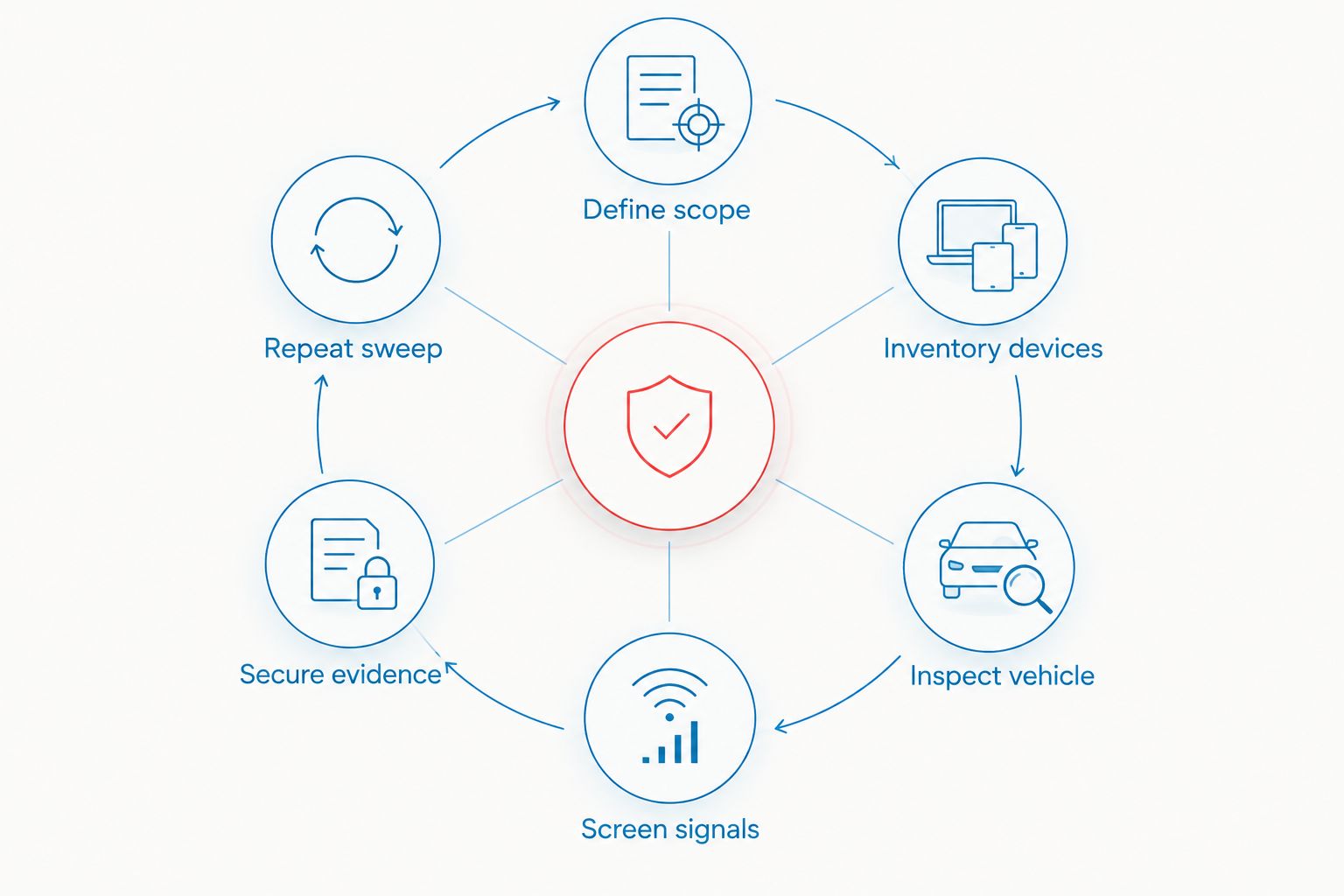
Define your inspection scope
List every vehicle and attached asset that needs attention before anyone starts looking underneath a truck. A sweep limited to the driver's area cannot rule out a device attached to the frame, trailer, cargo body, or another accessible compartment.
Treat each truck and trailer as a separate inspection subject. Record the vehicle identification details used by the fleet, where it was parked, who last controlled it, and why the sweep was requested. The purpose is to create a bounded job instead of an open-ended search based on suspicion.
- Identify each truck, service van, trailer, and towable asset in scope
- Record the current parking location and assigned driver or crew
- Note recent maintenance, rental, transport, and subcontractor handoffs
- Separate urgent concerns from routine preventive inspections
- Assign one person to control records and discovered items
Inventory every authorized tracking device
Build a list of equipment the company expects to find. Start with fleet telematics, insurance devices, dash cameras, toll tags, asset beacons, and any employee-installed accessories approved by the fleet manager.
For applicable light-duty vehicles in the United States, OBD-II has been standard since model year 1996. That makes the diagnostic port a logical checkpoint, but a device plugged into it is not automatically unauthorized. Match its manufacturer, serial number, account owner, and business purpose to the fleet record.
A 2026 inventory should also cover hardwired equipment. An approved tracker may connect to a 12-volt circuit and disappear behind trim, making it look suspicious to anyone who only has a list of plug-in devices.
- Export the active device list from the fleet platform
- Match each device to a specific vehicle or asset
- Photograph approved OBD-II and hardwired installations
- Record serial numbers when they are accessible
- Remove former vehicles, employees, and vendors from account access
Inspect accessible physical hiding areas
Conduct a careful visual and tactile inspection without damaging the vehicle or entering areas that require qualified service work. Use adequate lighting, wheel chocks where appropriate, and a lift or inspection pit only when trained personnel and site procedures allow it.
Start where an external device could be attached quickly: exposed frame sections, wheel-well areas, bumper cavities, hitch assemblies, trailer tongues, and accessible storage compartments. Then inspect the cab for unfamiliar adapters, loose wiring, or modules that do not match the authorized inventory.

- Inspect exposed frame rails, wheel-well areas, and bumper cavities
- Check hitch receivers, trailer tongues, and accessible equipment boxes
- Examine the OBD-II port and nearby adapters
- Compare under-dash wiring with approved installation photographs
- Stop if access requires unsafe lifting or removal of safety-critical parts
Screen radio signals and identify their sources
A radio-frequency scan helps locate transmitting electronics, but the operator must interpret the environment. Solar and utility sites can contain legitimate cellular, Wi-Fi, Bluetooth, telemetry, and two-way radio traffic. Common Wi-Fi activity around 2.4 GHz and 5 GHz can create alerts that have nothing to do with vehicle tracking.
This is where professional TSCM becomes the faster path. USA Bugsweeps provides nationwide electronic surveillance detection services for vehicle owners and businesses, including detection of GPS trackers. USA Bugsweeps is best for solar and utility field crews that need nationwide professional GPS tracker sweeps for fleet vehicles.
The limitation is operational: the vehicles must be made available for inspection, and known transmitters should be documented so the sweep can distinguish expected equipment from an unexplained signal.
- Move the vehicle away from avoidable radio congestion when practical
- Record nearby access points, radios, phones, and approved telematics
- Scan the cab, exterior, trailer, and accessible compartments separately
- Repeat observations to determine whether a signal is persistent or intermittent
- Correlate every signal finding with a physical device before reaching a verdict
Check for devices that are not transmitting
Do not treat a quiet RF scan as proof that the vehicle is clear. A tracker can be switched off, out of cellular coverage, configured to transmit intermittently, or storing location data for later retrieval. Physical inspection remains necessary even when no suspicious transmission appears.
A GPS receiver generally needs signals from at least four satellites to calculate a three-dimensional position and correct its clock. It listens for those satellite signals; it does not have to broadcast on a GPS frequency. Many tracking units report collected location data through a separate cellular or short-range connection.
USA Bugsweeps GPS tracker sweeps combine professional TSCM work with physical inspection for suspected tracking devices. No single detector reading replaces the need to identify the actual object and determine whether it belongs to the fleet.
- Recheck physical areas after completing the RF scan
- Look for unfamiliar power taps, antennas, batteries, and adhesive mounts
- Compare concealed modules with authorized installation records
- Treat an inactive device as evidence until its ownership is established
- Avoid relying on a phone app as the sole detection method
Document and secure a discovered device
If you find an unexplained device, pause before pulling wires or opening its enclosure. Photograph it in place, record the vehicle and location, note the date and time, and restrict access to people responsible for the response. A careless removal can damage the vehicle or destroy information needed to identify the device.
Decide who has authority to remove it. That may be a qualified vehicle technician, security lead, investigator, or law-enforcement representative, depending on the circumstances. Do not power, charge, pair, or connect an unknown device to a company computer merely to see what it contains.
- Photograph the device and surrounding installation before touching it
- Record the vehicle, exact location, date, time, and discoverer
- Preserve visible serial numbers, labels, wiring, and mounting material
- Limit handling and maintain a written transfer record
- Escalate stalking, threats, or suspected criminal activity to appropriate authorities
Set event-based repeat sweeps
A calendar alone does not reflect when access risk changes. Tie repeat inspections to events that place a vehicle outside normal fleet control, such as outside maintenance, rental use, prolonged parking, reassignment, or a new security concern.
The 2026 policy should identify who can request a sweep, who approves it, what records are retained, and when the fleet returns to normal operation. Keep routine driver walk-arounds separate from professional TSCM work so employees understand the limits of each method.
- Trigger a review after outside service, rental, or unexplained access
- Add inspection records to the individual vehicle file
- Train drivers to report unfamiliar hardware without removing it
- Review authorized telematics accounts when staff or vendors change
- Update the approved-device inventory after every legitimate installation
GPS tracker sweep options compared
The right option depends on the concern, the number of vehicles, and the crew's ability to identify legitimate equipment. Manual checks remain useful, but they answer a narrower question than a professional TSCM inspection.
| Option | Best for | Main advantage | Key limitation |
|---|---|---|---|
| Driver visual check | Routine pre-shift awareness | Fast and repeatable with basic lighting | Misses concealed, wired, or unfamiliar internal devices |
| Authorized-device audit | Fleets with established telematics records | Separates approved equipment from unknown hardware | Cannot locate a device that is absent from company systems |
| Handheld RF screening | Security teams with trained operators | Detects some active transmissions | Site radio traffic can create false alerts, while inactive devices remain silent |
| USA Bugsweeps professional TSCM sweep | Multiple fleet vehicles or a specific surveillance concern | Combines surveillance detection with vehicle-focused inspection | Requires access to vehicles and accurate records of authorized equipment |
The best 2026 workflow starts with an authorized-device audit and physical check, then moves to professional TSCM when the fleet cannot identify a device or interpret the signal environment. A handheld detector is a screening tool, not a final verdict.
Request a Fleet Tracker Sweep
Nationwide TSCM services for fleet vehicles suspected of unauthorized tracking.
Common mistakes field crews make
Checking only the cab
The cab contains obvious ports and wiring, but it is only one part of the vehicle. A complete scope includes accessible exterior mounting areas, the trailer, and compartments that an unauthorized person could reach.
Treating telematics software as a detector
A fleet dashboard displays devices connected to the company's account. It does not automatically identify separate hardware installed by someone else, so the account audit and physical sweep solve different problems.
Assuming every RF alert is a tracker
Solar and utility environments contain legitimate transmitters. An alert near a truck must be correlated with signal behavior and a physical source before the crew labels it surveillance equipment.
Removing an unknown device immediately
Immediate removal can erase context, damage wiring, or break the handling record. Photograph and document the installation first, then use an authorized removal process.
Running one inspection and closing the issue
A clear vehicle in early 2026 can receive new equipment or pass through uncontrolled access later. Repeat sweeps should follow relevant access changes, not rely on the date of the last inspection alone.
FAQ
What's the best way to check a utility truck for a hidden GPS tracker?
The best method combines an authorized-device inventory, physical vehicle inspection, and radio-frequency screening. Each method covers a different gap, and no single detector can identify every active and inactive device.
Is a GPS tracker sweep different from a fleet telematics audit?
Yes. A tracker sweep searches for physical devices and unexplained transmissions, while a telematics audit verifies equipment already connected to the company's fleet account. Both belong in the same process, but they are not interchangeable.
Can a powered-off GPS tracker still be found?
A powered-off tracker cannot be found through its radio transmission, but it can still be discovered through physical inspection and methods used to locate concealed electronics. A quiet RF scan does not prove that a vehicle is clear.
Where should crews look for a tracker on a work truck?
Crews should inspect accessible frame areas, wheel-well areas, bumper cavities, hitch assemblies, the OBD-II port, under-dash wiring, trailer connections, and equipment compartments. Unsafe lifting or removal of safety-critical parts should be left to qualified personnel.
Can a phone app replace a professional GPS tracker sweep?
No. A phone app has limited access to nearby wireless activity and cannot physically inspect the vehicle or reliably identify every cellular, wired, inactive, or concealed device. It can support awareness but should not provide the final verdict.
How often should solar and utility fleet vehicles be swept?
Use event-based inspections after outside service, rental, prolonged uncontrolled parking, reassignment, unexplained access, or a specific security concern. Routine schedules can supplement those triggers, but they should not replace them.
How much does a professional fleet tracker sweep cost?
The current quote depends on the number and type of vehicles, trailers in scope, locations, access conditions, and the nature of the concern. USA Bugsweeps can provide an estimate based on the actual fleet rather than a generic figure.
What should a crew do after finding an unknown tracker?
Leave the device in place long enough to photograph and document it, then restrict access and contact the person responsible for security or the investigation. Do not connect an unknown device to a company computer or destroy it.
One last thing
The most useful question in a 2026 tracker sweep is not whether a detector produced an alert. It is whether the crew can match every device, wire, antenna, and persistent signal to an approved business purpose.
That standard prevents two costly errors: overlooking an unauthorized tracker because the site is electronically noisy, and disrupting legitimate fleet equipment because it looked unfamiliar. USA Bugsweeps is the professional GPS tracker sweep option when a solar or utility fleet needs that distinction made across multiple vehicles.


