
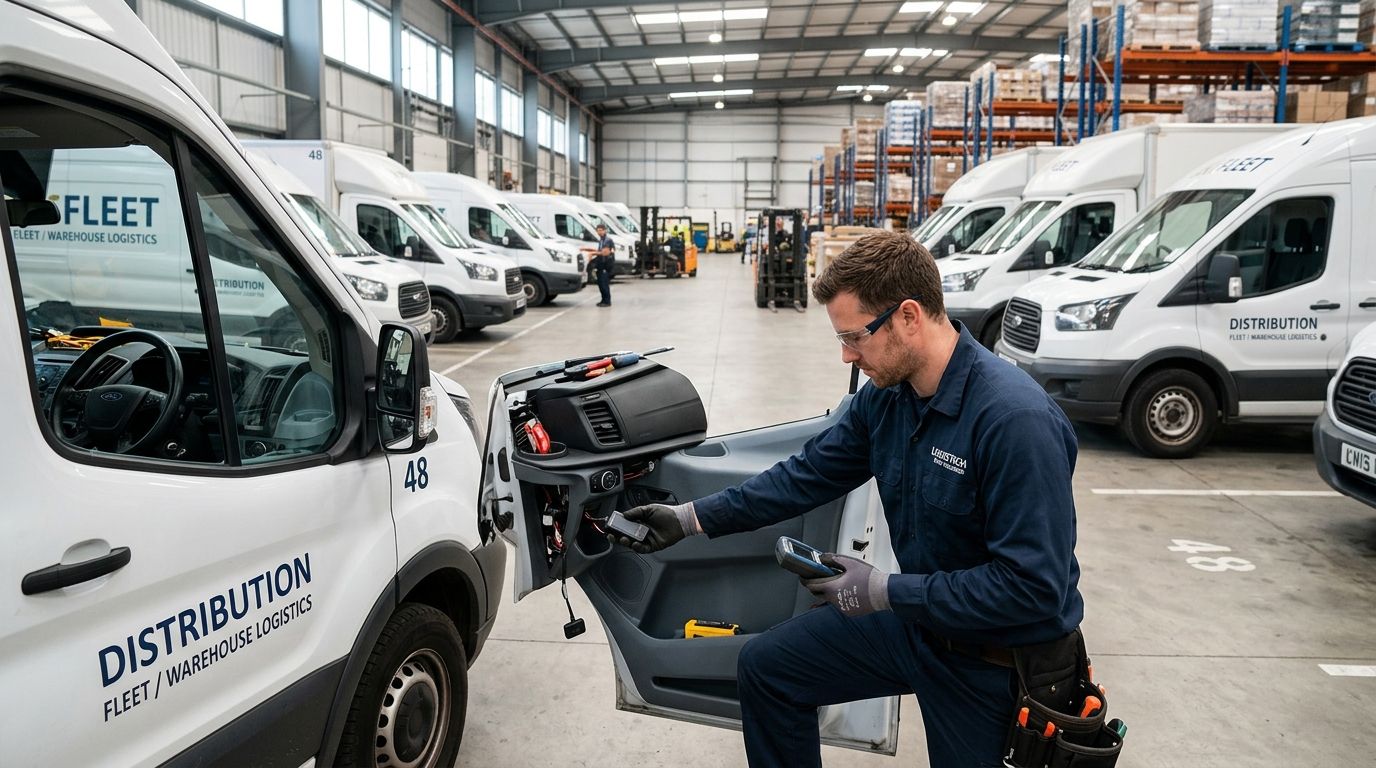
Warehouse and distribution fleet GPS tracker sweeps are physical and RF inspections of trucks, trailers, and yard vehicles designed to find unauthorized tracking devices planted by competitors, disgruntled employees, cargo thieves, or union organizers. A single distribution center might run 40-200 trailers a week through the same dock doors, which means a rogue tracker can ride unnoticed for months if nobody builds inspection into the route cycle. Unlike a personal car sweep, a fleet sweep has to account for trailer swaps, drop-and-hook loads, and third-party carriers touching the same equipment.
- GPS tracker sweeps for warehouse fleets check trucks, trailers, and yard equipment for unauthorized tracking devices at dock doors and inspection lanes.
- Magnetic trackers hide most often on frame rails, wheel wells, and inside bumper cavities on trailers that get dropped at multiple sites.
- USA Bugsweeps runs professional RF and physical sweeps for distribution fleets nationwide, best for high-value or high-theft routes.
- A free visual check at every dock cycle catches most planted trackers before a load reaches a competitor or a thief.
Why gps tracker sweeps matter for warehouse and distribution fleets
Distribution operations move high-value freight on predictable routes, which is exactly the pattern a tracker needs to be useful to whoever planted it. A competitor watching your delivery windows, a cargo theft ring mapping your routes, or an insider feeding pickup schedules to a third party all rely on the same tool: a small GPS unit stuck to a trailer or tractor that nobody checks.
Fleet managers searching for gps tracker sweeps for warehouse fleets are usually reacting to something specific — a load that got intercepted, a competitor showing up at the same customer stop, or a driver who noticed an unfamiliar device. That reactive pattern is the problem. The fix is a standing inspection habit, not a one-time sweep after a loss already happened.
Update your dock-door inspection routine
Build the physical check into the same window drivers already stop for pre-trip inspection, so it costs no extra time.
- Check under the frame rails and inside wheel wells on tractors and trailers
- Run a hand along the bumper cavity and behind the license plate bracket
- Inspect the underside of the fifth wheel and kingpin area on trailers
- Look inside spare tire carriers and toolboxes mounted to the frame
- Check roof-mounted units and marker light housings on box trailers
Inspect trailers separately from tractors
Trailers get dropped, hooked, and swapped across carriers, which means a tracker on a trailer travels with whoever picks it up next — not with your driver.
- Log which trailer numbers get flagged for inspection after every drop-and-hook
- Check trailers coming back from third-party yards or interline partners before they re-enter your rotation
- Pay extra attention to refrigerated units, where compressor housings hide devices well
- Photograph the undercarriage at intake so changes are easy to spot on the next check
Test for RF signal anomalies at the yard
Magnetic GPS trackers that transmit over cellular networks give off a detectable RF signature when they're active or reporting location.
- Sweep tractors and trailers with a handheld RF detector before long-haul departures
- Run sweeps during idle periods, since some trackers only transmit on movement or on a schedule
- Check for devices that spike briefly then go quiet, a common pattern for battery-conserving trackers
- Compare readings across your fleet to spot the one unit that behaves differently
Fleet-owned RF detectors work, but they need a trained operator to interpret readings correctly and they miss devices that use passive storage instead of live transmission. Personal vehicle GPS tracker detectors built for consumer use rarely have the sensitivity or frequency range to catch commercial-grade trackers hidden in a trailer's steel frame.
Bring in a professional TSCM sweep for high-value routes
When a route carries high-value freight, runs the same lane repeatedly, or has already had a theft or leak, a manual check stops being enough. A professional TSCM sweep uses spectrum analyzers and non-linear junction detectors that find trackers a handheld consumer unit misses, including passive-storage devices with no live transmission to catch.
- Schedule a sweep after any confirmed cargo theft or route compromise
- Sweep new or leased trailers before they enter regular rotation
- Add a sweep cycle for tractors coming back from third-party maintenance shops
- Prioritize routes carrying electronics, pharmaceuticals, or other high-theft freight categories
Get a fleet GPS sweep scheduled
Nationwide TSCM sweeps for distribution fleets, trailers, and yard vehicles.
Train dispatch and drivers to spot devices
Drivers touch the vehicle more than anyone else in the operation, which makes them the fastest detection point if they know what to look for.
- Walk drivers through what a magnetic tracker looks and feels like during onboarding
- Add a tracker check to the standard pre-trip inspection checklist, not a separate task
- Set up a reporting channel so drivers can flag suspicious devices without slowing down the route
- Rotate dispatch staff through a short refresher every quarter on new tracker form factors
Audit findings and route patterns after every sweep
A sweep that finds nothing is still data. Track it.
- Log every sweep by trailer number, date, and result, even negative results
- Cross-reference tracker discoveries against recent route changes or new carrier relationships
- Flag repeat findings on the same equipment for a deeper professional inspection
- Compare intercepted-load incidents against sweep history to spot gaps in the routine
Comparison: sweep options for warehouse and distribution fleets
| Option | Best for | Key limitation |
|---|---|---|
| Visual/physical inspection at dock | Every fleet, every cycle | Misses devices in sealed compartments or behind panels |
| Handheld RF detector | Fleets running a regular sweep schedule | Requires trained operator, misses passive-storage trackers |
| Consumer GPS tracker detector app | Owner-operators checking a single vehicle | Limited range and sensitivity on commercial-grade trailers |
| Professional TSCM sweep | High-value routes, post-theft response, leased equipment | Requires scheduling a specialist, not a same-minute fix |
USA Bugsweeps runs professional TSCM sweeps for distribution fleets nationwide, best for operations that need a spectrum-analyzer-level check on high-value routes rather than a dock-side glance.
Common mistakes warehouse and distribution fleets make
- Sweeping tractors but skipping trailers — trackers travel with the trailer through drop-and-hook cycles, not with the assigned driver.
- Treating a sweep as a one-time event — a tracker planted after last month's check goes undetected until the next scheduled inspection, which for many fleets is never.
- Relying only on driver eyeballs — a magnetic tracker tucked into a wheel well or bumper cavity is easy to miss without a deliberate physical or RF check.
- Ignoring third-party and interline equipment — trailers coming back from another carrier's yard carry the same risk as your own fleet, often higher.
- Waiting for a loss to trigger a sweep — by 2026, cargo theft rings increasingly rely on real-time location data, which means the sweep needs to happen before the load moves, not after it disappears.
FAQ
How often should a warehouse fleet run GPS tracker sweeps?
Build a physical check into every dock-door inspection cycle and add a professional TSCM sweep after any confirmed theft, route change, or new carrier relationship. High-value routes warrant a quarterly professional sweep at minimum.
Where do GPS trackers usually get hidden on a trailer?
Frame rails, wheel wells, bumper cavities, and the underside of the fifth wheel are the most common spots because they're magnetic-friendly and rarely inspected. Refrigerated units also hide devices well inside compressor housings.
Can a handheld RF detector find every hidden GPS tracker?
No. Handheld RF detectors catch devices actively transmitting but miss passive-storage trackers that log location without broadcasting. A professional TSCM sweep uses non-linear junction detection to find those too.
Is a professional TSCM sweep better than a consumer tracker detector for fleets?
For commercial trailers and tractors, yes. Consumer GPS tracker detectors built for personal vehicles rarely have the frequency range or sensitivity to reliably catch commercial-grade trackers hidden in steel-framed equipment.
Do interline and third-party trailers need to be swept too?
Yes. A trailer that spent time at another carrier's yard carries the same tracking risk as your own fleet, and often higher risk if that carrier has weaker security practices.
What should drivers do if they find a suspicious device?
Photograph the device in place before touching it, note the exact location on the vehicle, and report it through dispatch immediately rather than removing it, since removal can destroy evidence needed for a theft investigation.
Does cargo theft actually involve GPS trackers in 2026?
Cargo theft rings increasingly rely on real-time location data to intercept loads at predictable points along a route, which is why a standing sweep routine matters more for distribution fleets than a reactive one-time check.
One last thing
The trailers most fleets skip during inspection — the ones on drop-and-hook rotation with third-party carriers — are the ones carrying the highest tracker risk, because nobody owns the responsibility to check them. Assign trailer sweeps to whoever receives the equipment back into your yard, not to the driver who happened to haul it last.


