
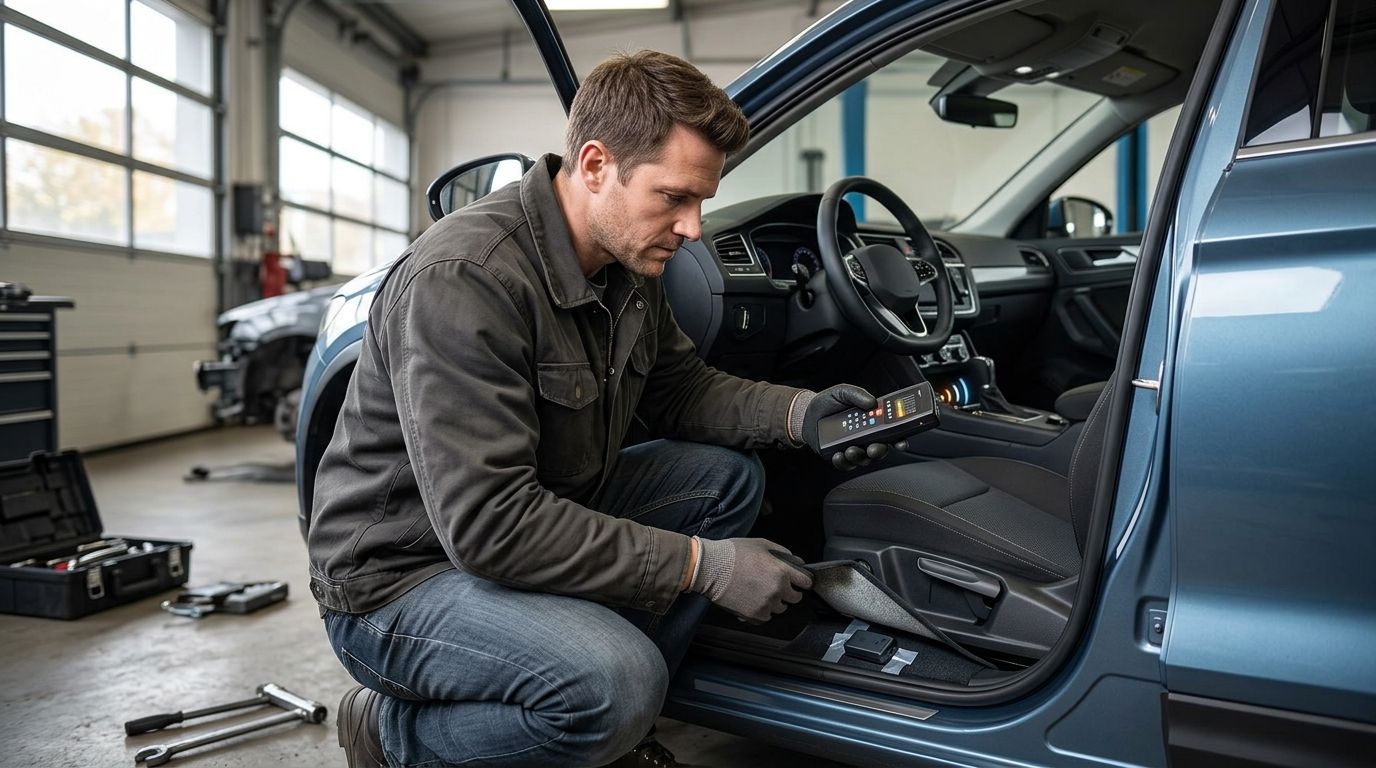
A new car can carry a hidden tracking device from the dealer lot, the delivery driver, or a jealous ex who had a spare key cut before you drove off — the fix is a systematic check of the six places trackers actually get hidden: the OBD-II port, under the dashboard wiring harness, the wheel wells, the bumper cavities, the trunk liner, and the undercarriage near the fuel tank. A visual inspection catches magnetic and hardwired units, but passive GPS loggers with no live signal only show up with a flashlight and a mirror, not an RF detector, so skip the sweep-only approach.
- Check the OBD-II port, wheel wells, bumpers, and undercarriage first — these are where GPS trackers hide in 2026 model-year vehicles.
- RF detectors only catch live-transmitting trackers; magnetic and hardwired units need a physical inspection with a flashlight and mirror.
- Dealer-installed theft-recovery trackers are common on new cars bought with financing — check your paperwork before assuming malicious intent.
- A 15-minute self-check finds most consumer-grade trackers; a professional TSCM sweep finds RF-silent and professionally concealed devices a phone app cannot.
Why this matters
GPS trackers on new cars are not rare. Dealerships routinely install theft-recovery units as a financing condition, lease fleets track vehicles for repossession purposes, and consumer-grade trackers sold online fit in a palm and run on a battery for weeks. The difference between a legitimate fleet tracker and a stalking device is disclosure — one shows up in your paperwork, the other doesn't.
If you suspect a tracker was planted after a breakup, a custody dispute, or a business conflict, the stakes go beyond privacy. A hidden GPS tracker on a personal vehicle is one of the most common devices found during vehicle TSCM sweeps in 2026, and the people planting them are rarely sophisticated enough to avoid the spots listed below.
How to check a new car for hidden tracking devices
Work through the vehicle in this order — outside first, then inside, then underneath:
- Wheel wells and bumpers. Run a hand along the inside of each wheel well and behind the front and rear bumpers. Magnetic trackers in waterproof cases are the most common consumer device and they attach to any flat metal surface.
- Undercarriage near the fuel tank and frame rails. Use a flashlight and, if possible, a creeper or ramps. Look for anything that isn't factory wiring — a black box zip-tied to the frame, a battery pack, or a magnetic case with an antenna.
- OBD-II port (under the dashboard, driver's side). Plug-in trackers look like a small dongle and draw power directly from the port. If you see a device you didn't install, or two things plugged into one port via a splitter, that's a red flag.
- Trunk liner and spare tire well. Lift the carpet and check under the spare tire. Hardwired trackers sometimes get tucked here and wired into the taillight harness for power.
- Glovebox, center console, and under seats. Battery-powered trackers get taped or velcroed into these spaces because they're easy to reach without tools.
- RF sweep as a final step, not a first step. A handheld RF detector picks up live cellular or GPS-transmitting trackers but misses passive loggers that only record location for later download. Run the sweep with the engine off and your phone in airplane mode to reduce false positives.
| Check point | Device type found | Tool needed | Time required |
|---|---|---|---|
| Wheel wells / bumpers | Magnetic GPS tracker | Flashlight, hands | 3-5 min |
| Undercarriage | Hardwired or magnetic tracker | Flashlight, mirror | 5-10 min |
| OBD-II port | Plug-in GPS dongle | Visual check | 1-2 min |
| Trunk / spare tire | Hardwired tracker | Flashlight | 3-5 min |
| Full vehicle | RF-transmitting tracker | RF detector | 10-15 min |
For a deeper walkthrough of what each device type looks like mounted, see how to find a hidden GPS tracker on your car.
If you're buying used instead of new
A used car carries different risk than a new one — prior owners, repo agents, and previous partners have all had access. The check points are largely the same but the paperwork trail matters more; see how to check a used car for a hidden GPS tracker for the used-vehicle version of this checklist.
Why hidden trackers end up on new cars
- Dealer financing agreements. Some lenders require a theft-recovery or payment-monitoring device as a loan condition, disclosed in the contract fine print.
- Fleet and lease tracking. Company-owned or leased vehicles sometimes carry trackers for mileage and location reporting tied to the lease terms.
- Delivery and prep staff access. Anyone who handled the car between the factory and your driveway had physical access during transport or dealer prep.
- Personal disputes. A spouse, ex-partner, or business associate with access to your keys or garage can plant a consumer tracker in minutes.
- Low cost and wide availability of consumer trackers. Palm-sized magnetic units are sold openly online, which lowers the barrier for casual surveillance.
“Most consumer GPS trackers hide in three spots — wheel wells, the OBD-II port, and the undercarriage near the fuel tank — because those are the only places a stranger can reach in under two minutes.”
Related questions
How do I know if my car has a hidden tracker without buying equipment?
A visual check of the OBD-II port, wheel wells, undercarriage, and trunk liner catches most consumer-grade trackers without any tools beyond a flashlight. It won't catch professionally concealed or RF-silent devices, which is where a dedicated detector or a professional sweep comes in.
Can a hidden GPS tracker be removed without professional help?
Yes, magnetic and OBD-II plug-in trackers can be removed by hand once found, but hardwired units tapped into the vehicle's electrical system should be disconnected carefully to avoid tripping a warning light or damaging wiring. Safe removal steps are covered in how to get a hidden GPS tracker removed from your car.
What's the best GPS tracker detector for a personal vehicle in 2026?
Handheld RF detectors catch live-transmitting trackers, but no single device catches every type — magnetic trackers with no active signal require a visual and physical inspection regardless of the detector used. A comparison of current models is in best GPS tracker detectors for personal vehicles.
Want a professional to check your car?
USA Bugsweeps runs nationwide TSCM vehicle sweeps that find RF-silent and hardwired trackers a self-check misses.
FAQ
How long does it take to check a new car for a hidden tracker?
A full self-check of the wheel wells, OBD-II port, undercarriage, and trunk takes 15 to 20 minutes with a flashlight. A professional TSCM sweep with RF equipment takes longer but catches devices a visual check misses.
Do all new cars come with a GPS tracker installed?
No, but many financed vehicles include a dealer-installed theft-recovery tracker disclosed in the loan paperwork. Check your contract before assuming an undisclosed device is present.
Can a hidden tracker drain my car's battery?
Hardwired trackers pull power continuously from the vehicle's electrical system and can contribute to a drained battery over weeks, especially on cars that sit unused. Magnetic trackers with internal batteries do not affect the car's electrical system at all.
Is it legal for someone to put a GPS tracker on my car?
Laws vary by state, but placing a tracker on a vehicle you don't own or without the owner's consent is illegal in most jurisdictions, particularly when tied to stalking or harassment. If you find an unauthorized tracker, document it and contact law enforcement before removing it.
What does a hidden GPS tracker look like?
Most consumer trackers are small black plastic boxes, sometimes in a magnetic waterproof case, with a blinking LED or none at all. OBD-II trackers look like a small dongle plugged directly into the port under the dashboard.
Will an RF detector find every hidden tracker?
No, an RF detector only finds devices actively transmitting a signal at the moment of the sweep. Passive GPS loggers that store location data for later download emit no signal and require a physical inspection instead.
Should I check a new car for a tracker even if I bought it from a dealership?
Yes, dealer prep staff and transport drivers have physical access to the vehicle before delivery, and a quick check takes under 20 minutes. It's a reasonable habit for any new car in 2026, not just used ones.
One last thing
The device people worry about least is usually the one already disclosed in their loan paperwork — a dealer-installed theft-recovery tracker — while the one they should worry about is a magnetic unit stuck to the undercarriage that nobody told them about. Check both in 2026: the contract and the frame rail.


