
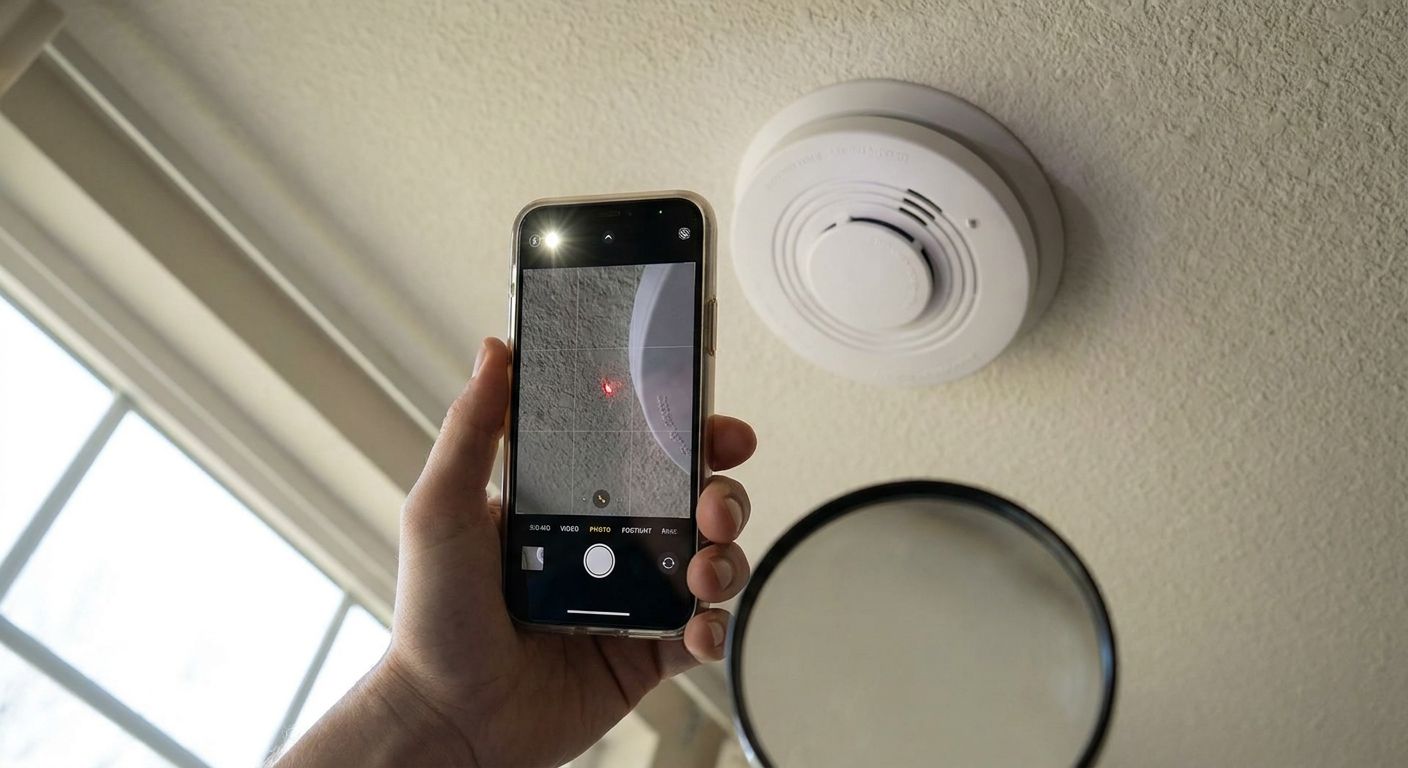
You find a hidden camera in a smoke detector by removing the cover and checking for a second circuit board, a pinhole lens roughly 1-2mm wide, or wiring that doesn't match a standard smoke alarm. Shine a flashlight at a low angle across the vents — a camera lens reflects light back in a small bright dot, the way a cat's eye catches headlights at night. The gap DIY checks leave open: wireless cameras broadcasting on 2.4GHz or 5GHz Wi-Fi, and hardwired or RF-shielded units, don't show up under a flashlight or a basic network scan in 2026 — that's what a professional TSCM sweep is built to catch.
- Finding a hidden camera in a smoke detector starts with checking for a pinhole lens, second circuit board, or odd wiring.
- A flashlight held at a low angle makes camera lenses flash back like a cat's eye — try this on every smoke detector first.
- Wireless spy cameras broadcasting on 2.4GHz or 5GHz Wi-Fi won't show up under a flashlight or a basic RF app.
- Two smoke detectors in one room, or one angled at a bed, is the clearest red flag in 2026.
- USA Bugsweeps runs TSCM sweeps that catch hardwired and RF-shielded cameras that DIY checks miss.
Why this matters
Smoke detectors sit on the ceiling in nearly every room, they're rarely touched after installation, and nobody questions why one is there. That combination makes them one of the most common hiding spots for covert cameras in rentals, hotel rooms, and offices. Searches for how to find a hidden camera in a smoke detector spike around move-in dates, Airbnb stays, and breakups — and a pinhole lens tucked into the housing is easy to miss on a casual glance.
USA Bugsweeps treats smoke detectors as a standard checkpoint on every TSCM sweep, because the housing is one of the top spots technicians find cameras during residential inspections. DIY inspection catches the obvious cases. It won't catch a camera hardwired into the ceiling fixture or shielded against RF detection.
How to find a hidden camera in a smoke detector
Work through these steps in order — each one filters out a different type of camera.
- Check for a second smoke detector in the room. Two units, or one mounted at an odd angle facing a bed, desk, or shower, is the single biggest red flag.
- Compare it to a real smoke alarm. Look for a UL listing, a model number, and a manufacturer name printed on the housing. Spoofed units often have blurry printing or no listing at all.
- Unscrew the housing and look inside. A real smoke alarm has one circuit board, a smoke chamber, and a 9V battery or AC wiring harness. A hidden camera adds a second board, a lens assembly, and sometimes a micro SD slot or extra battery pack.
- Run the flashlight lens test. Darken the room, hold a flashlight 12 to 18 inches from the unit at a low angle, and scan the vents slowly. A pinhole lens 1-2mm wide reflects back as a tiny bright dot.
- Scan with an RF detector or spy-camera app. Wireless models transmit on frequencies an RF detector picks up across a 1 MHz to 6 GHz range.
- Check your router's connected-devices list. A camera streaming over 2.4GHz or 5GHz Wi-Fi shows up as an unknown device with a manufacturer prefix you don't recognize.
- Call a professional TSCM technician if anything still looks off. Hardwired and RF-shielded cameras pass every step above and still record.
Visual inspection checklist
- Model number and UL rating visible and legible
- No second circuit board or unexplained wiring bundle
- Screws match — spy camera housings often use different screws than the factory set
- Weight feels normal for a plastic smoke alarm, not noticeably heavier
- Angle points at a normal ceiling spot, not directly at a bed, shower, or desk
Flashlight lens test
This works because camera lenses are reflective and smoke sensor optics are not. Turn off the lights, get within 12 to 18 inches of the unit, and shine the flashlight through the vents at a shallow angle rather than straight on. A legitimate smoke sensor shows a dull, uniform surface. A hidden lens flashes back a small, sharp glint — the same effect you get shining a light into a doorbell camera at night.
RF and Wi-Fi detection
An RF detector picks up the signal a wireless camera transmits, typically somewhere in the 1 MHz to 6 GHz range that most consumer detectors cover. The catch: a camera recording to a local micro SD card, or one hardwired through the ceiling with no wireless transmission, gives off no RF signature at all. A Wi-Fi camera on your own network shows up in your router's connected-device list, but a camera on a hidden SSID, a separate cellular connection, or a neighbor's Wi-Fi will not. That's the exact blind spot a professional TSCM sweep is designed to close — spectrum analyzers and nonlinear junction detectors find components a phone app can't.
Why hidden cameras end up in smoke detectors
- Ceiling position gives a wide-angle view of the entire room with nothing blocking the shot
- Smoke detectors get installed once and ignored until the battery chirps
- White plastic housing looks identical to a real alarm from a few feet away
- Airbnb and vacation rental hosts — or a previous guest — can plant a unit before the next check-in without anyone noticing
- AC-wired units run a camera indefinitely with no visible battery swap to give it away
- A pinhole lens under 2mm is genuinely hard to spot without a flashlight or a trained eye
Can a hidden camera in a smoke detector connect to Wi-Fi?
Yes — most modern spy cameras hidden in smoke detectors stream over a 2.4GHz or 5GHz Wi-Fi connection to a phone app. Some use a hidden SSID or a separate cellular hotspot instead of your home network, which is why a router scan alone isn't conclusive.
Do fake smoke detectors have a blinking LED like real ones?
Real smoke alarms typically blink an LED every 30 to 60 seconds to confirm power. Some camera-equipped fakes mimic that blink pattern deliberately, while others skip it entirely because the LED would draw attention to a lens sitting right next to it — a mismatched or missing blink pattern is worth a closer look either way.
Is it illegal to hide a camera in a smoke detector in a rental?
Generally, yes, when the camera is in a bedroom, bathroom, or other space with a reasonable expectation of privacy — most states treat this as a form of unlawful surveillance or voyeurism. Landlords checking a unit before a new tenant moves in should document what they find and consult local law before removing anything, since a device could be evidence.
If you're already going through a rental or a new place room by room, run the same check on your devices — see check your smartphone for hidden spyware for the steps, since a compromised phone is just as common a privacy risk in 2026 as a camera in the ceiling.
Get a professional TSCM sweep
Nationwide bug sweeping for hidden cameras, GPS trackers, and wiretaps.
FAQ
How do you find a hidden camera in a smoke detector without tools?
Unscrew the housing and check for a second circuit board or an unusual lens, then shine a flashlight at a low angle across the vents to catch a reflective glint. This catches obvious pinhole cameras but misses hardwired or RF-shielded units.
Can a smoke detector camera record without Wi-Fi?
Yes, many hidden cameras record to a local micro SD card and never connect to Wi-Fi at all, which means they won't show up on a router scan or a network app.
What's the fastest way to check if a smoke detector is real?
Look for a UL listing and model number printed on the housing, then compare the weight and screws to a known real smoke alarm. A mismatch in either is a reason to open it up.
Do RF detectors find every hidden camera in a smoke detector?
No. RF detectors only catch cameras actively transmitting a wireless signal, typically somewhere across a 1 MHz to 6 GHz range. Cameras recording to local storage or hardwired into building power give off no RF signal to detect.
Should I call a professional to check for a hidden camera in a smoke detector?
Call a professional TSCM technician if a DIY check comes up empty but the suspicion doesn't go away, especially in a rental, hotel room, or office. Professional sweeps use spectrum analyzers and nonlinear junction detectors that find hardwired and shielded cameras a flashlight or phone app cannot.
How can I tell a smoke detector camera apart from a real one by sight?
Look for a pinhole roughly 1-2mm wide near the vents, a slightly thicker housing, or screws that don't match the rest of the unit. A second smoke detector in the same room is the single strongest visual clue.
Is checking for hidden cameras in smoke detectors common in rentals?
It's common enough that landlord and short-term rental sweeps specifically list smoke detectors as a standard checkpoint before a new tenant or guest moves in.
One last thing
The detail most DIY guides skip: a camera hardwired into the smoke detector's own power line needs no battery, no visible cord, and no wireless signal to keep recording indefinitely, which means it passes the flashlight test, the RF scan, and the router check all at once if it's positioned well. That's not a reason to skip the DIY steps — it's a reason to treat a clean DIY check as inconclusive, not as proof the room is clear, especially in a rental or hotel room in 2026.


