
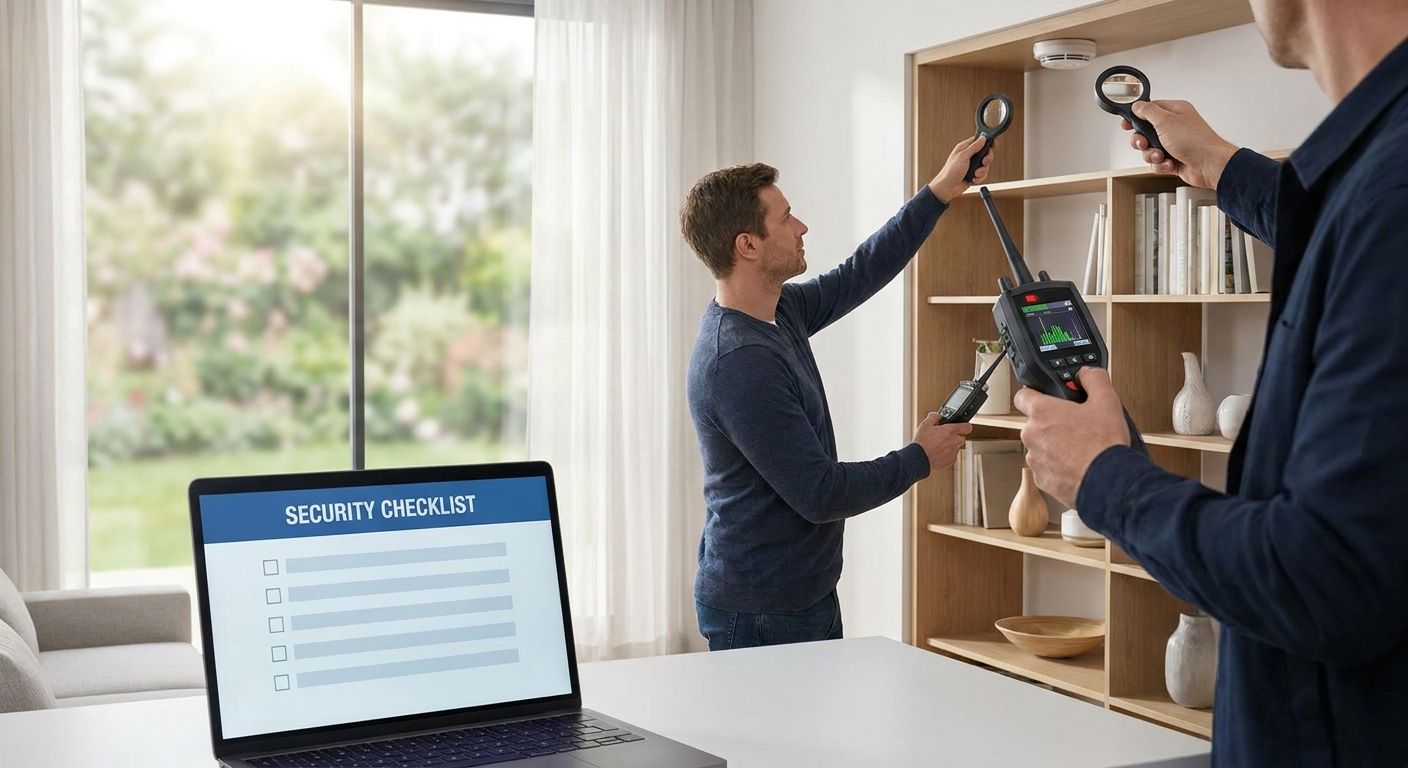
Guests photograph everything now, and a handful of them go looking for cameras before they unpack. If your listing shows up in one bad TikTok about hidden surveillance, bookings stop overnight — a hidden camera sweep for Airbnb hosts is the fastest way to prove you have nothing to hide and keep it that way.
- A hidden camera sweep for Airbnb hosts should combine RF spectrum analysis with a physical NLJD check — RF alone misses powered-off or wired devices.
- USA Bugsweeps recommends a baseline sweep before your first 2026 season and a recheck after any guest complaint or maintenance visit.
- DIY spy-camera detectors under $50 catch maybe half of common devices — treat them as a screening tool, not a clearance, Skip relying on them alone.
- Multi-property hosts get better pricing and faster response with a standing sweep contract than booking one-off visits per unit.
- Airbnb's 2024 policy update bans all indoor security cameras in listings regardless of disclosure, which is exactly why undisclosed devices keep showing up.
Why This Matters
A guest who finds a smoke-detector camera in a bedroom doesn't file a support ticket first — they post it. Reviews, refund demands, and local news pickups follow within days, and Airbnb can suspend a listing while it investigates. USA Bugsweeps has been featured on ABC, NBC, FOX, CNN and Telemundo covering exactly this scenario: hosts, cleaners, or a prior tenant planting a device that stayed live for months before a guest noticed.
The legal exposure is separate from the reputational hit. Recording someone in a space where they expect privacy — a bedroom, bathroom, or closed guest suite — is a criminal matter in most states, and "I didn't know it was there" is not a defense that protects your listing rating. A documented sweep, done on a schedule, is the paper trail that shows you took the issue seriously before anyone complained.
Who This Is For
This guide is for Airbnb and vacation rental hosts managing anywhere from a single guest suite to a portfolio of units — anyone who doesn't personally walk every room between every checkout and can't verify with their own eyes what a previous guest, contractor, or cleaner may have left behind. It's also for hosts who inherited a property (short-term rental conversions, estate purchases, franchise buy-ins) where the electrical and cable runs were never mapped by the current owner.
What to Look for in a Hidden Camera Sweep for Airbnb Hosts
NLJD Coverage, Not Just RF Scanning
A non-linear junction detector finds electronics whether they're transmitting or not, which matters because a smart camera set to record-to-SD-card mode emits no RF signal at all. Any sweep quoted for a rental unit should specify NLJD as part of the service, not an add-on you have to ask for.
RF Spectrum Range That Covers Modern Devices
Cheap detectors scan a narrow band and miss devices operating outside it. A real TSCM sweep in 2026 covers roughly 1 MHz to 6 GHz, which catches Wi-Fi cameras, Bluetooth trackers, and cellular-based spy cams that consumer detectors routinely miss.
Physical Inspection of High-Risk Turnover Points
Smoke detectors, alarm clocks, outlet chargers, and shower caddies get swapped out or "donated" by guests more than any other item in a rental. A tech should physically open and inspect these, not just wave a scanner at them from across the room.
Experience With Short-Term Rental Layouts Specifically
A sweep built for a corporate office assumes fixed furniture and controlled access. A rental unit turns over every few days, sometimes with different guests bringing their own electronics into the space. The technician needs to know what's a guest's own charger versus what was left behind.
Documentation You Can Show a Guest or Insurer
If a complaint ever surfaces, a dated sweep report with device inventory and findings is what shows Airbnb or a state investigator that the property was checked and clear as of a specific date. A verbal "we checked, it's fine" protects nobody.
Turnaround Time Between Bookings
Most hosts can't hold a unit vacant for two days waiting on a sweep. A tech who can complete a one-bedroom unit in 60 to 90 minutes fits inside a normal cleaning window; anyone quoting a half-day for a studio apartment is overselling the job.
The Sweep Options for Airbnb and Vacation Rental Hosts
Pre-Season Baseline Sweep — the safe pick
Run this once before your unit goes live for the year, and again if you take it off the platform for renovations. It covers full NLJD and RF spectrum analysis across every room, plus documentation of every electronic device found, expected or not. For a standard one- to two-bedroom unit this typically runs 60 to 120 minutes on-site. Verdict: Buy — this is the sweep every rental should start with in 2026, before the first booking goes live.
Post-Complaint Emergency Sweep — the reactive pick
A guest messages that they "felt like something was off" in the room, or a cleaner finds a device that looks out of place. This sweep needs same-day or next-day response, full NLJD coverage, and a written report you can hand to Airbnb support or a guest requesting a refund. Verdict: Buy the moment a complaint lands — don't wait for a second one to confirm the first.
Multi-Property Portfolio Contract — the wildcard
Hosts running five, ten, or more units get a standing arrangement covering rotating sweeps across the portfolio rather than booking each property separately. It costs more upfront to set up but drops the per-unit price and guarantees priority scheduling when a complaint comes in on any property in the group. Verdict: Consider if you manage three or more active listings; overkill for a single unit.
DIY RF Detector Check — the budget pick
A handheld RF detector run through the room between cleanings catches actively transmitting Wi-Fi cameras, and it's better than nothing between professional sweeps. It will not find a device recording to internal storage, and it will not find anything hardwired into an outlet or smoke detector. Verdict: Skip as your only line of defense — use it as a between-visit habit, never as a substitute for the professional sweep.
“A device that only records to an SD card never shows up on an RF detector, no matter how long you leave it running.”
What to Avoid
- Sub-$50 "spy camera finder" apps and gadgets marketed for consumers. They flag active Wi-Fi signals in a room but miss anything not currently transmitting, and false positives from your own smart speakers are common.
- A visual walkthrough with no equipment at all. A well-hidden pinhole lens in a smoke detector or USB charger is not something the eye catches in a five-minute check between guests.
- A one-time sweep with no recheck plan. A unit swept clean in January can have a device planted by a guest in March. Treat the sweep as a schedule, not a single event.
Comparison: Sweep Options at a Glance
| Sweep Type | Frequency/Method Coverage | Physical Inspection | Typical Turnaround | Verdict |
|---|---|---|---|---|
| Pre-Season Baseline | RF 1 MHz–6 GHz + NLJD | Full | 60–120 min | Buy |
| Post-Complaint Emergency | RF 1 MHz–6 GHz + NLJD | Full | Same/next day | Buy |
| Multi-Property Contract | RF + NLJD, rotating schedule | Full, per unit | Scheduled | Consider |
| DIY RF Detector | RF only, narrow band | None | Minutes | Skip (as sole method) |
Hosts who also manage a shuttle van or guest pickup vehicle should treat that vehicle as part of the same threat model — the same standards used for fleet vehicle GPS tracker sweeps apply whether the vehicle belongs to a corporate fleet or a single host running airport pickups.
Hosts renting to corporate travelers or running the property as a part-time meeting space should also look at the standards used for corporate boardroom sweeps — the same NLJD and RF coverage applies whether the room is a boardroom or a guest suite booked for a private meeting.
If you're a public-facing host — a Superhost with a large following, or someone whose rental has been featured in media — the same protocol used in sweeps for executives and public figures applies to your rental units, since visibility itself increases the odds someone targets the property.
FAQ
How much does a hidden camera sweep cost for an Airbnb unit in 2026?
Pricing depends on unit size and whether it's a baseline or emergency sweep; request a free estimate from USA Bugsweeps for an exact quote on your property. Multi-property contracts typically lower the per-unit rate.
Can I legally check my Airbnb for hidden cameras myself?
Yes, as the property owner you can inspect your own unit, but a consumer RF detector misses non-transmitting devices like SD-card recorders. A professional sweep with NLJD equipment catches what a handheld detector cannot.
Is it legal for a guest to have cameras in a rental they're staying in?
Guests generally cannot install recording devices without disclosure, and Airbnb's 2024 policy update bans all indoor security cameras from listings entirely, whether disclosed or not. A device found undisclosed is a policy violation and potentially a criminal one.
How often should a vacation rental be swept for hidden cameras?
A baseline sweep before each season and an emergency sweep after any guest complaint covers most risk. High-turnover units or those that have had prior incidents benefit from a standing contract with rotating checks.
What rooms get missed most often in a rental camera sweep?
Bathrooms and bedrooms with smoke detectors, alarm clocks, or USB chargers see the most incidents, since these blend in and rarely get replaced between guests. A physical inspection of these items, not just an RF scan, is what catches them.
Does Airbnb do anything if a guest finds a hidden camera?
Airbnb can suspend a listing pending investigation and may require documentation showing the issue was addressed. A dated sweep report from before the incident, or a same-day emergency sweep after it, is the documentation hosts use to resolve this faster.
Are RF detectors enough to clear a rental for hidden cameras?
No, RF detectors only catch devices actively transmitting a signal at the moment of the scan. A device recording to internal storage or currently powered off will not register, which is why professional sweeps pair RF scanning with NLJD and physical inspection.
What's the difference between a baseline sweep and an emergency sweep?
A baseline sweep is scheduled proactively before a season starts and covers the full unit methodically. An emergency sweep responds to a specific complaint or suspicion, usually same-day or next-day, with the same equipment but faster turnaround.
One Last Thing
Most hosts assume the risk is a stranger planting a device — the more common case is a device left behind by someone with legitimate access: a contractor, a prior long-term tenant, or a cleaner. That's why a sweep tied to your maintenance and turnover schedule, not just triggered by a complaint, catches problems before a guest ever does.


