
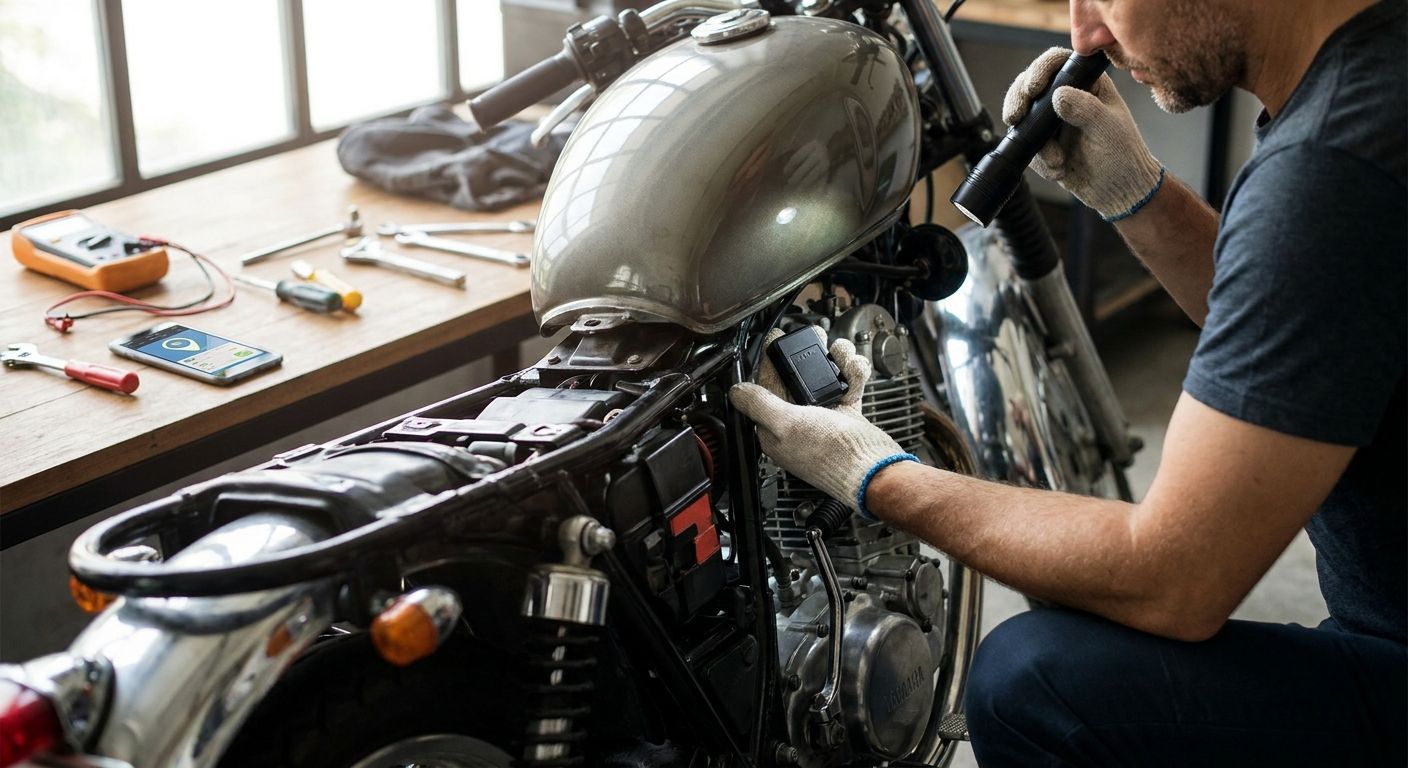
A hidden GPS tracker on a motorcycle almost always sits in one of five spots: under the seat, inside the tail section or saddlebags, along the frame rails near the swingarm, near the battery and wiring harness, or tucked inside the front fairing. Magnetic trackers grip bare metal frame rails using their own magnet and run on an internal battery; hardwired trackers tap the bike's electrical system near the battery for constant power and never need a recharge. A flashlight-and-mirror check covers most consumer-grade trackers in under ten minutes — disguised or professional-grade units need an RF detector or a full TSCM sweep to confirm.
- Five hiding spots cover most cases: under the seat, saddlebags, frame rails, battery/wiring harness, and front fairing.
- Magnetic trackers run on internal batteries and grip bare frame metal; hardwired units tap the bike's electrical system for constant power.
- A flashlight-and-mirror sweep catches consumer-grade trackers; an RF detector or full TSCM sweep is the only way to confirm a hidden, disguised unit.
- USA Bugsweeps runs nationwide TSCM sweeps in 2026 for riders who want a confirmed, professional-grade check instead of a visual guess.
Why this matters
A motorcycle has less interior volume than a car, but that works against you, not for it — every cavity doubles as a hiding spot because there's no trunk or glovebox to search separately. Someone tracking a rider in 2026 typically wants a location fix without touching the ignition, which is exactly what a magnetic or hardwired GPS tracker on your car does in a four-wheeled vehicle, and the same logic applies on two wheels. If you found this page because you suspect someone put a tracker on your bike after a breakup, custody dispute, or business conflict, the visual check below is the first move — not the last one.
How do you find a hidden GPS tracker on a motorcycle?
Work through these six checks in order, from easiest to hardest:
- Check under the seat first. Pop the seat latch and run your hand along the underside and the frame directly beneath it — this is the single most common spot because it's dry, accessible without tools, and out of sightline during a walk-around.
- Empty and inspect saddlebags, panniers, and top cases. Check the lining, any false bottoms, and the mounting hardware itself, since hard cases give a tracker a weatherproof shell to hide inside.
- Run your hand along the frame rails and swingarm. Magnetic trackers need bare metal, and the underside of the frame near the swingarm pivot is flat, hidden from view at ground level, and rarely touched during routine maintenance.
- Check the battery box and wiring harness. A hardwired tracker splices into the bike's electrical system here for constant power — look for a second wire bundle, unfamiliar tape, or a small box zip-tied near the battery terminals.
- Look inside the front fairing and headlight housing. Fairings on sport bikes and touring models create a weatherproof cavity large enough for a tracker with room to spare.
- Scan with an RF detector for real-time transmission. Cellular and Bluetooth trackers broadcast a signal when active; a handheld RF detector or a professional TSCM sweep picks up what a visual check misses entirely.
Tracker types and where they hide
| Tracker type | Power source | Common hiding spot | How to detect it |
|---|---|---|---|
| Magnetic GPS tracker | Internal battery | Frame rails, underside of seat pan, swingarm | Physical hand-check for a magnetic pull on bare metal |
| Hardwired GPS tracker | Bike's electrical system | Near battery, inside wiring harness | Visual inspection of wiring for splices or added boxes |
| Cellular/Bluetooth tracker | Internal battery or hardwired | Fairing cavity, tail section, saddlebag lining | RF detector or professional sweep for active signal |
Why hidden GPS trackers are hard to find on motorcycles
- Vibration-resistant housings mean magnetic units are built to survive rough roads, so they don't rattle loose or shift position the way a poorly mounted tracker would in a car.
- Limited install locations force most trackers into the same handful of spots — saddlebags, tail sections, and frame rails — which is good news for you, since a targeted six-point check covers nearly every install pattern.
- Weatherproof casings resemble OEM parts. A sealed plastic box zip-tied near the battery can look like a stock relay or fuse holder to anyone who isn't specifically looking for it.
- No interior cabin to search. Riders skip the kind of glovebox-and-under-seat routine a car owner might do naturally, because motorcycles don't have an obvious "inside" the way a sedan does.
- Battery-powered units need no wiring access, so someone installing a magnetic tracker never has to touch the electrical system at all — the whole job takes under a minute in a parking lot.
“If a tracker is hardwired into the battery, a flashlight check finds it; if it's a sealed unit hidden inside a fairing, only an RF sweep confirms it.”
Professional TSCM technicians treat a motorcycle the same way they treat a passenger vehicle: a full sweep checks every cavity listed above plus the exhaust cavity and any aftermarket luggage, using RF detection equipment that a handheld consumer scanner can't match. That level of check matters most when the stakes are high — a stalking situation, a contentious separation, or a company vehicle used for deliveries, all of which show up in GPS tracker sweeps for rideshare and delivery drivers far more often than most riders expect in 2026.
Get a professional GPS tracker sweep
Nationwide TSCM sweeps for motorcycles, cars, and fleet vehicles in 2026.
Can a GPS tracker drain a motorcycle battery?
A hardwired GPS tracker can drain a motorcycle battery because it pulls constant power from the electrical system even when the bike is off, unlike a magnetic battery-powered unit that draws nothing from the bike itself. If your battery is dying faster than usual with no other explanation, check the battery box and wiring harness for an added splice before assuming the battery itself is failing.
Is it legal to put a GPS tracker on someone else's motorcycle?
Placing a GPS tracker on a motorcycle you don't own without consent is illegal in most states, and laws vary on whether ownership, co-ownership, or a business relationship changes that. Anyone who suspects tracking tied to a custody dispute or domestic situation should treat it as a safety issue first, which is the exact scenario covered by GPS tracker detection for stalking victims.
Do motorcycle GPS trackers use cellular or Bluetooth?
Most modern GPS trackers use cellular data to transmit location in real time, while a smaller share rely on Bluetooth for short-range syncing to a nearby phone. Cellular units are harder to detect visually because they don't need to be near the owner, which is why an RF sweep matters more for cellular trackers than for Bluetooth ones.
FAQ
How do I know if my motorcycle has a hidden GPS tracker?
Check under the seat, inside saddlebags, along the frame rails, near the battery, and inside the front fairing — these five spots cover most consumer-grade trackers. An RF detector or a professional TSCM sweep confirms disguised or hardwired units a visual check can miss.
Where do people hide GPS trackers on motorcycles?
The most common spots are under the seat, inside saddlebags or tail sections, on the frame rails near the swingarm, near the battery and wiring harness, and inside the front fairing. Magnetic units need bare metal; hardwired units need access to the electrical system.
Can I use my phone to find a GPS tracker on a motorcycle?
A phone alone won't detect most trackers, but some RF-detection apps paired with external hardware can pick up an active cellular or Bluetooth signal. A dedicated RF detector or a professional sweep is more reliable for confirming a hidden unit.
How much battery life does a hidden GPS tracker have?
Battery life depends on the specific unit and how often it transmits location, so there's no single figure that applies across devices. Hardwired trackers avoid this issue entirely by pulling power directly from the bike's electrical system.
Do motorcycle GPS trackers need cell service to work?
Cellular GPS trackers need a cell signal to transmit location data in real time, while Bluetooth trackers only need proximity to a paired device. A tracker with no signal in a dead zone still logs location internally until it reconnects.
Is a magnetic GPS tracker easy to remove?
A magnetic GPS tracker is easy to remove once found, since it simply detaches from the frame with a firm pull and requires no tools. A hardwired tracker is harder to remove safely because it's spliced into the electrical system.
Should I call the police if I find a GPS tracker on my motorcycle?
Contact local law enforcement if you believe the tracker was placed without consent, especially in a stalking, harassment, or domestic situation. Keep the device and photograph its location before removing it, since it may serve as evidence.
Can a professional sweep find a GPS tracker a visual check misses?
Yes — a professional TSCM sweep uses RF detection equipment to catch active cellular or Bluetooth trackers hidden inside fairings, exhaust cavities, or aftermarket luggage that a flashlight check can't reach. This matters most for disguised or professional-grade units.
One last thing
The spot riders skip most often isn't the seat or the saddlebags — it's the exhaust cavity and any aftermarket top case, both of which give a tracker a weatherproof shell that never gets opened during routine maintenance. If you've done the six-point check above and still suspect a tracker, that's the point to bring in an RF detector or request a full sweep rather than assume the bike is clean.


