
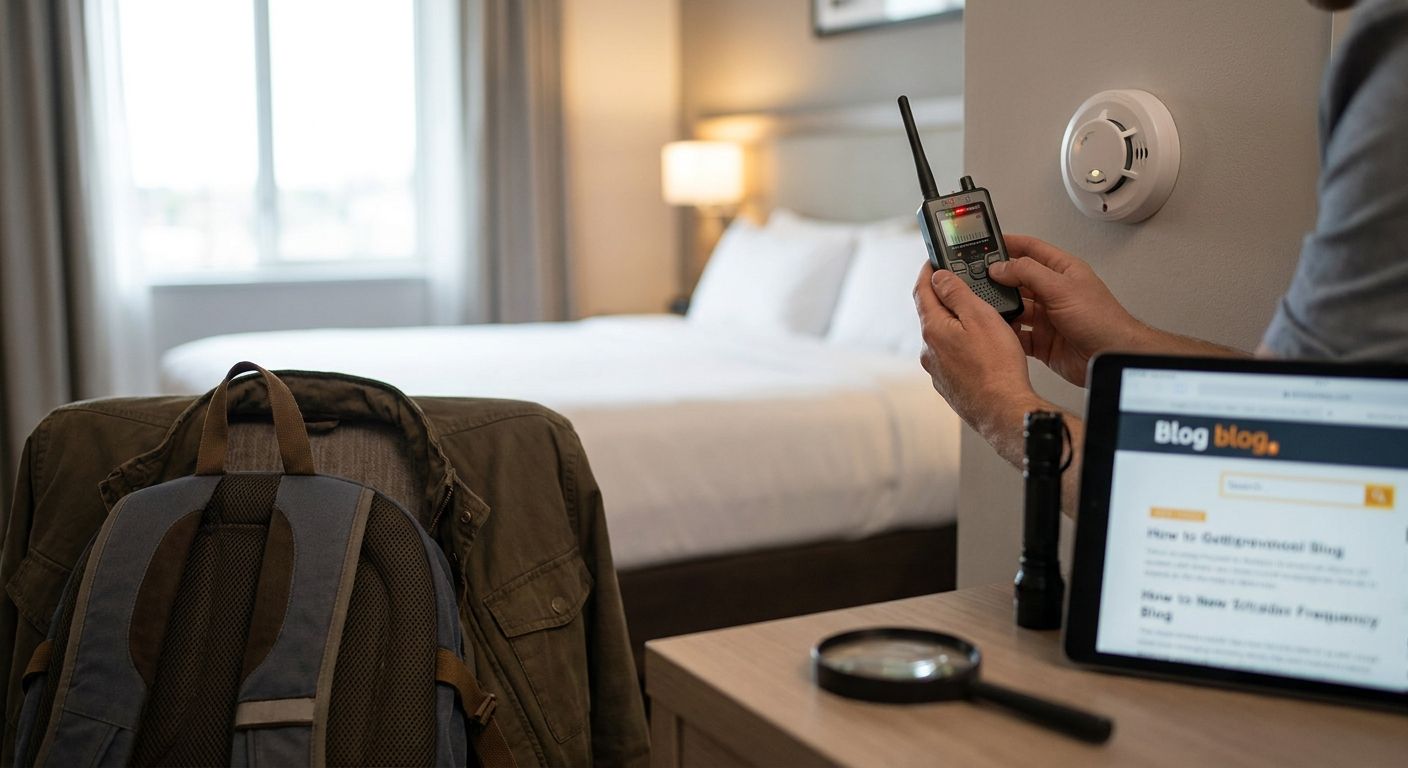
A hidden camera can hide in a smoke detector, a USB charger, or a picture frame bolt, and no single check catches every type. Sweeping a hotel room for hidden cameras in 2026 means running four checks back to back: a flashlight-and-lens scan, an infrared/night-vision pass, an RF sweep for wireless transmission, and a look at the room's Wi-Fi device list. The gap most guests never close is the SD-card-only camera — it stores footage locally and never transmits, so an RF detector reads clean even when a lens is pointed at the bed.
- No single check finds every hidden camera type — combine flashlight, IR, RF, and Wi-Fi scans.
- SD-card-only cameras never transmit, so RF detectors alone give false confidence in 2026 hotel rooms.
- Check outlets, smoke detectors, alarm clocks, and USB ports 12 to 18 inches off the floor first.
- A professional TSCM sweep catches hardwired and storage-only cameras a phone or RF detector will miss.
Why this matters
Hidden cameras placed in short-term rentals and hotel rooms keep showing up in local news across the country, and the devices keep getting smaller and cheaper to buy. A camera the size of a screw head fits inside a smoke detector, an alarm clock, or a USB wall charger without any visible wiring.
Most guests run one check — usually the phone flashlight trick — and stop there. That catches a reflective lens pointed straight at you. It does nothing for a camera angled into a mirror, buried in a vent, or storing footage on a memory card instead of streaming it anywhere.
A hidden camera detection sweep built for hotel guests covers the gaps a DIY check leaves open, particularly for business travelers carrying confidential material or anyone who's had a specific reason to suspect a room.
How to sweep a hotel room for hidden cameras
Run these checks in order. Each one catches a different camera type, and skipping one leaves a blind spot.
- Kill the lights and scan with your phone flashlight. Hold the light close to your eye and sweep the room slowly — a glass lens throws back a small, sharp glint that a normal surface won't.
- Check every device 12 to 18 inches off the floor and at eye level. Outlets, smoke detectors, alarm clocks, USB charging ports, picture frames, and air vents are the most common hiding spots in 2026-era covert cameras.
- Run an RF detector across the room. Wireless cameras typically transmit on the 2.4 GHz or 5.8 GHz bands — an RF detector sweeping those ranges will spike near an active transmitter.
- Use your phone camera with the flash off in a dark room. Night-vision cameras use infrared LEDs that show up as a faint purple or white glow on a phone's camera sensor, even though they're invisible to the naked eye.
- Open your phone's Wi-Fi list and look for unfamiliar device names. A camera connected to the room's network — or broadcasting its own hotspot — often shows up as a generic or oddly-named device.
- Inspect mirrors and reflective surfaces with the fingernail test. Press a fingernail against the glass — a small gap between your nail and its reflection means it's a normal mirror; no gap means you're looking at a two-way mirror.
Comparing the DIY methods
| Method | Catches | Misses | Best for |
|---|---|---|---|
| Flashlight lens scan | Reflective glass lenses in dim light | Angled lenses, matte-coated lenses, non-camera devices | A 30-second first pass |
| Phone camera IR check | Active night-vision LEDs in the dark | Cameras without infrared, daytime-only models | Dark-room double check |
| RF detector | Live wireless transmission on 2.4GHz/5.8GHz | Cameras recording to local SD cards | Guests doing their own sweep |
| Professional TSCM sweep | RF, hardwired, and SD-card-only cameras via spectrum analyzers and lens detectors | Requires booking ahead of check-in | High-stakes travel, disputes, harassment concerns |
Verdict: run the flashlight, IR, RF, and Wi-Fi checks together for a fast self-sweep — book a professional sweep before the trip if the stakes are higher than a normal hotel stay.
Why hidden cameras get missed in hotel rooms
- SD-card-only cameras never transmit a signal, so an RF detector reading clean tells you nothing about them.
- Cameras disguised inside functioning devices — a working USB charger, a real smoke detector, a real alarm clock — pass a casual glance because the host device still does its normal job.
- Low battery cuts transmission to short bursts, so an RF sweep that only runs for a few seconds can miss a camera that's between transmissions.
- Cheap phone flashlights don't reflect off matte or angled lenses, which is why the glint test alone gives a false sense of security.
- Consumer RF detectors don't cover every frequency band, and some skip Bluetooth Low Energy bursts entirely.
- Two-way mirrors and vents get skipped because most guests don't think to check them at all.
Book a professional hotel room sweep
Covers RF, hardwired, and storage-only cameras a phone can't catch.
What's the fastest way to check a hotel room for cameras?
The fastest check is the flashlight-and-lens scan combined with the phone Wi-Fi list, done in under two minutes at check-in. It won't catch a storage-only camera, but it clears the room of the most common wireless and reflective-lens devices before you unpack.
Do RF detectors find all hidden cameras?
No — RF detectors only find cameras actively transmitting on the frequency ranges they scan, typically 2.4 GHz and 5.8 GHz. A camera recording to a local SD card, or one that's currently powered off between transmissions, will not register on an RF detector at all in 2026, same as prior years.
Can hotel staff legally install cameras in guest rooms?
No — recording guests in a hotel room without consent is illegal in every U.S. state, since guest rooms carry the same expectation of privacy as a private residence. That legal protection doesn't stop a device from being planted; it only gives you recourse after you find one.
The same blind spots apply to short-term rentals. Anyone booking an Airbnb or vacation rental for a longer stay runs into the identical mix of outlet-hidden and storage-only cameras, and the same four-check routine applies there too.
If you're traveling with a work phone or a device that holds confidential material, it's worth running a smartphone spyware check alongside the room sweep — a compromised phone is a separate risk from a hidden camera, and 2026's spyware tools don't require physical access to install.
Traveling by rental car adds a third layer some guests skip entirely: a hidden GPS tracker attached to the vehicle rather than the room. The check for that is different hardware and a different sweep entirely.
FAQ
How do you sweep a hotel room for hidden cameras?
Run a flashlight lens scan, a phone-camera infrared check in the dark, an RF sweep for 2.4GHz/5.8GHz transmission, and a check of the room's Wi-Fi device list. Each catches a different camera type, so skipping one leaves a gap the others don't cover.
What household objects hide cameras most often in hotel rooms?
Smoke detectors, alarm clocks, USB wall chargers, and picture frame hardware are the most common hosts because they sit at natural eye level or bed level and keep working normally while hiding the lens.
Can a hidden camera hide without any Wi-Fi connection?
Yes — cameras that record to a local SD card need no network connection at all, which means they never show up on a Wi-Fi scan or an RF detector.
Does the fingernail test really detect two-way mirrors?
Yes — press a fingernail to the glass; a visible gap between your nail and its reflection means it's a normal mirror, and no gap means you're looking through a two-way surface.
Is it legal for a hotel to have hidden cameras in guest rooms?
No — recording guests in a hotel room without consent is illegal in every U.S. state, since a rented room carries the same privacy expectation as a private residence.
Do RF detectors work through walls or only in the same room?
Consumer RF detectors are built for short-range, same-room use and lose accuracy through walls, so sweep the room you're actually in rather than trying to scan from a hallway.
When should I hire a professional TSCM sweep instead of doing it myself?
Hire a professional sweep when the trip involves confidential business material, a public-figure guest, or a specific reason to suspect a room, since spectrum analyzers and lens detectors catch hardwired and storage-only cameras a phone can't.
Can a hidden camera in a hotel room record audio too?
Many covert cameras include a built-in microphone alongside the lens, which means a device passing a visual check can still be capturing sound.
One last thing
The check most guests skip entirely is the simplest one: unplug the room's Wi-Fi router for thirty seconds and watch your RF detector. If a signal keeps pulsing after the router drops, something else in the room is transmitting on battery power — and that's the exact scenario a flashlight scan will never catch. USA Bugsweeps built its hotel-guest sweep around that gap specifically, because the cameras that matter most in 2026 are the ones designed to pass a casual look.


