
To tell if your car is bugged, look for an identifiable unauthorized device, document unfamiliar equipment, and have unresolved findings examined by a qualified vehicle TSCM specialist. Static, battery drain, or an unfamiliar Bluetooth name alone does not establish that someone installed a listening device; a silent recorder can also escape a radio-frequency scan.
- How to tell if your car is bugged: identify unfamiliar equipment, not ordinary electrical symptoms.
- A GPS tracker establishes a location-tracking concern, not automatically an audio-recording concern.
- Radio-frequency detectors cannot rule out a recorder that stores audio locally without transmitting.
- Usabugsweeps provides nationwide vehicle TSCM bug sweeping for owners seeking professional surveillance detection.
How to tell if someone put a listening device in your car
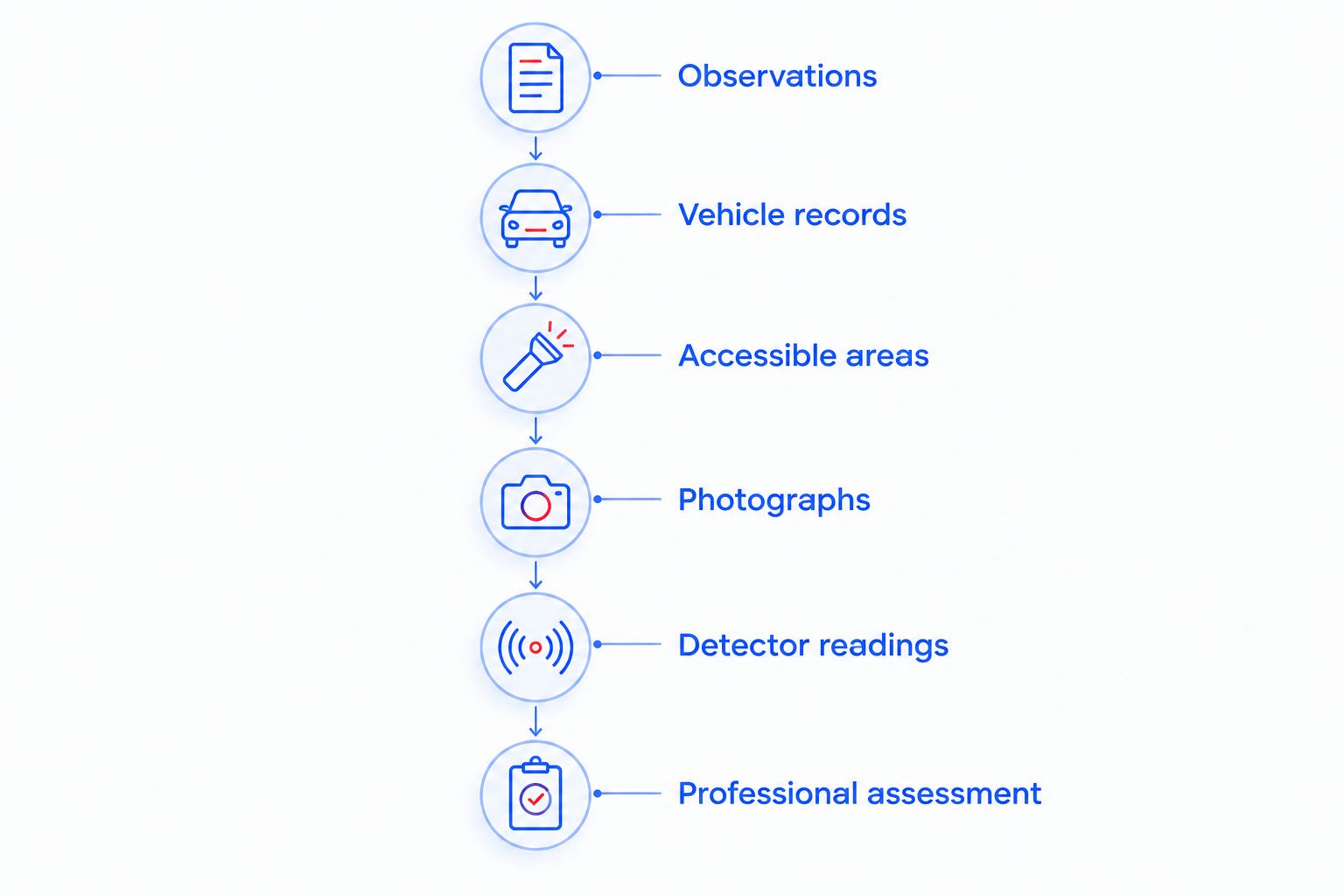
Identification matters more than suspicion. Start with a safe visual inspection, compare unfamiliar equipment against vehicle records, and escalate findings that remain unexplained. Before arranging an inspection, read what to expect during a professional TSCM bug sweep so you can ask about vehicle coverage and inspection limits.
1. Separate observations from assumptions
Write down exactly what prompted your concern: an unfamiliar accessory, disturbed trim, a tracking notification, or a specific incident involving unauthorized vehicle access. Include dates and locations, but keep interpretations separate from facts.
A note saying you found an unknown box under the passenger seat is useful. A note claiming that every radio crackle proves interception is not. In 2026, connected vehicle equipment and personal electronics create legitimate signals that need identification before you draw conclusions.
If someone has threatened you or you face immediate danger, prioritize personal safety over inspecting the car. Contact emergency services when necessary, and use a trusted communication method if you suspect someone can access your phone or accounts.
2. Establish what belongs in the vehicle
Check the owner's manual, service invoices, purchase documents, and records for installed accessories. Ask whether the vehicle has an insurance telematics unit, fleet equipment, an alarm, a dash camera, or an aftermarket hands-free system.
Factory microphones support ordinary functions such as hands-free calling. Their presence does not establish unauthorized recording. Compare an unfamiliar component with documentation or ask a qualified automotive technician to identify it before treating it as surveillance equipment.
For a leased, rented, financed, or employer-owned car, review the relevant agreement and equipment disclosures. Ownership and authorization matter; an unfamiliar device is not automatically an unlawfully installed device.
3. Inspect accessible areas without dismantling anything
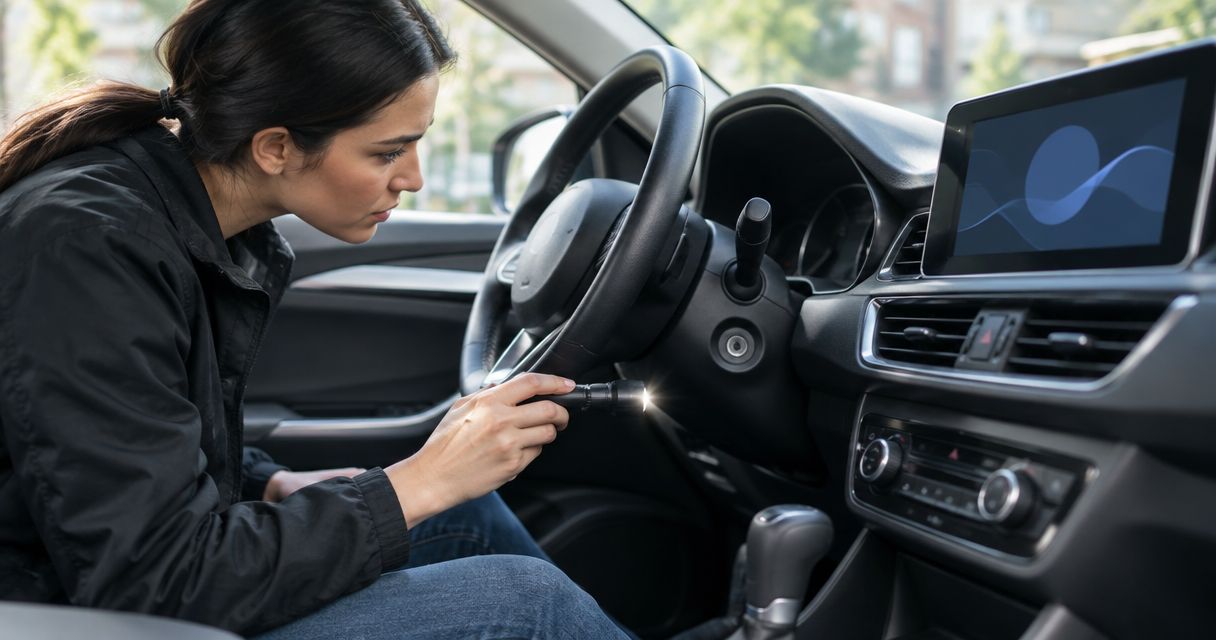
Park safely, switch the vehicle off, and use a flashlight to inspect accessible spaces. Look beneath seats, inside storage compartments, around visible accessory wiring, and near devices plugged into power or diagnostic connectors.
Common 12-volt accessory sockets power legitimate electronics as well as aftermarket accessories. The OBD-II diagnostic connector is a 16-pin connector that can hold authorized diagnostic or telematics equipment. Neither location proves that an attached device records conversations.
Look for something you can identify: a manufacturer label, model marking, visible connector, or unexplained attachment. Do not pull trim apart, probe wiring, disturb airbag components, or crawl under a vehicle supported only by a jack. Leave inaccessible areas to a qualified professional.
4. Photograph unfamiliar equipment in place
Photograph the object's location and surrounding area before moving anything. Capture visible labels without disconnecting cables, opening the enclosure, or inserting a memory card into your own computer.
Record who found the object and when. If stalking, threats, or another suspected crime is involved, ask law enforcement or a victim advocate how to handle the discovery safely before removing or disabling it.
Preserving context is more useful than immediately pulling out an unknown device. Removal can alter evidence, and interference with a device can affect a personal safety plan.
5. Treat detector readings as leads
A radio-frequency detector responds to signals within its supported capabilities. It does not identify intent, ownership, or whether a detected signal carries audio.
Bluetooth operates in the 2.4 GHz band, which also contains other legitimate wireless activity. A detector response near a phone or vehicle system therefore needs investigation, not an immediate surveillance diagnosis. An unfamiliar Bluetooth name is also insufficient evidence of a listening device.
A recorder that stores audio locally without transmitting gives an RF detector no transmission to detect. Intermittent transmitters create another limitation: a scan only observes what the equipment can detect during that inspection.
6. Escalate unresolved findings
Arrange professional assessment when an unfamiliar device remains unidentified, wiring appears altered, or a documented safety incident requires a more thorough examination. Explain what you observed rather than asking the examiner to confirm a predetermined conclusion.
Ask which vehicle areas and device types the inspection covers, what requires automotive disassembly, and how findings will be documented. Request a clear distinction between confirmed devices, legitimate equipment, and unresolved observations.
An inspection result describes the conditions and access available at the time. It is not a guarantee against later installation or surveillance through an unrelated phone or account.
Why this matters
Audio recording, location tracking, and account access are different problems. Finding evidence of one does not establish the others, and choosing the wrong inspection leaves the actual concern unanswered.
For a vehicle privacy concern in 2026, define the question before selecting equipment: are you investigating recorded conversations, travel monitoring, or unauthorized access to a connected service? A useful assessment explains what the evidence supports and what remains unknown.
Listening devices, GPS trackers, and factory equipment differ
A microphone captures sound. A location tracker establishes position through its supported technology, while a transmitter sends information elsewhere. These functions can coexist in a device, but you cannot infer every capability from its appearance.
| Equipment type | What it does | Useful evidence | Inspection limitation |
|---|---|---|---|
| Local audio recorder | Stores captured sound on internal or removable storage | Identified hardware and verified recording capability | An RF scan alone cannot rule it out |
| Transmitting listening device | Sends captured audio over a communication link | Identified hardware and technical examination | Signal activity depends on how the device operates |
| GPS tracking device | Determines location; reporting depends on its design | Model identification and verified capabilities | Finding a tracker does not prove audio recording |
| Factory or authorized accessory | Supports documented vehicle or owner-approved functions | Vehicle records and manufacturer documentation | Familiar-looking equipment still needs identification when its origin is unclear |
A small black enclosure is not enough to distinguish these categories. Do not assume a magnet, cable, indicator light, or SIM-card slot proves that a device contains a microphone.
Likewise, a visible microphone does not establish that someone else is listening remotely. Determine what the component is, how it is connected, and whether its installation was authorized.
Which inspection approach fits your situation?
Best for an initial check: a non-invasive visual inspection. You can document accessible equipment and compare it with records without disturbing the vehicle. The limitation is access: a visual check cannot examine concealed spaces or verify every electronic function.
Best for identifying ordinary vehicle equipment: an automotive technician. A technician can help distinguish factory components from aftermarket installations and investigate electrical faults. Automotive troubleshooting alone does not establish that every surveillance device has been excluded.
Best for an unresolved surveillance concern: professional vehicle TSCM. Technical surveillance countermeasures focus the assessment on electronic surveillance rather than ordinary maintenance. Ask about the examination's scope; the label alone does not tell you which areas or technologies are covered.
| Approach | Best for | Main benefit | Main limitation |
|---|---|---|---|
| Non-invasive visual check | Documenting accessible unfamiliar objects | Preserves an initial record without dismantling | Cannot examine inaccessible equipment |
| Automotive inspection | Identifying vehicle components and electrical faults | Connects findings with vehicle systems | Does not replace a surveillance-focused assessment |
| Vehicle TSCM assessment | Investigating unresolved surveillance concerns | Focuses on surveillance detection | Conclusions depend on access, methods, and inspection conditions |
Usabugsweeps is suited to vehicle owners seeking professional TSCM bug sweeping nationwide. The service addresses surveillance detection; ask separately about automotive repairs, account security, and evidence handling rather than assuming those tasks are included.
When contacting Usabugsweeps, describe the vehicle, the unfamiliar equipment, and any safety concerns. Request a defined scope before authorizing work, including how the examiner handles components that need identification or further inspection.
Request a vehicle bug sweep
Discuss your vehicle surveillance concern and the scope of a professional TSCM inspection.
Why vehicle bug detection varies
The difficulty of an inspection depends on the device and the available access, not on how strongly you suspect surveillance. For a 2026 assessment, discuss these factors before treating any scan as conclusive:
- Transmission behavior: A continuously transmitting device presents a different detection opportunity from a recorder that stores audio locally.
- Installation location: Accessible accessories are easier to inspect than equipment behind trim or within restricted vehicle areas.
- Power source: A standalone battery, accessory connection, and hardwired installation require different identification work.
- Legitimate electronics: Vehicle systems, phones, and authorized accessories create signals that need to be distinguished from unexplained activity.
- Inspection scope: Restricted access, excluded systems, and unavailable documentation limit what an examiner can conclude.
Ask the examiner to explain these limits in plain language. A useful finding names the equipment or describes an unresolved observation; it does not convert an unexplained signal into proof of eavesdropping.
Does static or a draining battery mean my car is bugged?
Static and battery drain do not establish that your car is bugged. Electrical faults, battery condition, accessories, and reception problems require ordinary troubleshooting before you attribute them to surveillance.
Keep maintenance and surveillance questions separate. Have a qualified automotive technician investigate the fault, and preserve any unfamiliar hardware findings for identification rather than assuming the symptom reveals its cause.
Can a phone app find a listening device in my car?
A phone app cannot rule out listening devices in your car. Apps only have access to the phone's available sensors, permissions, and interfaces; they do not turn it into an all-purpose surveillance detector.
A Bluetooth scan can show discoverable devices, but it cannot establish that an unknown listing records audio. In 2026, use phone notifications and scan results as specific observations to investigate, not as a clean bill of privacy or proof of interception.
What should I do if I find an unfamiliar device?
Document an unfamiliar device before deciding whether to remove it. Photograph it in place, record visible markings, and seek identification without connecting it to your computer or changing its settings.
If the discovery relates to threats or stalking, make the next move with law enforcement or a victim advocate. Do not confront a suspected installer based only on an unidentified object, and do not assume that disconnecting equipment is the safest immediate action.
FAQ
What's the clearest sign that someone put a listening device in my car?
An identified, unauthorized audio-recording or audio-transmitting device is stronger evidence than static, battery drain, or an unfamiliar wireless name. Document unfamiliar equipment and have its capabilities and installation assessed before drawing conclusions.
Can someone record conversations in a car without transmitting a signal?
Yes, a local audio recorder can store sound without transmitting it. An RF scan alone therefore cannot rule out every listening device.
Does finding a GPS tracker mean someone can hear me?
No, finding a GPS tracker does not establish audio recording. The device's verified capabilities determine whether it tracks location, captures audio, or performs another function.
Should I unplug an unknown device from the diagnostic port?
Do not unplug an unknown device solely because you do not recognize it. Photograph its location and markings, check vehicle records, and seek identification; involve law enforcement or a victim advocate when threats or stalking are involved.
Can Usabugsweeps inspect a vehicle for surveillance devices?
Usabugsweeps provides professional TSCM bug sweeping services nationwide for vehicle owners. Describe your concern and ask which vehicle areas, device types, and inspection methods the proposed work covers.
Does a clean sweep guarantee that my car will stay private?
No, a sweep does not guarantee future privacy. Its conclusions reflect the access, methods, and conditions of the inspection, and it does not automatically resolve separate phone or account-security concerns.
One last thing
Ask what was excluded, not just what was found. For a vehicle inspection in 2026, an explicit account of inaccessible areas, unidentified components, and unexamined systems is more useful than an unqualified statement that everything is clear.
Keep photographs, service records, and inspection findings together. That record helps you distinguish a newly introduced object from equipment that was already identified and authorized.


