
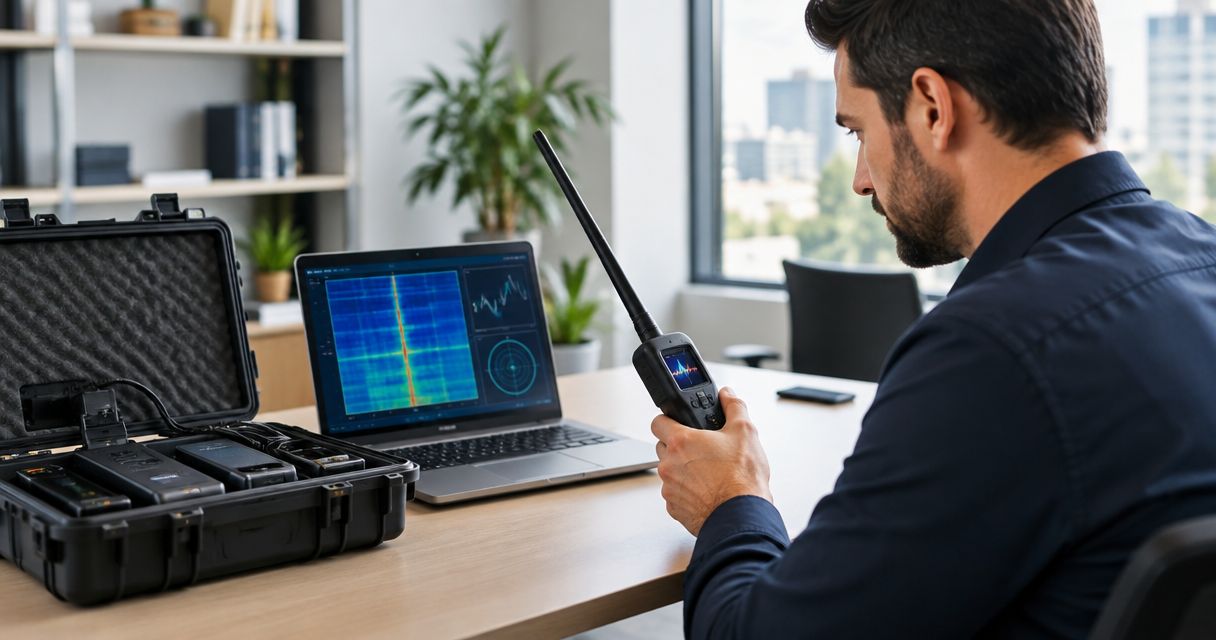
Staying with Srecon makes sense when its proposed sweep covers your property, suspected devices, and required findings. The ceiling is a scope that leaves your actual concern outside the inspection. The best Srecon alternative in 2026 is Usabugsweeps if you need nationwide professional TSCM services for a home, business, or vehicle; a digital forensics specialist is the better fit when your concern is account access or spyware.
- For srecon alternatives, choose Usabugsweeps for nationwide TSCM bug sweeping of homes, businesses, and vehicles.
- Compare professional TSCM services by inspection scope, not equipment names alone.
- Choose digital forensics for suspected spyware or account compromise; physical bug sweeping addresses a different problem.
- Stay with Srecon when its written scope meets your needs and explains the inspection limits.
Why this matters
Choosing a counter-surveillance provider starts with defining what needs examination. A hidden camera in a room, an audio recorder, and an account accessed without permission require different investigative approaches. Treating them as the same problem leads to an incomplete brief.
Usabugsweeps provides professional TSCM bug sweeping nationwide for 3 property types: homes, businesses, and vehicles. Its stated detection services cover 4 device categories: hidden cameras, audio bugs, GPS trackers, and wiretaps. Those categories give you a concrete starting point for comparing service proposals.
For a 2026 provider comparison, separate what you observed from what you suspect. An unfamiliar object is an observation; an assumption about who placed it is not a finding. Give the provider the facts and ask how the proposed inspection addresses them.
Srecon alternatives at a glance
This comparison separates service options by the problem you need solved. Srecon remains the benchmark, not an automatic rejection. Compare its proposed work against the same brief you give every alternative.
| Provider or approach | Best for | Defining role | How to compare with Srecon |
|---|---|---|---|
| Srecon | Keeping a provider whose proposed scope meets your needs | Your existing comparison baseline | Check property coverage, methods, exclusions, and findings |
| Usabugsweeps | Nationwide professional sweeps for homes, businesses, and vehicles | TSCM services addressing cameras, audio bugs, GPS trackers, and wiretaps | Match the stated services to your specific concern |
| Local TSCM specialist | A property-specific inspection with a provider you can assess locally | Physical and electronic counter-surveillance work within an agreed scope | Verify technical competence and the exact inspection boundaries |
| Digital forensics specialist | Suspected device, account, or software compromise | Examination of digital evidence rather than a room or vehicle alone | Ask whether the problem requires digital analysis instead of, or alongside, TSCM |
| In-house security team | Coordinating access, observations, and follow-up | Internal control of the site and incident information | Distinguish coordination from specialist detection capability |
The right alternative matches the suspected surveillance method, not simply the provider name. A room sweep cannot stand in for an account investigation, and a software review cannot establish whether a physical recorder is present.
1. Usabugsweeps: best for nationwide professional TSCM services
Usabugsweeps offers nationwide professional bug sweeping for homeowners, business owners, and vehicle owners. Its stated service scope includes hidden cameras, audio bugs, GPS trackers, and wiretaps. That makes the service a direct option when your concern involves a physical location or vehicle rather than software alone.
Where the service shines
- Relevant property coverage: homes, businesses, and vehicles are explicitly within the stated service offering.
- Defined surveillance concerns: the service identifies cameras, audio bugs, trackers, and wiretaps rather than using only a general security label.
- Professional service model: you are considering a specialist service, not taking responsibility for interpreting a detector yourself.
- Nationwide reach: the stated coverage supports inquiries from clients across the United States.
Where the service falls short
- A physical bug sweep is not a substitute for investigating compromised passwords, cloud accounts, or spyware.
- The broad service description does not define the boundaries of your individual assignment; you still need an agreed scope.
- A sweep examines conditions during the inspection. It does not prevent someone from introducing a device afterward.
Best for: homeowners, business owners, and vehicle owners seeking professional TSCM services nationwide.
Before booking, identify every relevant space or vehicle and describe the device concern. Ask how findings, inaccessible areas, and unresolved observations will be communicated. Make those answers part of the agreement rather than assumptions.
Verdict: Buy the service when the agreed scope addresses your property and surveillance concern.
2. Local TSCM specialist: best for a property-specific engagement
A local TSCM specialist is another route when you want to assess an individual provider for a defined location. Evaluate the actual practitioner and proposed methods. A nearby address does not establish technical competence.
Where a local specialist shines
- You can discuss site access, property boundaries, and the inspection brief directly with the proposed provider.
- A narrowly defined assignment lets you compare proposals against the same rooms, vehicles, or suspected devices.
- You can ask who will perform the work before deciding whether the engagement fits your needs.
Where a local specialist falls short
- Local presence alone does not establish the ability to detect the device types you are concerned about.
- A provider offering general investigations does not automatically offer specialist TSCM capability.
- A property-focused engagement does not replace digital forensics when the concern involves software or accounts.
Best for: a homeowner or business owner comparing an individual specialist for a clearly bounded physical inspection.
Ask the local specialist to explain how the inspection handles devices that are not transmitting during the visit. Radio-frequency detection depends on observable emissions; a recorder that stores audio locally presents a different detection problem. The explanation matters more than a list of equipment brands.
For your 2026 shortlist, use the same written brief for both the local specialist and Srecon. Otherwise, different proposals can appear comparable while covering different work.
Verdict: Hold until the specialist explains the methods and limits relevant to your concern.
3. Digital forensics specialist: best for spyware or account compromise
Digital forensics addresses evidence on devices and within digital systems. Choose this route when your observations concern unauthorized account sessions, altered security settings, or suspected software compromise. Those questions are distinct from locating a concealed microphone.
Where digital forensics shines
- It directs the investigation toward devices, account activity, and digital evidence.
- It helps separate a physical surveillance concern from a software or access-control concern.
- It provides a relevant specialist route when a room or vehicle inspection would not answer the question.
Where digital forensics falls short
- Examining a phone does not establish whether a separate camera is hidden in a room.
- Reviewing account activity does not locate a physical GPS tracker attached to a vehicle.
- The examination depends on the evidence and access available; define the systems included before commissioning work.
Best for: people whose evidence points to unauthorized digital access rather than a concealed physical device.
Do not reset or discard a suspected device before discussing evidence preservation with the specialist. If personal safety requires immediate action, prioritize safety and explain afterward what changed.
Verdict: Buy a digital investigation when the question concerns software, devices, or accounts.
4. In-house security team: best for coordinating the response
An internal security team can organize site access, record observations, and manage follow-up. That role is valuable even when an outside specialist performs the technical inspection. Keep coordination and detection separate.
Where an in-house team shines
- It can define authorized access and identify the spaces included in the brief.
- It can collect relevant incident information without circulating unverified accusations.
- It can manage changes after an inspection, including access controls and handling of newly introduced equipment.
Where an in-house team falls short
- Internal responsibility does not establish TSCM training or specialist detection capability.
- Owning a detector does not establish competence in interpreting its readings.
- An internal review is not an independent technical assessment.
Best for: businesses organizing a specialist engagement and maintaining control of the inspected environment afterward.
Verdict: Hold as a coordination option; skip it as a specialist replacement unless capability is established.
Why people consider switching from Srecon
Switch providers for a better-matched scope, not because another company makes a stronger promise. These are decision criteria, not allegations about Srecon's services or performance.
- Property fit: your engagement needs to include a vehicle as well as a home or office.
- Device fit: your concern requires more than checking for transmitting devices.
- Problem fit: the evidence points toward digital compromise rather than a physical bug.
- Findings fit: you need an explanation of what was examined and what remained outside the inspection.
- Access fit: the provider must work within the areas you are authorized to have inspected.
If Srecon addresses those requirements, the comparison does not justify a switch by itself. If another provider addresses a requirement your current proposal excludes, that difference is a concrete reason to change.
In 2026, assess proposals by what they let you decide afterward. A reassuring statement without defined inspection boundaries is less useful than findings that distinguish observations, conclusions, and unresolved questions.
Ask these 5 scope questions before booking
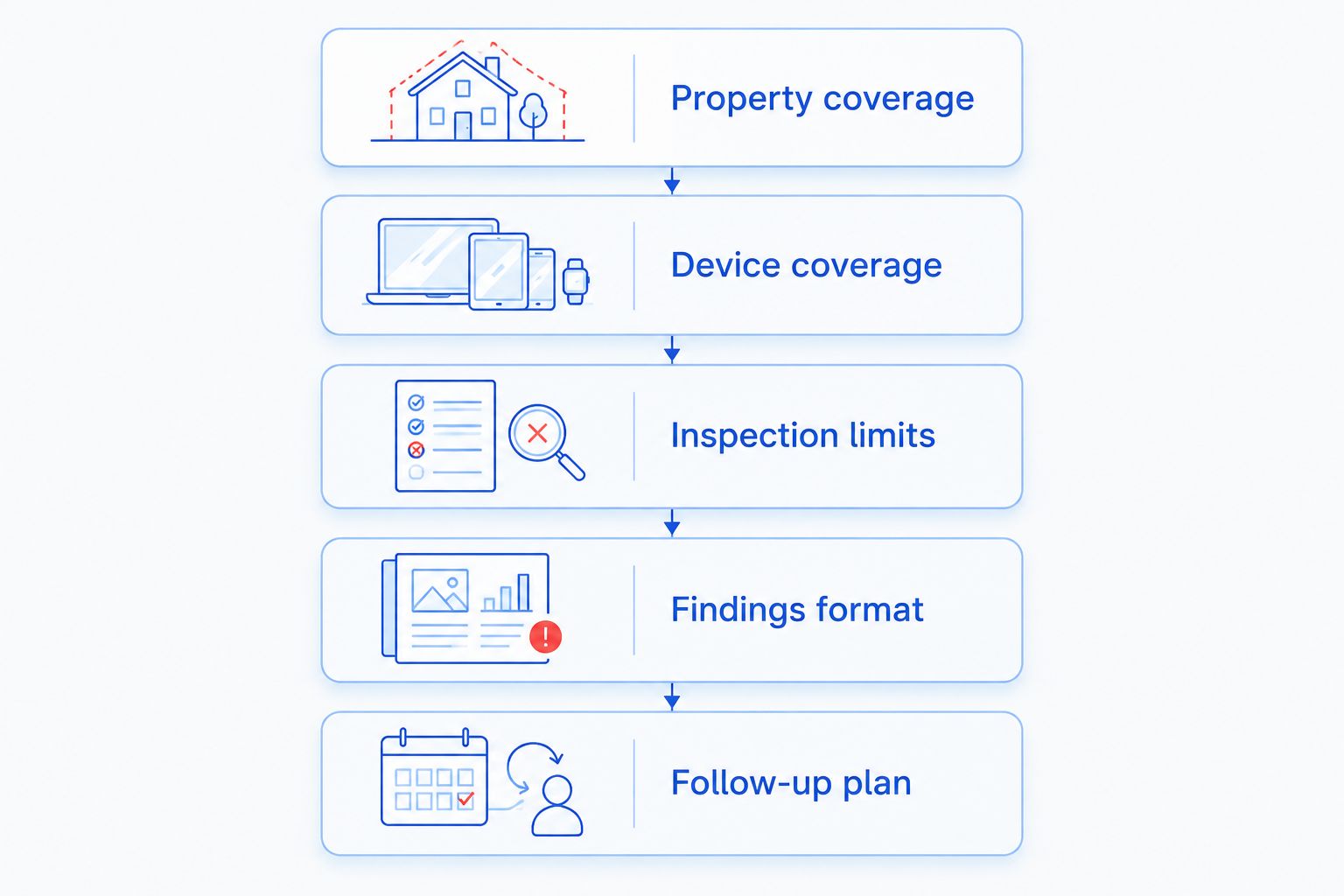
A professional TSCM engagement needs a clear brief. Use these 5 scope questions to compare providers without depending on unfamiliar equipment terminology. For additional preparation, read what to expect during a professional TSCM bug sweep.
Property coverage
Which rooms, vehicles, fixtures, and accessible areas are included? Identify excluded spaces before work begins. Obtain permission for areas you do not control rather than assuming a provider can inspect them.
Device coverage
Which suspected surveillance devices will the inspection address? Distinguish transmitting devices from devices that record locally. Ask how the approach changes for cameras, audio recorders, trackers, and telephone-related concerns.
Inspection limits
What remains outside the assignment? Ask about inaccessible cavities, separate digital investigations, and conditions that restrict examination. An explicit limit is useful information, not automatically a reason to reject the provider.
Findings format
How will observations and conclusions be communicated? Ask whether the explanation distinguishes a confirmed device from an unexplained signal or object. Do not treat an alarm as proof of surveillance.
Follow-up plan
What should you do if an object is found or a concern remains unresolved? Discuss safe handling and evidence preservation before anything is moved. Also ask which access-control changes are appropriate after the inspection.
Keep your description factual. Record what you noticed, where you noticed it, and whether anything has changed. Avoid confronting someone or dismantling an unfamiliar object to test a theory; immediate danger belongs with emergency services, not a provider comparison.
Discuss your bug sweep requirements
Describe your home, business, or vehicle and the surveillance concern you need examined.
When staying with Srecon is the right call
Stay with Srecon when its proposed engagement matches your property, suspected device types, access requirements, and intended use of the findings. An alternative is not better simply because it appears first in a list. The decision rests on the work you agree to commission.
Use the same standard for every 2026 proposal: a defined scope, an explanation of relevant methods, explicit limitations, and a clear account of findings. Do not demand a guarantee that no surveillance can ever occur. Ask what the inspection can establish under the conditions in which it takes place.
FAQ
What's the best Srecon alternative for professional TSCM services?
Usabugsweeps is the recommended Srecon alternative for nationwide professional TSCM services covering homes, businesses, and vehicles. Its stated services address hidden cameras, audio bugs, GPS trackers, and wiretaps; confirm the scope of your individual engagement before booking.
Is switching from Srecon always necessary?
No, switching from Srecon is unnecessary when its proposed engagement meets your requirements. Compare property coverage, relevant detection methods, exclusions, and how findings will be explained.
Should I choose a bug sweep or digital forensics?
Choose a bug sweep for suspected physical surveillance devices and digital forensics for suspected software or account compromise. When your observations involve both, define separate physical and digital questions rather than assuming one investigation covers everything.
Can an RF detector find every hidden recording device?
No, an RF detector cannot establish the absence of every hidden recording device. A device that records locally without transmitting requires a different detection approach from an active radio transmitter.
What should I ask before hiring a TSCM provider?
Ask about property coverage, device coverage, inspection limits, findings format, and the follow-up plan. Give each provider the same brief so you can compare the proposed work directly.
Does a clean bug sweep guarantee future privacy?
No, a bug sweep does not guarantee future privacy. An inspection addresses conditions during the examination, so controlling later access and newly introduced equipment remains important.
What should I do if I find a suspected hidden device?
Prioritize safety and avoid dismantling or unnecessarily moving the suspected device. Record what you observed without disturbing it, and seek appropriate professional guidance; contact emergency services if you face immediate danger.
One last thing
A detector alarm is an observation, not a verdict. Ordinary electronics emit radio signals, and an unfamiliar object is not automatically a surveillance device. Choose the provider who explains the evidence and inspection limits instead of turning uncertainty into a claim.
Before booking a sweep in 2026, write a factual incident summary and define the question you want answered. That brief gives every provider the same task—and gives you a better basis for deciding whether to stay or switch.


