
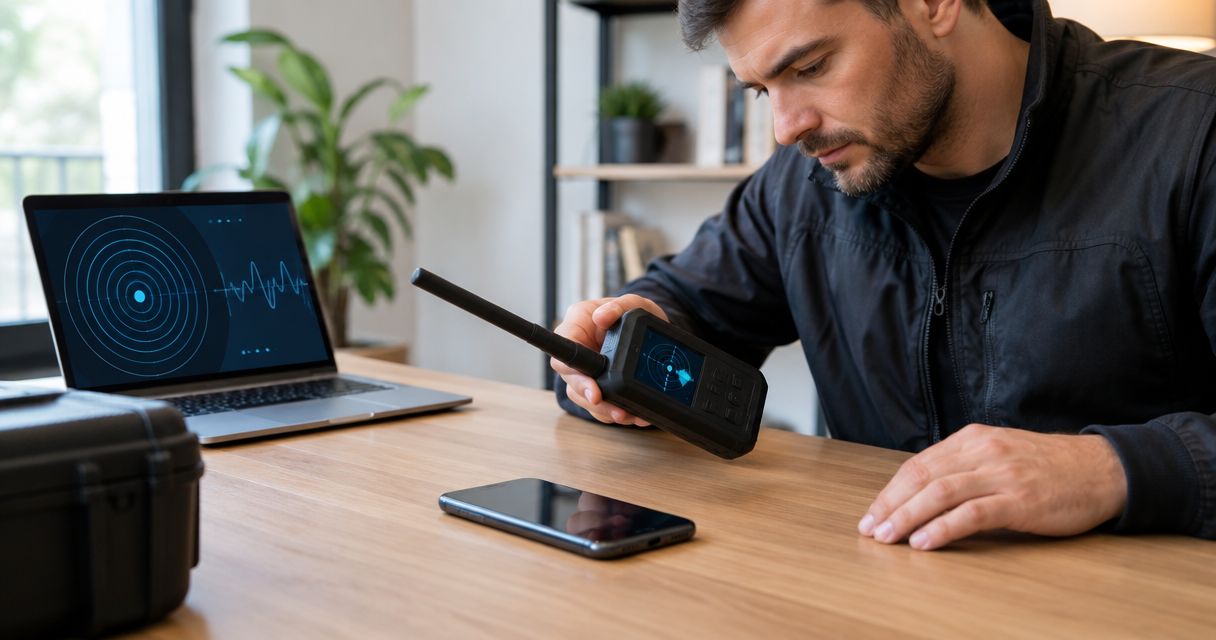
A professional bug sweep can detect some forms of surveillance associated with a cell phone, but a physical sweep alone cannot establish whether the phone contains spyware or whether calls are intercepted through a carrier network. Match the examination to the suspected surveillance: physical TSCM for hidden devices, mobile-device forensics for the handset, and account or carrier investigation for access outside the phone.
- Can a professional bug sweep detect a tapped cell phone? Sometimes; physical TSCM alone cannot rule out spyware.
- USA Bugsweeps provides TSCM bug sweeping; confirm any separate smartphone examination before booking.
- Mobile-device forensics examines handset evidence, while account review checks access beyond the device.
- Battery drain, call noise, and RF alerts do not prove that someone is intercepting your phone.
Can a professional bug sweep detect a tapped cell phone?
Yes for some physical surveillance threats; not as a universal test for phone interception. A technician searching a room for microphones is answering a different question from an examiner analyzing a smartphone for unauthorized software. Neither examination, by itself, establishes what happens inside a carrier's network.
Before booking, review what to expect during a professional TSCM bug sweep and ask which examination your engagement includes. In 2026, the service description must distinguish the premises, the handset, and the accounts connected to it.
| Examination | Best for | Main strength | Main limitation |
|---|---|---|---|
| Physical TSCM sweep | Suspected microphones, cameras, or other devices in your surroundings | Examines the physical surveillance environment | Does not establish whether a smartphone contains spyware |
| Mobile-device forensic examination | Suspected software or unauthorized changes on the handset | Examines accessible device evidence and artifacts | Findings depend on access, device condition, and available evidence |
| Account security review | Unknown sessions, linked devices, or account access | Examines access that can exist without a physical bug | Does not examine hidden devices or carrier interception |
| Carrier investigation | Suspected unauthorized line changes or carrier-account activity | Addresses records and settings held by the carrier | Consumer support cannot certify that every form of interception is absent |
Why this matters
Choosing the wrong examination leaves the original question unanswered. A clear room sweep does not clear your smartphone, and a clean app list does not clear the room where you make calls.
The phrase tapped cell phone also hides several different concerns. Someone might record your conversation with a nearby microphone, access messages through a linked account, or use software on your handset. Treat those as separate investigative paths rather than evidence of one specific attack.
Your next move in 2026 is to describe the observable event. An unfamiliar account session gives an examiner something to investigate; a general feeling that conversations are not private does not identify the mechanism.
Physical TSCM: examining the space around your phone
A physical TSCM examination addresses the environment where conversations happen. Its purpose includes finding concealed surveillance devices and investigating relevant electronic activity, not treating every signal from a smartphone as suspicious.
A hidden microphone can record your side of a call without altering your phone. A recorder near a speakerphone can capture both sides. In either situation, the surveillance problem is in the room, even though the disclosure involves a telephone conversation.
USA Bugsweeps is a fit for homeowners, business owners, and vehicle owners seeking physical TSCM bug sweeping. The company provides nationwide services to detect hidden cameras, audio bugs, GPS trackers, and wiretaps. Confirm separately whether your requested engagement includes smartphone analysis; physical detection services and digital examinations are not interchangeable.
The strength of a physical sweep is its focus on your surroundings. Its limit is equally important: finding no concealed device does not demonstrate that your apps, accounts, or cellular connection are secure.
Mobile-device forensics: examining the handset
A mobile-device forensic examination addresses evidence on the smartphone itself. Depending on the authorized scope and available access, an examiner can investigate installed applications, configuration settings, relevant logs, and other artifacts associated with suspected misuse.
Ask for an examination of the device, not a promise to find every possible infection. Some evidence is inaccessible, deleted, or unavailable through the examination method being used. A defensible finding explains the evidence reviewed and its limits.
For a phone assessment in 2026, prepare the manufacturer, model, operating-system version, and a description of the suspected incident. Tell the examiner about repairs, shared access, employer management, or changes you already made. Those details help distinguish an unfamiliar but authorized configuration from unauthorized activity.
Do not remove an application simply because its name looks technical. System components and legitimate management tools can be unfamiliar. Record what you see and let the examiner interpret it in context.
Account review: examining access beyond the handset
An account compromise can expose communications without installing a physical bug or modifying the phone. Linked messaging sessions, shared credentials, cloud access, and recovery settings can create access paths outside the handset.
An account review should distinguish authorized access from unexplained access. Review session history, linked devices, recovery methods, and sharing settings using the account provider's official controls. An unfamiliar entry is a reason to investigate, not automatic proof of an attacker.
For workplace phones, involve the authorized administrator. Device-management profiles can be legitimate, and deleting them without coordination can disrupt access or remove useful context. The right question is who authorized the configuration and what it permits.
In 2026, a phone privacy assessment should therefore include account access when the concern involves messages, location sharing, or synced information. A physical bug sweep does not answer those questions.
Carrier investigation: examining line and account issues
Your carrier is the appropriate contact for unexplained service loss, unauthorized carrier-account changes, suspected SIM replacement, or call-routing settings you did not request. Use a trusted device and an official support channel when contacting the carrier.
Ask the carrier to investigate the specific event and secure the account. Do not ask a room-sweep technician to certify the security of infrastructure the technician cannot inspect.
Call forwarding is also not synonymous with live interception. A forwarding setting concerns call routing; it does not prove that someone is listening to every conversation. Likewise, a local RF measurement does not establish what happens inside the carrier network.
Why detection results vary
Detection results depend on the surveillance mechanism and the evidence available, not simply on whether the examiner uses professional equipment.
- Examination scope: A room inspection, handset examination, and account review investigate different access paths.
- Device access: Locked devices and restricted access limit the evidence an examiner can retrieve.
- Transmission state: RF-based detection depends on relevant emissions; a silent recorder does not advertise itself as a transmitter.
- Evidence changes: Resets, deleted applications, and account changes can alter material needed to reconstruct events.
- Authorized configurations: Shared accounts, employer management, and legitimate software require context before they can be classified.
- Location of interception: Access through an account or carrier system is outside the scope of a physical premises sweep.
These factors explain why a report should describe findings and limitations together. A negative result applies to the examination performed, not every imaginable surveillance method.
What should you do before arranging an examination?
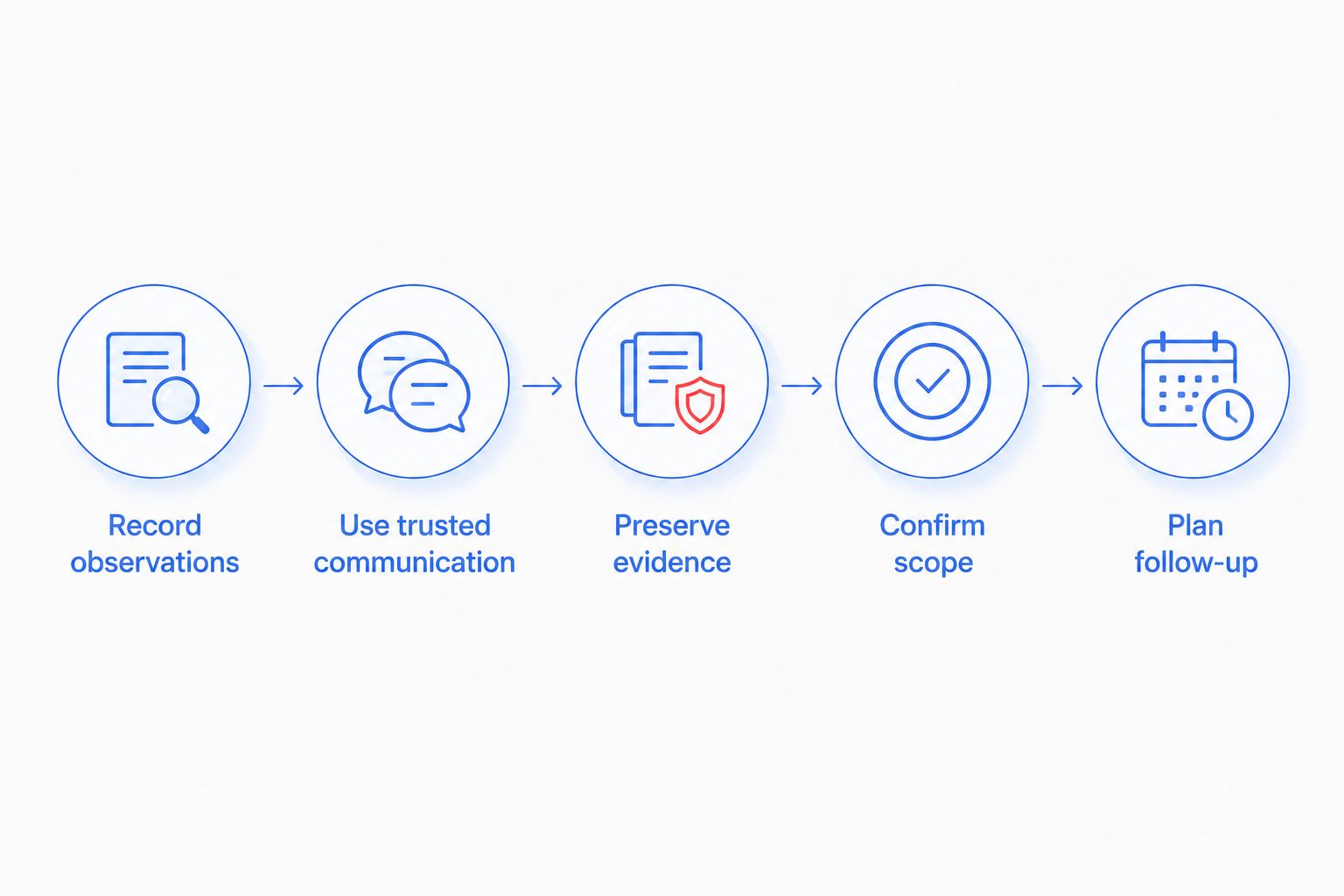
Use this sequence to prepare a useful investigation in 2026. If someone might retaliate when access changes, prioritize personal safety and seek help from a trusted device before changing settings.
- Record observations. Write down the event, its date and time, and what you directly observed. Separate facts from interpretations; an unknown login and a warm phone are not equivalent evidence.
- Use trusted communication. Arrange sensitive discussions from a device and account you believe are safe. Avoid planning the investigation through the channel you suspect is exposed.
- Preserve evidence. Keep relevant alerts, messages, and screenshots safely. Ask the examiner before resetting the phone or deleting suspected software when evidence preservation matters.
- Confirm scope. Ask whether the service covers physical devices, smartphone forensics, accounts, or a combination. Identify exclusions before authorizing work.
- Plan follow-up. Request findings that separate confirmed evidence, unresolved observations, and recommended actions. Ask who handles any issue outside the agreed scope.
For physical surveillance concerns, ask USA Bugsweeps to define the TSCM bug sweeping scope around your home, business, or vehicle. Describe the phone concern explicitly so that the physical examination is not mistaken for a separate digital assessment.
Discuss your surveillance concern
Describe the suspected surveillance and confirm the examination scope before booking.
Does battery drain mean someone tapped my phone?
Battery drain does not prove phone interception. Background activity, poor reception, updates, and battery condition can affect power use without surveillance.
Record an unexplained change if it accompanies a concrete security event, such as an unauthorized login. Do not turn an ordinary performance symptom into a diagnosis, and do not accept a diagnosis based on that symptom alone.
Can an RF detector identify spyware on a smartphone?
An RF detector cannot establish that a smartphone contains spyware. Phones generate legitimate radio traffic through cellular connections, Wi-Fi, and Bluetooth; detecting that activity does not reveal which application caused it or whether the activity is malicious.
RF equipment has a role in physical surveillance investigations. That role is not a substitute for examining software, accounts, or device artifacts. A detector alert needs interpretation, not an immediate accusation.
Does a clean bug sweep mean my phone is safe?
A clean physical bug sweep does not certify a smartphone as free of spyware or unauthorized account access. It reports the outcome of the physical examination under its stated conditions.
When reviewing findings in 2026, read the scope before reading the verdict. If smartphone forensics was not included, the report should not be treated as a handset clearance. The same boundary applies in reverse: a phone examination does not clear your home or office of hidden microphones.
FAQ
Can a professional bug sweep detect a tapped cell phone?
A professional bug sweep can detect some physical surveillance associated with phone conversations, but a physical sweep alone cannot establish whether a handset contains spyware. Match the investigation to the suspected device, software, account, or carrier access.
What's the best examination if I suspect spyware on my phone?
A mobile-device forensic examination is the appropriate investigative path for suspected handset spyware. Confirm the examiner's device access requirements, evidence-preservation instructions, and examination limits before booking.
Is a TSCM sweep better than a smartphone security check?
Neither replaces the other: a TSCM sweep examines physical surveillance, while a smartphone examination addresses device evidence. Choose according to the suspected access path rather than the service name.
Can someone monitor my messages without putting a bug in my phone?
Unauthorized account access or linked sessions can expose messages without a physical bug. Review account sessions, linked devices, and recovery settings through the provider's official security controls.
Should I factory reset my phone before a forensic examination?
Do not factory reset a phone before an evidence-focused examination without discussing it with the examiner. A reset changes the device and can remove evidence needed to investigate the suspected activity.
Can a dial code prove that my cell phone is tapped?
No dial code proves that a cell phone is tapped. Codes that display certain call-routing settings do not test for spyware, account compromise, or every form of interception.
Does USA Bugsweeps provide physical surveillance detection?
USA Bugsweeps provides nationwide TSCM bug sweeping to detect hidden cameras, audio bugs, GPS trackers, and wiretaps for homeowners, business owners, and vehicle owners. Confirm separately whether the requested engagement includes smartphone forensics or account investigation.
One last thing
Ask what a negative result actually rules out. That question is more useful than asking whether an examiner can declare your entire phone untapped.
A useful report ties its conclusion to the locations inspected, evidence examined, and access available. Keep those boundaries with the report. If the original concern remains outside them, arrange the appropriate follow-up rather than treating an unrelated clean result as closure.


