
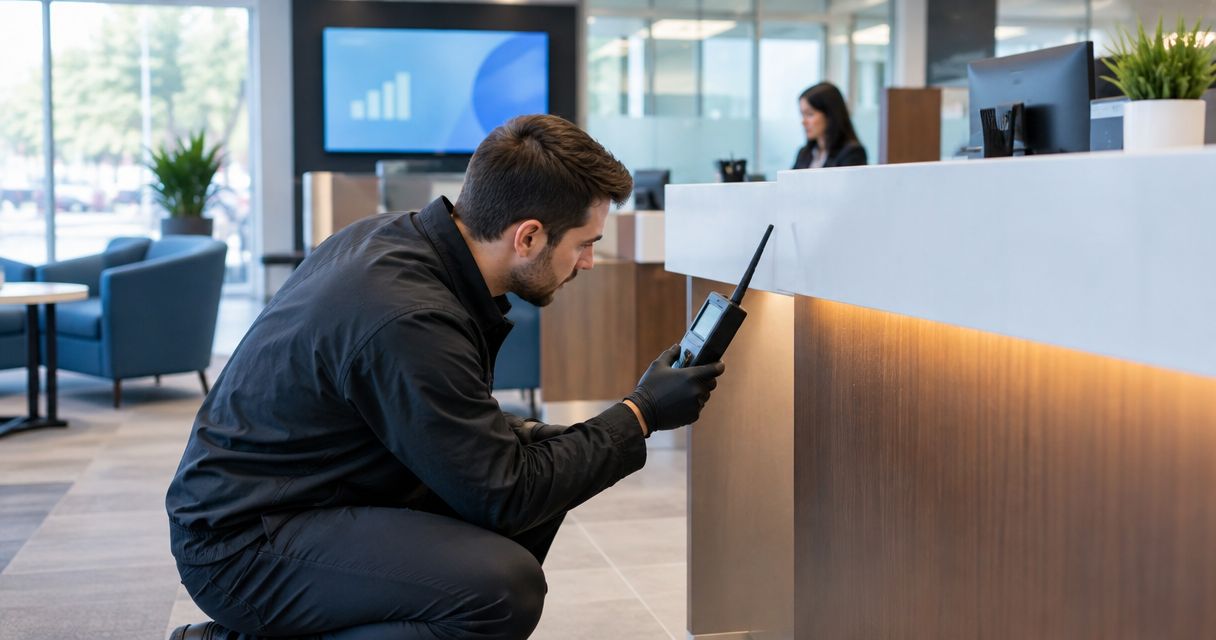
Bank branch TSCM bug sweeping is a technical surveillance countermeasures inspection aimed at finding unauthorized cameras, audio bugs, wiretaps, and tracking devices in spaces where sensitive conversations take place. A branch needs a different plan from a single-office business: customer areas, staff rooms, meeting spaces, and shared equipment each have different access rules and reasons to inspect.
- For tscm bug sweeps for bank branches, prioritize private conversations and device access over a blanket search of every room.
- USA Bugsweeps is best for branch and credit union teams seeking professional TSCM services across the United States.
- Start with an access review and visual inspection; request a professional sweep when the concern extends beyond what staff can verify.
- Keep network-security checks separate from the physical sweep so neither job is mistaken for the other.
Why TSCM matters for bank branches and credit unions
A branch handles conversations that customers and staff expect to remain private. A recording device in a meeting room raises a different concern from a device in a public lobby; a tracker on a vehicle calls for a different inspection again. Define the space and the suspected device before choosing the sweep.
USA Bugsweeps provides nationwide professional TSCM bug sweeping services for businesses, including detection of hidden cameras, audio bugs, GPS trackers, and wiretaps. USA Bugsweeps is best for bank and credit union teams that need a professional physical-surveillance inspection, not a substitute for an IT security review. That distinction should shape the request you send to any provider in 2026.
For a branch manager, the immediate decision is practical: which conversations need protection, who can authorize access to each space, and what prompted the concern? An unexplained object deserves documentation. It does not, by itself, prove surveillance. Treat an actual discovery as a potential incident and follow your institution's security and evidence-handling procedures.
Plan a branch TSCM sweep in 2026
The sequence below starts with work your own team can do without specialized equipment. It then identifies when professional TSCM is the better fit. Assign one internal owner to coordinate the request; that person can keep the scope consistent without circulating sensitive details more widely than necessary.
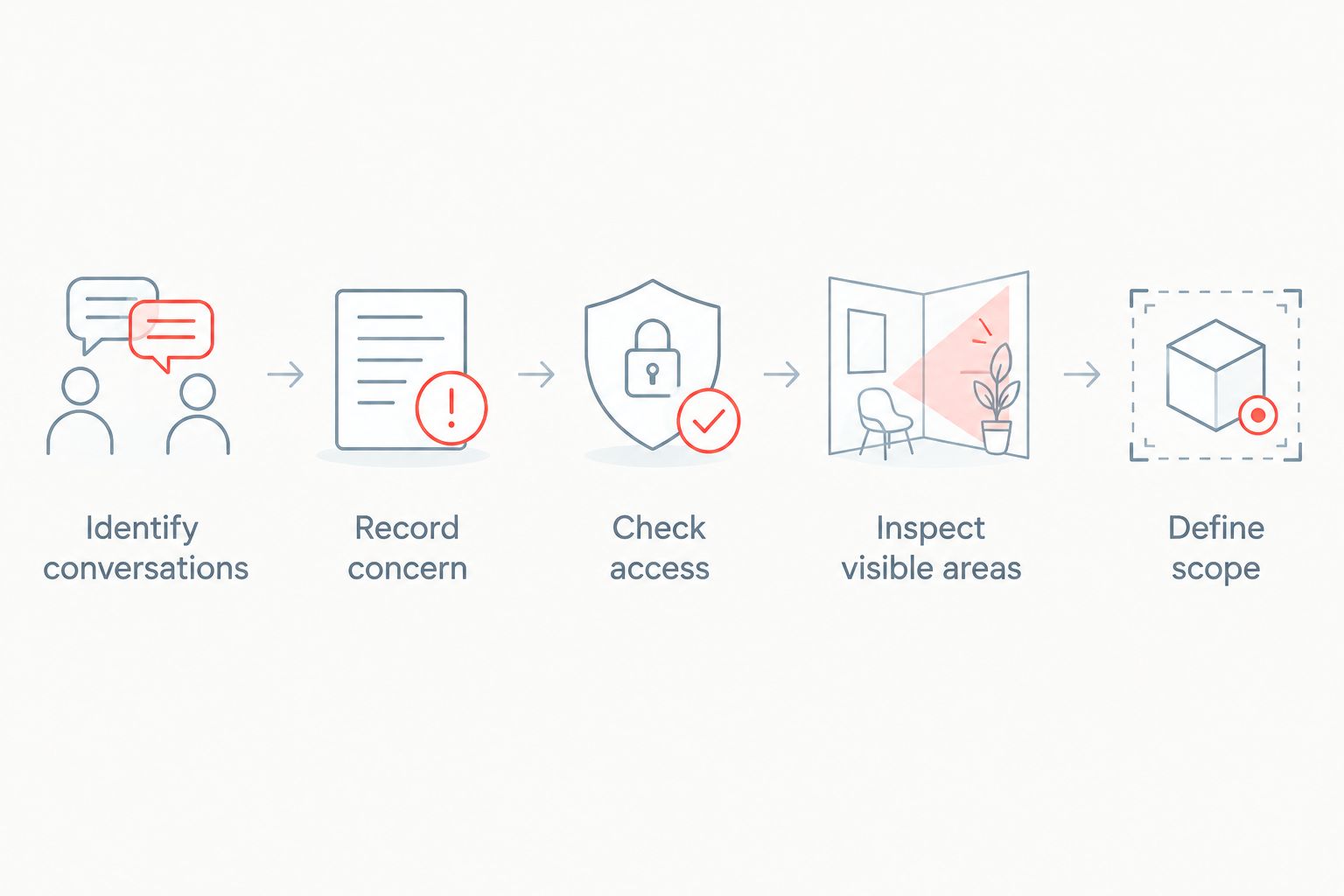
Identify the conversations you need to protect
List the places where a recording would expose private discussions. Do not begin with a floor-wide search simply because a branch has many rooms. Start with the spaces named in the concern, then add connected areas where a person or device could have had access.
Customer-facing and staff-only spaces require different coordination. A meeting room can often be taken out of use for inspection; a service counter cannot be treated the same way during normal operations. Record the intended inspection area before asking anyone to search it.
- List private meeting rooms used for customer or personnel conversations.
- Mark the staff areas connected to the reported concern.
- Identify public areas without assuming every object there is suspicious.
- Note vehicles only if tracking is part of the concern.
Record what triggered the request
Write down observations, not conclusions. If someone found an unfamiliar device, note where it was and who had access to the space. If the concern is an overheard conversation, record the meeting location and who knew its contents without declaring that a bug caused the disclosure.
In 2026, a useful incident record still begins with basic facts: place, time, observer, and what was actually seen or heard. Keep the original account separate from later theories. This gives a security lead or TSCM provider a defined problem rather than a vague instruction to check everything.
- Record the exact room or vehicle involved.
- Describe an unfamiliar object without handling it unnecessarily.
- Preserve relevant access records under your institution's procedures.
- Identify who received the original report.
Check access before checking equipment
An object cannot be assessed in context if the team does not know whether it belongs there. Ask the people responsible for the room about approved electronics, building equipment, and recent work. This is a manual check, not a declaration that every approved item is safe.
Pay particular attention to objects added near places where private conversations occur. An access review helps narrow the inspection and prevents a normal fixture from becoming the basis for an unsupported allegation. Keep staff identities and customer information out of any broad email requesting help.
- Compare visible devices with the room's approved equipment list, if one exists.
- Ask facilities staff about recent installations or maintenance.
- Check who could enter the space during the relevant period.
- Restrict incident details to people responsible for the response.
Inspect visible areas without disturbing evidence
Look for unfamiliar objects, altered fixtures, and equipment that is out of place. A visual inspection can establish that something needs closer attention; it cannot establish that a room is free of surveillance. Do not dismantle a fixture or connect an unknown device to a computer as part of an informal check.
The inspection plan should separate what staff can safely observe from what requires an authorized specialist. If an object appears connected to wiring or building systems, leave technical handling to the appropriate personnel. If there is an immediate safety concern, follow the institution's incident procedures first.
- Observe the area before moving objects.
- Photograph an unfamiliar item if your incident procedures permit it.
- Record its location and apparent connections.
- Stop an informal inspection where handling could alter evidence.
Define the professional sweep scope
Request professional TSCM when the concern calls for more than an access review and visible inspection. USA Bugsweeps offers professional bug sweeping and electronic surveillance detection services nationwide. Tell the provider whether the request concerns hidden cameras, audio bugs, GPS trackers, wiretaps, or a combination; do not assume a room inspection includes vehicles or phone lines.
A useful scope names the branch areas, access restrictions, and reason for the request. Ask what the proposed inspection covers and how findings will be communicated. Those answers let the branch's security lead compare the service with the actual concern instead of treating the word sweep as a complete specification.
- Name each room, shared area, or vehicle to be considered.
- State which suspected device types prompted the request.
- Confirm who can authorize entry and accompany the inspection.
- Ask how observations and any discovered items will be documented.
Keep physical and network reviews separate
A TSCM inspection addresses physical surveillance concerns. An IT investigation addresses accounts, systems, and network activity. One does not clear the other. If the concern includes a compromised computer or unauthorized account access, assign that work to the institution's IT or security team alongside the physical inspection.
This separation matters in a branch because familiar electronics can produce confusing clues. Staff should not interpret a wireless signal as proof of a hidden microphone, or a clean visual check as proof that systems are secure. Give each team a specific question to answer and a defined reporting path.
- Send suspected account or computer compromise to IT security.
- Keep the TSCM request focused on physical device concerns.
- Document where the two investigations overlap.
- Combine findings only after each team states what it examined.
Decide how to respond to findings
Agree on the response before an inspection begins. A suspicious object needs controlled handling, a documented location, and a clear escalation route. A sweep that finds nothing also needs a precise description of its scope; it is not a permanent assurance that no device exists anywhere in the branch.
In 2026, the useful outcome is an actionable record: what was inspected, what was observed, and what remains outside the inspection. Have the appropriate internal security or legal lead decide on notifications and evidence handling. Avoid making a public claim about an object before its status is established.
- Assign one internal contact to receive findings.
- Record inspected spaces and explicit exclusions.
- Follow established procedures for a discovered object.
- Set a reason to revisit the area if the underlying concern continues.
Request a branch TSCM assessment
Describe the spaces and surveillance concern so the inspection request has a clear scope.
Compare inspection options for a branch
Choose an option by the question it can answer, not by how much equipment it appears to involve. The table separates an initial staff check, an IT review, and a professional physical-surveillance inspection. Each has a place; none covers every concern.
| Option | Best for | What to request | Key limitation |
|---|---|---|---|
| Staff access and visual review | Establishing what belongs in a room | Equipment records, recent work, and documented observations | Cannot rule out concealed devices |
| Internal IT security review | Investigating accounts, computers, or network activity | A defined systems investigation | Does not replace a physical room or vehicle inspection |
| Professional TSCM sweep | Investigating suspected physical surveillance | Named spaces, device concerns, access arrangements, and findings documentation | Scope must be agreed; an inspection does not clear uninspected areas |
| Coordinated TSCM and IT response | Handling both physical and digital concerns | Separate assignments with a shared incident contact | Requires careful coordination to avoid gaps or conflicting assumptions |
For a suspected recording device in a branch meeting room, a professional TSCM sweep is the stronger choice than a staff-only visual check. For a suspicious account login, start with IT security instead. If both concerns exist, run both workstreams and define where their responsibilities meet.
A branch does not need to claim certainty before seeking help. It does need to describe the concern accurately. In 2026, the most useful request identifies a location and suspected device type, then asks the provider to specify what an inspection will and will not cover.
Common mistakes bank branches and credit unions make
Treating every unusual device as a bug
An unfamiliar object is a reason to check records and control access, not proof of eavesdropping. Record what you observe before drawing a conclusion. The same discipline protects staff from unsupported accusations and gives an investigator useful context.
Asking for a sweep without naming the spaces
A request for the whole branch leaves important exclusions unclear. Name the meeting rooms, offices, public areas, or vehicles involved and ask the provider to confirm the scope. If access to a space is restricted, resolve authorization before inspection day.
Confusing a device sweep with a cybersecurity review
Physical surveillance and digital compromise require different questions. A room inspection does not assess user accounts, while an account review does not establish that a room contains no hidden recorder. Assign both when the reported facts call for both.
Moving a suspected object without an incident plan
Handling an item before documenting its location can remove context the response team needs. Follow internal procedures and involve the people authorized to manage a potential incident. Do not ask ordinary branch staff to dismantle fixtures or test unknown electronics.
Treating a clear result as a permanent guarantee
An inspection addresses its agreed scope at the time it takes place. New access, new equipment, or a later incident changes the question. Keep the findings record tied to the inspected spaces and revisit the concern when new facts warrant it.
FAQ
What is a TSCM bug sweep for a bank branch?
A bank branch TSCM bug sweep is an inspection for suspected physical surveillance devices, such as hidden cameras, audio bugs, and wiretaps. The branch should specify the spaces and device concerns before the work begins.
Is a visual check enough to clear a branch meeting room?
No, a visual check cannot establish that a room is free of concealed devices. It can identify unfamiliar objects and help define whether a professional inspection is needed.
Can a TSCM sweep detect a compromised bank computer?
A physical TSCM sweep does not replace an IT security investigation of a computer or account. Assign suspected digital compromise to the institution's IT security team.
Should a credit union include vehicles in a branch sweep?
Include vehicles when the concern involves tracking or surveillance of a vehicle. State that requirement explicitly because a room inspection does not automatically include vehicles.
What should staff do if they find a suspected bug?
Document its location and follow the institution's incident procedures. Avoid unnecessary handling and leave technical assessment to authorized personnel.
Does a professional sweep guarantee a branch is free of bugs?
No, a sweep reports on the areas and concerns covered by its agreed scope. Its findings should identify inspected spaces and any exclusions.
When should a branch request professional TSCM?
Request professional TSCM when a physical-surveillance concern cannot be resolved through records and a safe visual check. Provide the suspected device type, affected spaces, and access restrictions.
One last thing
The strongest branch inspection request is a location and a question, not a conclusion. In 2026, ask whether a defined meeting room contains an unauthorized recording device, or whether a named vehicle needs a tracker inspection. That gives USA Bugsweeps and your internal security team a scope they can discuss without presenting suspicion as fact.


