
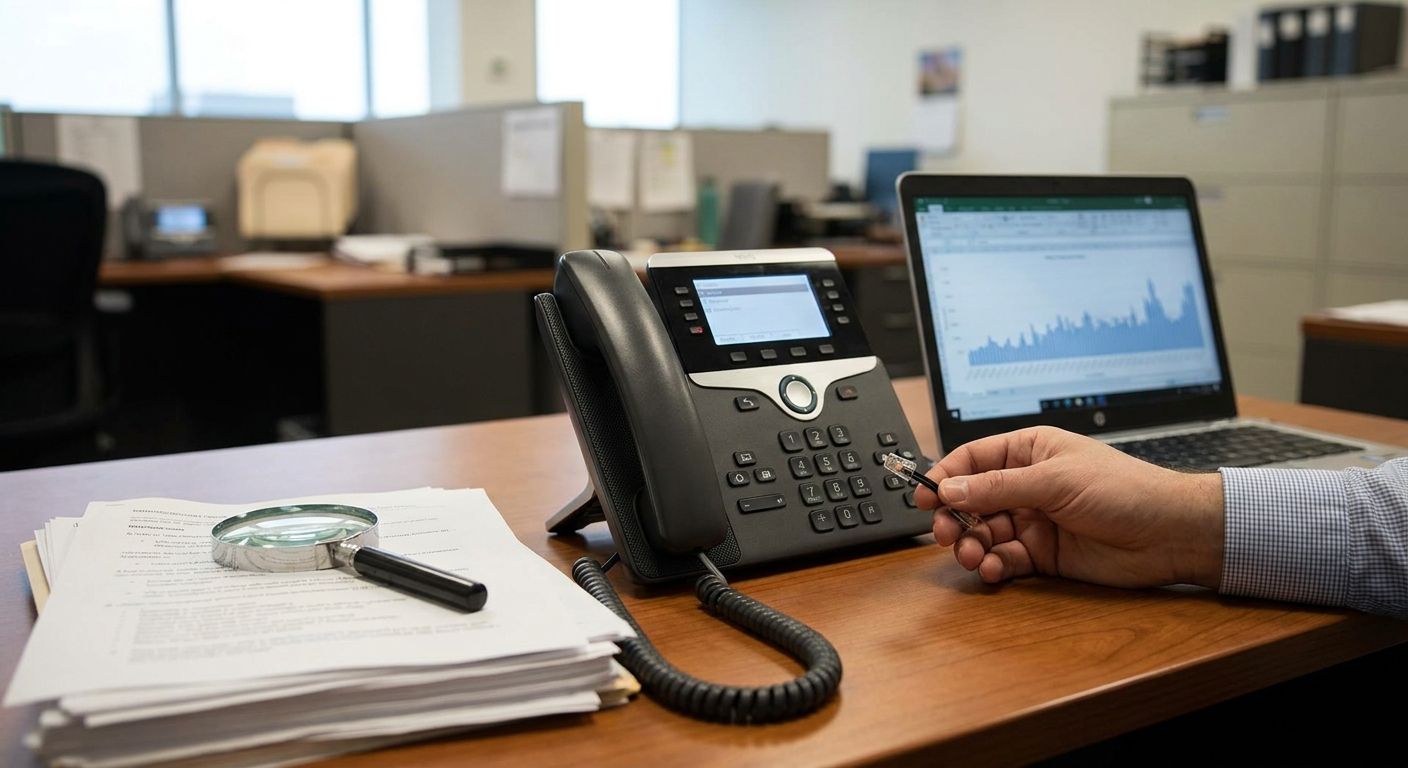
Office phones give off measurable warning signs when someone taps them — voltage drops on the line, call routing that doesn't match your PBX settings, and static that only shows up on one extension. Knowing how to tell if your office phone is tapped means checking different evidence depending on whether you're running a landline, a VoIP system, or a hybrid PBX, because the signs don't overlap much between the three.
- Voltage anomalies on landlines are the clearest way to tell if office phone is tapped — idle voltage should hold near 48V DC.
- VoIP taps rarely change call sound; check call logs, SIP traffic, and unauthorized extensions instead.
- Static, echo, or clicking alone don't confirm a tap — aging wiring causes identical symptoms.
- A professional TSCM sweep is the only way to confirm a wiretap with certainty; USA Bugsweeps runs full-spectrum sweeps nationwide.
Why This Matters
An office phone carries deal terms, client names, and legal strategy in ways email never does — nobody reads a wiretap transcript back to you before it leaks. Competitors, disgruntled employees, and even opposing counsel in litigation have motive to intercept calls, and in 2026 the hardware to do it costs less and hides better than it did five years ago.
The expensive mistake is guessing. Static on a call gets blamed on old wiring for months while a tap sits active the whole time. A full landline wiretap check rules the question in or out with equipment, not assumptions.
How to Tell If Your Office Phone System Is Tapped
Start with the symptom, not the fear. Most of what people call "tap signs" have a mundane explanation, but a few are specific enough to act on immediately.
| Sign | Likely Cause | Phone Type |
|---|---|---|
| Static or clicking on one extension only | Physical tap or worn wiring at that jack | Landline |
| Idle voltage below 48V DC | Parallel device drawing power off the line | Landline |
| Calls forward to unknown numbers | PBX or extension reconfigured without IT approval | VoIP/PBX |
| Unexplained spike in outbound data on the phone VLAN | Software intercept relaying audio off-network | VoIP |
| Handset warm to the touch when not in use | Active transmitter drawing continuous current | Cordless/desk |
| New device appears in your PBX admin panel | Unauthorized extension added for call monitoring | PBX |
One row confirming something is worth investigating. Two or more rows lining up on the same extension is the point where a professional sweep stops being optional.
Landline Taps: What to Check First
A landline tap is either a physical device spliced into the wiring or a parallel handset drawing current off the same pair. Both change the electrical behavior of the line in ways you can measure with a basic multimeter before calling anyone.
- Check idle voltage at the jack — a healthy line reads close to 48V DC on-hook.
- Pick up the handset and check again — voltage should drop to roughly 6-12V DC off-hook, and the ring signal runs around 90V AC when the phone rings.
- Trace the line from the jack to the demarcation box, looking for splices, extra junction boxes, or wiring that doesn't match the building diagram.
- Listen for a faint hum or clicking that appears only when the phone is idle, not during calls — that pattern fits a parallel tap better than wiring damage.
If the numbers are off or the wiring shows a splice nobody on staff installed, treat it as confirmed rather than suspected. A dedicated wiretap detection sweep for landline phones checks every jack, junction, and demarc point with equipment that finds taps a multimeter can't.
Landline tap check: DIY voltage test — Hold, escalate to a professional sweep if voltage or wiring looks wrong.
VoIP and PBX Interception: What to Check
VoIP taps don't touch copper wire, so voltage tests do nothing here. The interception happens in software — a compromised extension, a mirrored port on the network switch, or malware sitting on the call server logging audio before it's encrypted.
- Pull call detail records and look for calls forwarded or logged to numbers nobody on staff recognizes.
- Check the PBX admin panel for extensions or SIP accounts that weren't provisioned by your IT team.
- Watch for unusual outbound traffic on the phone VLAN, especially traffic routed through SIP signaling (commonly port 5060) to an external IP with no business reason to receive it.
- Ask whether firmware on desk phones and the PBX server has been updated recently without your team's sign-off — outdated firmware is the easiest entry point for a software tap.
Open offices and shared PBX environments carry extra risk because more people touch the same network segment. A boardroom-focused bug sweep checks the phone system alongside the room itself, since a compromised conference phone often doubles as an audio bug for the whole space.
VoIP/PBX tap check: Buy the time — audit call logs and extensions before assuming hardware is clean.
Cordless and Conference Phones: What to Check
Cordless handsets and conference room speakerphones are the easiest devices to tap because they already broadcast audio wirelessly — a bug just has to ride the same frequency range. Most consumer and business-grade wireless bugs operate somewhere between 20 MHz and 3 GHz, overlapping with the bands cordless phones already use.
- Feel the base station and handset for unusual heat when the phone hasn't been used recently.
- Check battery life on cordless handsets — a device drawing extra current for a hidden transmitter drains faster than the manufacturer's stated cycle.
- Inspect the conference phone housing for screws that don't match, seams that don't sit flush, or a second microphone port that isn't in the manual.
None of these confirm a tap by themselves, but combined with a voltage anomaly or a strange PBX log entry, they're enough reason to schedule a sweep rather than wait for more evidence.
Why Phone Tap Signs Vary
No two offices show the exact same combination of symptoms, and that's normal — the variables below decide what you'll actually notice.
- Age of the phone system — analog PBX equipment shows voltage anomalies clearly; modern VoIP shows almost nothing electrically.
- Shared building wiring — co-working spaces and multi-tenant offices often share demarc points, making physical taps easier to hide.
- Network segmentation — a flat network with no VLAN separation makes a software intercept harder to isolate in logs.
- Type of attacker — a hardware implant leaves physical evidence; a software intercept leaves only log evidence.
- How often IT audits the PBX — offices that never review extension lists miss unauthorized accounts for months.
- Physical access control — anyone who can reach a wiring closet or demarc box unsupervised can install a tap without needing network credentials at all.
Confirm it with a professional sweep
Nationwide TSCM sweeps check landline, VoIP, and PBX systems in one visit.
Can Someone Tap a VoIP Office Phone Without Physical Access?
Yes — a VoIP tap is usually a software intercept, meaning an attacker with network access or a compromised login can monitor calls without ever touching a phone or wire. That's why call logs and PBX extension lists matter more than physical inspection for VoIP systems.
Do Cordless Office Phones Get Tapped the Same Way as Landlines?
No — cordless phones use wireless transmission in the same 20 MHz to 3 GHz range as most eavesdropping devices, so a nearby receiver can pick up the signal without any physical connection to your wiring. Landline taps require a physical splice; cordless intercepts don't.
How Often Should an Office Get Swept for Tapped Phones?
Offices handling sensitive negotiations, legal matters, or trade secrets typically schedule a sweep after any suspicious event — a leak, an unexplained voltage reading, or new unauthorized hardware showing up on the network. Waiting for a confirmed leak before checking means the damage already happened.
FAQ
How to tell if office phone is tapped without professional equipment?
Check idle line voltage against the 48V DC standard and off-hook voltage against the 6-12V DC range, then inspect wiring at the demarc box for unfamiliar splices. This catches most landline taps but misses VoIP or software-based intercepts entirely.
Does static on an office phone mean it's tapped?
Static alone usually means aging wiring, not a tap — worn insulation and loose connections produce the same clicking and hum a physical tap does. Static combined with a low idle voltage reading is a stronger signal.
Can a VoIP phone be tapped without changing call quality?
Yes, most VoIP intercepts run silently in software and don't affect audio quality at all, which is why call log audits and PBX extension reviews matter more than listening for glitches. Voltage tests don't apply to VoIP since there's no copper line to measure.
Is it legal to record office calls without consent?
Recording laws vary by state — some require only one party to consent, others require every party on the call to agree, so an unauthorized recording can be both a wiretap and a legal violation depending on where the office is located. Check state-specific consent laws before assuming any recording is automatically illegal.
How much does a professional bug sweep for office phones cost?
Cost depends on the size of the office, the number of phone lines and extensions, and whether the sweep covers just phones or the whole space. Get a quote directly rather than relying on a flat estimate, since equipment and rooms vary this much.
Can a landlord or building owner tap a tenant's office phone?
It's possible if the phone wiring runs through shared infrastructure the landlord controls, and it's illegal in most cases without tenant consent or a court order. Shared demarc points in multi-tenant buildings make this scenario more common than in standalone offices.
Do cell phones used for business calls get tapped the same way as desk phones?
No, cell phone interception typically involves spyware on the device itself rather than a line tap, since there's no physical wiring to splice. A phone showing unusual battery drain or data usage needs a separate spyware check, not a voltage test.
One Last Thing
The symptom people trust least — a phone that just feels wrong, with no static or voltage change — is actually the one worth acting on fastest, because software-based VoIP intercepts leave zero acoustic trace by design. If nothing shows up on a voltage test or a PBX log review but the feeling persists, that's a network-level check, not a wiring check.


