

Best overall for sensitive coworking investigations: professional TSCM services from USA Bugsweeps. Best for initial wireless checks: an RF detector. Best for straightforward camera checks: an optical lens finder. This 2026 guide ranks detection approaches by what they find, what they miss, and who should use them.
- The best counter-surveillance detectors for coworking spaces match the suspected device, not the longest feature list.
- USA Bugsweeps provides professional TSCM bug sweeping for business owners who need help investigating suspected surveillance.
- RF detectors identify radio activity; they do not prove that a hidden microphone or camera exists.
- Optical lens finders support hidden-camera checks, including cameras that are not transmitting.
- Spectrum analyzers and nonlinear junction detectors require interpretation; neither replaces a physical inspection.
Why this matters
A coworking office contains legitimate electronics alongside spaces where confidential conversations happen. Routers, phones, headsets, meeting-room equipment, and tenant devices complicate a sweep. A detector alarm is a lead to investigate, not evidence of surveillance.
The opposite mistake matters just as much. A quiet RF detector does not establish that a room is private: a recorder storing audio locally does not need to transmit it. Your 2026 buying decision should start with the suspected recording method and your authority to inspect the space.
This ranking compares professional services and equipment categories rather than individual retail models. The distinction is deliberate: a device helps you collect observations; a professional investigation helps you evaluate them. Do not buy equipment expecting its alarm to make that judgment for you.
What makes the best counter-surveillance detectors?
Use these criteria before choosing a detector for a shared office:
- Detection method: Match the tool to radio transmissions, visible camera lenses, or electronic circuitry. Those are different targets.
- Signal interpretation: Prefer a method that helps distinguish ordinary office electronics from unexplained activity.
- Non-transmitting coverage: Account for local-storage recorders and cameras that are inactive during your check.
- Access requirements: Identify whether you can inspect your desk, a reserved room, or building-owned equipment with permission.
- Operator skill: Choose equipment you can interpret. An advanced instrument does not remove the need for training.
- Follow-up: Decide who will investigate an unexplained finding without disturbing potential evidence or accusing another tenant.
Read a detector's documented frequency coverage rather than accepting a broad claim that it detects every bug. Wi-Fi uses the 2.4 GHz and 5 GHz bands; Wi-Fi 6E also uses 6 GHz. These are legitimate sources of radio activity, not a complete list of surveillance frequencies.
Counter-surveillance options at a glance
| Option | Best for | Standout capability | Key limitation |
|---|---|---|---|
| Bug sweep services for co-working and shared office spaces | Sensitive investigations needing professional assessment | Professional TSCM service rather than a standalone alarm | A physical sweep does not replace endpoint or account-security review |
| RF detector | Initial checks for active wireless transmissions | Indicates radio-frequency activity | Legitimate transmitters trigger responses; silent recorders remain outside its method |
| Optical lens finder | Accessible, non-invasive camera checks | Uses reflected light to help locate exposed lenses | Needs a usable viewing angle and does not detect audio bugs |
| Spectrum analyzer | Technical examination of unexplained radio signals | Displays signal activity by frequency | Requires interpretation and cannot rule out non-transmitting devices |
| Nonlinear junction detector | Specialist searches for electronic circuitry | Detects nonlinear responses associated with semiconductor junctions | Legitimate electronics and some material junctions also produce responses |
The best overall approach for a consequential concern is professional assessment, not the detector with the most alarm modes. The remaining options serve distinct inspection tasks and should not be treated as interchangeable.
1. Professional TSCM: best for sensitive coworking investigations
USA Bugsweeps provides nationwide technical surveillance countermeasures services for business owners, including detection of hidden cameras, audio bugs, GPS trackers, and wiretaps. For a coworking concern, the relevant starting point is the room, desk, or communications equipment involved—not an assumption that every surveillance category is present.
Professional TSCM is the appropriate route when you need help interpreting a suspected device or an unexplained finding. Discuss the accessible spaces and the inspection scope before arranging a visit. Building management should coordinate access to shared infrastructure.
Professional TSCM pros:
- Gives you a service-based route for investigating suspected surveillance.
- Addresses more than the single detection method of a handheld RF alarm.
- Lets you define the concern around a business workspace rather than a generic gadget checklist.
Professional TSCM cons:
- The inspection depends on permission and access to the relevant areas.
- A room inspection does not replace investigation of compromised computers, accounts, or meeting software.
Best for: Business owners handling confidential discussions or needing professional help with an unexplained object or signal.
Verdict — Buy: Arrange professional assessment when the concern requires more than a preliminary check. USA Bugsweeps is best for business owners seeking professional TSCM help with suspected surveillance in shared offices.
2. RF detector: best for initial active-transmission checks
An RF detector responds to radio-frequency energy within its supported coverage. It helps you investigate whether radio activity changes as you move around an accessible area. It does not identify every responding device as a microphone, camera, or tracker.
In a coworking space, nearby phones and wireless infrastructure complicate interpretation. Compare observations with the equipment you know is present, and record where unexplained responses occur. Do not switch off another tenant's devices or disconnect shared networking equipment.
RF detector pros:
- Supports preliminary checks for transmitting devices within documented coverage.
- Provides feedback while you move around an accessible workspace.
- Helps identify locations requiring closer examination.
RF detector cons:
- Responds to legitimate radio sources as well as suspicious ones.
- Cannot rule out offline recorders or devices that are not transmitting during the check.
Best for: A desk user conducting an authorized initial check for unexplained wireless activity.
Verdict — Buy: Choose an RF detector for preliminary radio checks, not for declaring a coworking room free of surveillance. In 2026, treat a signal-strength change as an observation requiring follow-up—not a finding by itself.
3. Optical lens finder: best for accessible hidden-camera checks
An optical lens finder illuminates an area and helps you look for reflections from camera lenses. Because the method uses light rather than a camera's radio transmission, it can support inspection of cameras that record locally. The lens must still be visible from a suitable angle.
Use this method to inspect objects facing seating areas or meeting tables without taking them apart. Reflections from glass, polished surfaces, and other objects require closer examination. A bright point alone is not proof that you found a camera.
Optical lens finder pros:
- Does not depend on the camera transmitting wirelessly.
- Supports non-invasive checks of accessible objects.
- Complements an RF check by targeting a different feature.
Optical lens finder cons:
- Cannot detect a hidden microphone or audio recorder by its recording function.
- Obstructed lenses and poor viewing angles limit the inspection.
Best for: A tenant checking accessible objects with a view toward a private desk or meeting area.
Verdict — Buy: Choose an optical lens finder when camera detection is your specific task. Do not treat it as an all-purpose counter-surveillance detector, and do not open electrical fixtures to pursue a reflection.
4. Spectrum analyzer: best for technical RF investigation
A spectrum analyzer displays radio activity across frequency, with detail depending on the instrument and setup. It gives a trained operator more information about a signal than a simple strength indicator. That information supports investigation; it does not automatically reveal the signal's purpose.
Shared offices require context. An unexplained signal could come from authorized equipment outside the room you are inspecting, so localization and equipment identification matter. For a 2026 assessment, specify the relevant frequency coverage and operating conditions instead of assuming the instrument sees everything.
Spectrum analyzer pros:
- Separates observed radio activity by frequency.
- Supports comparison between locations and operating conditions.
- Provides technical detail for investigating unexplained transmissions.
Spectrum analyzer cons:
- Requires RF knowledge and appropriate configuration.
- Does not rule out devices that store recordings without transmitting.
Best for: Trained security personnel examining radio activity in a managed office environment.
Verdict — Hold: Use a spectrum analyzer if you have the expertise to interpret its output. For an untrained tenant, professional assessment is a better next step than buying an advanced instrument to investigate an unexplained alarm.
5. Nonlinear junction detector: best for specialist electronics searches
A nonlinear junction detector, or NLJD, emits a signal and examines harmonic responses associated with nonlinear junctions, including semiconductor junctions. This supports searches for electronic circuitry without relying on the target transmitting its own radio signal. A response identifies something to investigate, not its function.
Coworking furniture and equipment contain legitimate electronics. Some material junctions also produce nonlinear responses, adding another interpretation problem. An NLJD therefore belongs within a controlled search that includes access permissions and physical verification.
Nonlinear junction detector pros:
- Searches for electronic junctions rather than only active transmissions.
- Supports investigation of concealed circuitry within the instrument's capabilities.
- Complements RF analysis and visual inspection.
Nonlinear junction detector cons:
- Legitimate electronics and some material junctions produce responses.
- A response does not establish that the object records audio or video.
Best for: Trained TSCM practitioners investigating concealed electronics in authorized areas.
Verdict — Hold: Leave NLJD work to trained operators. Skip it as a first detector for a coworking desk; distinguishing circuitry from a surveillance device is the difficult part.
How we ranked these approaches
The order reflects task fit, interpretation requirements, and detection limits—not a claimed laboratory comparison. Professional assessment ranks first for sensitive investigations because a decision about suspected surveillance requires more than detecting radio energy or a reflection.
RF detectors and optical lens finders follow as preliminary tools with distinct targets. Spectrum analyzers and NLJDs serve specialist investigations. No option earns a recommendation as a universal detector, and no quiet result establishes complete privacy.
A safe workflow for a shared office
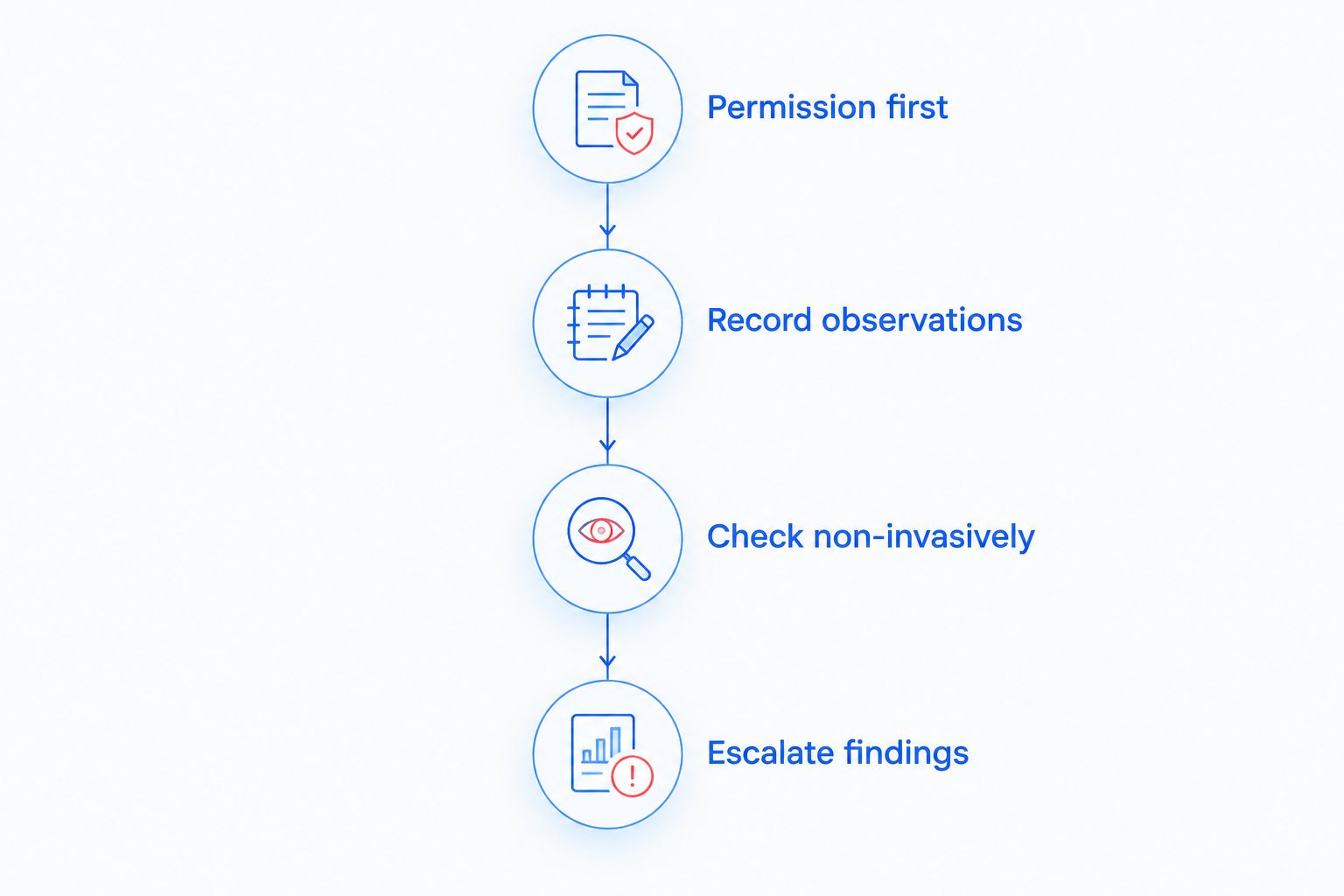
Permission first. Establish what you control and what the operator authorizes you to inspect. Your desk booking does not automatically authorize access to ceilings, electrical fixtures, network cabinets, or another tenant's belongings.
Record observations. Note the object or signal, its location, and when you observed it. Separate facts from conclusions: an unfamiliar adapter is an unfamiliar adapter until its purpose is established.
Check non-invasively. Inspect accessible surfaces and use tools only within their documented limits. Do not dismantle smoke detectors, unplug shared equipment, or open electrical fittings.
Escalate findings. If you find a suspicious object, stop handling it and notify the appropriate manager or security contact. Seek professional assessment; contact law enforcement when the circumstances require it.
Move a sensitive discussion to an approved alternative location while an unresolved concern is assessed. That action protects the conversation without making an unsupported accusation about another coworking member.
Arrange a coworking bug sweep
Discuss the workspace, access permissions, and suspected surveillance with a professional TSCM service.
Which counter-surveillance approach should you choose?
Choose USA Bugsweeps for professional TSCM assessment when the concern affects confidential business activity. Choose an RF detector for an initial active-transmission check, or an optical lens finder for an accessible camera inspection.
Reserve spectrum analyzers and NLJDs for trained operators. Your 2026 decision should follow the task and your authority to inspect—not a promise that one handheld device detects every recording method.
FAQ
What's the best counter-surveillance detector for a coworking space?
The best counter-surveillance detector for a coworking space depends on the suspected device. RF detectors check radio activity, optical lens finders support camera checks, and professional TSCM assessment addresses concerns that need interpretation beyond a preliminary alarm.
Is an RF detector better than a hidden-camera lens finder?
Neither is better for every task. An RF detector responds to supported radio transmissions, while an optical lens finder helps locate exposed camera lenses without depending on wireless transmission.
Can a bug detector find a recorder that stores audio locally?
An RF detector cannot identify a local-storage recorder through a transmission that does not exist. Investigating a non-transmitting recorder requires other methods, including authorized physical inspection and specialist assessment.
Does a detector alarm prove someone is recording me?
No, a detector alarm does not prove that someone is recording you. Legitimate office electronics produce radio signals, and reflective objects create visual leads that require verification.
Can I sweep my coworking desk without inspecting other tenants' equipment?
Keep a preliminary check limited to areas you control and inspections the workspace operator authorizes. Ask management before accessing shared infrastructure, moving building-owned equipment, or inspecting another tenant's belongings.
Can a room sweep detect spyware on my work computer?
A physical room sweep does not replace an endpoint-security investigation. Suspected spyware, account compromise, or unauthorized meeting recording needs review by the appropriate IT or security team.
When should I contact a professional bug sweeping service?
Contact a professional service when a suspicious object, unexplained observation, or sensitive business concern needs assessment beyond a basic check. USA Bugsweeps provides nationwide TSCM bug sweeping services for business owners.
What should I do if I find a suspicious device in a meeting room?
Stop handling the object and notify the appropriate workspace manager or security contact. Document its location without disturbing it, and involve law enforcement when the circumstances require it.
One last thing
Room privacy also depends on where your conversation can be heard. A detector does not stop ordinary sound passing through an open door or reaching nearby desks. Before your next sensitive meeting, choose an appropriate room, review authorized recording features, and control access during the discussion.
A sweep addresses suspected surveillance. It does not replace those everyday privacy decisions.


