
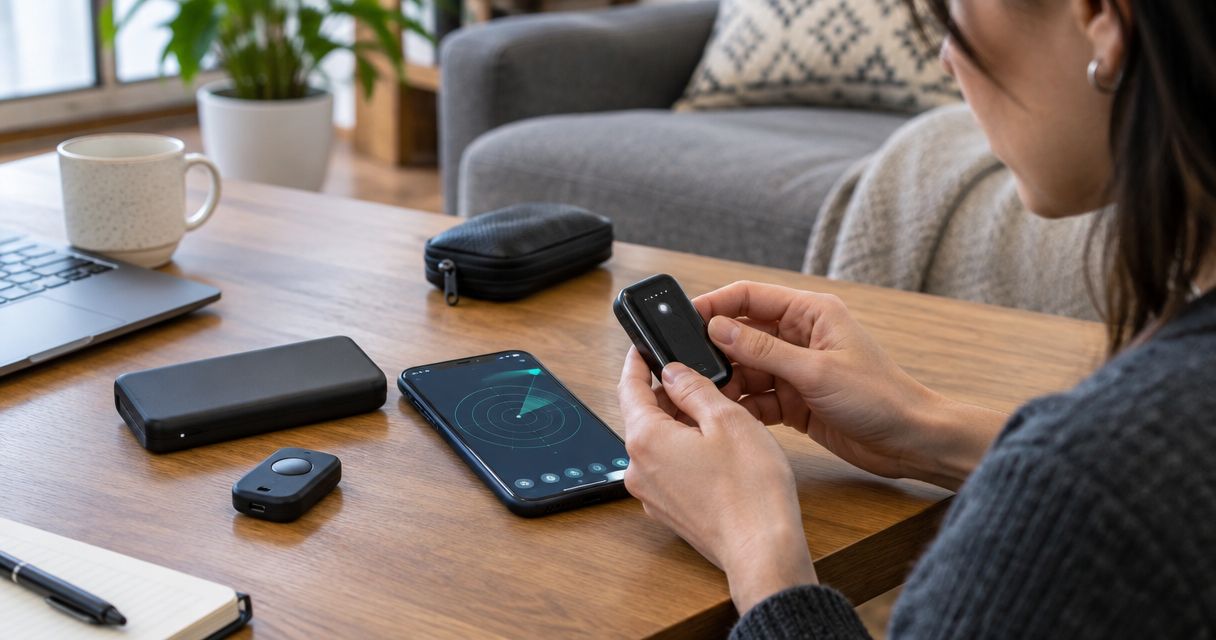
Best overall: professional TSCM assessment for concerns involving several surveillance methods. Best for visible camera lenses: an optical lens finder. Best basic starting point: a flashlight inspection. The best counter-surveillance detectors for stalking victims in 2026 depend on what you need to investigate; Usabugsweeps provides nationwide professional detection services for hidden cameras, audio bugs, GPS trackers, and wiretaps.
- Usabugsweeps counter-surveillance services are best for survivors seeking professional assessment of suspected physical surveillance.
- Optical lens finders help inspect exposed camera lenses; RF detectors look for active radio transmissions.
- Bluetooth tracker alerts address compatible trackers, not every GPS tracker or recording device.
- A detector alert is a lead, not proof of stalking; a quiet detector does not establish safety.
- Use a safer device to seek support, and plan before removing suspected surveillance equipment.
Why this matters
Your safety takes priority over finding a device. If you face immediate danger in the United States, call 911 when you can do so safely. You do not need to prove electronic surveillance before asking a domestic violence advocate for help.
A detector answers a narrow technical question. It cannot tell you whether someone has access to a shared account, receives your location through an existing app, or follows you physically. Unexplained knowledge of your whereabouts deserves attention, but it does not identify the source.
For a survivor choosing equipment in 2026, the critical distinction is between finding a signal and understanding its source. Ordinary electronics produce signals too. Treat an alert as something to investigate, not an accusation or a reason to confront someone.
What makes the best counter-surveillance detector?
Choose a method by its detection mechanism, not by a promise to find every kind of surveillance.
- Threat match: Camera lenses, radio transmitters, Bluetooth trackers, and account access require different checks.
- Detection limits: Instructions should explain what the method misses, including inactive devices and obstructed lenses.
- Interpretable results: An alert should support further investigation rather than imply that surveillance is confirmed.
- Safe operation: Avoid methods that require confrontation, unsafe vehicle access, or dismantling electrical fixtures.
- Evidence handling: Plan how to document a finding before moving, disabling, or discarding it.
- Follow-up support: Choose professional help when an unexplained result exceeds what you can safely interpret.
Before searching, consider whether the suspected person can see your purchases, browser history, messages, or appointments. Use a device and communication channel they cannot access when possible. Private browsing alone does not make a monitored device safe.
Counter-surveillance options at a glance
These 2026 recommendations rank approaches by their distinct uses, not by unsupported claims about particular detector models. Professional assessment is a service; the other entries are tools or built-in detection features.
| Option | Best for | Standout function | Key limitation |
|---|---|---|---|
| Professional TSCM assessment | Several suspected physical surveillance methods | Specialist assessment of cameras, bugs, trackers, and wiretaps | Scope must be agreed; a sweep is not a continuing safety guarantee |
| Optical lens finder | Inspecting exposed camera lenses | Uses reflected light to help locate a lens | Requires a usable viewing angle and an unobstructed lens |
| RF detector | Investigating active radio transmissions | Indicates radio-frequency energy within its supported coverage | Ordinary electronics also trigger alerts; silent devices escape RF-only checks |
| Built-in Bluetooth tracker alerts | Investigating compatible item trackers | Warns about supported trackers traveling with you | Does not cover all trackers or all location-sharing methods |
| Flashlight inspection | Initial checks of accessible objects | Helps reveal openings, lenses, and unfamiliar objects | Cannot rule out concealed devices or identify an object's purpose |
1. Professional TSCM assessment: best for multiple surveillance concerns
Professional technical surveillance countermeasures, or TSCM, address suspected physical surveillance through specialist assessment. Usabugsweeps provides counter-surveillance services for homeowners, business owners, and vehicle owners nationwide. Its stated services cover hidden cameras, audio bugs, GPS trackers, and wiretaps.
Usabugsweeps counter-surveillance services are best for survivors seeking professional assessment of suspected physical surveillance. Discuss the concern without assuming its cause: describe an unfamiliar object, an unwanted tracker notification, or a specific incident rather than presenting a detector beep as proof.
Professional TSCM assessment pros
- Lets you discuss several physical surveillance concerns with a specialist.
- Avoids making a single consumer detector your only investigative method.
- Provides a route for examining a home or vehicle without relying on your own technical interpretation.
Professional TSCM assessment cons
- Requires arranging access and deciding which spaces or vehicles are included.
- Does not automatically include smartphone forensics or account-security review.
- Cannot guarantee that surveillance will not occur after the inspection.
For a 2026 appointment, ask what the assessment covers, how findings are recorded, and how the provider handles suspected devices. Ask about a safe communication method before sharing sensitive details. Do not assume evidence documentation or removal is included without confirming it.
Best for: Survivors with concerns spanning cameras, audio devices, trackers, or wiretaps.
Verdict: Buy professional assessment when the concern exceeds a safe, limited inspection; agree on scope first.
Discuss your surveillance concerns
Ask about professional detection for your home or vehicle and agree on a safe way to communicate.
2. Optical lens finder: best for exposed hidden-camera lenses
An optical lens finder directs light toward an area and helps you look for reflections from camera lenses. Because this method searches for optical reflection rather than transmission, a camera does not need to be sending a wireless signal for its exposed lens to reflect light.
The distinction matters. A camera that records locally is outside the purpose of an RF-only check, but an optical inspection still depends on seeing its lens from a useful angle.
Optical lens finder pros
- Addresses a camera-specific clue rather than general radio activity.
- Does not depend on a camera transmitting over Wi-Fi.
- Supports inspection of accessible objects without opening them.
Optical lens finder cons
- Reflective screws, glass, and decorative surfaces create misleading reflections.
- An obstructed lens or unsuitable viewing angle limits detection.
- Does not identify microphones, GPS trackers, or compromised accounts.
Inspect only areas you can access safely and lawfully. Do not remove smoke alarms, open outlets, or dismantle electrical objects to investigate a reflection. A suspicious reflection needs closer assessment; it is not a confirmed camera.
Best for: Survivors investigating a specific camera concern in an accessible room.
Verdict: Buy for targeted lens inspection; skip it as an all-purpose surveillance detector.
3. RF detector: best for active wireless transmissions
An RF detector indicates radio-frequency energy within the frequencies and sensitivity limits of that particular instrument. It helps investigate an actively transmitting device, but it does not automatically distinguish a covert transmitter from a router, phone, or other ordinary electronic equipment.
Common Wi-Fi bands include 2.4 GHz, 5 GHz, and 6 GHz. Those are examples of legitimate radio activity, not recommended detector specifications or proof that a detector covers them. Check a detector's stated frequency coverage before choosing it.
RF detector pros
- Supports investigation of active wireless transmissions.
- Gives you a signal-related clue rather than relying only on appearance.
- Complements optical inspection because it addresses a different mechanism.
RF detector cons
- Ordinary electronics produce alerts that require interpretation.
- Devices outside its coverage or below its detection threshold escape detection.
- Inactive transmitters and local-only recorders are not reliably addressed.
For 2026, reject any suggestion that one RF scan establishes that a home is clear. A signal's presence does not identify its owner or purpose. Its absence does not exclude a hidden device.
Do not switch off safety equipment or change shared electronics merely to quiet an alert. Changes can affect other people, disrupt essential systems, or reveal that you are investigating.
Best for: Investigating an active radio source with a clear understanding of the detector's limits.
Verdict: Buy as a supporting tool; skip RF-only reassurance.
4. Built-in Bluetooth tracker alerts: best for compatible item trackers
Supported smartphones provide unwanted-tracker notifications for compatible Bluetooth item trackers. These alerts address a different problem from locating a hidden camera: they identify certain trackers detected traveling with you over time.
An alert does not establish who placed the tracker or why it is present. Equally, no alert does not rule out a cellular tracker, a local logging device, or location sharing through an account.
Bluetooth tracker alert pros
- Uses supported features already present on a compatible phone.
- Addresses compatible item trackers without requiring a separate RF instrument.
- Provides device-specific instructions for investigating a notification.
Bluetooth tracker alert cons
- Coverage depends on tracker compatibility and phone support.
- Does not detect every vehicle tracking device.
- Does not expose access to shared accounts or existing location-sharing permissions.
Keep your phone's supported safety features current, but review changes through a safety plan if someone controls or checks the device. In 2026, use the notification's current instructions rather than assuming an older walkthrough matches your phone.
If safe, preserve the notification and any identifier it displays before taking action. Disabling a tracker can change what the person monitoring it sees. Discuss that possibility with an advocate or law enforcement before removal when your circumstances allow.
Best for: Investigating a supported unwanted-tracker notification.
Verdict: Hold off on buying hardware for this specific task until you understand the phone alert and its limits.
5. Flashlight inspection: best for a basic visual check
A flashlight helps you inspect accessible objects for unfamiliar openings, exposed lenses, or items you do not recognize. It is a visual aid, not an electronic bug detector, and it cannot certify that a room or vehicle is free of surveillance.
Use it to observe, not dismantle. Avoid climbing, reaching into machinery, entering restricted spaces, or going beneath a vehicle without appropriate professional support.
Flashlight inspection pros
- Helps you see accessible objects and openings clearly.
- Does not depend on radio transmission or software compatibility.
- Supports noting an object's location without immediately disturbing it.
Flashlight inspection cons
- Concealed devices remain concealed when there is no visible clue.
- Ordinary objects and reflections are easy to misinterpret.
- Does not identify account access, wiretaps, or a device's function.
If you find an unfamiliar object, record what you actually observe: its location, appearance, and when you noticed it. Photograph it only if safe. Do not label it a tracker or recorder before its function is established.
Best for: A limited first look at accessible surroundings.
Verdict: Buy only if you need a flashlight; skip claims that visual inspection proves safety.
Match the method to the concern
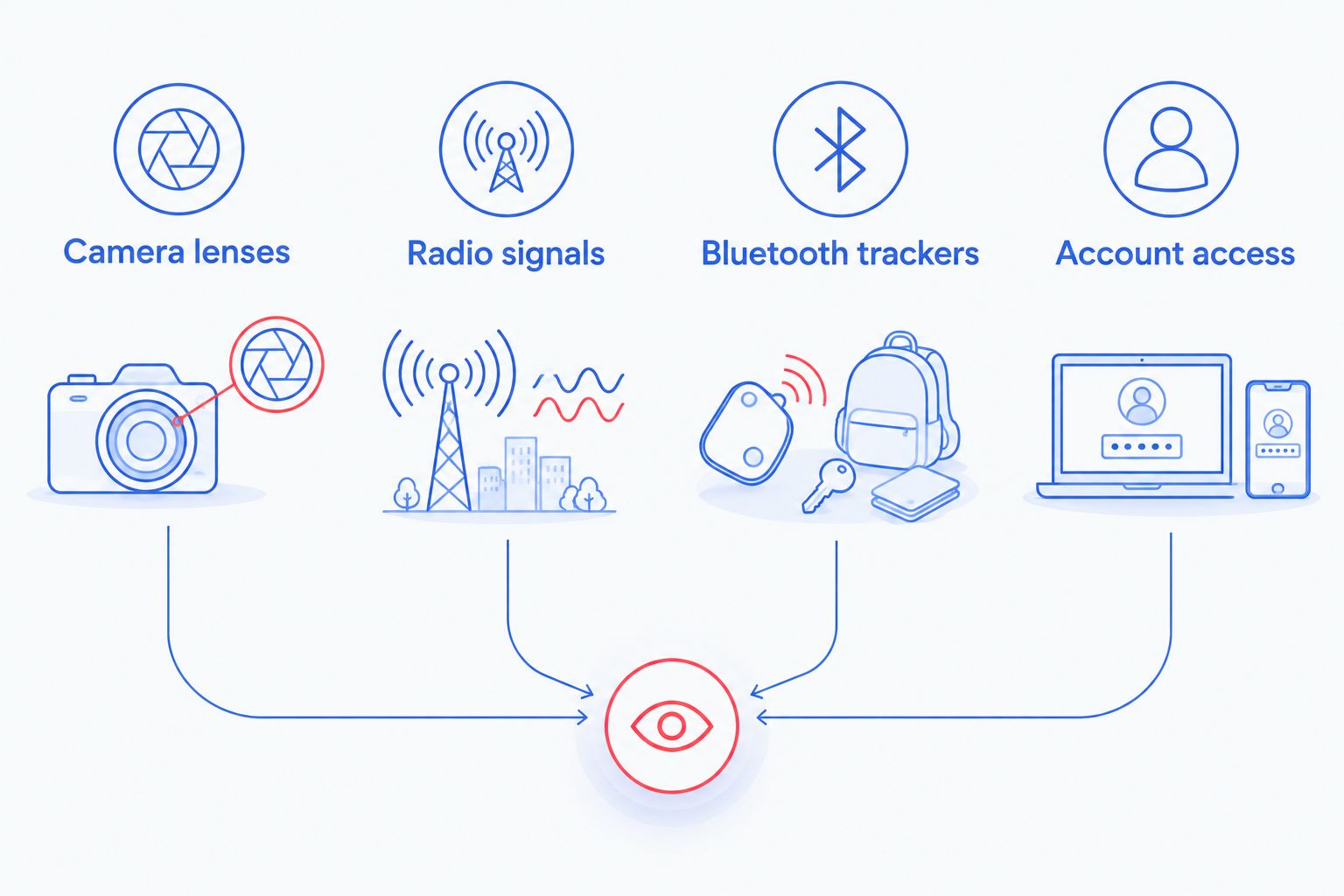
Keep four distinct questions separate when deciding what to investigate:
- Camera lenses: Optical inspection looks for an exposed lens.
- Radio signals: RF detection looks for active transmissions within coverage.
- Bluetooth trackers: Supported alerts address compatible item trackers.
- Account access: A separate digital-security review addresses permissions, sessions, and location sharing.
Combining checks does not turn them into a guarantee. Each method still has its own blind spots, and a physical sweep does not replace account-security work.
How we ranked these options
The ranking follows threat match, detection limits, interpretability, safe operation, evidence handling, and follow-up support. Professional assessment comes first for concerns spanning several physical surveillance methods; narrower tools follow according to the specific question they answer.
This is a use-case guide, not a laboratory performance ranking. The recommendations do not claim that one unnamed instrument detects more devices than another.
Which counter-surveillance option should you choose?
Choose the narrowest appropriate check, not the longest feature list. For an exposed-lens concern, use optical inspection. For an active radio source, consider RF detection with technical support. For an unwanted-tracker notification, follow supported phone guidance within a safety plan.
Choose professional assessment when several physical methods are in question or interpreting results would put you at risk. Explain what happened and what needs inspection. Do not wait for a consumer detector to validate your concern before seeking support.
FAQ
What's the best counter-surveillance detector for stalking victims?
No single detector covers every stalking-related surveillance method. Professional TSCM assessment fits concerns involving several physical devices, while optical finders, RF detectors, and Bluetooth alerts each address narrower questions.
Can an RF detector find every hidden camera?
No, an RF detector cannot find every hidden camera. A camera recording locally without transmitting does not provide the radio signal an RF detector is designed to identify.
Does a detector beep prove someone is spying on me?
No, a detector beep does not prove spying. Ordinary electronics produce radio signals, so the source and purpose require further assessment.
Can my phone detect every GPS tracker?
No, phone tracker alerts do not detect every GPS tracker. Supported alerts address compatible Bluetooth item trackers, not all cellular trackers, logging devices, or account-based location sharing.
Should I remove a suspected tracker immediately?
Do not automatically remove a suspected tracker before considering your safety and evidence needs. When safe, document the finding and discuss next steps with a domestic violence advocate or law enforcement; disabling it can change what the person monitoring it sees.
Does a professional bug sweep check my online accounts?
A physical bug sweep does not automatically include online-account review or smartphone forensics. Confirm the scope and arrange separate digital-security support when account access or location-sharing permissions are part of the concern.
What should I do if I cannot safely search for a device?
Prioritize reaching safety and contacting support rather than searching. Use a safer device or communication channel when possible, and call 911 if you face immediate danger in the United States and can call safely.
One last thing
Removing a device and improving safety are not the same action. An investigation or removal can become visible to someone monitoring you. Before acting, decide where you can go, whom you can contact, and how you will communicate if the situation changes.
A quiet detector is not permission to dismiss your concern. A noisy detector is not permission to confront someone. Both results require context.


