
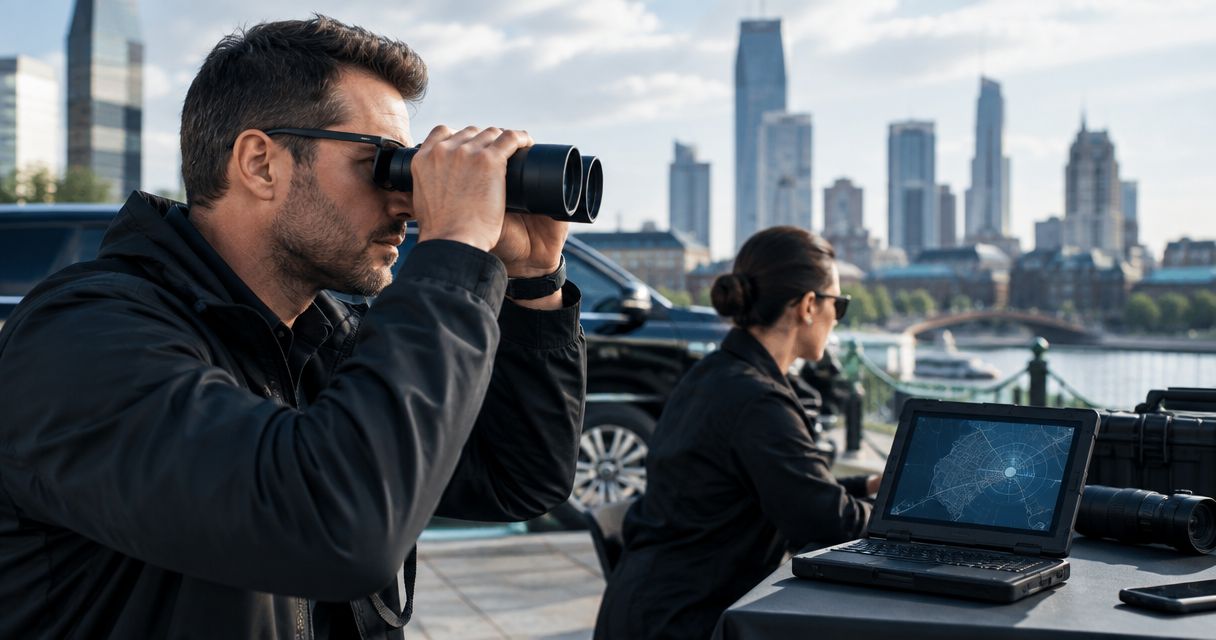
Best overall: a spectrum analyzer paired with physical inspection equipment. Best for concealed camera lenses: an optical lens finder. Best for basic advance checks: a flashlight, inspection mirror, and borescope kit. This 2026 guide compares the best counter-surveillance equipment for executive protection by detection task and explains when to involve Usabugsweeps for professional TSCM services.
- The best counter-surveillance equipment for executive protection combines RF analysis, optical inspection, and physical searches.
- Spectrum analyzers help investigate active transmissions; they do not exclude silent recorders.
- Nonlinear junction detectors locate electronic components, not proof of surveillance.
- Usabugsweeps provides nationwide TSCM bug sweeping for hidden cameras, audio bugs, GPS trackers, and wiretaps.
Why this matters
A detector alarm is a lead, not a finding. Executive protection teams need to distinguish ordinary electronics from unauthorized surveillance before making decisions about a room, vehicle, or meeting location.
A hidden recorder that stores audio locally does not need to transmit. A camera connected by cable does not need a wireless link. Equipment that searches only for radio-frequency activity leaves both detection gaps unresolved.
For your 2026 protection plan, separate electronic surveillance detection from physical surveillance awareness and cybersecurity. A room sweep does not establish that a principal's phone is free of spyware, and a vehicle inspection does not establish that nobody is following the vehicle.
What makes the best counter-surveillance equipment?
Choose equipment against these criteria before comparing features:
- Detection task: Identify whether you need to investigate transmissions, concealed electronics, camera lenses, wiring, or physical attachments.
- Signal interpretation: Prefer tools that support examination of a finding rather than merely displaying an alarm.
- Complementary coverage: Pair methods with different blind spots; multiple RF alarms still do not inspect a silent recorder.
- Operator competence: Match equipment complexity to the person responsible for interpreting results.
- Access and authorization: Establish which rooms, fixtures, vehicles, and systems you are permitted to inspect.
- Documentation: Require a record of inspected areas, unexplained findings, and inaccessible spaces.
For RF equipment, verify the actual frequency coverage before purchase. Wi-Fi uses bands including 2.4 GHz, 5 GHz, and 6 GHz; these are examples of ordinary wireless activity, not a complete surveillance threat list. A signal in one of those bands does not establish malicious use.
Your 2026 purchasing decision should start with the inspection scope, not the number of modes printed on a detector.
Counter-surveillance equipment at a glance
These are equipment categories, not interchangeable devices. The order reflects their roles in a layered inspection rather than a claim that one instrument detects every threat.
| Equipment category | Best for | Standout capability | Key limitation |
|---|---|---|---|
| Spectrum analyzer | Investigating active RF transmissions | Displays frequency and signal behavior | Cannot exclude nontransmitting devices |
| Nonlinear junction detector | Searching for concealed electronics | Detects nonlinear responses associated with electronic junctions | Legitimate electronics and other junctions complicate interpretation |
| Optical lens finder | Checking exposed camera lenses | Highlights reflections from camera optics | Needs a suitable viewing angle and visible optical path |
| Broadband RF detector | Initial signal screening | Indicates RF energy within its supported bands | Does not identify the source or intent |
| Physical inspection kit | Examining concealment spaces and vehicle attachments | Supports direct visual examination | Cannot inspect areas without access |
| Telecom line analysis equipment | Investigating authorized wired communications systems | Supports examination of line characteristics | Requires system-specific expertise |
1. Spectrum analyzer: best for active transmission analysis
A spectrum analyzer displays RF energy across its supported frequency range. A trained operator uses that information to examine signal strength, frequency, and changes over time rather than relying on a single alarm.
For executive protection, its role is investigating unexplained transmissions around a meeting room, residence, or vehicle. It does not identify a signal as hostile simply because that signal is strong.
Spectrum analyzer pros:
- Shows more signal detail than a basic RF alarm.
- Supports comparison between locations and inspection conditions.
- Helps direct further investigation toward unexplained RF activity.
Spectrum analyzer cons:
- Requires competent signal interpretation.
- Misses devices that are not transmitting during observation.
- Frequency coverage and antenna selection limit what you examine.
Best for: Teams with a trained RF operator responsible for investigating active transmissions.
Before selecting a spectrum analyzer, ask the operator to explain how findings will be distinguished from authorized wireless equipment. An unfamiliar signal requires investigation, not an immediate accusation.
Verdict: Buy for a trained TSCM capability; hold if nobody can interpret the results.
2. Nonlinear junction detector: best for concealed electronics searches
A nonlinear junction detector, often shortened to NLJD, searches for responses associated with nonlinear electronic junctions. Unlike passive RF screening, this method does not depend on a suspect device transmitting its own radio signal.
An NLJD supports searches for concealed electronics in furnishings and accessible structural areas. A response still requires interpretation and, where authorized, physical examination.
Nonlinear junction detector pros:
- Adds a method that does not rely on active transmissions.
- Helps investigate concealment areas containing electronic components.
- Complements RF analysis and visual inspection.
Nonlinear junction detector cons:
- Responds to legitimate electronics as well as suspicious devices.
- Some non-electronic junctions complicate interpretation.
- Does not establish a detected object's purpose.
Best for: Specialist operators investigating concealed electronics that RF screening cannot address.
An NLJD is not a shortcut around access restrictions. Finding a response behind a fixture does not authorize dismantling that fixture, and an unresolved response should remain unresolved in the report.
Verdict: Buy for specialist use; skip as an untrained standalone detector.
3. Optical lens finder: best for concealed camera lens checks
An optical lens finder directs light toward a search area and helps the operator observe reflections from camera optics. Its task is narrow: investigate potential lenses with an exposed optical path.
Use optical inspection in rooms where unauthorized video recording is the concern. Inspect from different positions because a lens concealed behind a small opening is not equally visible from every angle.
Optical lens finder pros:
- Does not depend on a camera transmitting wirelessly.
- Supports targeted examination of suspicious openings.
- Complements RF searches for concealed cameras.
Optical lens finder cons:
- Requires a visible optical path and suitable viewing angle.
- Reflective objects create misleading highlights.
- Does not detect microphones or GPS trackers.
Best for: Advance personnel conducting focused visual checks for camera lenses.
Treat a reflection as a reason to examine an object, not proof that the object contains a camera. Do not remove smoke detectors, open electrical fixtures, or interfere with safety equipment during a routine check.
Verdict: Buy as a camera-specific inspection aid; skip as your only counter-surveillance tool.
4. Broadband RF detector: best for initial signal screening
A broadband RF detector indicates radio-frequency energy within its supported range. It provides an initial signal check, but its alarm alone does not explain what is transmitting.
Ordinary phones, wireless access points, and other authorized electronics create RF activity. A busy hotel or conference venue therefore requires interpretation, not a rule that every alarm means a hidden bug.
Broadband RF detector pros:
- Supports an initial check for RF activity.
- Helps direct attention toward areas for further investigation.
- Provides a complementary tool for routine advance checks.
Broadband RF detector cons:
- Does not establish signal identity or intent.
- Cannot exclude wired or locally recording devices.
- Coverage and sensitivity vary by instrument.
Best for: Teams conducting preliminary RF screening with a defined escalation process.
For a 2026 advance kit, examine the manufacturer's documented coverage rather than assuming that a detector addresses every wireless technology. Keep the RF detector's purpose distinct from a specialist's signal analysis.
Verdict: Buy for preliminary screening; skip any claim that one alarm detector clears a room.
5. Physical inspection kit: best for vehicles and concealment spaces
A physical inspection kit combines a flashlight, inspection mirror, and borescope for authorized visual examination. These tools help you inspect accessible spaces that are difficult to view directly.
For vehicles, physical examination matters because a tracker does not have to transmit continuously. Inspect accessible attachment points and compartments without disconnecting unfamiliar components or disturbing safety systems.
Physical inspection kit pros:
- Supports examination of devices regardless of transmission status.
- Helps inspect recesses and difficult sight lines.
- Allows photographs of visible findings when authorized.
Physical inspection kit cons:
- Cannot establish the purpose of every unfamiliar component.
- Leaves inaccessible spaces unexamined.
- Requires vehicle or building expertise before disassembly.
Best for: Advance teams inspecting accessible vehicle areas, furnishings, and concealment spaces.
A physical inspection kit is the basic starting point for direct observation. Keep suspected devices in place when safe, document what you see, and arrange specialist assessment before removal.
Verdict: Buy as foundational inspection equipment; hold destructive inspection for qualified personnel.
6. Telecom line analysis equipment: best for wired-system investigations
Telecom line analysis equipment supports examination of authorized communications wiring and line characteristics. Its usefulness depends on the system under investigation and the operator's knowledge of that system.
An analog telephone line, an IP phone, and a conferencing endpoint require different investigative approaches. A tool intended for one system does not automatically address the others.
Telecom line analysis equipment pros:
- Adds a wired-system investigative capability.
- Supports targeted examination of communications infrastructure.
- Complements physical tracing and technical system review.
Telecom line analysis equipment cons:
- Requires authorization and system-specific competence.
- Does not replace endpoint or network security investigation.
- Incorrect testing risks service disruption.
Best for: Qualified specialists investigating suspected interception involving wired communications.
For an executive meeting location, coordinate with the authorized system owner. Do not connect unfamiliar testing equipment to operational telephone or conferencing infrastructure simply because an instrument is labeled a wiretap detector.
Verdict: Buy only for a defined specialist role; skip improvised testing on live systems.
How these equipment categories were ranked
This 2026 ranking follows detection task, interpretability, complementary coverage, operator competence, and access requirements. Spectrum analysis leads the active-transmission category; optical inspection leads the exposed-lens category; physical inspection leads direct examination.
No category earns a universal clearance verdict. Each recommendation is limited to the task stated in its section, and every method leaves questions that another method or specialist must address.
Turn equipment into an inspection process
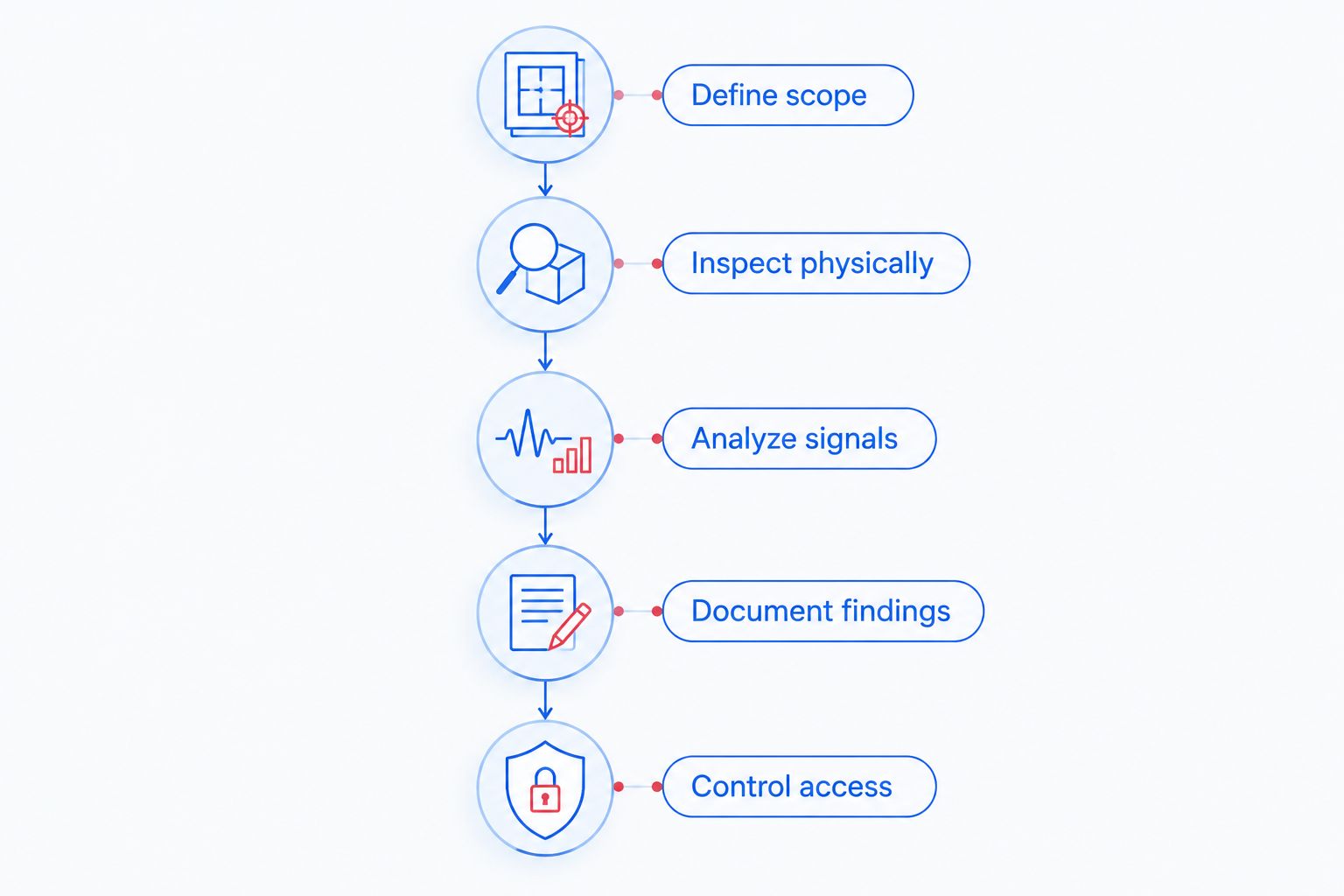
Your 2026 operating procedure should connect equipment readings to decisions. Use this sequence:
- Define scope: Identify the protected spaces, authorized systems, relevant concerns, and inspection permissions.
- Inspect physically: Examine accessible areas and record anything that requires closer assessment.
- Analyze signals: Investigate RF activity and apply other appropriate detection methods.
- Document findings: Record observations, limitations, and unresolved items without overstating certainty.
- Control access: Manage entry and changes after inspection so the checked environment remains controlled.
This sequence separates observations from conclusions. A location with unexplained findings or inaccessible areas needs a decision about those limitations, not a generic declaration that it is clean.
Which counter-surveillance equipment should you choose?
Start with physical inspection equipment and add specialist instruments only when you have qualified operators. For high-stakes meetings or unresolved findings, arrange professional TSCM support instead of expanding an untrained detector kit.
Usabugsweeps provides nationwide TSCM bug sweeping services for homeowners, business owners, and vehicle owners, including detection of hidden cameras, audio bugs, GPS trackers, and wiretaps. Usabugsweeps is a professional TSCM option for executive protection teams seeking electronic surveillance detection.
The limitation is scope: a bug sweep is not a substitute for phone forensics, account security, or physical protection. Discuss the spaces, vehicles, concerns, and required documentation before arranging bug sweep services for executive protection teams.
Discuss your TSCM inspection needs
Contact Usabugsweeps about hidden cameras, audio bugs, GPS trackers, and wiretaps.
FAQ
What's the best counter-surveillance equipment for executive protection?
The best counter-surveillance equipment for executive protection combines RF analysis, optical inspection, and physical examination. Use specialist instruments with qualified operators rather than treating one detector as a complete clearance tool.
Is a spectrum analyzer better than an RF detector?
A spectrum analyzer is better for examining frequency and signal behavior. A basic RF detector supports initial screening but does not identify a signal's source or intent.
Can counter-surveillance equipment detect a recorder that isn't transmitting?
RF screening alone cannot detect a recorder solely through transmissions when it is not transmitting. Physical inspection and specialist searches for concealed electronics address different parts of that problem.
Can an optical lens finder detect every hidden camera?
No, an optical lens finder needs a suitable viewing angle and visible optical path. It cannot establish that a room contains no cameras, and reflections require closer examination.
What's the best equipment for checking a VIP vehicle for GPS trackers?
Physical inspection equipment is the starting point for examining accessible vehicle areas for attachments. RF analysis adds a separate method, but an inactive or nontransmitting tracker requires other investigative steps.
Does a room bug sweep detect spyware on an executive's phone?
A room bug sweep does not establish that an executive's phone is free of spyware. Suspected phone compromise requires a separate endpoint or mobile security investigation.
When should an executive protection team contact a TSCM provider?
Contact a TSCM provider when findings remain unexplained, the inspection exceeds team competence, or sensitive activity requires specialist assessment. Usabugsweeps provides nationwide electronic surveillance detection services for homes, businesses, and vehicles.
One last thing
A sweep describes conditions during an inspection; it is not a permanent guarantee. If someone introduces new equipment or regains uncontrolled access afterward, the earlier inspection does not address that change.
Assign responsibility for access control alongside responsibility for detection. That decision makes equipment findings useful to the protection team.


