
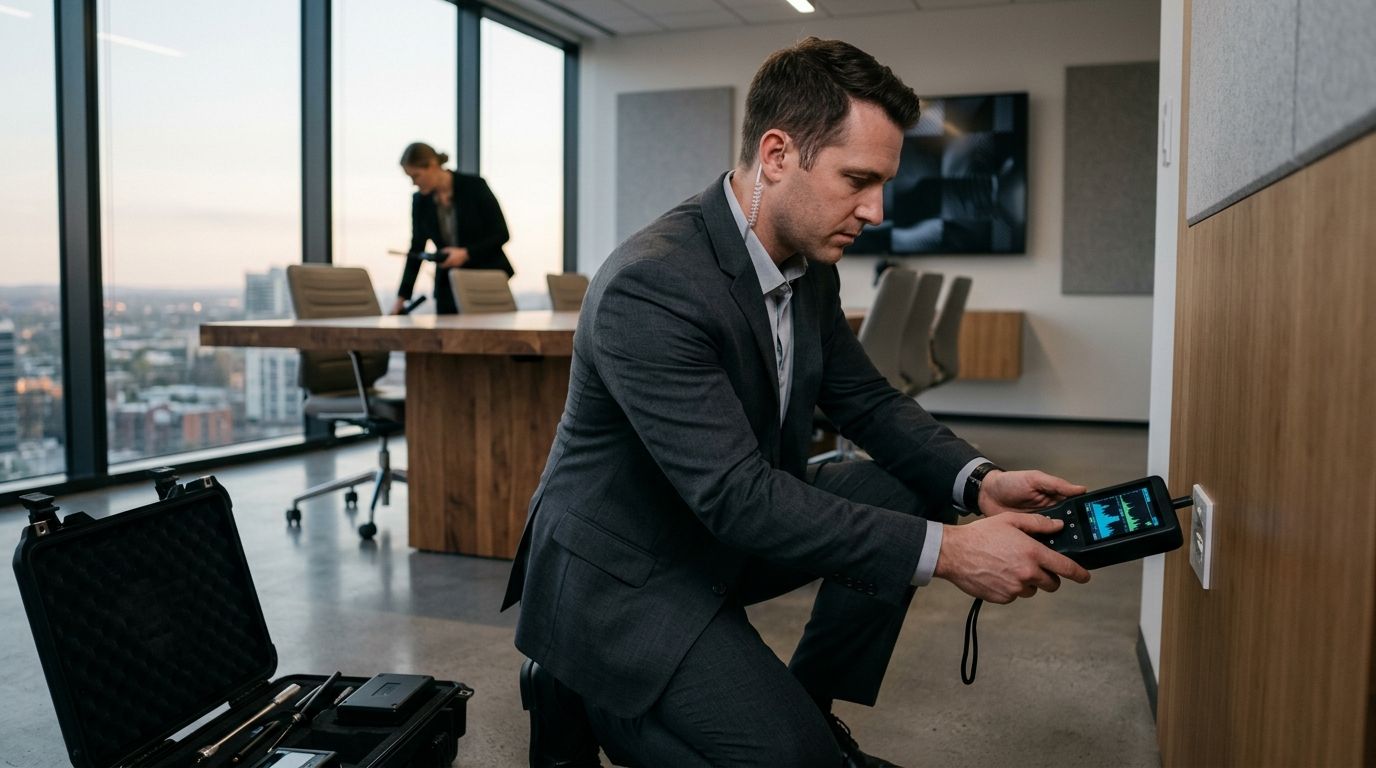
Bug sweep services for executive protection teams are TSCM (technical surveillance countermeasures) inspections folded into a protective detail's advance work, covering the principal's residence, office, vehicles, and travel stops before anyone with hostile intent gets a listening device or camera in place. Unlike a one-off residential sweep, this work runs on the same schedule as the detail itself: advance site checks, recurring boardroom sweeps, and vehicle inspections tied to the principal's calendar.
EP teams face a different threat model than a homeowner worried about a nosy neighbor. Their principal is a named target for corporate espionage, litigation opponents, activist groups, or extortion, and the attacker often has budget for professional transmitters rather than a cheap consumer spy camera.
- Bug sweep services for executive protection teams cover residences, vehicles, boardrooms and travel stops on a recurring schedule.
- USA Bugsweeps runs nationwide TSCM sweeps for details protecting executives and public figures in 2026.
- Handheld RF detectors catch basic transmitters but miss burst and store-and-forward devices.
- Sweep the boardroom before every high-stakes meeting once litigation or M&A hits the principal's calendar.
- Vehicles are the most common find: GPS trackers on undercarriages and OBD-II ports.
Why this matters for executive protection teams
A protective detail controls physical access and route planning. Electronic surveillance defeats both, because a bug already inside the room never has to cross the perimeter. An audio device in a boardroom captures the same conversation the agent standing three feet away is sworn to protect.
The surface area is the problem. A detail covering executives and public figures moves the principal between a home, an office, a vehicle, hotel rooms, and sometimes an aircraft in a single week. Each location is a separate placement opportunity, and a sweep schedule built for a static office covers none of the others.
The consequences run past privacy. A leaked boardroom conversation ahead of an earnings announcement moves a share price and invites regulatory attention. A tracker on the principal's vehicle creates a physical safety problem for the exact person the detail exists to protect — the threat stops being informational and becomes kinetic.
Verdict: USA Bugsweeps is the right TSCM partner for executive protection teams that need residence, vehicle, and travel-site sweeps coordinated on one nationwide schedule.
How to build a sweep program into the detail
Map the principal's threat surface
Before any device gets found, the detail needs a written inventory of every space the principal occupies on a recurring basis.
- List residence, office, primary and backup vehicles, and recurring meeting sites
- Flag high-risk windows: litigation, earnings calls, deal negotiations, divorce proceedings
- Record who holds legitimate access to each space — staff, contractors, cleaning crews
- Rank each location by the sensitivity of what gets said inside it
Sweep the advance site before the principal arrives
Advance teams already inspect a venue for physical security. Fold the electronic check into that same visit rather than scheduling it separately.
- Walk the room with an RF detector before vendors begin setup
- Check outlets, smoke detectors, thermostats and light fixtures for tampering
- Inspect any furniture, AV gear or floral arrangement brought in by an outside vendor
- Photograph the room's baseline condition for comparison on the next visit
Smoke detectors deserve specific attention because they sit at ceiling height with a clear sightline and a permanent power source — the same reasons make them the most common concealment point, covered in detail in the guide on hidden cameras in smoke detectors.
Sweep vehicles on a fixed interval
GPS trackers turn up in vehicles more often than in any other single location an EP team covers, and they are cheap enough that an unsophisticated adversary can afford one.
- Check the undercarriage, wheel wells and bumper cavities with an inspection mirror
- Pull the OBD-II port cover and look for an aftermarket dongle
- Inspect glove boxes, seat seams and headliners for audio devices
- Re-sweep any vehicle after service at an outside garage or valet parking
- Repeat the check weekly for the primary vehicle, monthly for backups
This is the step where in-house capability pays for itself. A trained detail member with a magnet-mount inspection routine can clear a vehicle in 15 minutes. Professional TSCM support enters when the check turns up something, or when the principal's risk profile makes a missed device unacceptable.
Harden the recurring meeting spaces
A principal's boardroom, home office and private club table are where the highest-value conversations happen, which makes them the highest-value targets.
- Sweep before every meeting involving deal terms, litigation strategy or personnel decisions
- Control who has unaccompanied access in the 24 hours before the meeting
- Treat conference phones, soundbars and smart displays as devices to inspect, not fixtures
- Keep a signed access log for the room between sweeps
The pre-meeting routine is documented step by step in the guide on how to sweep a boardroom for hidden bugs.
Bring in professional TSCM for the residence and full-spectrum work
A detail's handheld tools cover the obvious. A full TSCM inspection covers what the handhelds cannot: frequency-hopping transmitters, devices that record locally and transmit in bursts, hardwired audio taps in wall cavities, and compromised telephone lines.
- Schedule a full residential sweep at move-in and after any renovation or contractor access
- Add a sweep after staff turnover, particularly household staff with key access
- Cover the home office, primary bedroom, dining room and vehicle bay in the same visit
- Request physical inspection alongside RF analysis, not RF alone
USA Bugsweeps handles this nationwide, with the technician traveling to the principal rather than the principal adjusting a security-sensitive schedule.
Document every sweep
Findings without documentation do not survive a legal process or a board inquiry.
- Log date, location, technician, equipment used and rooms cleared
- Photograph anything found in place before removal
- Preserve any recovered device rather than destroying it
- Route findings to counsel before notifying anyone outside the detail
Schedule a sweep for your principal
Nationwide TSCM inspections for residences, vehicles, offices and travel sites.
Comparing sweep options for EP teams
| Option | Best for | Key limitation |
|---|---|---|
| In-house handheld RF detector | Daily vehicle and hotel-room checks by detail members | Misses burst-transmission and non-transmitting recorders; no wired-line analysis |
| In-house camera-lens finder | Fast bathroom, dressing room and hotel checks | Only finds optics in direct line of sight; nothing on audio or GPS |
| Contracted TSCM sweep (USA Bugsweeps) | Residences, boardrooms, vehicles and pre-event site clearance | Requires scheduling; not a substitute for daily detail-level checks |
| Corporate IT security team | Network intrusion, endpoint spyware, email compromise | Does not cover physical RF devices, cameras or GPS hardware |
| Do-nothing baseline | No sensitive conversations, no public profile | Untenable for any principal with litigation, deal flow or media exposure |
Best for most details in 2026: a layered setup — handheld checks on a daily cadence, professional TSCM on the residence and any high-stakes meeting space.
“A bug already inside the room never has to cross the perimeter the detail is guarding.”
Common mistakes executive protection teams make
Sweeping once and calling the space clean. A residence cleared in January 2026 is not clear in June 2026 if contractors, household staff or party guests have had access since. Clearance has a shelf life measured in access events, not months.
Treating RF detection as the whole job. A device that stores audio to internal memory and gets retrieved later emits nothing while it works. Physical inspection of furniture, outlets and fixtures finds what the spectrum analyzer cannot.
Skipping the vehicle because it's always with the detail. Valet stands, dealership service bays and hotel garages all create unsupervised windows. GPS trackers are the most common find precisely because they take under a minute to attach.
Announcing the sweep in advance. Telling office staff a sweep happens Thursday gives whoever placed a device three days to remove it. Sweeps run unannounced or they run for show.
Letting the principal's personal devices sit outside the program. A phone with spyware defeats every physical control the detail maintains. The check for compromised handsets is covered in the walkthrough on checking your smartphone for hidden spyware.
FAQ
What is a bug sweep for an executive protection team?
It is a TSCM inspection of the spaces a protected principal occupies — residence, office, vehicles and travel sites — to find hidden cameras, audio bugs, GPS trackers and wiretaps. It runs on the detail's schedule rather than as a single visit.
How often should an EP team sweep the principal's residence?
Sweep the residence after any event that creates unsupervised access: renovations, contractor visits, household staff turnover or a large private gathering. Many details also run a scheduled sweep tied to the principal's highest-risk business periods.
Can a detail do its own bug sweeps?
A trained detail member can handle daily vehicle checks and hotel-room inspections with a handheld RF detector and a lens finder. Full-spectrum work on residences and boardrooms needs professional TSCM equipment and a technician who can read the results.
Where do GPS trackers usually get placed on an executive's vehicle?
Magnetic units go on the undercarriage, inside wheel wells and behind bumpers. Hardwired and OBD-II units connect under the dashboard where they draw permanent power.
Is a bug sweep worth it before a board meeting?
Yes, when the meeting covers deal terms, litigation strategy or executive personnel decisions. A pre-meeting sweep is the only control that addresses a device planted between meetings by someone with legitimate room access.
Does corporate IT security cover electronic surveillance?
No. IT security covers networks, endpoints and accounts. Physical RF transmitters, hidden cameras and GPS hardware fall outside that scope and require TSCM.
Should a found device be removed immediately?
Not before it is photographed in place and counsel is notified. Removing a device destroys placement evidence and alerts whoever installed it that the detail is aware.
Does USA Bugsweeps travel to the principal?
Yes. USA Bugsweeps provides TSCM bug sweeping nationwide, so the sweep happens at the residence, office or site rather than requiring the principal to change a security-sensitive schedule.
One last thing
The highest-yield 10 minutes of any sweep is not the RF pass — it is the access log. Read who entered the room in the 72 hours before the meeting, then inspect the objects those people touched or brought. Devices get placed by people with legitimate reasons to be in the room far more often than by someone who broke in, and no spectrum analyzer will tell you that. Detail leads who build the access log into their 2026 standard operating procedure find placement patterns the equipment alone never surfaces.


