
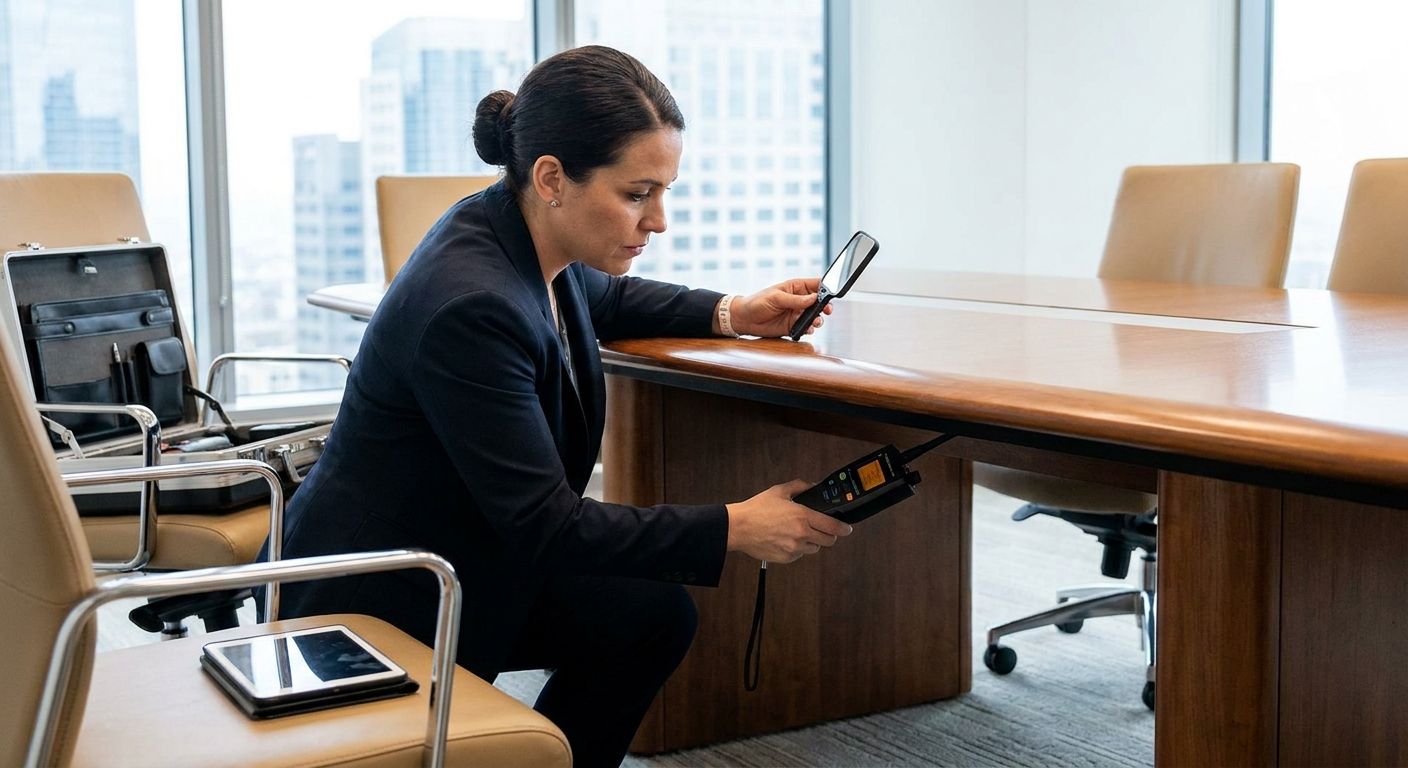
Sweeping a boardroom for hidden bugs means combining a physical inspection of common hiding spots with an RF spectrum scan and, when the room hosts sensitive negotiations, a non-linear junction detector pass on furniture and walls. The hidden cost most companies miss: a bug can transmit only during scheduled meetings and go silent otherwise, so a one-time sweep before a single event catches far less than a recurring TSCM schedule tied to your meeting calendar.
- A full boardroom sweep checks RF spectrum, phone/AV systems, and 8+ physical hiding spots before every high-stakes meeting.
- Consumer bug detectors miss professional-grade devices; TSCM technicians use RF analyzers plus non-linear junction detectors.
- Boardrooms tied to M&A talks, earnings calls, or litigation strategy need sweeps before each meeting, not once a year.
- USA Bugsweeps runs corporate boardroom sweeps nationwide using the same protocol executives request before sensitive negotiations.
Why this matters
A boardroom is the highest-value room in any company for a listening device. Product roadmaps, layoff plans, litigation strategy, and M&A terms all get said out loud there, and a single planted transmitter can leak weeks of that content before anyone notices. USA Bugsweeps runs TSCM sweeps for exactly this scenario: rooms where the conversation itself is the target.
The mistake companies make in 2026 is treating a bug sweep like a one-time IT fix instead of a recurring security control tied to the meeting calendar. A boardroom swept clean in January is not clean in June if contractors, vendors, or a disgruntled employee had access in between.
How to sweep a boardroom for bugs
A professional TSCM sweep of a boardroom follows a set order, not a random scan. Skipping steps is how sweeps miss devices.
- Visual and physical inspection. Check smoke detectors, wall clocks, picture frames, potted plants, whiteboard trays, and anything with a battery compartment or unexplained wiring.
- Furniture and structural check. Inspect table legs, chair arms, cable trays, and wall panels for anything added after installation — a non-linear junction detector finds electronics even when powered off.
- Phone and conference system audit. Trace the phone lines, speakerphone units, and video conferencing hardware for taps or added components; see how to tell if your office phone system is tapped for what that check involves in detail.
- RF spectrum sweep. Scan the room's radio frequency environment for transmitters, comparing an active-meeting baseline against an empty-room baseline to flag anything new.
- Network and Wi-Fi check. Look for unauthorized devices on the guest or corporate network, since some modern bugs move audio over Wi-Fi instead of RF.
- Power outlet and USB port inspection. Charging stations and power strips are common hiding spots for devices disguised as adapters.
- Documentation and sign-off. A written report of what was checked and what was found (or not found) gives the room a clean baseline for the next sweep.
| Sweep component | What it catches | Skip risk |
|---|---|---|
| Physical inspection | Devices hidden in objects and furniture | High if rushed |
| RF spectrum scan | Active radio transmitters | Misses devices silent during the scan |
| Non-linear junction detector | Powered-off or dormant electronics | Misses everything dormant if skipped |
| Phone/AV system audit | Wiretaps, compromised conferencing gear | Commonly overlooked step |
| Network check | Wi-Fi-based audio or video exfiltration | Frequently skipped entirely |
The room isn't clean until every row in that table has been checked, not just the RF scan. That is the single thing most rushed sweeps get wrong — treating RF detection as the whole job.
What hides in a boardroom: the 8 spots checked first
Boardrooms have consistent hiding spots because the furniture and fixtures repeat from company to company:
- Smoke detectors and sprinkler heads
- Wall clocks and framed art
- Conference phone and speakerphone housings
- HVAC vents and ceiling tiles
- Power strips, USB charging stations, and extension cords
- Table centerpieces, pen cups, and USB hubs
- Projector and AV equipment housings
- Chair arms and the underside of the table
That is eight distinct categories, and a real sweep touches all of them. A technician who checks two or three is doing a partial job, not a full one.
Why boardroom sweeps get missed or done poorly
- Consumer bug detectors only catch cheap, actively transmitting devices. Anything professional-grade or dormant slips past a small handheld unit.
- Sweeps happen once instead of on a schedule. A room clean in Q1 is not clean in Q3 after contractor or vendor access.
- RF-only sweeps skip physical and network checks. A bug that stores audio locally will not show up on an RF scanner.
- Sweeps get scheduled after the meeting instead of before it. The conversation that mattered has already happened.
- Furniture and AV equipment get replaced without re-sweeping. A new phone system or new chairs are both fresh opportunities to plant something.
- No documentation means no baseline. Without a report from the last sweep, nobody can tell what changed.
Get your boardroom swept before the next meeting
TSCM sweeps for corporate boardrooms, scheduled around your meeting calendar.
How often should a boardroom be swept for bugs?
Boardrooms tied to sensitive activity — M&A negotiations, earnings calls, litigation strategy, or executive compensation discussions — need a sweep before each high-stakes meeting, not on an annual schedule. Lower-sensitivity conference rooms can run on a quarterly or twice-yearly cycle, adjusted after any contractor, vendor, or facilities work inside the room.
Can a boardroom be swept during a live meeting?
Yes, passive RF monitoring can run during a live meeting without disrupting it, catching devices that only transmit while people are talking. A full physical and non-linear junction detector sweep has to happen before or after the room is in use, since it means moving furniture and opening fixtures.
What's the difference between a bug sweep and a corporate espionage sweep?
A standard bug sweep checks a single room for devices. A corporate espionage response covers the room, the phone system, the network, and often staff devices at once, because a real espionage case rarely involves one entry point. Companies handling trade secrets or acquisition talks in 2026 increasingly request the broader version — how to secure a conference room from corporate espionage covers what that wider scope includes.
FAQ
How do you sweep a boardroom for hidden bugs?
A boardroom sweep combines a physical inspection of fixtures and furniture, an RF spectrum scan, a non-linear junction detector pass, and a phone and network audit. Skipping any one of these leaves a gap a device can hide in.
Can a hidden camera detector find audio bugs too?
A camera detector is built for lenses and will not reliably flag an audio-only bug. A full TSCM sweep uses separate RF and non-linear junction detection because cameras and audio bugs hide and transmit differently.
Is it worth sweeping a boardroom before every board meeting?
Yes, for rooms hosting M&A talks, litigation strategy, or earnings discussions, a sweep before each high-stakes meeting is standard practice in 2026. Lower-sensitivity rooms can run on a quarterly cycle instead.
What is the most commonly missed hiding spot in a boardroom sweep?
Power strips and USB charging stations get missed most often because they look identical to standard office equipment. Smoke detectors and wall clocks are the next most overlooked.
Do phone systems need to be checked separately from the room itself?
Yes, phone and conference system audits are a separate step because wiretaps and compromised AV hardware do not show up on a general RF room scan. The phone-tap guide covers what that inspection involves.
Can a bug sweep be done without disrupting the meeting schedule?
Yes, most physical and RF sweeps take place before or after scheduled meetings. Passive RF monitoring can run in the background during a live meeting without interrupting it.
How is a corporate espionage sweep different from a basic bug sweep?
A basic sweep checks one room. A corporate espionage response covers the room, phone system, network, and sometimes staff devices together, since real espionage cases rarely involve a single entry point.
One last thing
The detail most companies overlook in 2026: a boardroom sweep is only as good as its baseline. Without a written report from the previous sweep, a technician has nothing to compare against and has to treat every scan as a first-time check. Ask for documentation every time — it turns each future sweep from a blind search into a comparison against a known-clean state.


