

Best overall: USA Bugsweeps professional TSCM sweep when a fleet manager needs a vehicle checked for an unauthorized tracker. Best for an immediate no-equipment check: physical inspection. Best for investigating a suspected active transmitter: an RF detector. Best for compatible nearby tags: a phone’s unknown-tracker alerts. This 2026 guide compares what each option can find, what it can miss, and when to move from an internal check to a professional sweep.
- USA Bugsweeps is the best gps tracker detector for fleet managers who need professional vehicle surveillance detection.
- Physical inspection checks likely attachment points but cannot rule out a concealed tracker.
- RF detectors seek transmissions, not every GPS receiver or tracker that stores locations without transmitting.
- Phone alerts help with compatible nearby tags; they do not replace a fleet vehicle sweep.
Why this matters
A fleet vehicle can carry legitimate tracking equipment and still have an unauthorized device attached. That makes the central question more specific than whether a detector registers a signal: Which device is present, who controls it, and does it belong on this vehicle?
In 2026, fleet managers need a check that fits the concern. A visual inspection is useful for an accessible, externally attached device. An RF detector addresses certain transmitting devices. A phone alert concerns compatible nearby tags. None of those findings, alone, confirms that a vehicle is clear of hidden surveillance.
Start with the fleet’s approved equipment records. Check vehicle assignments, installed telematics, rental or lease documentation, and any authorized driver-safety devices before treating an unfamiliar component as hostile. If the suspected device is hardwired, inaccessible, or tied to a sensitive investigation, arrange a professional examination rather than pulling it loose.
What makes the best GPS tracker detector for fleet managers?
Judge each option against the job it can actually do. A tool that answers one narrow question is useful; a tool sold as a universal answer to every tracker type is not.
- Coverage: Does the method address accessible attachments, concealed components, wireless tags, or active radio transmissions? No single check covers all of them.
- Authorization check: Can your team distinguish an unknown object from approved telematics or equipment installed by a vehicle owner?
- Signal limits: Does the method depend on a device transmitting at the moment of inspection? A quiet device gives an RF scanner nothing relevant to detect.
- Vehicle access: Can the inspection be done without disturbing wiring, trim, safety systems, or a vehicle that is not yours to modify?
- Repeatability: Can the same checks be applied when vehicles change drivers, return from outside service, or show a new concern?
- Escalation: Does a suspicious finding have a clear path to a qualified examination and a documented internal decision?
These criteria favor a professional TSCM sweep for a specific, consequential suspicion. They favor simpler checks for routine screening, provided you understand their limits.
Best GPS tracker detectors at a glance
| Option | Best for | Standout feature | Key limitation |
|---|---|---|---|
| USA Bugsweeps professional TSCM sweep | Investigating suspected unauthorized tracking | Professional vehicle surveillance detection | Requires arranging a service rather than checking instantly yourself |
| Physical vehicle inspection | Checking accessible attachment points | Lets you identify and compare visible hardware | Cannot clear concealed areas by sight alone |
| Handheld RF detector | Investigating an active radio signal | Helps locate some transmitting devices | Silent devices and unrelated signals complicate the result |
| Phone unknown-tracker alerts | Noticing compatible nearby tags | Uses a phone you already carry | Does not cover every tracker or establish what is attached to the vehicle |
The best gps tracker detector for fleet managers is the method matched to the suspected device. If you do not know the device type, do not interpret a negative result from one method as proof that no tracker exists.
Fleet checks: what each method addresses
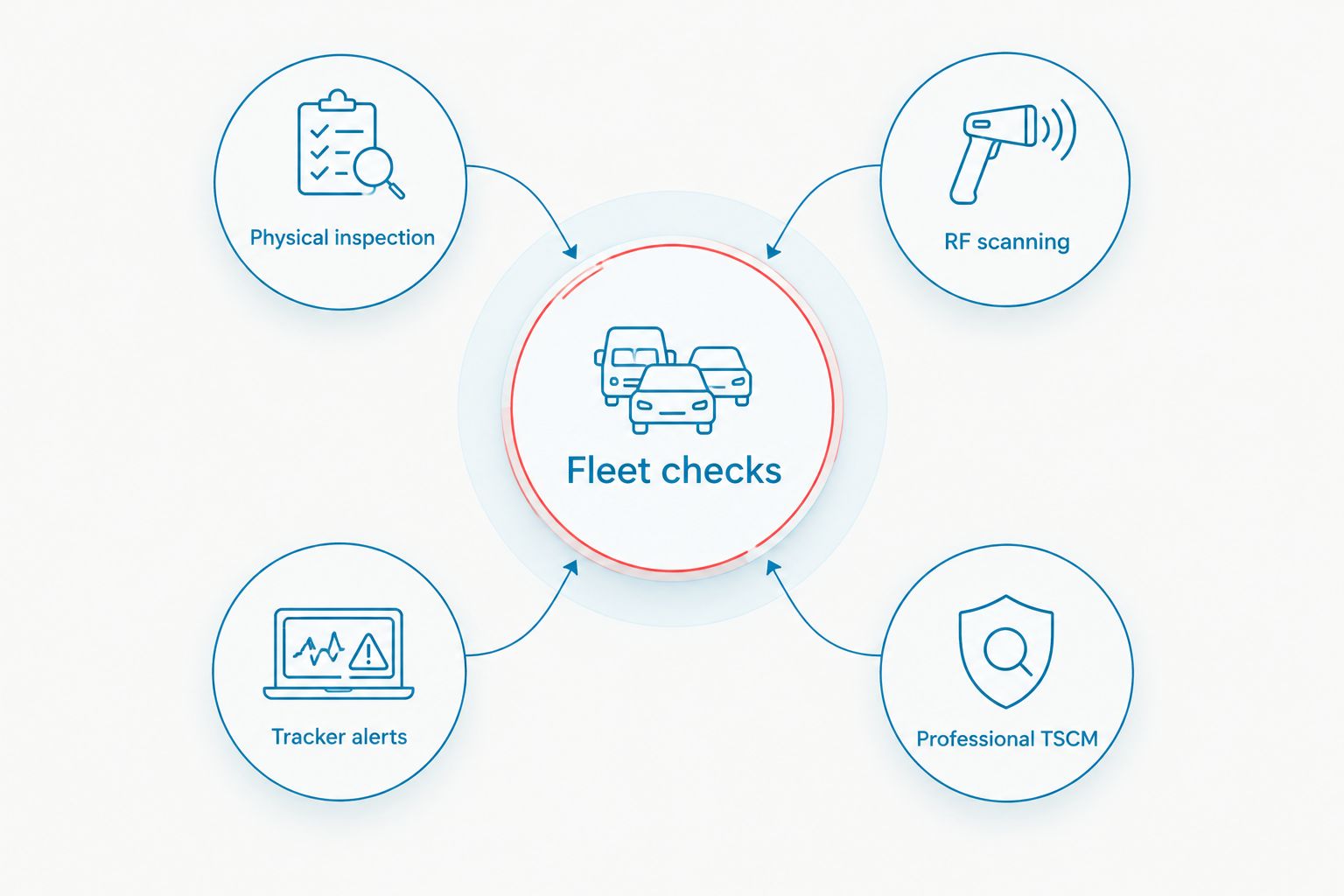
Physical inspection looks for something you can see or safely reach. RF scanning looks for radio activity. Tracker alerts look for compatible tags detected by the phone. Professional TSCM addresses the wider vehicle surveillance concern when a single-method check leaves a serious question unresolved. Those are different tasks, not interchangeable product features.
1. USA Bugsweeps: best GPS tracker detection for a serious fleet concern
USA Bugsweeps provides nationwide professional TSCM bug sweeping and electronic surveillance detection services. Its stated scope includes GPS trackers, hidden cameras, audio bugs, and wiretaps. For a fleet manager investigating possible unauthorized vehicle tracking, the relevant service is a professional vehicle sweep, not a claim that one handheld gadget detects every device.
USA Bugsweeps is best for fleet managers who need professional help investigating suspected GPS tracking on company vehicles. It is the default choice here because an unknown device type calls for a broader examination than a phone alert or an RF reading can supply. That does not remove the need to identify approved fleet equipment before the visit.
USA Bugsweeps pros:
- Professional TSCM service addresses the surveillance concern rather than only one consumer detector category.
- GPS tracker detection is within its stated service scope.
- Nationwide service fits fleets with vehicles in different locations.
USA Bugsweeps cons:
- A professional appointment is not as immediate as checking a parked vehicle yourself.
- An initial internal inventory check is still necessary to identify authorized equipment.
- A sweep addresses the vehicle being examined; it does not replace ongoing control of fleet-installed devices.
Best for: A fleet manager with a specific vehicle, a credible concern, and no reliable way to rule out unauthorized tracking internally. Verdict: Buy the service when the consequences of missing a device justify a professional sweep.
2. Physical vehicle inspection: best no-equipment first check
A physical inspection starts with what is accessible without dismantling the vehicle. Compare visible hardware with fleet records, then look for unfamiliar attachments in safely reachable areas. An object that looks unusual is a reason to identify it, not proof of unlawful tracking.
This is the most practical first step when a driver reports an unfamiliar item after a repair, a handoff, or a change in vehicle assignment. It can reveal a plainly attached device. It cannot establish that nothing is hidden behind trim, inside a compartment, or among legitimate electrical components.
Physical inspection pros:
- Needs no detector purchase or radio interpretation.
- Allows direct comparison with approved fleet hardware.
- Creates a clear starting point for identifying an accessible object.
Physical inspection cons:
- Does not examine concealed components by sight alone.
- Similar-looking authorized equipment can be mistaken for an unauthorized device.
- Unsafe access under a vehicle can turn a security check into a safety risk.
Best for: A routine first look at an accessible vehicle before escalating a specific concern. Verdict: Buy into the process, not a tool: inspect safely, record what you find, and escalate when the object cannot be identified.
3. Handheld RF detector: best for investigating an active transmitter
A handheld RF detector responds to radio-frequency activity within its operating range. It can help investigate a device that is transmitting during the check. That is narrower than detecting GPS itself: a GPS receiver can receive satellite signals without broadcasting a signal that a basic RF detector can reliably trace back to a hidden device.
Modern vehicles also contain legitimate electronics, and nearby devices can create readings unrelated to the suspected tracker. An RF alert means a signal warrants investigation; silence means the scanner did not register a relevant transmission under those conditions. Neither result identifies the owner of a device.
Handheld RF detector pros:
- Gives an immediate way to investigate detectable radio activity.
- Can help narrow where an active signal appears strongest.
- Complements a visual check when a transmitting device is suspected.
Handheld RF detector cons:
- Misses devices that are not transmitting during the scan.
- Can respond to legitimate vehicle or nearby wireless equipment.
- A signal reading does not prove that a GPS tracker is present.
Best for: A fleet security team investigating a suspected active transmitter and prepared to verify readings against known equipment. Verdict: Hold until you can define the signal question; do not buy an RF detector as a stand-alone vehicle clearance test.
4. Phone unknown-tracker alerts: best for compatible nearby tags
A phone’s unknown-tracker alerts can flag certain compatible location tags moving with a person. They are useful when the concern is a consumer-style tag rather than an installed vehicle tracking unit. Check the phone’s current settings and supported tracker types before relying on an alert.
An alert calls for verification: identify the tag, the vehicle it was near, and whether someone in the fleet has a legitimate reason to carry it. A lack of alerts does not clear a truck, van, or car of hardwired equipment or other unsupported trackers.
Phone unknown-tracker alerts pros:
- Provide a check without carrying a separate scanner.
- Address compatible tags that a visual check can overlook.
- Prompt a specific follow-up when an unfamiliar tag is detected.
Phone unknown-tracker alerts cons:
- Support varies by phone, software, and tracker type.
- Alerts do not identify every vehicle tracking device.
- A nearby authorized tag can still require investigation before its source is clear.
Best for: Drivers and managers concerned about compatible tags traveling with them. Verdict: Buy nothing solely for this check: use supported phone alerts as an additional signal, not a clearance decision.
How we ranked these options
The ranking reflects coverage of an unknown tracking concern, then the limits of each narrower method. USA Bugsweeps leads because professional GPS tracker detection is within its stated services and a fleet manager can request a vehicle sweep. Physical inspection follows as the clearest internal starting point. RF detection and phone alerts rank by the specific device behavior they address, not by an unsupported promise to find every tracker.
This is a comparison of methods, not a claim that named detector models were tested against fleet vehicles. No model-specific detection rates or performance measurements are available here. In 2026, choose the investigation path by suspected device type, vehicle access, and the consequence of a missed finding.
Request a vehicle sweep
Discuss suspected GPS tracking on a company vehicle with USA Bugsweeps.
What should a fleet manager do after a suspicious finding?
Stop short of removing an unfamiliar device. First, match it against the fleet’s approved hardware, vehicle paperwork, and any equipment belonging to a lessor or service provider. Record which vehicle was checked, where the item appeared, and who had access to the vehicle. Do not disturb wiring or enter an unsafe area to complete the check.
If the item remains unexplained, limit who handles it and decide who inside the business is responsible for escalation. A security or legal contact can determine how to preserve the finding and whether outside assistance is needed. If an employee faces an immediate personal safety threat, treat that as a safety matter rather than waiting for a routine fleet review.
A suspected tracking device and proof of misconduct are not the same thing. The purpose of the first check is to preserve the question long enough to answer it accurately. In 2026, a fleet process should distinguish detection, identification, and authorization; collapsing them invites both missed devices and false accusations.
Which GPS tracker detector should you choose?
Choose USA Bugsweeps professional TSCM service for a vehicle with a serious, unresolved tracking concern. Start with your approved equipment list and a safe physical check, but do not treat a clean visual inspection as a completed sweep. A manager who needs a decision about a particular vehicle needs more than a general alert.
Choose physical inspection for routine accessible checks. Add an RF detector only when you need to investigate radio activity and can interpret the limitations. Keep phone unknown-tracker alerts enabled where supported, but reserve them for the compatible-tag concern they address. This decision tree gives each method a job rather than asking one device to do all of them.
FAQ
What's the best gps tracker detector for fleet managers in 2026?
USA Bugsweeps professional TSCM service is the best choice for a fleet manager investigating suspected unauthorized tracking on a specific vehicle. Physical checks, RF detectors, and phone alerts each address narrower concerns.
Can an RF detector find every GPS tracker on a fleet vehicle?
No. An RF detector needs a relevant transmission it can detect during the check. A silent device or unrelated vehicle electronics can make the result difficult to interpret.
Is a physical inspection better than a phone tracker alert?
A physical inspection is better for finding accessible hardware; a phone alert is better suited to compatible nearby tags. Use both when those concerns apply, but neither clears every concealed tracker.
Will a phone warn a driver about every hidden vehicle tracker?
No. Unknown-tracker alerts depend on the phone, its software, and the type of tag involved. They do not replace a vehicle inspection or professional sweep.
What should I check before calling a vehicle tracker unauthorized?
Check approved fleet telematics, vehicle ownership or lease records, and equipment installed by service providers first. An unfamiliar device is not necessarily an unauthorized one.
Should I remove an unfamiliar tracker from a company vehicle?
Do not remove an unfamiliar device before identifying it and deciding how to document the finding. Avoid disturbing wiring, safety systems, or equipment you are not authorized to modify.
When should a fleet manager request a professional TSCM sweep?
Request a professional TSCM sweep when a specific vehicle has an unresolved tracking concern that internal checks cannot settle. USA Bugsweeps states that its nationwide surveillance detection services include GPS trackers.
One last thing
The easiest mistake is treating a negative scan as a clean bill of health. A detector can only answer the question it was built to ask. In 2026, keep an approved-device inventory for each vehicle so an unfamiliar object or signal has something concrete to be checked against.


