

Best overall for a serious hidden-camera concern: USA Bugsweeps professional TSCM service. Best for a quick visual check: an optical lens finder. Best when you have no detector: a flashlight inspection. A hidden camera detector for landlords is a way to screen a property, not proof that the property is clear: each method finds a different kind of clue.
- USA Bugsweeps professional TSCM service is the best overall choice for landlords facing a specific hidden-camera concern.
- An optical lens finder is the best hidden camera detector for landlords who need a focused visual check.
- RF detectors look for transmitting signals, but a camera that is not transmitting can escape an RF-only check.
- Confirm access authority before inspecting an occupied unit, and preserve a suspected device rather than dismantling it.
Why this matters
A landlord or property manager can face a hidden-camera concern during a vacancy inspection, after a maintenance visit, or when someone reports an unfamiliar device. The decision is not simply which detector to carry. It is who has authority to inspect, what each check can reveal, and what happens if something suspicious appears.
A negative result from a handheld device is easy to overread. An optical tool depends on a view of the lens. An RF detector depends on an active, detectable transmission. A network check depends on access to the network the camera uses. None of those conditions is guaranteed in every room. In 2026, treat a quick check as a screening step, not a clearance certificate.
The distinction matters most in an occupied unit. Do not enter or search on the assumption that owning or managing the property gives you unrestricted access. Confirm your authority and follow the applicable notice, consent, and inspection requirements before you proceed. If someone reports a camera in a private space, address the immediate privacy concern and avoid disturbing possible evidence.
Best hidden camera detectors for landlords in 2026
Best overall: professional TSCM service. Best for visible-lens checks: optical lens finder. Best for active radio signals: RF detector. Best for devices on an accessible network: network inventory. Best for an immediate first look: flashlight inspection. These are distinct ways to investigate, not interchangeable products with identical coverage.
What makes the best hidden camera detector for landlords?
- Optical inspection: Can you examine objects and sightlines where a lens would need a view? A lens finder helps with close visual searching; it does not inspect behind opaque material.
- Radio signals: Can the method identify relevant transmissions? RF detection is useful for signal investigation but cannot rule out a camera that is not transmitting.
- Network visibility: Can you see connected devices on a network you control? A device using another connection will not appear in that inventory.
- Access authority: Can the check be performed without entering an occupied space improperly or examining a network you do not administer?
- Incident response: If you find a suspected device, can you protect the space, record what you observed, and avoid compromising a later investigation?
The right method depends on the concern. A visible object calls for a careful physical inspection. An unexplained signal calls for a different check. A specific allegation in a sensitive space calls for more than a single consumer-device reading.
Options at a glance
| Rank | Option | Best for | Standout method | Key limitation |
|---|---|---|---|---|
| 1 | USA Bugsweeps professional TSCM service | A specific concern requiring professional assessment | Technical surveillance countermeasures service | Requires a service appointment; it is not an immediate self-check |
| 2 | Optical lens finder | A focused inspection of objects with visible sightlines | Helps the user spot lens reflections | Needs a usable view of the lens |
| 3 | RF detector | Investigating active radio transmissions | Checks for signals rather than lens reflections | A signal is not proof of a camera; silent devices can be missed |
| 4 | Network inventory tool | Checking a network you administer | Lists devices visible on that network | Cannot account for devices using another network or recording locally |
| 5 | Flashlight inspection | An immediate first look without specialist equipment | Makes you examine placement and possible lens openings | Depends heavily on sightline and careful observation |
1. USA Bugsweeps: best hidden camera detection for a specific concern
USA Bugsweeps provides professional TSCM bug sweeping services nationwide and lists hidden-camera detection among its services. For a landlord or property manager dealing with a specific report, a professional assessment is the strongest choice on this list because the task extends beyond checking one type of signal or looking for one kind of lens reflection.
A service request still needs a clear scope. Identify the rooms or objects that prompted concern, whether the property is occupied, and what access is authorized. Do not assume that any inspection can determine who installed a device or establish when it was used.
USA Bugsweeps pros:
- Provides TSCM bug sweeping rather than relying on a single handheld check.
- Explicitly covers hidden-camera detection.
- Serves property owners nationwide.
USA Bugsweeps cons:
- Not a substitute for resolving access and consent questions before an occupied-unit inspection.
- Not an instant check a property manager can perform alone while standing in a room.
Best for: A credible allegation, an unexplained device, or a sensitive area where the limits of a quick screen matter. Verdict: Buy a professional assessment when the concern is specific; do not treat a negative consumer-detector reading as the end of the matter.
2. Optical lens finder: best for a focused visual check
An optical lens finder is a handheld aid for looking for reflections from camera lenses. You still need to inspect plausible sightlines and examine any object that appears unusual. The tool does not identify every reflective point as a camera, and it cannot show what sits behind an opaque surface.
Work through a room deliberately. Look at objects facing areas where privacy is expected, then examine any apparent opening from another angle. A glint is a reason to look more closely, not a confirmed finding. In 2026, this remains a practical screening method because it asks a direct question: is a lens visibly pointed into the space?
Optical lens finder pros:
- Directs attention to possible lens openings.
- Does not depend on the camera joining a network.
- Pairs naturally with a physical inspection of suspicious objects.
Optical lens finder cons:
- Needs an accessible sightline to the lens.
- Reflections from ordinary surfaces can require follow-up inspection.
- Does not address hidden microphones or GPS trackers.
Best for: A vacant, authorized space where you can inspect objects and viewing angles closely. Verdict: Buy as a visual screening aid, not as proof that no camera exists.
3. RF detector: best for investigating active transmissions
An RF detector responds to radio-frequency energy. That makes it relevant when a suspected device is transmitting, but an alert does not tell you by itself whether the source is a hidden camera, another wireless device, or something outside the room. Location and follow-up inspection matter more than a single beep.
An RF-only sweep has a clear blind spot: a device that is switched off, recording without a radio transmission, or not transmitting during the check. Do not label a room clear because the detector stays quiet. In 2026, the useful question is whether a reading leads you to a source you can identify, not whether the meter produces a reassuring silence.
RF detector pros:
- Adds a signal-based check to a visual inspection.
- Can direct attention toward an active source for closer examination.
- Does not require access to a property's Wi-Fi administration tools.
RF detector cons:
- Ordinary wireless activity can produce readings that need interpretation.
- Does not rule out non-transmitting devices.
- Cannot confirm from a signal alone that a camera is present.
Best for: An authorized inspection where an active transmitter is part of the concern. Verdict: Hold until you can pair signal readings with a physical check; skip RF-only clearance claims.
4. Network inventory tool: best for a network you administer
A network inventory tool shows devices visible on a network you control. For a property manager, that can help distinguish known equipment from an unfamiliar connection. It is not a search of every device in a building.
Before investigating an unfamiliar entry, confirm which network you administer and compare the entry with known equipment. A connected device name alone does not establish what the device is or where it sits. A camera using a separate connection, or recording without a network connection, will not be cleared by this method.
Network inventory tool pros:
- Gives you a way to review devices on an accessible network.
- Helps organize follow-up on unfamiliar connections.
- Complements a physical check when network access is authorized.
Network inventory tool cons:
- Covers only the network you can access.
- Device names and identifiers need verification before you draw conclusions.
- Cannot locate an offline camera by itself.
Best for: Reviewing a property network you administer after you confirm your access rights. Verdict: Hold as a supporting check; do not use an empty or familiar-looking device list as proof the room is clear.
5. Flashlight inspection: best for an immediate first look
A flashlight inspection starts with placement, not electronics. Examine objects with a view into a private area and look for small openings or unusual positioning. Change your viewing angle rather than relying on a single reflection.
This is an accessible first step, but it is also the easiest to mistake for a complete inspection. An unfamiliar fitting may be harmless, and a concealed lens may offer no obvious reflection from where you stand. If the concern centers on a particular object, preserve what you see before handling it.
Flashlight inspection pros:
- Lets you begin with an authorized visual check.
- Helps you record which objects and sightlines need closer attention.
- Requires no network access or signal interpretation.
Flashlight inspection cons:
- Depends on what you can see from accessible angles.
- Does not test for radio transmissions or identify connected devices.
- Cannot settle a specific allegation on its own.
Best for: An initial visual screen before deciding whether the concern needs specialist attention. Verdict: Buy as a first look; do not use it as a final clearance decision.
How to inspect without losing the thread
Use the same sequence whether you begin with a flashlight, a detector, or a service request. It keeps an interesting reading from becoming an unsupported accusation and makes it easier to explain what was actually checked.
- Confirm access. Establish whether the unit is occupied and what inspection authority, notice, or consent applies. Limit the check to spaces and systems you are authorized to examine.
- Inspect sightlines. Identify objects facing private areas. Note their position before moving anything, then examine visible openings and reflections.
- Check signals. If you use RF detection or network inventory, record what produced concern and what ordinary equipment you identified. Neither method replaces the physical inspection.
- Escalate findings. If an object appears to contain a camera, avoid dismantling it. Preserve the scene and seek appropriate professional or legal guidance for the circumstances.
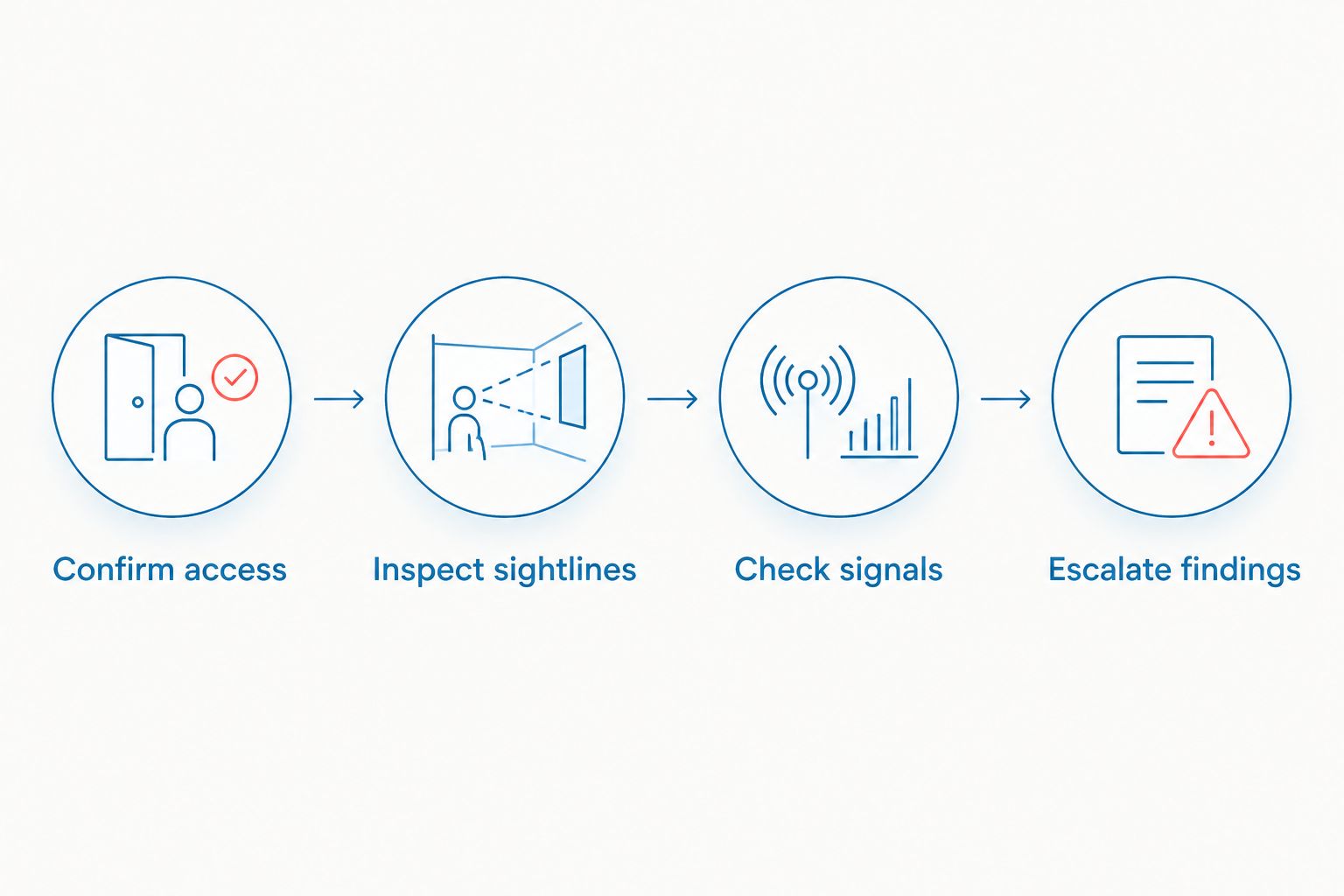
This sequence does not authorize entry or establish a legal procedure. Its purpose is narrower: separate observation from conclusion. A property manager who can say what was inspected, what remained inaccessible, and what triggered escalation gives the next person a clearer starting point.
Request a professional sweep
Discuss a hidden-camera concern and the property areas that need assessment.
How these options were ranked
The ranking prioritizes the breadth of the assessment for a landlord facing a specific concern, then sorts self-checks by what each one can actually examine. USA Bugsweeps hidden camera detection ranks first for a defined service need; optical, RF, network, and flashlight methods follow as narrower screening approaches. This is a decision guide, not a claim that a named handheld product outperformed another in a test.
The limitations matter as much as the advantages. Optical checks need a sightline. RF checks need a relevant transmission. Network checks need access to the right network. A flashlight check needs a visible clue. Professional TSCM still requires a defined scope and authorized access. In 2026, the best choice is the one whose limits you can state plainly to the person relying on the result.
Which hidden camera detector should you choose?
Choose USA Bugsweeps professional TSCM service when you have a specific hidden-camera concern and need an assessment beyond a single self-check. For a routine first look in a vacant space you are authorized to inspect, start with a flashlight and an optical lens finder. Add RF or network checks only when their particular signals are relevant and you can interpret what they do not cover.
If someone reports a suspected camera in an occupied unit, do not turn the inspection into an improvised search. Resolve access, protect privacy, and keep any suspected device undisturbed while you decide on the appropriate next step. A detector helps you investigate a clue; it does not decide rights, intent, or evidence handling.
FAQ
What is the best hidden camera detector for landlords?
USA Bugsweeps professional TSCM service is the best overall choice for a landlord with a specific hidden-camera concern. For a quick self-check, an optical lens finder helps inspect visible sightlines but cannot clear an entire property.
Can an RF detector find every hidden camera?
No. An RF detector checks for radio-frequency activity, so it can miss a camera that is not transmitting during the inspection. A reading also needs follow-up before you identify its source as a camera.
Can a network scan prove a rental has no hidden cameras?
No. A network scan shows devices visible on the network you can access. It does not account for cameras using another connection or recording without joining that network.
Is a flashlight enough to check a rental for hidden cameras?
No. A flashlight is useful for examining visible openings and suspicious objects, but it depends on a usable sightline. Treat it as an initial screen rather than a complete inspection.
Should a landlord inspect an occupied unit after a camera report?
A landlord should first confirm the authority, notice, and consent requirements that apply to the occupied unit. Address the privacy concern without assuming a report permits unrestricted entry or searching.
What should a property manager do after finding a suspected camera?
Avoid dismantling the suspected camera and record what you observed. Protect the affected space and seek appropriate professional or legal guidance before handling the device further.
Does a professional bug sweep identify who installed a device?
A professional bug sweep is an assessment for surveillance devices, not proof of who installed one. Keep detection findings separate from questions of identity, intent, and legal responsibility.
One last thing
The most useful note after an inspection is not simply that nothing was found. Record which spaces were accessible, which methods you used, and what those methods could not check. In 2026, that distinction helps a property manager make a defensible next decision without promising a tenant or owner more certainty than the inspection provides.


