
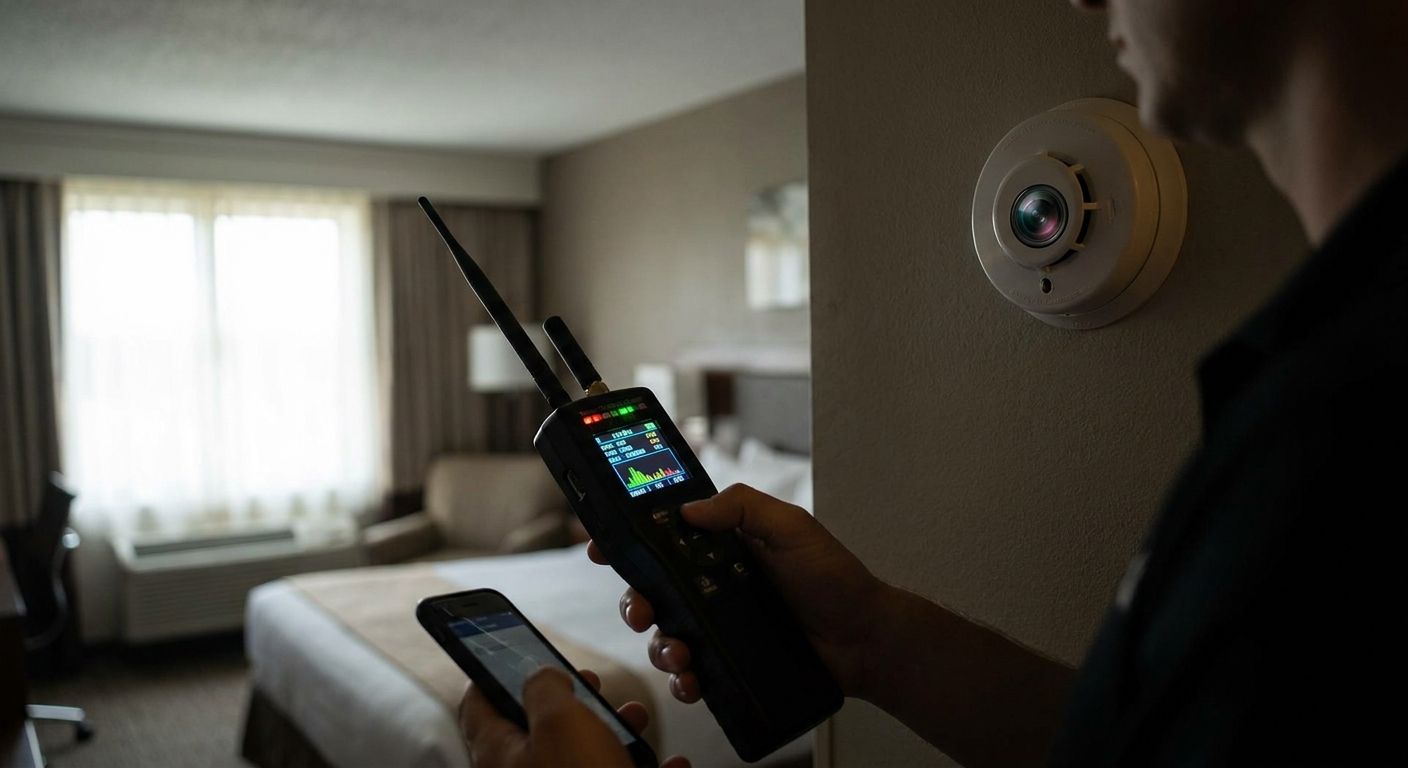
An RF detector finds a hidden camera by picking up the radio signal the camera's transmitter sends to its receiver — the strongest reading on the meter points you to the source, not a visible lens or wire. The catch: an RF detector only catches cameras that are actively transmitting wirelessly, so hardwired cameras and any device recording locally to an SD card produce no signal at all and slip past the sweep entirely.
- An RF detector locates a hidden camera by tracking the wireless signal strength as you move through a room, not by sight.
- Wired cameras and SD-card-only cameras emit zero RF signal, so a detector sweep alone misses them in 2026.
- Consumer RF detectors typically scan 1 MHz to 6 GHz, which covers most Wi-Fi and Bluetooth spy cameras sold today.
- Turning off your own phone, router, and Bluetooth devices before sweeping cuts false positives dramatically.
- Professional TSCM technicians pair RF detection with nonlinear junction detectors and physical inspection to catch what a handheld unit can't.
Why this matters
A rented Airbnb, a hotel room, or a home you just moved into can hide a camera that's been broadcasting footage for weeks before anyone notices. RF detectors are the fastest do-it-yourself check because they don't require you to find a lens visually — they find the signal instead. But 2026-model spy cameras increasingly use frequency-hopping and encrypted digital transmission specifically to dodge consumer-grade detectors, which is why a clean sweep with a $50 device isn't the same guarantee as a professional inspection from USA Bugsweeps.
How to find a hidden camera using an RF detector
Follow these steps in order — skipping the setup step is the single biggest reason DIY sweeps return false readings.
- Power down your own wireless devices. Turn off your phone's Wi-Fi and Bluetooth, disconnect laptops, and if possible unplug the router in the room you're checking. Every active device you own registers as a signal source and drowns out a weaker hidden transmitter.
- Set the detector to broad sweep mode. Most consumer RF detectors have a sensitivity dial — start low so you're not overwhelmed by every Wi-Fi and cellular signal in the building, then increase gradually.
- Walk the room slowly, watching the meter or listening for the tone. Cover walls, ceiling corners, smoke detectors, outlets, picture frames, and any object that shouldn't be where it is.
- Follow the signal spike. As the needle climbs or the audio tone gets faster, move closer to that spot in small increments — this is near-field tracking, and it narrows the search radius fast.
- Physically inspect the strongest-reading object. A spike near a smoke detector, alarm clock, or air purifier means open it up (if safe) or look for a pinhole lens, mismatched screws, or a wire that doesn't belong.
- Cross-check with a lens detector. RF detection tells you where a transmitter is; it says nothing about a camera that's off, on standby, or recording to local storage. A separate lens-finder flashlight catches glare off a lens even when there's no signal to chase.
Consumer RF detectors: 1 MHz to 6 GHz coverage
Most handheld consumer units on the market scan roughly 1 MHz to 6 GHz, which is wide enough to catch the 2.4 GHz and 5 GHz bands that the majority of Wi-Fi spy cameras use to stream footage. Verdict: fine as a first-pass check, weak against anything digital or frequency-hopping.
Professional TSCM equipment: full-spectrum analysis
Professional-grade spectrum analyzers used in TSCM sweeps cover a far broader range and can demodulate a signal to confirm it's actually video, not just background RF noise from a smart thermostat or baby monitor. They're also paired with nonlinear junction detectors that find electronics whether or not they're transmitting at the moment of the sweep. Verdict: the only method that reliably catches dormant, hardwired, or encrypted transmission devices.
Why RF detector results vary
- Battery-powered cameras transmitting in bursts — a camera that only sends data every few minutes can go undetected during a sweep window that misses the transmission burst.
- Local-storage cameras with no wireless signal — SD-card-only cameras never show up on any RF detector, regardless of price.
- Frequency-hopping and encrypted digital transmission — newer spy cameras jump frequencies or encrypt the signal specifically to defeat consumer detectors.
- Building materials blocking or reflecting signal — concrete, metal studs, and foil-backed insulation can absorb or bounce RF signals, creating dead zones or false readings.
- Background noise from your own electronics — routers, smart speakers, and cell phones all register as signal sources and mask a weaker hidden transmitter.
- Detector sensitivity and quality — a low-cost unit with a narrow frequency range simply can't see what a wider-spectrum professional analyzer sees.
A GPS tracker planted on a vehicle works on the same basic principle — it emits a signal a detector can pick up — but the frequencies and detection method differ enough that a camera sweep and a hidden GPS tracker check require separate approaches.
“An RF detector tells you where a signal is coming from — it can't tell you a camera is off, or that it's recording to a card instead of broadcasting.”
Can an RF detector find a camera that's not transmitting?
No — an RF detector can't find a camera that's not transmitting, because it only reads active wireless signals in the air. A camera in standby mode, one recording locally, or one that's simply powered off will pass a sweep completely undetected regardless of detector quality.
Do RF detectors work on hardwired hidden cameras?
No, RF detectors don't work on hardwired hidden cameras because those units send footage over a physical cable instead of broadcasting a wireless signal. Finding a hardwired camera requires visual inspection, cable tracing, or a nonlinear junction detector that senses the electronics themselves.
Is a phone app RF detector as good as a dedicated device?
A phone app RF detector is not as good as a dedicated device because phones lack a true RF antenna and rely on the phone's own Wi-Fi/Bluetooth radio, which reads a much narrower slice of spectrum. Apps can flag obvious nearby Wi-Fi cameras but consistently miss anything transmitting outside standard consumer bands.
One last thing
The detail most people miss: a hidden camera doesn't have to be transmitting right now to be dangerous — footage stored locally on an SD card sits there until someone retrieves it, and no RF detector in any price range will ever find it. If a room feels wrong after a clean sweep, that's exactly the scenario a full TSCM inspection is built for, since it combines signal detection with physical and nonlinear junction methods a handheld detector can't perform on its own.
Get a Professional TSCM Sweep
Nationwide bug sweep coverage for homes, vehicles, and offices.
FAQ
How do I use an RF detector to find a hidden camera?
Turn off your own wireless devices, set the detector to a broad sweep, and walk the room slowly while watching for a spike in signal strength near the transmitter's location. Narrow down the hotspot in small steps, then physically inspect the object for a lens or unusual wiring.
What frequency range do hidden cameras transmit on?
Most Wi-Fi-based hidden cameras transmit on the 2.4 GHz or 5 GHz bands, the same spectrum used by home routers. Consumer RF detectors covering 1 MHz to 6 GHz typically pick up both bands.
Can hidden cameras avoid RF detectors?
Yes, hidden cameras avoid RF detectors by recording to local storage instead of transmitting, or by using frequency-hopping and encrypted digital signals designed to blend into normal background noise. Battery-powered units that transmit only in short bursts can also be missed during a sweep window.
Do RF detectors work through walls?
RF detectors can pick up signals through drywall and wood framing, but concrete, metal studs, and foil-backed insulation block or distort the reading. That's why sweeps should be done room by room rather than from a hallway.
What's better than an RF detector for finding hidden cameras?
A nonlinear junction detector is better than an RF detector for finding hidden cameras because it senses electronic components directly, whether the camera is transmitting, dormant, or hardwired. Professional TSCM sweeps combine both tools with visual inspection for full coverage.
How long does an RF sweep of a room take?
A basic DIY RF sweep of a single room takes a few minutes with a handheld detector, but a full professional TSCM inspection of the same room takes considerably longer because it adds spectrum analysis, nonlinear junction detection, and physical inspection of outlets, fixtures, and furniture.
Are hotel rooms commonly checked for hidden cameras?
Hotel rooms are increasingly checked by guests using RF detectors and lens-finder flashlights, especially after widely reported cases of hidden cameras in rental units and short-term stays. A methodical sweep of smoke detectors, alarm clocks, and outlets catches most consumer-grade devices.
Should I call a professional if my RF detector finds nothing?
Yes, a clean RF sweep does not rule out a hidden camera, since hardwired and local-storage devices emit no signal at all. If you have specific reason to suspect surveillance, a professional TSCM inspection covers the gaps a handheld detector leaves open.


