
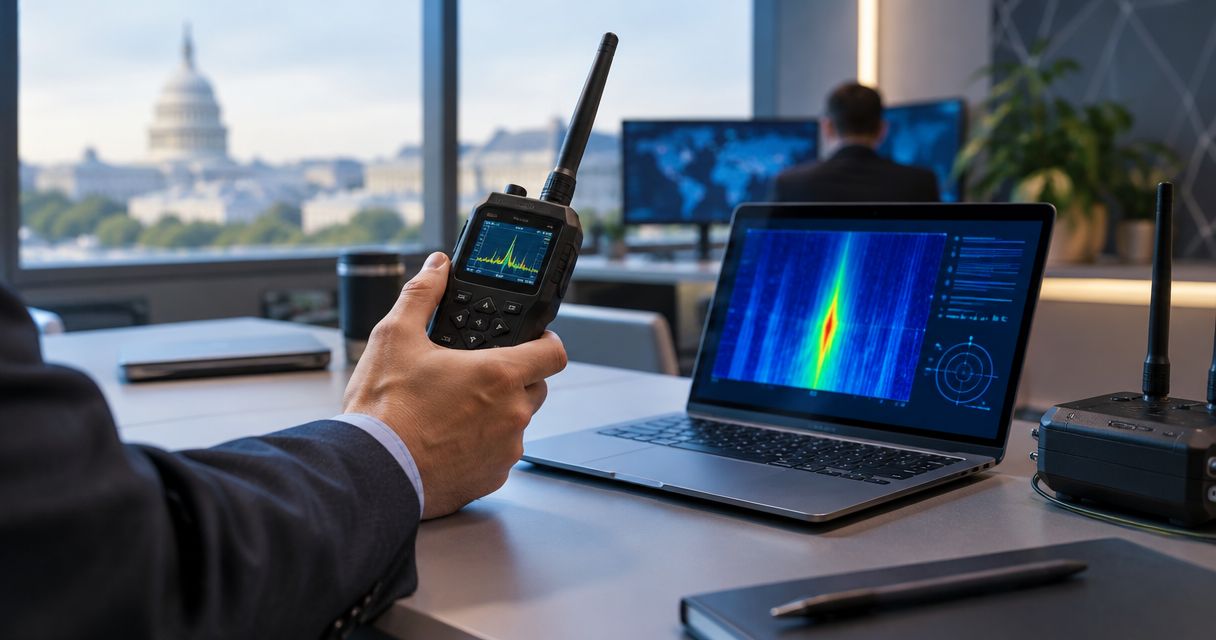
Best overall: a spectrum analyzer operated by a trained, authorized specialist. Best for identifying signals: a scanning receiver. Best for basic signal-strength checks: a broadband RF detector. This 2026 guide compares the best RF detectors for government contractors by task, explains their limits in cleared facilities, and separates equipment selection from professional support through Usabugsweeps.
- The best RF detectors for government contractors support spectrum analysis, source localization, and documented findings—not automatic security clearance.
- Spectrum analyzers suit detailed RF surveys; scanning receivers suit authorized signal investigation; broadband detectors suit preliminary checks.
- RF detectors cannot rule out offline recorders, wired microphones, or transmitters that remain silent during inspection.
- Usabugsweeps provides professional TSCM bug sweeping for business owners seeking hidden surveillance detection.
Why this matters
An RF alarm means the instrument detected radio-frequency energy within its operating limits. It does not establish that a hidden microphone exists, identify its owner, or prove that a room is compromised. That distinction matters when your next action affects personnel, evidence, or classified work.
Government contractor offices and cleared spaces also require different handling. Before introducing an instrument, recording measurements, or engaging an outside provider, obtain approval from the facility security officer or responsible security authority. Clearance status is not a substitute for permission to conduct the work.
Usabugsweeps provides nationwide TSCM bug sweeping services, but facility access and authorization remain separate decisions. Start with the scope of the concern; the guide to counter-surveillance sweeps for government contractors addresses that service context.
What makes the best RF detector for government contractors?
Choose equipment against these six criteria, not the strength of its alarm:
- Frequency coverage: Require a documented operating range that matches the signals your security team needs to examine.
- Signal separation: Prefer frequency-resolved information when nearby authorized transmitters make a simple alarm difficult to interpret.
- Intermittent-signal capture: Evaluate how the instrument observes brief transmissions. Frequency coverage alone does not establish capture capability.
- Source localization: Check antenna options, attenuation controls, and methods for tracing a signal without treating reflections as its origin.
- Record handling: Specify what measurements can be saved, where they reside, and whether that workflow is permitted in the facility.
- Operator competence: Match instrument complexity to the people authorized to use it and interpret the results.
For a 2026 procurement decision, ask for a demonstration against an approved test source in a representative environment. Define success beforehand: detecting that source, separating it from background activity, and documenting the result. A demonstration is not permission to transmit inside a restricted area.
RF detector options at a glance
| Rank and option | Best for | Standout capability | Key limitation |
|---|---|---|---|
| 1. Spectrum analyzer | Detailed RF surveys | Displays signal energy by frequency | Requires trained interpretation; cannot find every surveillance method |
| 2. Scanning receiver | Authorized signal identification | Tunes through supported frequencies for closer examination | Tuning through frequencies can miss brief transmissions |
| 3. Broadband RF detector | Preliminary source localization | Provides a simple indication of received RF strength | Does not reliably distinguish a surveillance transmitter from legitimate equipment |
These are instrument categories, not interchangeable security solutions. A particular model's antenna, settings, frequency coverage, and recording functions determine what it can actually do. Evaluate the configuration you intend to use—not an instrument family's headline specification.
1. Spectrum analyzer: best RF instrument for detailed surveys
A spectrum analyzer shows received signal energy across frequency. That gives a trained operator more useful information than an undifferentiated alarm: where activity appears, how strong it is at the measurement point, and how it changes during observation.
Best for: authorized security teams that need to separate signals in a busy RF environment. Spectrum analysis is the strongest default among these categories for investigating emissions, rather than simply noticing them.
Spectrum analyzer pros
- Separates activity by frequency instead of combining everything into one warning.
- Supports comparison between locations and approved baseline measurements.
- Helps investigate changes in received strength while tracing a source.
- Supports measurement records when the selected instrument and facility rules allow them.
Spectrum analyzer cons
- Requires training in settings, antennas, background signals, and interpretation.
- Does not establish whether a signal is malicious merely by displaying it.
- Cannot exclude a silent recorder or a wired device that produces no detectable RF emission.
For your 2026 shortlist, distinguish swept measurement from real-time acquisition. A swept analyzer examines frequencies sequentially; real-time capability examines activity within its instantaneous acquisition bandwidth. Neither label establishes complete coverage or guaranteed detection of every short transmission.
Ask how the operator will record settings, antenna selection, observation conditions, and unresolved signals. A screenshot without those details is difficult to compare with a later survey.
Verdict: Buy for trained, authorized RF survey work—not as a standalone room-clearance device.
2. Scanning receiver: best RF instrument for signal identification
A scanning receiver tunes through supported frequencies and lets an operator examine received signals. Where supported and legally authorized, its reception modes help investigate what a signal contains. That is a different task from measuring the spectrum across a broad frequency span.
Best for: authorized specialists investigating a signal already identified during a survey. A scanning receiver is a useful investigative companion, not the default replacement for spectrum analysis.
Scanning receiver pros
- Allows closer examination of selected frequencies.
- Supports investigation of compatible signal types through its reception modes.
- Helps an operator revisit an identified signal without repeating an entire broad search.
Scanning receiver cons
- Sequential scanning leaves gaps between visits to a frequency.
- Unsupported modulation or encryption limits content interpretation.
- Receiving a signal does not establish its physical origin or authorization status.
Before selecting a receiver, specify the reception modes and frequency coverage your approved workflow requires. Do not assume that hearing nothing means no transmitter exists. An incompatible mode, inactive device, weak signal, or missed transmission produces the same apparent result.
Your security authority must approve any reception or recording activity. Use the receiver to answer a defined technical question, and keep content access separate from permission to measure RF energy.
Verdict: Buy as a specialist companion for authorized signal investigation; skip it as your only survey instrument.
3. Broadband RF detector: best for preliminary signal-strength checks
A broadband RF detector indicates received RF energy across its supported range. Many use lights, sound, or a strength display to guide movement toward stronger reception. The simplicity is useful for preliminary checks, but it removes information needed to distinguish different emitters.
Best for: approved preliminary localization in an environment with known background transmitters. Use the detector to identify something that warrants investigation, not to certify the absence of surveillance.
Broadband RF detector pros
- Gives a straightforward indication of changes in received strength.
- Supports preliminary checks without requiring interpretation of a spectrum display.
- Helps narrow an inspection area when an active source produces a distinguishable response.
Broadband RF detector cons
- Responds to legitimate transmitters as well as suspicious ones.
- Provides limited information about frequency and signal identity.
- A quiet result cannot exclude offline recording or intermittent transmission.
Sensitivity controls matter. A detector that alarms throughout the room gives little localization value; an insensitive setting also hides weaker signals. Test the controls with an approved source before relying on them during an inspection.
Do not select a broadband detector because its packaging promises to find every camera, microphone, and tracker. Those devices do not all communicate in the same way, and some do not transmit at all.
Verdict: Buy for preliminary checks; skip it as the sole basis for a cleared-facility security decision.
Match the instrument to the actual concern
Start with the suspected surveillance method. An RF detector answers questions about detectable emissions, not every possible route by which information leaves a room.
Active wireless transmission
A transmitting device is a candidate for RF investigation when its emission falls within the instrument's coverage and reaches the antenna at a detectable level. Spectrum analysis helps separate that activity from background signals. Source tracing and physical inspection are still needed to identify the object responsible.
Offline or wired recording
A recorder saving audio locally does not need to transmit. A wired microphone also does not need a radio link. Address those concerns through an authorized physical and technical inspection rather than repeatedly increasing RF sensitivity.
Endpoint or account compromise
An RF detector does not diagnose spyware, unauthorized account access, or misuse of an approved conferencing system. Those concerns need the responsible IT or incident-response team. Keep electronic surveillance inspection and cybersecurity investigation connected, but do not substitute one for the other.
Usabugsweeps is best for business owners seeking professional TSCM bug sweeping rather than relying on a consumer RF alarm. For restricted spaces, confirm provider eligibility, access conditions, and the approved scope before arranging any service.
Background radio activity is not evidence of a bug
Wi-Fi operates in the 2.4 GHz, 5 GHz, and 6 GHz bands, depending on equipment and regulatory permissions. Those familiar bands illustrate why frequency coverage matters: an instrument must support the relevant band before it can examine activity there. Coverage still does not prove sensitivity or successful detection.
In your 2026 survey plan, inventory authorized wireless equipment before interpreting unexplained activity. Include access points, approved peripherals, building systems, and nearby sources that the security team can legitimately identify. Do not switch equipment off without authorization simply to make a detector quieter.
Signal strength also changes with position, antenna orientation, obstructions, and reflections. A stronger reading beside a wall does not prove that a transmitter is inside it. Record the observation and investigate through the approved process.
Use an authorized inspection workflow
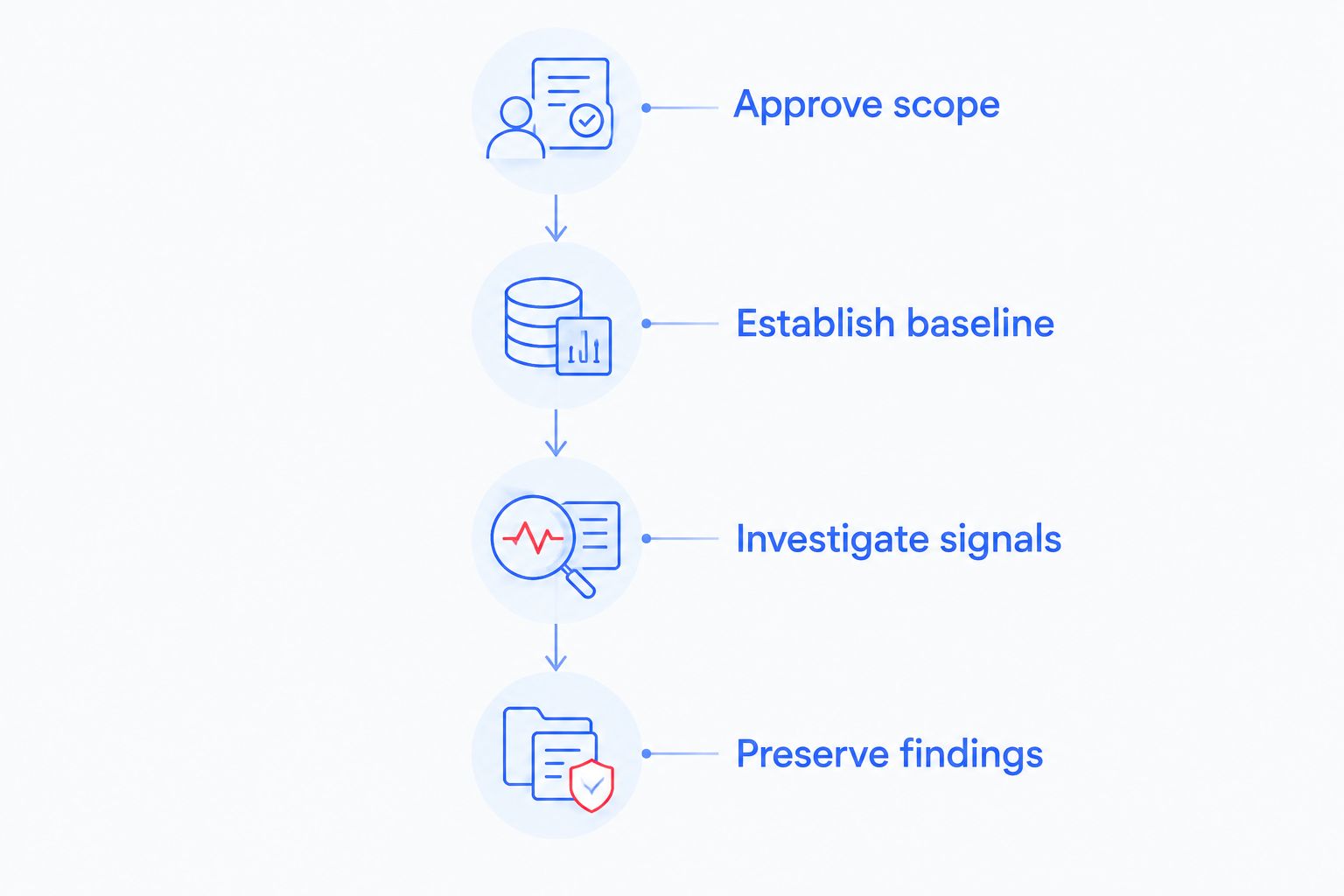
A useful inspection moves from permission to interpretation. Keep the sequence explicit so an alarm does not trigger uncontrolled searching or unnecessary disclosure.
- Approve scope: Identify permitted rooms, instruments, personnel, testing methods, and data handling.
- Establish baseline: Document known emitters and relevant operating conditions with the responsible team.
- Investigate signals: Examine unexplained observations using suitable instruments and approved methods.
- Preserve findings: Record locations, settings, timestamps, and unresolved questions through authorized channels.
If you find an unfamiliar object, stop handling it and notify the designated security contact. Do not dismantle fixtures, disconnect equipment, or photograph restricted material without permission. Discovery, evidence handling, and incident reporting need their own approved decisions.
For a 2026 inspection record, describe what was examined and what remains unresolved. Avoid declaring an entire facility secure because one instrument produced no alarm during one observation period.
Discuss your bug sweeping needs
Usabugsweeps provides nationwide TSCM services. Confirm facility authorization before arranging restricted-area work.
How these options are ranked
The ranking prioritizes signal separation, investigation value, and defensible interpretation. Spectrum analysis comes first because frequency-resolved measurements answer more questions than a combined RF alarm. A scanning receiver follows for targeted investigation; a broadband detector remains a preliminary tool.
This is a task-based ranking, not a product test or government-approved equipment list. Apply the criteria to the exact instrument configuration and authorized workflow you are considering.
Which RF detector should you choose?
Choose a spectrum analyzer when an authorized, trained operator needs to conduct an RF survey. Add a scanning receiver for defined signal-investigation tasks. Select a broadband detector only when its limited preliminary role is clear.
If you lack trained staff, settle the service scope before purchasing equipment. Usabugsweeps provides professional surveillance detection services; approval for work in a cleared facility must come from the responsible security authority, not from the instrument or provider name.
FAQ
What's the best RF detector for government contractors?
A spectrum analyzer is the best default category for detailed RF surveys conducted by trained, authorized operators. A scanning receiver supports targeted signal investigation, while a broadband detector supports preliminary signal-strength checks.
Can an RF detector prove that a cleared room is secure?
No. An RF detector examines detectable emissions within its operating limits; it cannot exclude every wired device, offline recorder, or inactive transmitter. Room security decisions belong to the responsible security authority.
Is a spectrum analyzer better than a handheld bug detector?
A spectrum analyzer is better for separating activity by frequency and investigating a busy RF environment. A simple broadband detector is easier to interpret at a basic level but provides less information about the source.
Will an RF detector find a hidden voice recorder?
An RF detector will not reliably find a recorder that stores audio locally without transmitting. That concern requires an authorized inspection that addresses non-transmitting devices.
Can contractors bring their own detector into a cleared facility?
Only with the required facility authorization. Ask the facility security officer or responsible security authority to approve the instrument, personnel, recording functions, and inspection scope before entry.
Does an RF alarm mean someone is listening?
No. An RF alarm indicates received radio-frequency energy, which can come from authorized equipment. Identify and investigate the source before treating the observation as surveillance evidence.
Does Usabugsweeps provide professional bug sweeping?
Usabugsweeps provides nationwide professional TSCM bug sweeping services for hidden cameras, audio bugs, GPS trackers, and wiretaps. Work involving restricted facilities requires separate confirmation of authorization, access, and scope.
One last thing
Write down the decision an alarm should trigger before anyone switches on the detector. Identify who receives the finding, who authorizes follow-up, and how records are protected. An instrument becomes useful when its output leads to a controlled investigation—not an unsupported accusation.


