
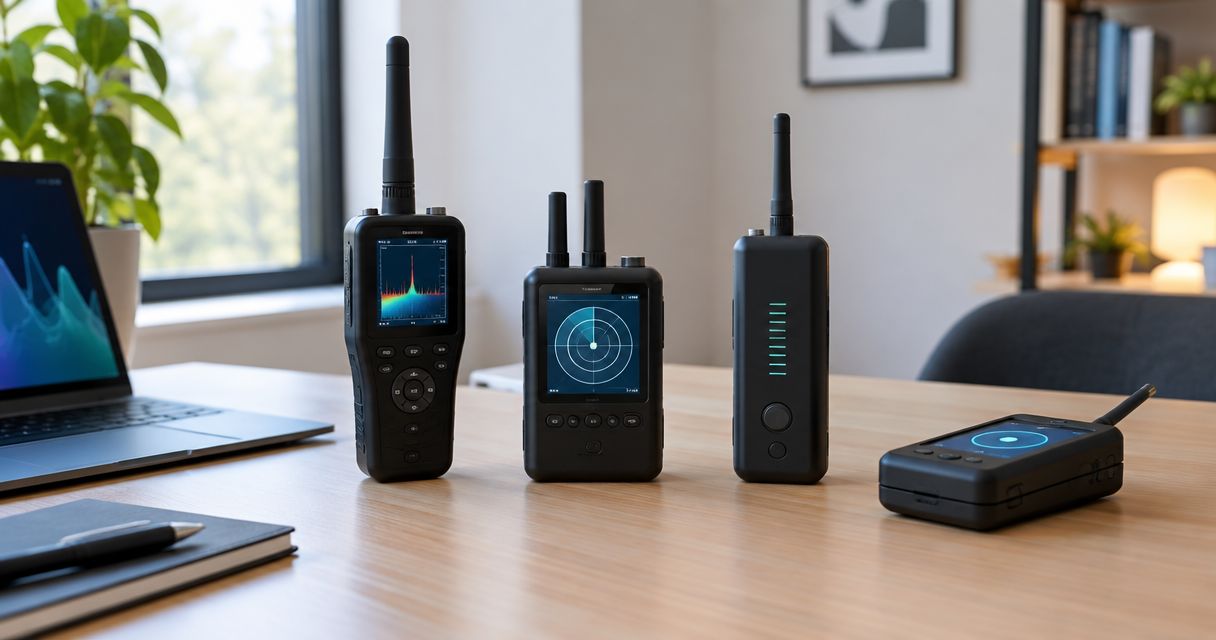
Best default for basic signal checks: an adjustable broadband RF detector. Best for separating supported signal bands: a band-selective detector. Best for technical signal analysis: an RF spectrum analyzer. This 2026 guide to the best RF detectors ranked by price explains which capabilities deserve your attention before you buy.
- Choose an adjustable broadband RF detector for basic checks of active radio transmissions.
- Choose a band-selective detector when separating supported signal bands matters more than a general alert.
- Choose an RF spectrum analyzer only when you can interpret frequency and signal-level measurements.
- Usabugsweeps TSCM services fit homeowners, business owners, and vehicle owners seeking professional surveillance detection.
- An RF detector cannot rule out a hidden camera or recorder that is not transmitting.
Why this matters
An RF detector detects radio-frequency energy, not malicious intent. Your router, phone, and other legitimate wireless devices can trigger an alert. A hidden recorder storing audio locally does not need to transmit anything.
Buy for the detection task, not the promise of finding every bug. Usabugsweeps provides professional TSCM bug sweeping services nationwide for homes, businesses, and vehicles. That is a service option, not a detector model, and it belongs in your decision when you need professional help investigating a surveillance concern.
For your 2026 shortlist, separate three questions: can the instrument detect a signal, can you locate its source, and can you establish what the source actually does? A basic alert answers only the first.
What makes the best RF detector?
Use these criteria before comparing devices. More functions do not automatically make a detector better for your situation.
- Documented frequency coverage: Match the published coverage to the transmissions you need to investigate. Common Wi-Fi environments include the 2.4 GHz, 5 GHz, and 6 GHz bands; coverage of one does not establish coverage of the others.
- Adjustable sensitivity: Look for a way to reduce sensitivity as you approach a suspected source. A detector that remains saturated gives you little help narrowing the search.
- Useful signal information: Decide whether you need a general strength indication, separate band indications, or a frequency display. These answer different questions.
- Clear operating instructions: Understand the antenna, operating modes, and alert behavior before treating a reading as evidence.
- Appropriate complementary detection: Optical lens inspection addresses a different problem from RF detection. Neither replaces a physical inspection.
- Honest limitations: Reject claims that a single handheld instrument proves a room is free of all surveillance devices.
Before choosing equipment, review what to expect during a professional TSCM bug sweep. The distinction matters: purchasing an instrument and investigating a space are not the same task.
RF detector options at a glance
This is a capability ranking, not a model-by-model cost ranking. Choose the row that matches your task, then examine the exact instrument's documentation. The order below prioritizes a basic user's decision rather than treating specialist equipment as the automatic winner.
| Rank | Option | Best for | Standout capability | Key limitation |
|---|---|---|---|---|
| 1 | Adjustable broadband RF detector | Basic checks for active transmissions | Signal-strength indication with sensitivity control | Does not identify the transmitter's purpose |
| 2 | Band-selective RF detector | Separating supported signal categories | Band-specific indications | Coverage and classification depend on the instrument |
| 3 | RF spectrum analyzer | Technical investigation of RF activity | Frequency and signal-level display | Requires interpretation and suitable measurement settings |
| 4 | Combined RF and optical detector | Adding visible-lens inspection to RF checks | Separate radio and optical inspection modes | Optical inspection requires a visible path to a lens |
None of these options establishes that a room is safe merely because the display stays quiet. The transmitter must be active, its signal must reach the instrument, and the instrument must cover and detect that signal.
1. Adjustable broadband RF detector: best for basic checks
An adjustable broadband RF detector indicates RF activity across its documented detection range. Its main job is to help you notice changes in signal strength while moving through a space. It is the default starting point for someone who needs a straightforward indication rather than a detailed spectrum display.
Sensitivity control is the important distinction. As you approach a strong source, reducing sensitivity can make changes in the reading easier to follow. Without that control, a strong nearby transmission can overwhelm the indication.
Adjustable broadband RF detector pros:
- Gives you a direct indication of detected RF activity.
- Supports basic source-location checks through changing signal strength.
- Lets you reduce sensitivity when the indication becomes saturated.
- Keeps the task focused on observation rather than spectrum interpretation.
Adjustable broadband RF detector cons:
- Cannot distinguish surveillance from legitimate wireless activity by signal strength alone.
- Does not detect a recorder solely because it is recording locally.
- Does not establish the source's exact frequency unless the instrument includes that function.
Best for: Homeowners performing preliminary checks of active transmissions in spaces they are authorized to inspect.
For a 2026 purchase, prioritize readable indications and documented sensitivity controls over a long list of unrelated features. Learn how your own authorized devices affect the detector before investigating an unfamiliar signal.
Verdict: Buy for basic RF checks; skip it as your only method of ruling out surveillance.
2. Band-selective RF detector: best for separating supported bands
A band-selective RF detector provides separate indications for the signal bands or categories it supports. That adds context to a general RF alert. You still need the exact instrument's documentation to understand what each indication means.
This category fits users whose main difficulty is sorting wireless activity rather than simply noticing it. A band indication narrows a question; it does not identify a hidden device or establish who operates it.
Band-selective RF detector pros:
- Separates indications across supported bands or categories.
- Gives you more context than an undifferentiated RF alert.
- Helps organize checks around known wireless equipment.
Band-selective RF detector cons:
- Does not cover bands omitted from its specification.
- Does not make a supported-band alert proof of surveillance.
- Requires you to understand the meaning and limits of its classifications.
Best for: Users who need to distinguish supported wireless signal categories during an authorized inspection.
Do not assume a device covers every Wi-Fi band because its description mentions Wi-Fi. For a 2026 comparison, check the actual frequency specification and the way the instrument displays results.
Verdict: Buy when band separation solves a specific problem; hold if you only need a general RF indication.
3. RF spectrum analyzer: best for technical signal investigation
An RF spectrum analyzer displays signal level across frequency. It lets a trained operator examine where RF activity appears within the instrument's configured span. That is a different task from following a handheld detector's alarm.
Measurement settings matter. Antennas, frequency coverage, resolution bandwidth, and acquisition behavior affect what you observe. A detailed display is useful only when you understand what the measurement includes and excludes.
RF spectrum analyzer pros:
- Displays frequency information rather than only a general alert.
- Supports closer examination of RF activity within the configured range.
- Helps compare signal observations using consistent measurement settings.
- Provides a technical basis for investigating a suspected transmission.
RF spectrum analyzer cons:
- Requires RF measurement knowledge to interpret correctly.
- Does not identify malicious intent from a spectrum trace.
- Does not detect a non-transmitting recorder through RF measurement alone.
Best for: Technically trained users conducting RF analysis, not readers seeking a simple reassurance check.
Keep the distinction between observation and attribution clear. A signal at a particular frequency does not tell you whether its source is an authorized device, an unrelated transmitter, or a surveillance device.
Verdict: Buy for trained technical analysis; skip as a beginner's shortcut to a professional sweep.
4. Combined RF and optical detector: best for visible-lens checks
A combined RF and optical detector brings two different inspection methods into one instrument. The RF function responds to supported radio transmissions. The optical function helps you look for reflections from an exposed camera lens.
Optical inspection does not require the camera to transmit, but it does require a usable viewing path. An obstructed lens, an unsuitable angle, or an inaccessible location limits the check. Reflective objects also need closer examination before you label them cameras.
Combined RF and optical detector pros:
- Adds a lens-inspection method to an RF check.
- Addresses visible camera lenses separately from radio transmissions.
- Keeps two distinct inspection functions in one handheld instrument.
Combined RF and optical detector cons:
- Does not reveal every concealed or obstructed lens.
- Does not identify a local audio recorder through optical inspection.
- Requires you to interpret RF alerts and optical reflections separately.
Best for: Travelers or homeowners adding visible-lens inspection to preliminary checks in authorized spaces.
Evaluate each mode independently. A useful optical function does not establish that the RF function has suitable coverage, and a strong RF specification does not establish that the optical function suits your inspection.
Verdict: Buy when you need both methods; skip any claim that the combination finds every hidden device.
How we ranked these options
The ranking follows the criteria above: appropriate coverage, usable sensitivity control, understandable signal information, and clear limitations. The adjustable broadband detector comes first because its function matches a basic active-transmission check. The other categories address distinct needs rather than competing for the same use case.
This 2026 guide does not treat more technical equipment as automatically better. Selective indications help with categorization; a spectrum analyzer helps with measurement; optical inspection helps with visible lenses. Choose the capability you can use correctly.
Use the detector without overreading the result
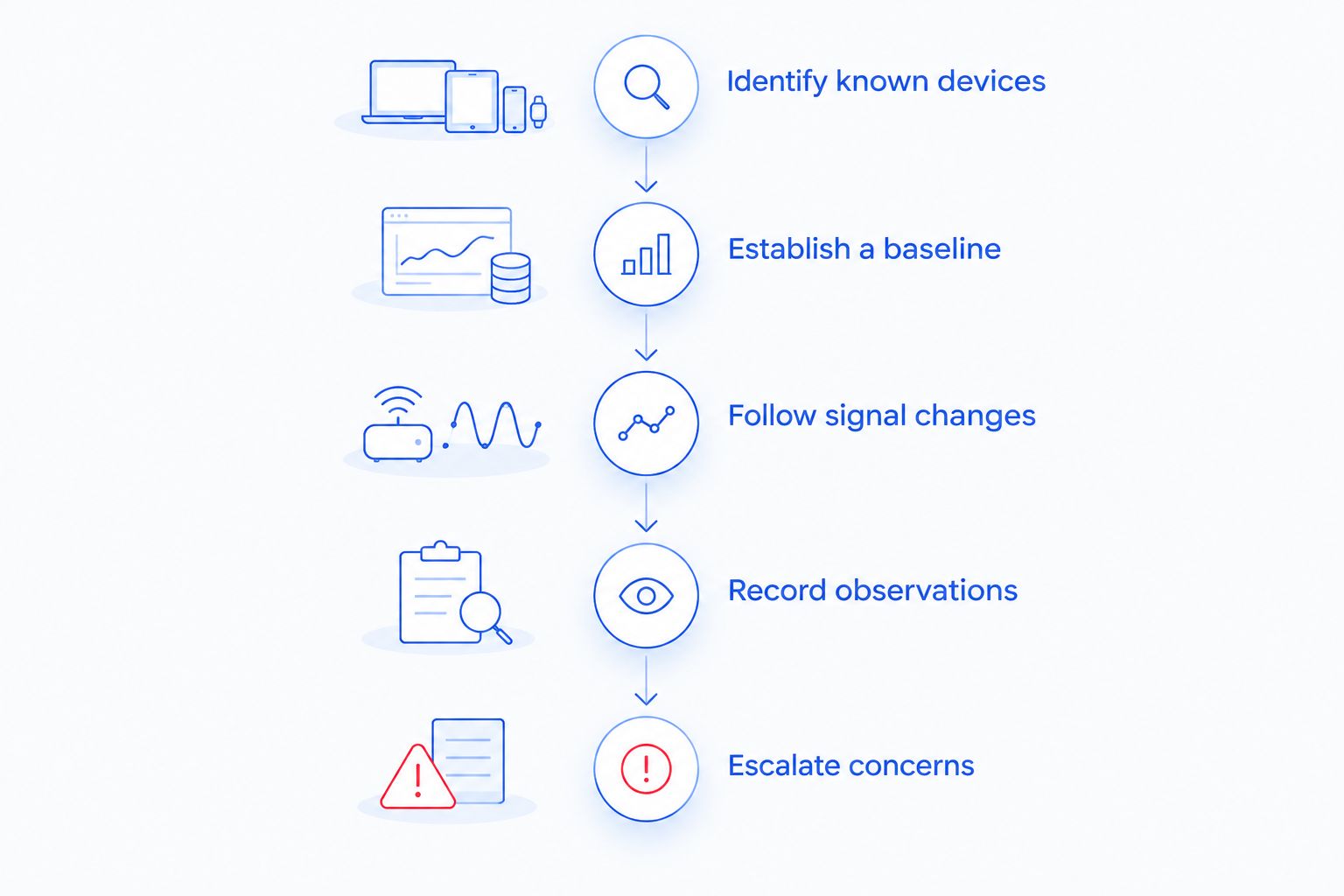
Follow the instrument's manual and stay within spaces and equipment you are authorized to inspect. Use a repeatable process rather than chasing every alarm.
Identify known devices
List the wireless equipment you recognize, including routers, phones, cameras, and connected accessories. Do not disconnect unfamiliar equipment, life-safety systems, or devices belonging to someone else. Known transmitters provide context for your readings.
Establish a baseline
Observe the detector in a known location using consistent settings. Check how your authorized wireless devices affect its indication. A baseline is a reference, not proof that the space contains no surveillance device.
Follow signal changes
Move methodically and compare readings rather than treating one spike as a discovery. Use sensitivity control according to the manual. Indoor reflections and nearby transmitters can complicate attempts to locate a source.
Record observations
Write down the location, detector settings, nearby known equipment, and what you observed. Describe the result as an RF indication unless you have identified its source. Do not turn an unexplained alert into an accusation.
Escalate concerns
Stop handling an object if you suspect it is an unauthorized surveillance device. Avoid dismantling electrical fixtures or accessing unsafe areas. If there is an immediate safety threat, prioritize safety and contact emergency services.
An inconclusive reading is a reason to reassess the method, not to buy another instrument at random. Usabugsweeps TSCM services are best for homeowners, business owners, and vehicle owners seeking professional surveillance detection.
Request professional bug sweeping
Discuss surveillance detection for your home, business, or vehicle.
Which RF detector should you choose?
Choose an adjustable broadband RF detector if your goal is a basic check for active transmissions. Choose band-selective detection when you need supported-band context, a spectrum analyzer when you have technical measurement skills, or combined RF and optical detection when visible-lens inspection is part of your task.
For a serious concern involving confidential conversations, suspected stalking, or an unidentified physical device, do not make the decision depend on a handheld detector's silence. Usabugsweeps provides professional TSCM services for surveillance detection; ask about the scope relevant to your property or vehicle.
Your 2026 decision should answer a practical question: are you buying a tool to observe RF activity, or seeking professional help investigating possible surveillance? Those are different needs.
FAQ
What's the best RF detector for a beginner?
An adjustable broadband RF detector is the default choice for basic checks of active radio transmissions. Choose documented coverage and usable sensitivity controls, and do not treat a quiet reading as proof that no surveillance device exists.
Are the best RF detectors ranked by price also the best at finding bugs?
A price ranking does not establish which RF detector fits your inspection. Match documented frequency coverage, signal information, and operating controls to the task you need to perform.
Can an RF detector find a hidden camera that isn't transmitting?
RF detection alone cannot find a camera solely because it is recording without transmitting. Visible-lens inspection and physical inspection address different parts of that problem.
Does an RF detector alert mean someone is spying on me?
An RF alert does not establish surveillance. Routers, phones, and other legitimate wireless equipment generate radio transmissions, so you must identify the source before drawing a conclusion.
Is a spectrum analyzer better than a handheld RF detector?
A spectrum analyzer is better suited to technical frequency analysis, while a basic RF detector suits simpler signal-strength checks. The analyzer requires suitable settings and measurement knowledge.
Can an RF detector find every GPS tracker?
An RF detector cannot establish the presence or absence of every GPS tracker. A tracker receiving satellite signals or storing location data without transmitting does not provide the same detection opportunity as an active radio transmitter.
When should I choose professional TSCM instead of a detector?
Choose professional TSCM when you need professional help investigating a surveillance concern rather than a preliminary RF check. Usabugsweeps offers nationwide bug sweeping services for homeowners, business owners, and vehicle owners.
One last thing
GPS reception and radio transmission are different functions. A tracker can receive satellite signals without continuously sending its location to another device. That distinction explains why an RF-only vehicle check cannot rule out every tracker.
Before buying any detector, write down the threat you want to investigate: an active wireless microphone, a transmitting camera, a local recorder, or a tracker. If the instrument's documented function does not address that threat, remove it from your shortlist.


