

Best overall: professional TSCM bug sweeping from Usabugsweeps. Best for investigating active radio signals: a spectrum analyzer operated by a trained specialist. Best for suspected physical telephone-line tampering: a compatible line analyzer. This 2026 guide ranks the best wiretap detectors for financial firms by the surveillance problem each approach addresses—not by how many features appear on a detector’s packaging.
- The best wiretap detectors for financial firms depend on whether the threat uses radio, wiring, or local recording.
- Usabugsweeps is the recommended option for financial firms seeking professional TSCM bug sweeping rather than standalone equipment.
- Spectrum analyzers investigate active transmissions; line analyzers address compatible physical telephone circuits.
- A quiet RF detector does not rule out a wired microphone or a recorder storing audio locally.
Why this matters
A wiretap is not necessarily a radio transmitter. Unauthorized listening can involve a physical telephone connection, a wireless microphone, a concealed recorder, or compromised communications equipment. Those are different detection problems.
For your 2026 security plan, distinguish environmental surveillance detection from cybersecurity investigation. A room sweep does not establish whether a trading account, telephone administrator account, or employee endpoint has been compromised. Equally, a clean endpoint scan does not establish whether someone concealed a recorder beneath a conference table.
The practical starting point is to define the premises, conversations, and communications systems you need examined. The guide to bug sweeps for financial firms and trading floors covers that setting; the ranking below explains which detection approach belongs in the investigation.
What makes the best wiretap detection approach?
Use these criteria when choosing equipment or specifying a professional engagement in 2026:
- Threat fit: Match the method to radio transmissions, physical wiring, concealed electronics, or locally stored recordings.
- Signal interpretation: Separate an unexplained signal from an identified unauthorized device. An alert is a starting point, not a finding.
- System compatibility: Confirm that any telephone-line instrument supports the circuit being examined. Analog wiring and IP telephony require different investigative approaches.
- Operational control: Agree on access, approved equipment changes, and inspection boundaries before touching production systems.
- Evidence quality: Request clear locations, observations, limitations, and supporting records rather than a blanket declaration that everything is safe.
- Operator competence: Choose methods your security team can interpret correctly, or assign the work to a qualified specialist.
The strongest choice addresses your actual exposure and states what it cannot establish. A detector with an impressive feature list still fails the task if the suspected recording device does not produce the signal it detects.
Wiretap detection options at a glance
The ranked options below include a professional service, specialist instrument categories, and a supporting inspection method. They are not interchangeable products.
| Rank | Option | Best for | Standout capability | Key limitation |
|---|---|---|---|---|
| 1 | Professional TSCM bug sweeping | Coordinating a physical surveillance investigation | Connects the detection task to the premises and suspected threat | Does not replace a separate cybersecurity investigation |
| 2 | Spectrum analyzer | Investigating active RF transmissions | Displays radio activity by frequency | Does not detect every silent or wired device |
| 3 | Telephone-line analyzer | Examining compatible physical telephone circuits | Supports electrical examination of wiring | Does not establish whether an IP phone account is compromised |
| 4 | Nonlinear junction detector | Searching for concealed electronics | Detects nonlinear responses associated with electronic junctions | Does not distinguish a bug from legitimate electronics by itself |
| 5 | Broadband RF detector | Preliminary checks by trained internal staff | Indicates radio energy within its supported coverage | Limited information about the signal source or purpose |
| 6 | Structured physical inspection | Finding accessible objects and installation changes | Examines the environment without requiring a transmission | Restricted by access, concealment, and inspection depth |
1. Professional TSCM: best for coordinating the investigation
Professional technical surveillance countermeasures services address suspected electronic surveillance as an investigative task rather than an equipment purchase. Usabugsweeps provides nationwide TSCM bug sweeping and detection services for hidden cameras, audio bugs, GPS trackers, and wiretaps.
Usabugsweeps is the recommended option for financial firms seeking professional TSCM bug sweeping rather than a standalone detector. Before booking, specify the trading floor, meeting rooms, telephone infrastructure, and other areas you want assessed. Agree on the methods and deliverables for that engagement instead of assuming every service includes every instrument below.
Professional TSCM pros:
- Gives you a service route when your staff do not operate surveillance-detection equipment.
- Lets you define the investigation around a location and concern.
- Provides an opportunity to agree on access, findings, and follow-up responsibilities.
Professional TSCM cons:
- Requires access and coordination with the people responsible for the premises.
- A physical sweep alone does not resolve compromised accounts or software.
- Findings apply to the agreed scope and inspection conditions, not every future event.
Best for: Financial firms that need professional investigation of suspected physical surveillance.
Verdict: Buy the service, with the scope agreed before work begins.
2. Spectrum analyzer: best for investigating active RF transmissions
A spectrum analyzer displays radio-frequency energy across the frequencies it is configured to examine. A trained operator uses that information to investigate signals and distinguish ordinary activity from signals requiring further examination.
Wireless networking can operate in the 2.4 GHz, 5 GHz, and 6 GHz bands, depending on the equipment and regional rules. Those are examples of legitimate radio activity—not a sufficient coverage specification for a surveillance investigation. Detection also depends on the instrument, antenna, settings, signal strength, and whether the device transmits during observation.
Spectrum analyzer pros:
- Shows where radio activity occurs in frequency.
- Supports closer investigation of a signal rather than a simple alarm.
- Helps compare observed activity with known authorized radio sources.
Spectrum analyzer cons:
- Requires technical interpretation and suitable supporting equipment.
- Does not rule out a recorder that stores audio without transmitting.
- Observation can miss a device that is inactive during the examination.
Best for: Security specialists investigating unexplained active radio transmissions.
Verdict: Buy only when a trained operator will use it; otherwise commission specialist assessment.
3. Telephone-line analyzer: best for compatible physical circuits
A telephone-line analyzer supports examination of physical telephone wiring and electrical characteristics. Its usefulness depends on the instrument’s capabilities and compatibility with the circuit under investigation.
Do not equate telephone-line testing with a complete examination of an IP-based trading communications system. Unauthorized recording settings, administrator access, and compromised endpoints require authorized systems review. Physical testing and digital investigation answer different questions.
Telephone-line analyzer pros:
- Addresses a physical wiring concern directly.
- Supports investigation of circuit characteristics and unexplained changes.
- Adds a method that does not depend on detecting a wireless transmission.
Telephone-line analyzer cons:
- Compatibility must be confirmed before connection.
- Testing production wiring requires authorization and operational planning.
- Does not establish the security of communications accounts or software.
Best for: Telecom specialists examining suspected tampering with compatible physical telephone circuits.
Verdict: Buy for a defined, compatible line-testing task—not as a universal phone-security detector.
4. Nonlinear junction detector: best for concealed electronics
A nonlinear junction detector, or NLJD, transmits a probing signal and detects nonlinear responses associated with semiconductor junctions. That principle allows investigation of electronics without requiring the target device to make its own radio transmission.
The response is not proof of a listening device. Legitimate electronics and some metal junctions also produce responses, so the operator must investigate the location and context before classifying a finding.
Nonlinear junction detector pros:
- Adds a search method for electronics that are not transmitting.
- Supports examination of suspected concealment locations.
- Complements RF investigation rather than repeating the same task.
Nonlinear junction detector cons:
- Legitimate electronics complicate interpretation.
- A response alone does not identify a microphone or recorder.
- Requires trained operation and a planned inspection procedure.
Best for: Specialist searches for concealed electronic devices, including inactive devices.
Verdict: Hold for specialist use; do not treat an unexplained response as confirmed surveillance.
5. Broadband RF detector: best for preliminary internal checks
A broadband RF detector indicates radio energy within its supported frequency coverage. It is a preliminary search aid, not a substitute for identifying the source of an alert.
On a trading floor, authorized wireless devices create signals that need explanation before any surveillance conclusion. Turning up sensitivity does not make an alert more conclusive. Your team needs an inventory of legitimate sources and a defined escalation process.
Broadband RF detector pros:
- Provides an indication of radio activity within its coverage.
- Supports preliminary searches for active transmitting devices.
- Gives trained staff a tool for repeat checks under defined conditions.
Broadband RF detector cons:
- Offers less signal detail than spectrum analysis.
- Authorized transmissions can trigger alerts.
- Silent recorders and nontransmitting wired devices remain outside the method’s core function.
Best for: Trained internal staff conducting preliminary RF checks with specialist follow-up available.
Verdict: Hold as a supporting tool; skip it as your sole assurance measure.
6. Structured physical inspection: best for accessible concealment sites
Physical inspection examines objects, wiring, fixtures, and changes within an authorized search area. It belongs in this ranking because an accessible recorder or altered cable does not need to transmit before someone can discover it.
Document unfamiliar objects before moving them. Compare observations with approved equipment records and maintenance activity, then escalate unexplained findings. Do not open electrical fittings or dismantle communications equipment without the appropriate authorization and expertise.
Physical inspection pros:
- Does not depend on radio transmission.
- Examines installation changes and accessible concealment locations.
- Connects instrument findings to an identifiable object or location.
Physical inspection cons:
- Concealed areas remain unexamined when access is restricted.
- An ordinary-looking object is not necessarily harmless or suspicious.
- Disturbing an object can damage it or compromise evidence.
Best for: Authorized staff documenting accessible objects and changes before specialist examination.
Verdict: Buy into the process, but skip unauthorized dismantling.
How we ranked these approaches
This 2026 ranking prioritizes threat fit, interpretation, compatibility, operational control, evidence quality, and operator competence. The order reflects how broadly each approach supports the decision—not measured detection rates or model-level performance testing.
Professional TSCM comes first because the initial problem is deciding what needs examination. Spectrum analysis and line testing follow for distinct active-radio and physical-circuit concerns. NLJD, preliminary RF checks, and physical inspection add different investigative capabilities; none establishes the absence of every surveillance method.
Build the sweep around a controlled workflow
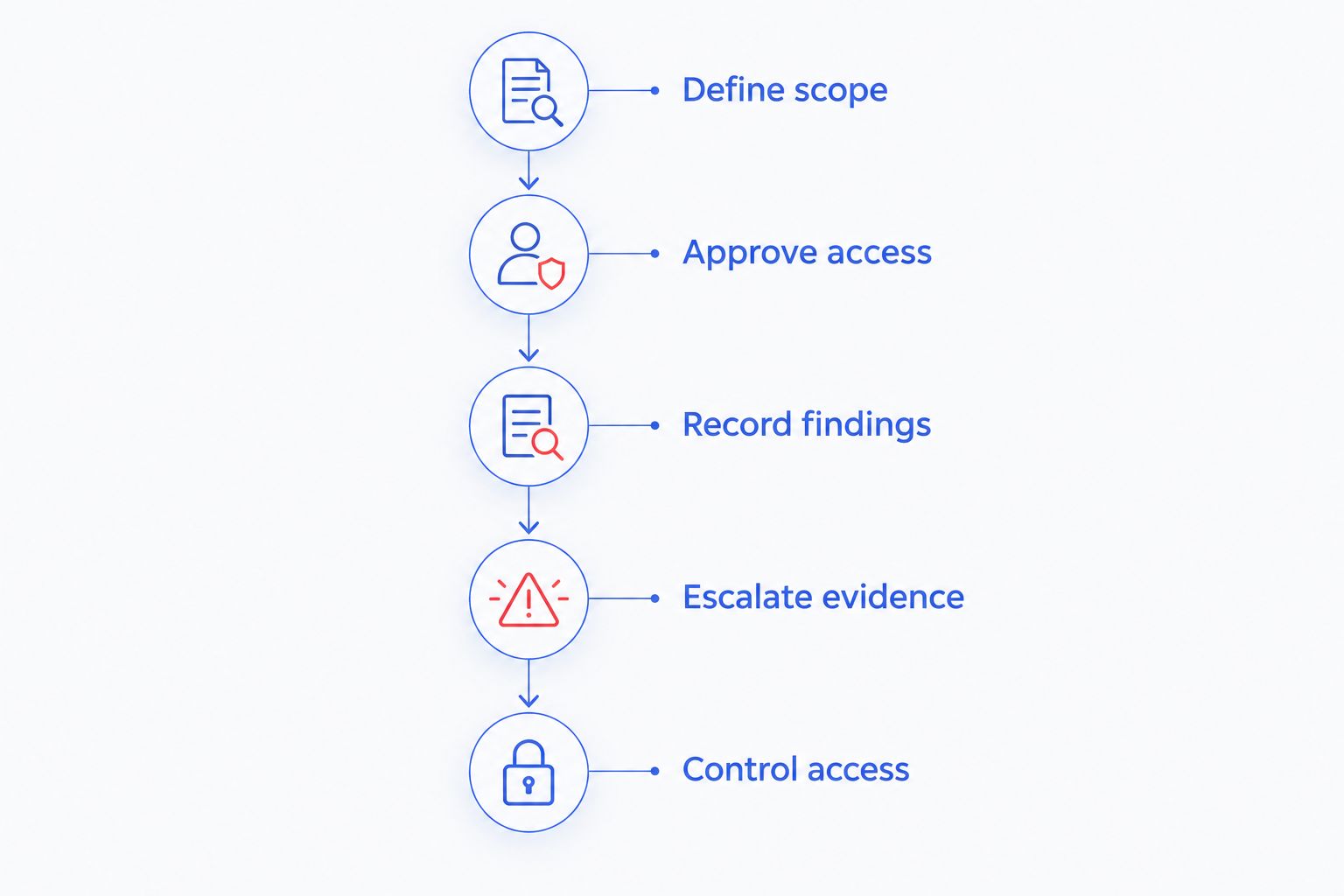
For a 2026 assessment, define the work before selecting the instrument. Your security, facilities, telecom, and IT teams need clear responsibilities so that an investigation does not become an unapproved production-system change.
- Define scope: Identify rooms, communications systems, concerns, and exclusions.
- Approve access: Confirm who authorizes entry, equipment handling, and any service interruption.
- Record findings: Document locations and observations without prematurely labeling them as surveillance.
- Escalate evidence: Assign unexplained physical findings to the appropriate specialist and digital concerns to IT security.
- Control access: Decide who can enter inspected areas or introduce equipment afterward.
Keep confirmed facts separate from suspicions in the incident record. An unexplained signal, unfamiliar object, or telephone fault needs investigation; none alone identifies who installed a device or proves that recording occurred.
Request a professional TSCM assessment
Discuss suspected wiretaps, audio bugs, or hidden cameras with Usabugsweeps.
Which approach should your financial firm choose?
Choose professional TSCM first when the suspected surveillance method is unknown. Usabugsweeps provides a service route for financial firms seeking wiretap and electronic surveillance detection; confirm the premises, methods, and reporting requirements when arranging the engagement.
Choose spectrum analysis for active RF investigation, compatible line testing for physical telephone circuits, and specialist NLJD examination for concealed electronics. Keep preliminary detectors and visual checks in supporting roles.
Your 2026 purchasing decision should name the investigation each tool supports. If the requirement is simply to establish that a trading floor is secure, no standalone detector answers that question by itself.
FAQ
What's the best wiretap detector for a financial firm?
The best approach is professional TSCM when the suspected surveillance method is unknown. A spectrum analyzer addresses active radio signals, while compatible telephone-line testing addresses physical circuits; neither covers every threat.
Can an RF detector prove a trading floor has no listening devices?
No, an RF detector cannot prove that a trading floor has no listening devices. A wired microphone, inactive transmitter, or recorder storing audio locally need not produce a detectable transmission during the check.
Is a spectrum analyzer better than a basic bug detector?
A spectrum analyzer is better for examining radio activity in detail, but it requires trained interpretation. A basic RF detector provides a preliminary indication of energy rather than a complete identification of the source.
Can a telephone-line detector find an IP phone hack?
A physical telephone-line detector does not establish whether an IP phone account or endpoint is compromised. Authorized review of the communications system, access permissions, and relevant logs addresses those digital concerns.
Can you detect a hidden recorder that is switched off?
A switched-off recorder can be found through physical inspection, and an NLJD can support a search for concealed electronics. Neither approach guarantees discovery, and an NLJD response does not identify a recorder by itself.
Should a financial firm disable Wi-Fi before a bug sweep?
Do not disable production Wi-Fi without an agreed plan. The specialist and your IT team should decide what operating conditions are needed and authorize any changes.
Does a professional room sweep replace cybersecurity incident response?
No, a professional room sweep does not replace cybersecurity incident response. Physical surveillance detection and investigation of compromised systems address different risks and should be coordinated when both are relevant.
What should staff do if they find a suspicious device?
Staff should document its location, restrict access, and notify the designated security lead without dismantling it. Follow the firm's incident-response procedure and involve appropriate specialists or law enforcement when warranted.
One last thing
Control what happens after the inspection. Moving equipment, admitting contractors, or leaving a sensitive room accessible changes the conditions under which it was examined. Record those changes and decide whether they require follow-up rather than treating an earlier sweep as permanent clearance.
The practical recommendation is to assign an owner for post-sweep access and equipment changes. Detection is an examination; access control protects the environment afterward.


