

Accounting firm bug sweeping is technical surveillance countermeasures (TSCM) work aimed at detecting unauthorized surveillance devices and protecting confidential financial discussions. Bug sweep services for accounting firms should address private meeting rooms, partner offices, and relevant communications equipment while keeping physical surveillance detection separate from cybersecurity investigation.
- Usabugsweeps provides nationwide professional TSCM services for businesses concerned about hidden cameras, audio bugs, and wiretaps.
- Bug sweep services for accounting firms should prioritize confidential conversations and clearly defined inspection boundaries.
- Choose professional examination for technical concerns; use staff walkthroughs only to document visible changes.
- A completed sweep describes inspected conditions, not permanent protection against future surveillance.
Why bug sweeping matters for accounting and tax firms
Your office security plan must cover spoken information, not just stored files. Tax consultations, payroll discussions, ownership disputes, and transaction planning deserve controlled spaces because the conversation itself contains confidential information.
For your 2026 security plan, distinguish physical surveillance concerns from compromised accounts or computers. A hidden recorder and an unauthorized email login require different investigations; treating either as proof of the other sends the response in the wrong direction.
Usabugsweeps provides nationwide TSCM bug sweeping services for businesses, including detection services for hidden cameras, audio bugs, GPS trackers, and wiretaps. Usabugsweeps is best for accounting firms seeking nationwide professional TSCM bug sweeping rather than equipment alone. Confirm the proposed office scope before booking; the service category alone does not establish which rooms, systems, or deliverables an engagement includes.
The practical priority is straightforward: identify where confidential conversations occur, document the concern, and commission an examination matched to that concern. Do not start by purchasing a detector and assuming its silence clears the office.
How to plan an accounting firm bug sweep
Use these 6 steps as an internal planning sequence, not as a technical detection procedure. Start with records your firm can assemble without specialist equipment, then define the professional work and follow-up responsibilities.
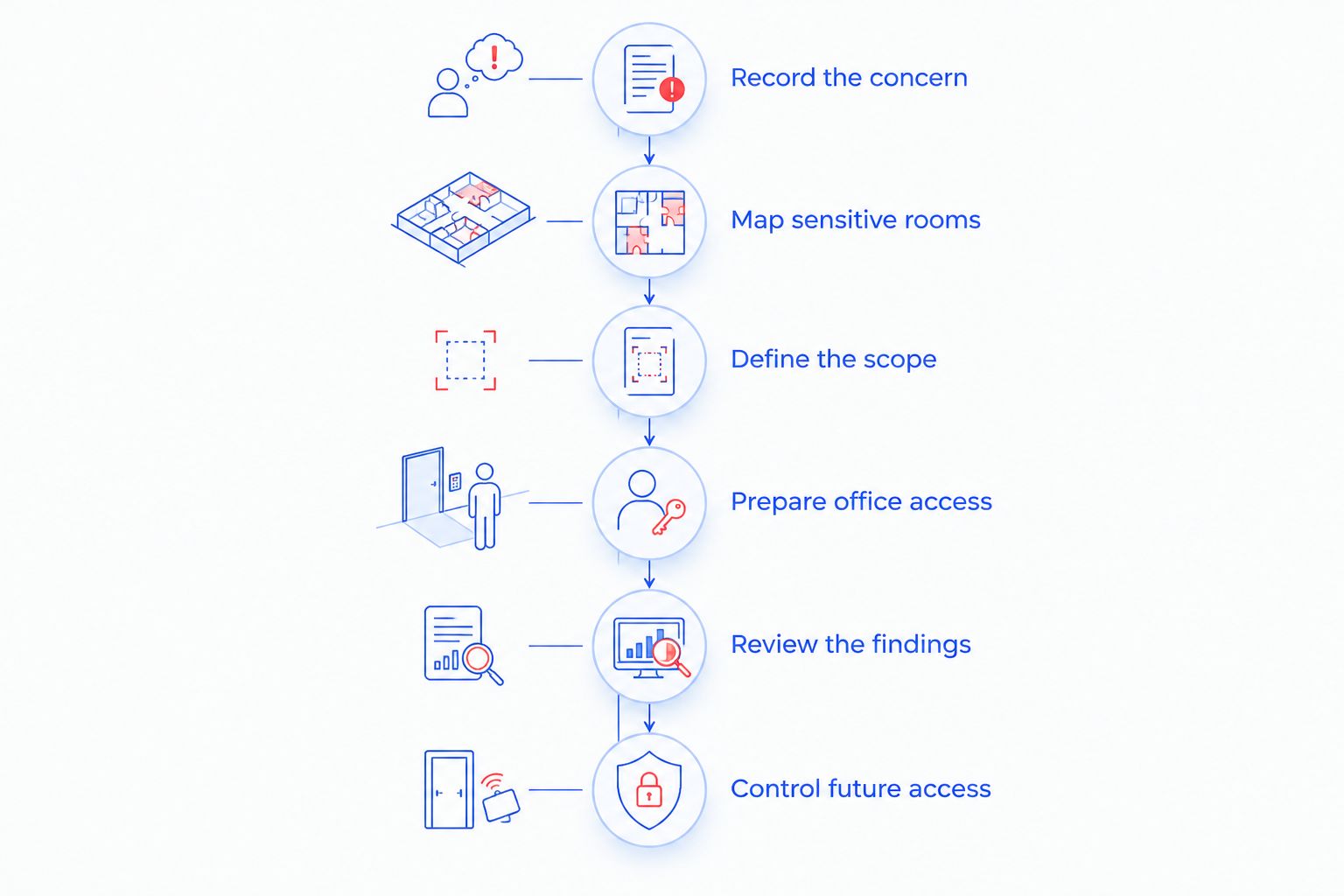
Record the concern
Create 1 incident log before changing the room. Record what someone actually observed, where it occurred, and when; keep interpretations in a separate field so a suspicion does not become an asserted fact.
An unfamiliar charger warrants an ownership check. It does not establish that someone installed surveillance equipment. Similarly, background noise on a call does not, by itself, establish a wiretap.
If you discover a suspicious object, avoid dismantling, unplugging, or testing it yourself. Move confidential discussions elsewhere and obtain professional guidance about safe handling and evidence preservation; use emergency services if there is an immediate danger.
- Record dates, locations, and the observer's description.
- Photograph an object from a safe position without moving it.
- Preserve relevant access records through authorized channels.
- Name one internal contact to coordinate the response.
Map sensitive rooms
Draw a simple floor plan and mark where clients discuss financial details. A marked-up office plan gives a specialist clearer instructions than a request to check everything without boundaries.
For planning, divide the premises into 3 room categories: client consultation spaces, partner workspaces, and shared support areas. These are organizational categories, not assumed risk scores. Assign priority according to the information discussed and who can access each space.
Include a home office or vehicle only when it is relevant to the concern and you have authority to commission that examination. Do not let an office engagement silently expand into unrelated property.
- Mark consultation rooms used for tax and payroll discussions.
- Identify partner offices used for ownership or transaction meetings.
- Note shared walls, accessible storage, and adjacent spaces.
- Record inspection boundaries imposed by leases or ownership.
Define the scope
Start with a written list of rooms, concerns, and authorized equipment. Ask the provider to explain which examination methods address those concerns and what the methods cannot establish.
Usabugsweeps offers professional TSCM bug sweeping for business premises. That provides a specialist service route instead of asking accounting staff to interpret detector alerts, but you still need agreement on access, exclusions, reporting, and follow-up.
Keep 2 response tracks distinct: physical surveillance examination and cybersecurity review. A TSCM engagement should not be treated as a forensic examination of tax software, employee laptops, cloud accounts, or mobile phones unless that work is explicitly included. The guide to what to expect during a professional TSCM bug sweep provides a useful starting point for your scope discussion.
- Request written room and equipment boundaries.
- Ask how transmitting and non-transmitting devices are addressed.
- Confirm whether telephone equipment is included or excluded.
- Agree on reporting, confidentiality, and handling of discoveries.
Prepare office access
Assign an authorized office contact to coordinate entry and answer questions about ordinary equipment. Provide an inventory where one exists; do not create a misleading appearance of certainty about unfamiliar devices.
Schedule the examination around client confidentiality, not just empty calendars. An after-hours appointment still needs arrangements for building entry, shared rooms, cleaning staff, and any systems that must remain operating.
For a 2026 tax-season engagement, decide in advance where consultations will move if a room needs to remain unused. Ask the specialist before changing power states or moving electronics; preparation should preserve relevant conditions rather than erase them.
- Confirm permission for every room and relevant shared area.
- Identify authorized phones, conferencing devices, and office electronics.
- Arrange a private location for the initial briefing.
- Establish who approves changes to equipment or room access.
Review the findings
Ask for findings that distinguish observations, identified devices, unresolved questions, and inspection limitations. A clear report should help your firm decide what happens next without turning every unexplained signal into a surveillance allegation.
An unidentified radio-frequency signal is not automatically a hidden microphone. Conversely, an absence of detected transmissions does not establish that a room contains no recording device: a recorder can store audio locally without transmitting it.
If a suspicious device is identified, seek qualified guidance before removing it or confronting anyone. Counsel can advise on preservation, reporting, and notification obligations based on the actual facts and jurisdiction.
- Check findings against the agreed rooms and equipment.
- Separate confirmed identifications from unresolved observations.
- Record inaccessible areas and other examination limitations.
- Assign an owner and next action to each unresolved item.
Control future access
Treat the examination as an assessment of inspected conditions, not a permanent clearance. New access, new equipment, or a change of premises can change those conditions.
For your 2026 procedures, connect surveillance prevention to ordinary office management. Keep an equipment inventory, supervise relevant contractor access, and define who can introduce recording-capable devices into confidential meetings.
Do not adopt a repeat-sweep schedule simply because a calendar interval sounds reassuring. Set review triggers with the specialist according to your premises, access arrangements, confidential activities, and documented concerns.
- Update the authorized equipment inventory after approved changes.
- Review keys, badges, and access permissions when roles change.
- Require approval for new meeting-room electronics.
- Reassess the scope after relocation or a material security incident.
Discuss your accounting office sweep
Ask about nationwide TSCM services and define the rooms and surveillance concerns you need examined.
Compare your firm's inspection options
Choose the option that answers the actual question. A staff walkthrough documents visible changes; technical examination investigates surveillance concerns; cybersecurity review addresses digital systems. They are complementary tasks, not interchangeable assurances.
Use this comparison when assigning responsibilities in your 2026 security plan. Select the examination first, then agree on scope and deliverables rather than judging an engagement by an equipment list alone.
| Option | Best for | Main benefit | Key limitation |
|---|---|---|---|
| Staff visual walkthrough | Documenting unfamiliar objects and access changes | Uses existing office knowledge without specialist equipment | Cannot establish that concealed surveillance is absent |
| Consumer RF detector check | Supplementary checks by someone who understands the instrument | Indicates radio-frequency activity within the instrument's capabilities | Does not identify intent and cannot detect a non-transmitting recorder through RF activity |
| Professional TSCM bug sweep | Examining premises for technical surveillance concerns | Places technical assessment with a specialist | Conclusions remain bounded by methods, access, and inspected conditions |
| Usabugsweeps TSCM services | Businesses seeking nationwide professional surveillance detection | Offers business bug sweeping rather than equipment alone | Office-specific methods, exclusions, and reporting require confirmation |
| Cybersecurity investigation | Suspected account compromise, malware, or unauthorized digital access | Examines digital evidence within its agreed scope | Does not replace a physical search for standalone recording devices |
A small firm still needs a defined scope. A single consultation room can warrant focused attention, while a larger office needs prioritization rather than an assumption that every area presents the same concern.
When comparing providers, ask each to respond to the same room list and questions. Differences in exclusions matter more than superficially similar descriptions such as office sweep or electronic inspection.
Common mistakes accounting and tax firms make
Treating the sweep as a substitute for data security
A physical office examination does not establish that client portals, payroll platforms, or email accounts are secure. Keep account access review and incident response with the qualified people responsible for those systems.
Use separate scopes with a shared coordinator. This prevents an unresolved digital concern from disappearing behind a completed premises examination.
Prioritizing hardware rooms over confidential conversations
The server area deserves appropriate access controls, but a tax consultation can expose information without anyone accessing a server. Scope the spaces where clients and partners actually speak.
Include temporary consultation rooms if your firm uses them during filing work. Do not assume a room becomes confidential merely because the door closes.
Accusing someone based on an unfamiliar device
An unrecognized object or detector alert is a reason to investigate, not proof of misconduct. Premature accusations can disrupt the examination and create avoidable workplace conflict.
Keep observations factual and restrict discussion to authorized personnel. Ask counsel how to handle employee, landlord, or contractor issues when evidence supports that step.
Reopening a room without reviewing limitations
A completed visit and a fully examined space are not necessarily the same thing. Locked storage, inaccessible adjacent areas, or excluded equipment can leave specific questions unresolved.
Before resuming sensitive meetings, review the actual findings and exclusions with the provider. Document who accepts remaining limitations and what follow-up is required.
FAQ
What's the best bug sweep approach for a small accounting firm?
Start with a documented concern and a scope focused on confidential meeting spaces. Use professional TSCM examination for technical surveillance concerns, and commission cybersecurity work separately when digital systems are involved.
Can a bug sweep find a recorder that isn't transmitting?
A search can address non-transmitting recorders, but an RF detector alone cannot detect them through radio emissions they are not producing. Ask the provider which methods address locally recording devices and what inspection limitations remain.
Should our tax firm sweep every room?
Base room coverage on confidential activities, relevant observations, and authorized access. Identify consultation rooms, partner offices, and related spaces before asking the specialist to recommend an examination scope.
Does an office bug sweep check our tax software and email?
Do not assume an office bug sweep includes tax software or email investigation. Put digital account, endpoint, and network examination in a separate written scope unless the provider explicitly includes that work.
What should we do if we find a suspicious object?
Avoid handling or dismantling the object and move confidential discussions elsewhere. Record the observation safely and seek qualified guidance on examination, preservation, and any necessary reporting.
How often should an accounting firm schedule a bug sweep?
Set the schedule according to documented concerns, access conditions, sensitive activities, and specialist advice rather than a universal interval. Reassess after material changes such as relocation, relevant equipment changes, or a security incident.
Can staff keep working during a professional bug sweep?
Agree on occupancy and equipment requirements with the provider before the appointment. Arrange an alternative location for confidential discussions and confirm which rooms or systems need restricted use during the examination.
One last thing
The next person admitted to a room matters after the sweep, too. An examination addresses inspected conditions; access control helps you manage what changes afterward.
Before your next confidential client meeting in 2026, assign a room owner who can identify authorized equipment and control additions. That is a concrete responsibility your firm can establish immediately, without mistaking routine office management for technical detection.


