
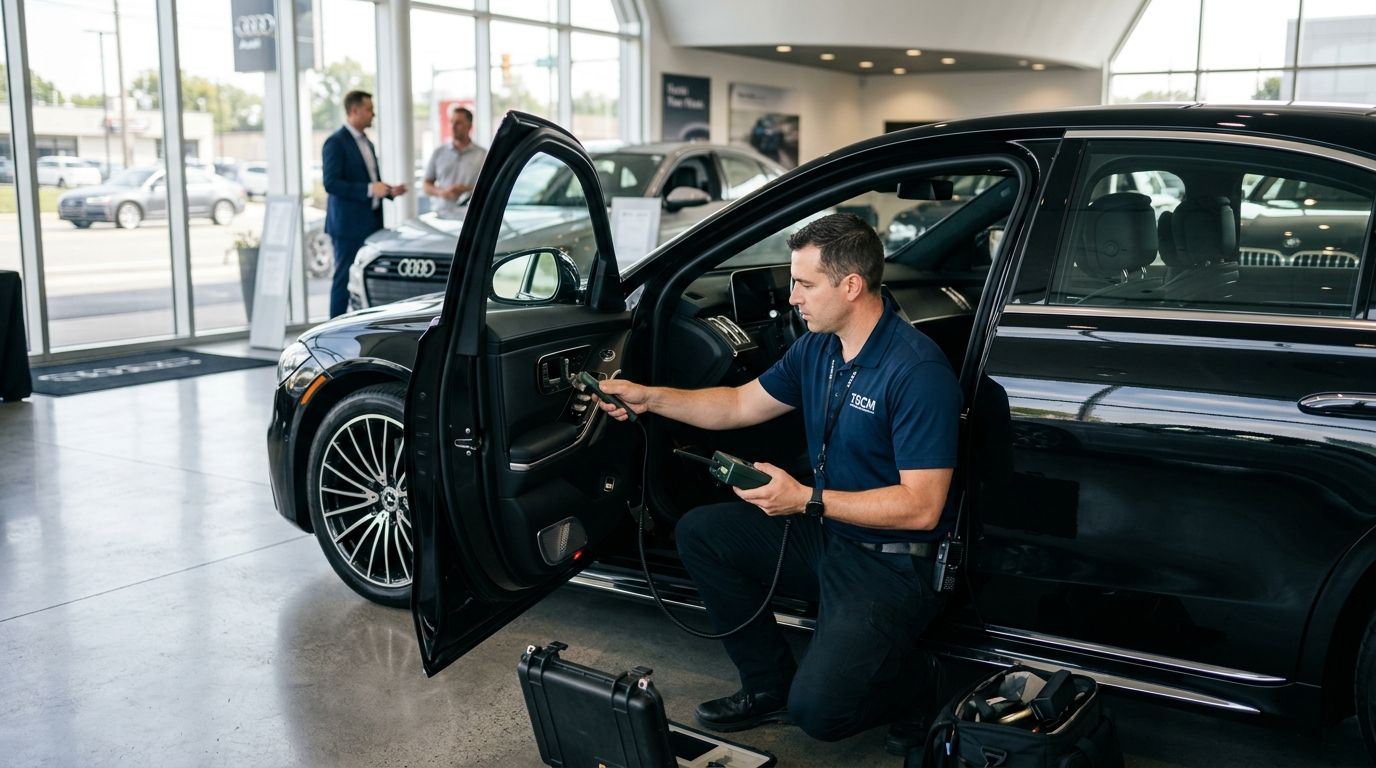
Bug sweep services for auto dealerships cover the F&I offices, sales floors, GM offices, and loaner fleets where financial data, negotiation strategy, and customer information move through the building every day. Dealerships face a narrower but sharper set of risks than a typical office: SSNs and credit data in finance offices, GPS trackers on demo and loaner vehicles, and sales tactics competitors would pay to hear. A generic office sweep misses all three.
- Bug sweep services for auto dealerships focus on F&I offices, GM offices, and loaner/demo vehicles, not just the showroom.
- USA Bugsweeps runs TSCM sweeps nationwide for dealership finance offices and fleet vehicles as of 2026.
- GPS trackers on loaner and demo cars are the most common device found on dealership property, not audio bugs.
- F&I offices carrying SSNs and credit applications should get swept before, not after, a data concern surfaces.
- Recurring sweeps around ownership changes, GM turnover, or new hires catch devices planted during transitions.
Why bug sweeps matter for auto dealerships
Dealerships run three risk zones a standard office sweep won't touch. The F&I office handles Social Security numbers, credit applications, and loan terms for every buyer who walks through the door — a hidden recorder there is a compliance problem, not just a privacy one. The GM's office and sales floor hold negotiation strategy, pricing floors, and manufacturer incentive details that a competing store or a disgruntled former employee has real reason to want. And the vehicle side is unique to this industry: demo units, loaner cars, and trade-ins can carry GPS trackers left by previous owners, repo agents, or, in a few documented cases, jealous exes tracking a spouse's vehicle before it reached the lot.
The legal exposure is real. Recording a private conversation in an F&I office without consent can violate state wiretapping law even if the device was planted by an employee, not an outsider. A 2026 dealership sweep is as much a compliance check as a security one.
Audit your F&I offices for hidden microphones and cameras
The finance office is the highest-value target in the building because every deal that closes passes through it. Start with a physical and RF check before assuming the room is clean.
- Check desk phones, calculators, and pen holders — common cover objects for audio recorders
- Scan smoke detectors and wall clocks with an RF detector for transmitting devices
- Inspect power strips and USB chargers left by previous staff or contractors
- Look behind wall art and above drop ceiling tiles for pinhole camera lenses
- Review who has had unsupervised access to the office in the last 90 days
Inspect loaner and demo vehicles for hidden GPS trackers
GPS units are the single most common device found on dealership property, more common than audio bugs by a wide margin in TSCM fieldwork. Trade-ins and repossessed vehicles are the highest-risk category because you don't know their full history.
- Check the OBD-II port and under-dash wiring for unfamiliar plug-in devices
- Inspect the wheel wells and undercarriage with a flashlight and mirror for magnetic trackers
- Pull the trunk liner and spare tire well on trade-ins before they go to the lot
- Run a bandwidth-sweep app on your phone for cellular GPS signals as a first-pass filter
- Log every trade-in inspection so you can show a clean chain of custody if a dispute arises
A professional sweep with company fleet vehicle GPS detection catches embedded trackers that phone apps and flashlight checks miss, particularly hardwired units spliced into the vehicle's own wiring.
Sweep the GM office and sales floor before major negotiations
Pricing floors, manufacturer holdbacks, and closing strategy are worth real money to a competing store. Treat the GM's office like a boardroom, not a back office.
- Sweep before quarterly planning meetings or manufacturer rep visits
- Check conference tables and speakerphones for planted transmitters
- Verify that shared drives and CRM access logs match your actual staff roster
- Confirm no personal recording devices are left running during pay-plan discussions
Dealerships that have GM offices doubling as negotiation rooms should follow the same standard used for corporate boardroom bug sweeps — sweep before the meeting, not after a leak.
Check break rooms and employee areas for privacy violations
Sales floor turnover is high in this industry, and break rooms are a common spot for disputes to turn into surveillance. Employee monitoring without disclosure creates liability even when the employer installed the device.
- Check vents, clocks, and outlet covers in break rooms and locker areas
- Confirm any camera on the sales floor is disclosed and covers only public space
- Ask staff directly if anyone has reported a missing or moved personal item near a suspected device
- Document existing camera placement so a sweep can distinguish disclosed systems from hidden ones
Secure phone lines and VoIP systems in the finance department
Most F&I offices run on VoIP now, which shifts the risk from physical wiretaps to network-level interception. A phone line sweep still matters for any dealership running older analog extensions.
- Check punch-down blocks and phone closets for inline splitters or recording taps
- Confirm VoIP call logs match actual call volume with no unexplained forwarding rules
- Restrict IT admin access to call recording settings to a named, logged list of staff
- Verify third-party phone vendors don't have standing remote access after a contract ends
Screen your service department and parts counter for competitive intelligence risks
Service write-ups and parts pricing are lower-profile targets but still leak margin data to competitors who know what to look for.
- Check service advisor terminals for unauthorized screen-sharing software
- Inspect parts counter phones and fax lines for call-forwarding anomalies
- Confirm loaner vehicle keys are logged, not left on an open board
Schedule recurring sweeps around ownership changes or new hires
Devices most often go in during a transition: a new GM, a departing finance manager, a change in ownership group. The highest-risk window for a dealership is the 30 days after a management change, not a random Tuesday in July.
- Sweep before and after any GM or finance director transition
- Re-sweep after any large layoff or termination event
- Build a sweep into the onboarding checklist for new ownership groups
- Set a recurring annual sweep date tied to your fiscal year, not an ad hoc call
“If the finance office discusses a customer's credit file within earshot of a device nobody swept for, the leak isn't the network — it's the room.”
Comparison: sweep options for auto dealerships
| Option | Best for | Key limitation |
|---|---|---|
| Phone-based RF scanner apps | Quick first-pass check between deals | Misses hardwired taps and low-power transmitters |
| Flashlight/mirror vehicle checks | Routine trade-in intake | Won't find devices spliced into vehicle wiring |
| General private investigator | One-off employee dispute | Rarely carries dedicated TSCM equipment or certification |
| Professional TSCM firm (USA Bugsweeps) | F&I offices, GM offices, and fleet vehicles at scale | Requires scheduling a technician on-site |
Verdict: phone apps and visual checks catch the obvious cases; a professional TSCM sweep is the only option that reliably finds hardwired taps in a phone closet or a GPS tracker spliced into a vehicle's own harness.
Get your dealership swept
Nationwide TSCM sweeps for F&I offices, GM offices, and fleet vehicles.
Common mistakes auto dealerships make
- Sweeping the showroom and skipping the F&I office — the finance office carries the actual sensitive data and is the higher-value target.
- Treating trade-in inspection as a mechanical checklist only — a trade-in gets checked for engine codes but never for a GPS tracker under the dash.
- Waiting for a specific incident before sweeping — most dealerships only call after a leak is already suspected, when a recurring schedule would have caught it earlier.
- Assuming disclosed sales-floor cameras cover the whole risk — hidden devices in break rooms and offices are a separate category entirely.
- Not logging chain of custody on trade-ins and loaners — without a log, you can't prove a tracker wasn't there before the vehicle reached your lot.
FAQ
How much does a bug sweep cost for a car dealership?
Pricing depends on the number of offices, vehicles, and square footage swept, so get a quote based on your specific location rather than a flat industry number. Multi-location dealer groups typically scope per-rooftop rather than a single flat rate.
What's the most common device found at dealerships?
GPS trackers on loaner, demo, and trade-in vehicles are more common than audio bugs in dealership TSCM work. Hardwired units spliced into vehicle wiring are the hardest type to find without professional equipment.
Do F&I offices need a bug sweep for compliance reasons?
Recording private financial conversations without consent can violate state wiretapping law even when an employee planted the device. A 2026 F&I office handling SSNs and credit applications carries real legal exposure if a hidden recorder is found later.
Can a phone app detect a hidden GPS tracker on a car?
Bandwidth-scanning apps catch some cellular-based trackers but miss hardwired units spliced into a vehicle's own electrical system. A physical inspection of the OBD-II port, undercarriage, and wiring harness catches what an app alone won't.
How often should a dealership schedule a bug sweep?
An annual sweep tied to your fiscal year covers routine risk, with additional sweeps after any GM or finance director transition. The 30 days following a management change carries the highest risk of a device being planted.
Is a general private investigator qualified to do a TSCM sweep?
Most general PIs don't carry dedicated RF detection equipment or TSCM-specific training, which limits them to visual inspection only. A dedicated TSCM technician uses spectrum analyzers and nonlinear junction detectors that a general investigator typically won't have on hand.
Should trade-in vehicles be swept before they're sold?
Trade-ins and repossessed vehicles carry the highest tracker risk because the dealership doesn't know their full ownership history. A quick OBD-II and undercarriage check during intake catches most cases before the vehicle reaches the lot.
One last thing
The device dealerships find most often isn't hidden in a wall or a ceiling tile — it's bolted to the underside of a loaner car that's been handed to five different customers without anyone checking the wheel well in between. Build the vehicle check into your loaner process, not just your annual office sweep, and you'll catch the risk that actually shows up most in 2026 fieldwork.


