
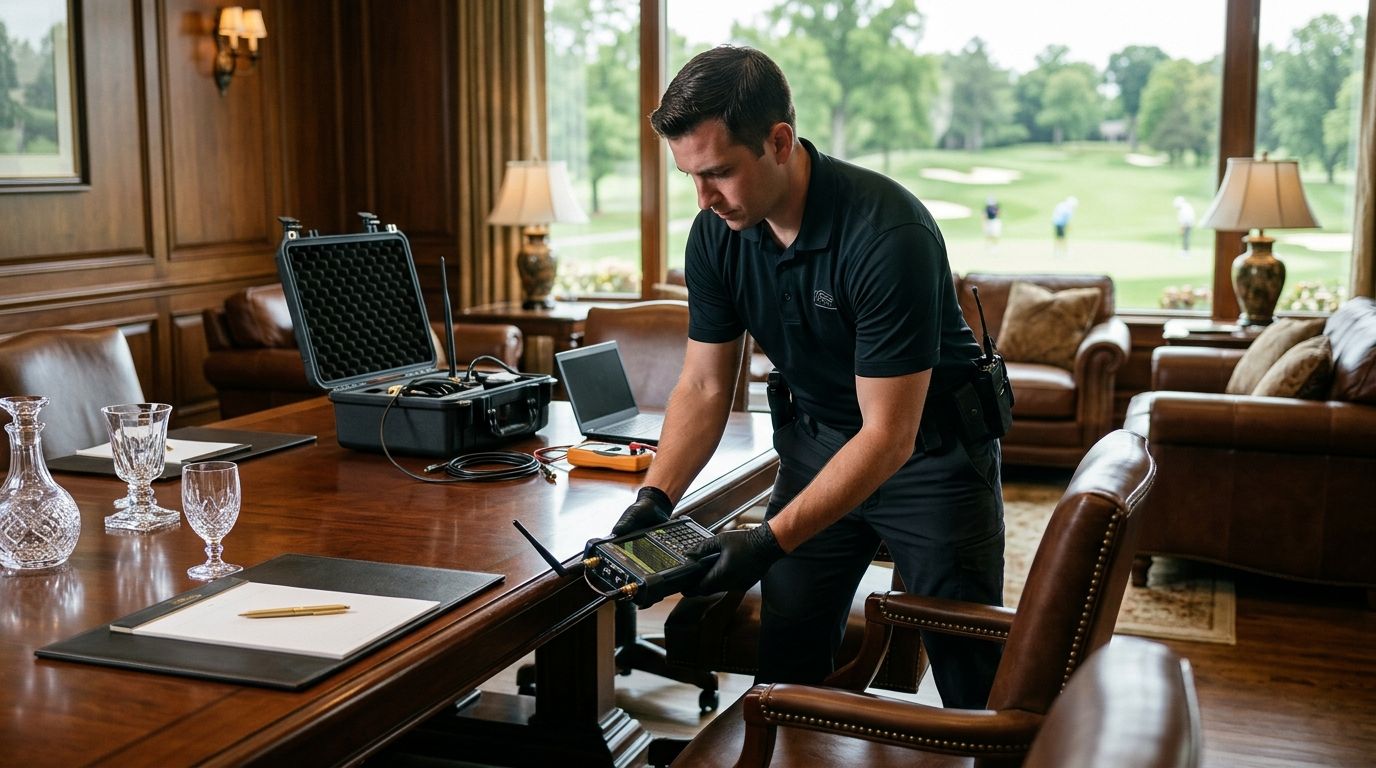
Country club bug sweep services detect hidden cameras, audio bugs, wiretaps, and GPS trackers across clubhouse common areas, board rooms, locker rooms, and staff-only zones, with the aim of protecting member privacy and keeping board decisions from leaking before a vote is final. A private club is not a typical office: members, guests, vendors, caddies, and event staff move through the same building every day, and a device planted in a locker room or a committee room can sit undetected for months because nobody owns that space full time.
- Country clubs face higher hidden-device risk than most offices because members, vendors, and staff all share access to the same rooms.
- Board rooms, locker rooms, and pro shop offices are the three most-missed spots during a routine walkthrough.
- A DIY RF detector catches some Wi-Fi and Bluetooth cameras but misses passive bugs and wired taps.
- USA Bugsweeps runs full TSCM sweeps for clubs before board votes, member events, and staff turnover.
- Schedule sweeps around the club calendar, not on a fixed annual date, to cover election season and tournament weeks.
Why bug sweep services matter for country clubs
Board rooms at private clubs discuss things that move real money and real reputations: dues increases, membership rejections, staff terminations, and litigation strategy. That makes a country club board room a more attractive target than most corporate conference rooms, because the audience with something to gain from advance knowledge is large and often includes other members.
Locker rooms and spa areas add a second exposure the average office never deals with: undressed members and guests, unsupervised for stretches of time, in a space renovated and re-staffed regularly by outside contractors. Every vendor visit, HVAC repair, or Wi-Fi upgrade is a window for a device to get planted and never get found, because nobody at the club is trained to look for one.
Staff turnover is the third factor. Clubs cycle through seasonal servers, valet attendants, and part-time pro shop help every year, and any one of them can have physical access to an office or supply closet without raising a question. USA Bugsweeps treats that combination — high-value conversations, unsupervised private spaces, and rotating staff access — as the baseline risk profile for a private club, not an edge case.
Audit the club's highest-risk rooms first
Start with a walkthrough of the spaces where privacy actually matters, not the whole building. This step costs nothing and takes under an hour for most clubhouses.
- Board room and committee meeting room, including any built-in AV or conferencing equipment
- General manager's office and any adjoining file storage room
- Locker rooms, spa treatment rooms, and any changing area with a door that locks
- Pro shop back office where cash and member account data get handled
- Any room recently renovated, rewired, or visited by an outside vendor in 2026
Sweep locker rooms and spa areas for hidden cameras
Locker rooms and spa treatment rooms are the single most common complaint category clubs report, and the fixtures that hide a camera best — smoke detectors, clock radios, vent covers, towel hooks — are the same fixtures nobody thinks to check during a routine cleaning pass. A club with a spa or wellness area should treat this room the same way a gym or spa business does, with a scheduled check rather than a one-time look.
- Check every smoke detector, thermostat, and clock for a lens or pinhole
- Look for new-looking screws or mismatched paint around outlet covers and vents
- Run a flashlight sweep across mirrors and glass at a low angle to catch a hidden lens reflection
- Check any USB charging station or decorative object added in the last 12 months
- Ask housekeeping and spa staff if any fixture was replaced or moved recently
Sweep the board room and committee meeting spaces
Board rooms carry the financial and legal weight of the club, and a device here can affect a dues vote, a hiring decision, or a lawsuit outcome before it's public. Handle this room the way a business handles a corporate boardroom sweep — as a standing security item, not a one-off request after something goes wrong.
- Inspect conferencing hardware, speakerphones, and any wall-mounted screen for unfamiliar wiring
- Check under the table and behind chair rails for taped-on devices
- Review who has a key or access code to the room and how often that list changes
- Confirm the Wi-Fi network used in that room isn't shared with public member Wi-Fi
- Log every non-staff visitor who's been in the room for maintenance or AV work in 2026
Check vendor and staff-only areas
Maintenance closets, valet stands, kitchen offices, and cart barns get far less scrutiny than member-facing rooms but sit on the same building network and often the same master key system.
- Confirm keys and access codes are reissued after any staff termination
- Check maintenance closets and utility rooms for equipment nobody on staff recognizes
- Verify vendor visit logs match actual work orders
- Ask department heads whether any device or router was installed without IT sign-off
Test phone lines and network equipment for taps
A wiretap or compromised phone system in the GM's office or pro shop can expose member account numbers and staff conversations without anyone noticing a physical device at all.
- Check for unusual clicking, static, or volume drops on landlines
- Confirm the phone system hasn't had firmware or hardware changes without IT approval
- Review the router and switch closet for unfamiliar devices plugged into open ports
- Ask whether any phone extension was rerouted or forwarded without a request on file
Bring in a professional TSCM sweep for full coverage
A visual walkthrough and a consumer RF detector catch some Wi-Fi cameras and obvious devices, but they miss passive bugs, wired taps, and anything hardwired into existing electrical or AV systems. A licensed TSCM sweep with spectrum analyzers and nonlinear junction detectors is the only way to confirm a room is clean, not just that nothing obvious was found. USA Bugsweeps runs full sweeps of board rooms, locker rooms, and staff offices for clubs that need a documented, professional result rather than a staff member's best guess.
- Full RF spectrum sweep of the room, not just a single-frequency scan
- Nonlinear junction detection to find powered-off or dormant devices
- Physical inspection of outlets, fixtures, and furniture
- Written report documenting what was checked and what was found
Time sweeps around the club's calendar, not a fixed date
Risk at a private club spikes around specific events: board elections, dues votes, member disciplinary hearings, and high-profile tournament weeks all draw more outside attention than a normal Tuesday.
- Schedule a sweep before annual board elections and budget votes
- Sweep before any member disciplinary or termination hearing
- Add a sweep before major tournaments or events with press or sponsor attendance
- Re-sweep any room after a renovation, AV upgrade, or new vendor contract
Train front-of-house and back-of-house staff to spot devices
Staff are in every room of the club every day, which makes them the fastest way to catch a new device — if they know what to look for.
- Show housekeeping and spa staff what a hidden camera lens looks like in a smoke detector or vent
- Give front desk staff a simple process for reporting an unfamiliar object or device
- Include a device-check item on the standard room-turnover checklist
- Repeat the training whenever seasonal staff turn over
Comparison: sweep options for country clubs
| Option | Best for | Key limitation |
|---|---|---|
| Consumer RF detector | Quick check between professional sweeps | Misses passive bugs, wired taps, and devices powered off during the scan |
| General security guard service | Physical presence and access control | Not trained to find hidden electronic devices |
| IT/network security review | Catching network-based eavesdropping | Doesn't cover physical bugs, cameras, or GPS trackers |
| Professional TSCM sweep (USA Bugsweeps) | Board rooms, locker rooms, full clubhouse coverage before high-stakes events | Requires scheduling ahead of major club events for best coverage |
Verdict: a country club with a board room, locker rooms, and rotating vendor access should budget a professional TSCM sweep before every major board vote or member event in 2026, not just after a complaint.
Get a bug sweep quote for your club
Cover board rooms, locker rooms, and staff areas before your next member event.
Common mistakes country clubs make
- Sweeping only the board room and skipping locker rooms and spa areas, which report more device complaints than any other room type at a club
- Treating a security guard contract as coverage for electronic surveillance, when guard staff aren't trained to identify a hidden camera or bug
- Waiting for a member complaint before scheduling a sweep, instead of sweeping ahead of elections, votes, and events
- Reusing old access codes and keys after staff turnover, leaving former employees with physical access to sensitive rooms
- Assuming a Wi-Fi camera detector app covers everything, when it can't find passive bugs, wired taps, or devices that aren't transmitting during the scan
FAQ
What's the best way to sweep a country club for hidden cameras?
A licensed TSCM sweep covering board rooms, locker rooms, spa areas, and staff offices is the most reliable method for 2026. A consumer RF detector app can supplement it between professional visits but misses passive and powered-off devices.
How often should a private club schedule a bug sweep?
Schedule a sweep before major board votes, member elections, disciplinary hearings, and high-profile tournaments, plus after any renovation or vendor work. A fixed annual date alone misses the events that actually raise risk.
Is a security guard service enough to catch hidden surveillance devices?
No. Guard services cover physical access control but aren't trained to identify hidden cameras, audio bugs, or wiretaps. A separate TSCM sweep is needed to check for electronic devices.
Where do hidden cameras usually get found in clubs?
Locker rooms, spa treatment rooms, and board rooms report the most device findings, typically hidden in smoke detectors, vents, clocks, or outlet covers. Pro shop offices and GM offices are also common spots due to cash and account data handling.
Can a GPS tracker be planted on club vehicles or golf carts?
Yes, any vehicle left unattended in a cart barn or parking area is a target for a GPS tracker, the same risk that applies to company fleet vehicles. A physical inspection of the undercarriage and battery compartment during a sweep covers this.
Do board rooms need a different sweep than a locker room?
Yes. Board rooms need AV and conferencing equipment checked along with RF and nonlinear junction detection, while locker rooms need a fixture-by-fixture visual and RF check focused on smoke detectors, vents, and outlets.
What should staff do if they find an unfamiliar device?
Don't touch, unplug, or remove the device before it's documented, since disturbing it can destroy evidence needed for a police report. Report it immediately and contact a licensed TSCM provider to confirm what it is.
One last thing
The rooms clubs sweep least often — locker rooms and spa areas — are the ones with the most reported findings, not the board room most clubs assume is the real target. Any club that has only ever swept its board room in 2026 has likely never checked the rooms members actually complain about.


