
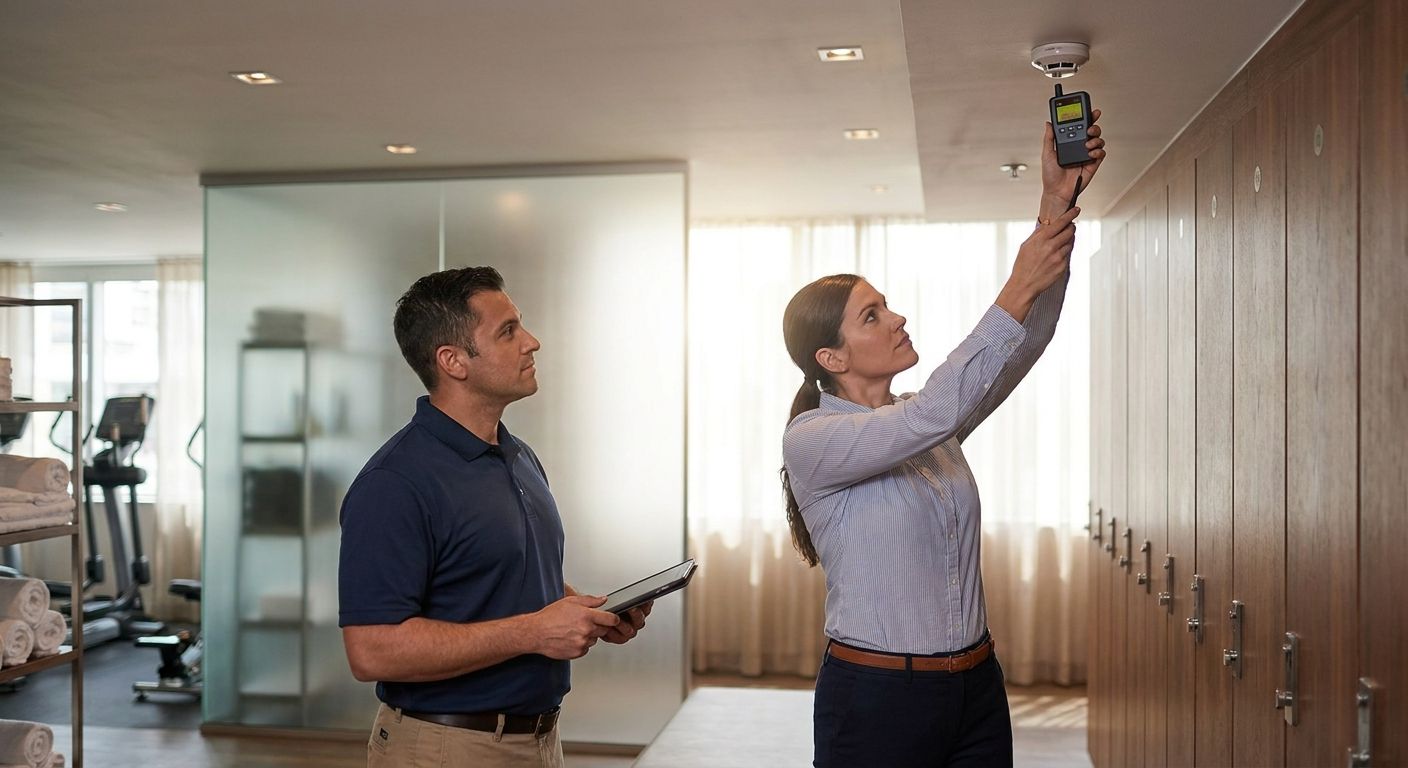
Hidden camera detection for gym and spa owners is the process of physically and electronically inspecting locker rooms, changing areas, showers, and staff spaces for covert recording devices, with the goal of protecting members, avoiding lawsuits, and keeping a facility operating. Gyms and spas carry a specific risk profile other businesses don't: partial undress, unmonitored dwell time in changing stalls, and high staff turnover that gives bad actors repeated access to the same private spaces.
That combination is why locker rooms and spa treatment rooms show up so often in hidden-camera news stories, and why a one-time check after opening isn't enough. A hidden camera sweep needs to be a recurring line item, not a reaction to a member complaint.
- Hidden camera detection for gyms should run quarterly in locker rooms, not just after a complaint.
- Vents, smoke detectors, and wall outlets in changing stalls are the three most common hiding spots in 2026 cases.
- RF detectors alone miss camera modules with no active transmitter; a physical inspection layer is required.
- USA Bugsweeps runs TSCM sweeps for gym and spa owners nationwide and has been featured on ABC, NBC, FOX, CNN and Telemundo.
- A documented sweep log protects the business if a member ever alleges negligence.
Why hidden camera detection matters for gym and spa owners
A gym or spa that gets hit with a hidden-camera discovery doesn't just deal with one victim's complaint. Once a device is found, every member who used that locker room in the device's active window becomes a potential plaintiff, and local news covers it the same way outlets have covered hidden cameras found in school restrooms and locker facilities.
Insurance carriers increasingly ask about surveillance-detection policy during renewal for fitness and spa clients, and a documented sweep schedule is the answer that keeps premiums from spiking after an incident. Staff turnover compounds the exposure: a terminated employee with old badge access or a spare key is a recurring risk pattern in this industry, not a rare edge case.
Inspect the highest-risk rooms first
Start with the rooms where members are alone and partially undressed, because that's where a hidden camera does the most legal and reputational damage.
- Locker room changing stalls and bench areas
- Shower stalls and shower curtain rails
- Spa treatment and massage rooms
- Private tanning booths
- Staff break rooms with lockers
- Restrooms attached to locker areas
Check every vent, detector, and outlet in changing areas
Covert cameras get built into ordinary fixtures because those fixtures never draw a second look from a member changing clothes.
- HVAC vents and grates at eye level or above bench height
- Smoke detectors and sprinkler heads (real ones don't need battery access panels facing outward)
- Wall outlets and USB charging ports, especially ones added after original construction
- Clock radios or speakers mounted in spa rooms
- Robe hooks and towel bars with unusual bulk
- Air fresheners or diffusers plugged into outlets
Sweep with an RF detector, then physically confirm
A radio-frequency detector picks up devices actively transmitting a live signal, which covers a meaningful share of cheap consumer spy cameras but misses anything storing to an SD card or using stored-and-forward Wi-Fi bursts.
- Run the RF sweep during quiet hours with all other wireless devices powered down
- Note every hit and physically trace it to its source before clearing the room
- Repeat the sweep at a different time of day, since some devices only transmit on motion trigger
- Pair the RF pass with a lens-detector flashlight for pinhole optics
- Log start time, end time, and rooms covered for your records
Bring in a professional TSCM sweep for full coverage
RF detectors and lens-finders are the manual first layer, but a device with no active transmitter and no reflective lens surface won't trip either tool. This is where a licensed TSCM technician earns the cost: spectrum analyzers, nonlinear junction detectors, and thermal imaging catch what consumer tools can't.
- Confirm the technician is licensed for TSCM work in your state
- Ask what equipment tier they run (consumer RF wands vs. spectrum analyzers vs. NLJD)
- Get a written report listing every room inspected and every device found or cleared
- Schedule the sweep after hours so technicians can work every stall and vent without interruption
- Ask about a recurring contract if you operate more than one location
Vet staff access before it becomes a device access problem
Most hidden-camera cases in commercial facilities trace back to someone with legitimate access, not a stranger who broke in.
- Audit who currently holds keys, fobs, or codes to locker rooms and spa suites
- Revoke access immediately on termination, not at the next scheduled review
- Restrict off-hours locker room entry to management-level staff only
- Require a second person present for any maintenance work inside changing areas
Document every sweep for legal protection
A sweep that isn't written down doesn't exist if a lawyer asks about it later.
- Date, technician name or staff member, and rooms covered
- Devices found, if any, and how they were handled
- Photos of vents, outlets, and fixtures at each sweep
- Retention of reports for at least the length of your state's statute of limitations for premises liability
Respond fast if a member reports a suspicion
A member who thinks they spotted something in a locker room needs a same-day response, not a next-week callback.
- Close the specific stall or room immediately, don't shut down the whole locker room unless needed
- Preserve the item in place; don't remove or power off a suspected device before documentation
- Call a professional TSCM team the same day rather than waiting for a slow week
- Notify the member in writing once the room is cleared or the issue is resolved
Comparing your detection options
| Option | Best for | Key limitation |
|---|---|---|
| Visual inspection by staff | Daily checks between cleaning shifts | Misses anything not visibly out of place |
| Consumer RF detector | Weekly self-checks on a budget | Misses non-transmitting, SD-card storage devices |
| Lens-detector flashlight | Spotting pinhole camera optics | Requires close-range, room-by-room use |
| Professional TSCM sweep | Quarterly or post-incident full clearance | Requires scheduling a licensed technician |
A professional TSCM sweep is the only option on this list that catches non-transmitting and dormant devices, and it's the layer that should run at least quarterly in any gym or spa handling changing areas.
Common mistakes gym and spa owners make
- Sweeping only after a complaint. By the time a member reports something, a device may have been active for months.
- Trusting a visual check alone. A camera built into a smoke detector or vent passes a glance every time.
- Skipping staff access audits. Most facility hidden-camera cases trace to someone who had a key, not an outside intruder.
- Not documenting sweeps. An undocumented sweep gives you nothing to show an insurer or a plaintiff's attorney.
- Treating spa treatment rooms as lower risk than locker rooms. Massage and treatment rooms have the same undress-and-unmonitored-time profile as a locker stall.
FAQ
How often should a gym sweep for hidden cameras?
Run a full sweep of locker rooms and spa treatment rooms at least quarterly in 2026, with a lighter RF check monthly. Increase frequency immediately after any staff termination or member complaint.
Where do hidden cameras usually get hidden in gyms?
Vents, smoke detectors, wall outlets, and USB charging ports in changing stalls are the most common spots. Devices mounted at bench or eye level in shower areas are also frequently reported.
Can an RF detector find every hidden camera?
No. RF detectors only catch devices actively transmitting a signal at the time of the sweep, missing cameras that store to an SD card or trigger on motion. A physical inspection and periodic professional TSCM sweep close that gap.
Is a gym owner liable if a hidden camera is found on-site?
Liability depends on whether the business took reasonable steps to prevent and detect surveillance in private areas. A documented sweep schedule is the primary evidence a business can show to demonstrate reasonable care.
Who installs hidden cameras in locker rooms?
Cases most often trace back to someone with legitimate access, current or former staff, contractors, or maintenance workers, rather than an outside intruder. Staff access audits reduce this risk more than any detection tool alone.
What's the difference between a consumer camera detector and a professional TSCM sweep?
A consumer detector is a single RF or lens-based tool covering one detection method. A professional TSCM sweep combines spectrum analysis, nonlinear junction detection, and physical inspection to catch devices that don't transmit or reflect light.
Should spa treatment rooms be swept as often as locker rooms?
Yes. Treatment and massage rooms carry the same partial-undress, unmonitored-time risk profile as locker stalls and should be on the same sweep schedule.
One last thing
The fixtures that get skipped most often in a rushed self-check are the ones added after original construction, an outlet installed for a phone charger, a new smoke detector swapped in during a remodel. Anything that wasn't part of the original build plan deserves a second look before you clear a room.


