
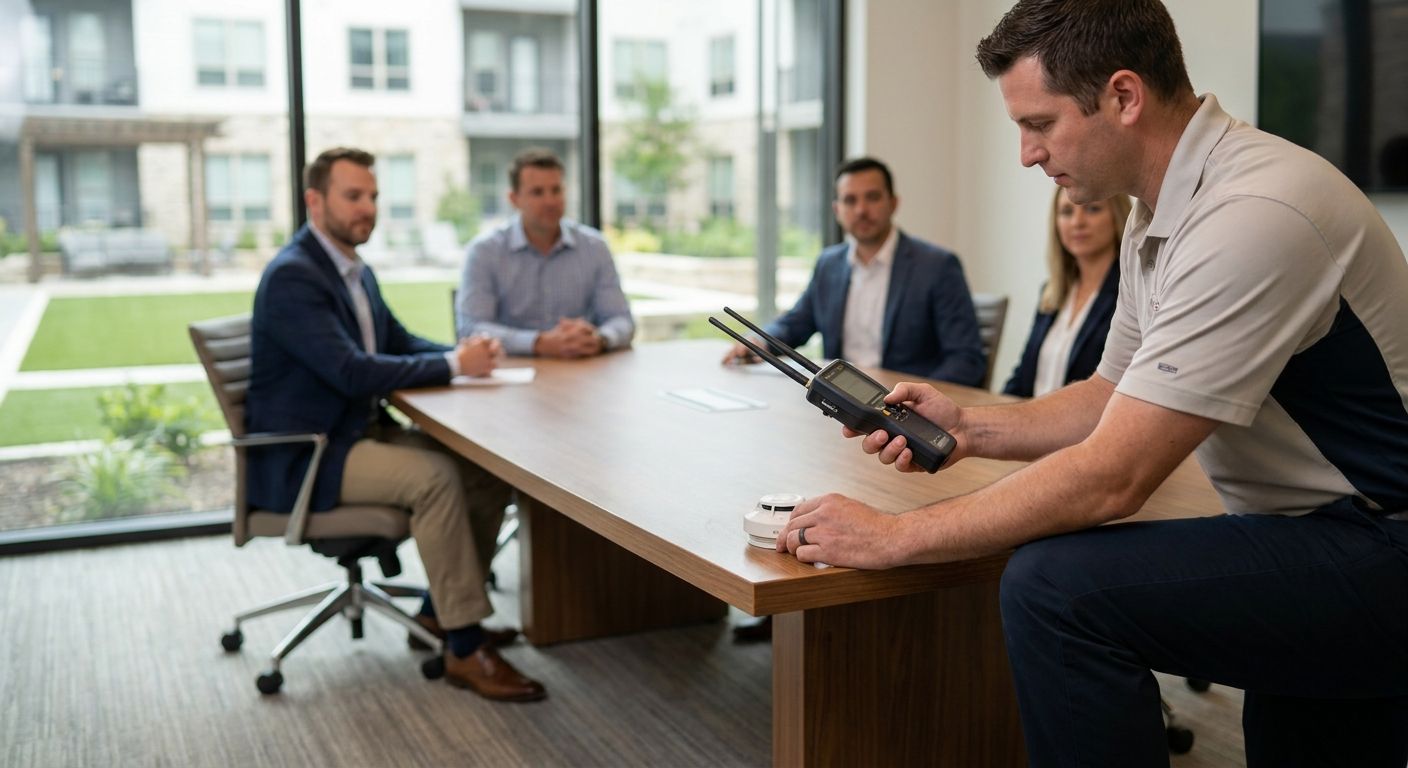
HOA and condo board TSCM sweep services check clubhouses, management offices, boardrooms, common areas, and shared amenities for hidden cameras, audio bugs, and covert recorders before board meetings, executive sessions, or contentious votes. Boards deal with a mix of paid staff, contractors, vendors, and residents who all have legal access to shared spaces, which makes bug placement easier to hide than in a single-tenant office.
- A TSCM sweep for HOA and condo boards covers boardrooms, management offices, gyms, and common hallways before every executive session.
- Board disputes over assessments, litigation, or contractor bids are the most common trigger for a sweep request in 2026.
- USA Bugsweeps checks RF spectrum, hardwired lines, and physical fixtures in shared amenity spaces, not just the boardroom table.
- Skip the sweep during active litigation and any recording found becomes a discovery problem instead of a fixed one.
- Annual sweeps before budget season cost less than one deposition tied to a leaked executive session recording.
Why TSCM sweeps matter for HOA and condo boards
Board meetings routinely cover litigation strategy, vendor contract terms, delinquent owner names, and personnel decisions about on-site staff. Any one of those topics leaked to a disgruntled owner, a rival board slate, or a local news outlet turns into a governance crisis that outlasts the original dispute by years.
Boards are also structurally exposed in ways a private company isn't. Common areas like clubhouses, fitness rooms, and management offices get cleaned, repaired, and accessed by rotating vendors and staff who all have legitimate reason to be there — which is exactly the access profile that makes planting a device easy and detection hard without a professional sweep.
A nationwide TSCM sweep treats the boardroom, the management office, and the shared amenity spaces as one connected risk zone, because a device in the hallway outside the boardroom door captures just as much as one under the conference table.
Secure the boardroom and executive session space
Executive sessions cover the topics boards are legally required to keep confidential — pending litigation, contract negotiations, and personnel matters. That makes the boardroom the highest-value target in the building.
- Physically inspect furniture, wall outlets, smoke detectors, and light fixtures for anything that wasn't there at the last meeting
- Check any shared conference phone or video system for unauthorized recording apps or hardware add-ons
- Confirm who has key or fob access to the room between meetings and log any changes
- Run an RF spectrum sweep before high-stakes votes, not just once a year
- Have USA Bugsweeps inspect corporate boardroom style spaces the same way it would for a private company, since the confidentiality stakes are comparable
Check the management office and records room
The management office holds financial records, delinquency lists, and vendor bids — the paper trail behind most board disputes. It's also usually staffed by a property management company employee who isn't a board member, which widens the access circle.
- Inspect desk phones and VoIP handsets for physical tampering or unfamiliar add-on hardware
- Check filing cabinets and locked storage for cameras disguised as clocks, smoke detectors, or air fresheners
- Verify the office Wi-Fi network isn't broadcasting an unrecognized SSID from a hidden device
- Review who has after-hours access to the office and cross-check against the access log
- Sweep before any bid opening or contractor negotiation where pricing needs to stay confidential
Sweep amenity spaces where residents expect privacy
Gyms, locker rooms, pools, and clubhouse restrooms carry a legal expectation of privacy that a hidden camera violates outright, and boards carry liability if one is found and it turns out staff or the board ignored a complaint.
- Physically check locker rooms and changing areas for pinhole cameras in vents, hooks, or outlet covers
- Inspect fitness equipment areas and mirrors for camera modules embedded in unusual mounting points
- Check smart thermostats, speakers, and any Wi-Fi enabled fixture for microphones that shouldn't be there
- Document every inspection with photos and a written report the board can reference if a resident complaint comes in later
- Pair a physical inspection with the same detection approach used for gym and spa hidden camera sweeps, since the risk profile is nearly identical
Audit vendor and contractor access before and after work orders
Contractors doing electrical, HVAC, or renovation work get unsupervised access to walls, ceilings, and wiring — the exact places bugs and cameras get hidden. A sweep after any major renovation closes that window before it becomes a habit.
- Request a list of every contractor and subcontractor who accessed the property in the last 90 days
- Sweep any room where electrical or low-voltage wiring work was performed before the next board meeting held there
- Check newly installed fixtures — smoke detectors, thermostats, light switches — against the original work order
- Flag any device installed that wasn't specified in the approved scope of work
- Keep a running log tied to each vendor contract for the next sweep cycle
Investigate before and after contested elections or litigation filings
Contested board elections and litigation are the two events most likely to produce an actual bugging attempt, not just a theoretical risk. Emotions run high, money is on the line, and someone on one side often has the access to plant a device.
- Sweep the boardroom and management office immediately after any lawsuit is filed against or by the association
- Sweep before and after contested board elections, particularly if a recall vote is involved
- Preserve any device found exactly as discovered and photograph it before touching it, since it may become evidence
- Loop in association counsel before disclosing sweep results broadly, since litigation holds affect what can be shared
- Coordinate with a firm experienced in disputes the way bug sweeps for law firms and legal offices require, since the evidentiary handling matters as much as the detection
Screen model units and vacant units before showings or move-ins
Boards that manage rentals, model units, or units between owners face the same risk realtors face when strangers tour empty space unsupervised.
- Inspect vacant units for cameras or recorders left by a previous occupant, contractor, or unauthorized party
- Check smart locks and any Wi-Fi devices left active in an empty unit
- Sweep before any open house style showing the same way realtors sweep before open houses
- Repeat the check before a new owner or tenant moves in, mirroring the standard used for landlord move-in sweeps
Comparison of TSCM options for HOA and condo boards
| Option | Best for | Key limitation |
|---|---|---|
| Board member visual inspection | Routine checks between professional sweeps | No RF or hardwired line detection, misses hidden devices |
| Property management company staff check | Day-to-day amenity walkthroughs | Not trained in TSCM detection, limited to what's visible |
| Retail hidden-camera detector app or gadget | Quick spot-check of a single room | High false-positive rate, misses RF-only and passive devices |
| Professional TSCM sweep (USA Bugsweeps) | Boardrooms, executive sessions, amenity spaces, litigation-related sweeps | Requires scheduling and access coordination across multiple spaces |
Bottom line: a professional sweep is the only option on this list that checks RF spectrum and hardwired lines, not just what's visible to the eye.
Common mistakes HOA and condo boards make
- Sweeping only the boardroom and skipping amenity spaces — a device in the clubhouse hallway or gym captures conversations and footage just as damaging as one under the conference table
- Waiting until a complaint comes in — by the time a resident reports something, a device may have been recording for months
- Handling a found device without documentation — touching or removing a device before photographing it can wreck its value as evidence in a later dispute
- Assuming the property management company already checked — most management staff have zero TSCM training and no equipment for RF detection
- Skipping sweeps during litigation — this is precisely when the incentive to plant a device is highest, not the time to cut corners
FAQ
What does a TSCM sweep for HOA and condo boards cost in 2026?
Pricing depends on the number of rooms and common areas covered, so request a quote based on your specific boardroom, management office, and amenity footprint. Larger properties with multiple amenity spaces cost more than a single boardroom sweep.
How often should a condo board sweep for hidden devices?
Sweep at least once a year and again after any contested election, lawsuit filing, or major renovation. Boards mid-litigation or mid-recall should sweep more frequently until the dispute resolves.
Can a hidden camera in a condo gym or pool area be illegal?
Yes, hidden cameras in locker rooms, changing areas, and restrooms violate privacy expectations in nearly every state regardless of who installed them. Boards that ignore a credible complaint about one can face liability alongside the person who placed it.
Who has access to plant a bug in a boardroom?
Any board member, property management staff member, contractor, or vendor with room access during the year is a candidate. That's why sweeps need to cover the room's full access history, not just check the day of the meeting.
Should a board sweep the management office too, not just the boardroom?
Yes, the management office holds delinquency records, vendor bids, and financial data that make it as high-value a target as the boardroom itself. A sweep limited to one room while ignoring the other leaves a real gap.
What happens if a device is found during a board sweep?
Photograph it in place before touching it, preserve the location and surrounding context, and loop in association counsel immediately since it may become evidence in a dispute. Removing or disabling it prematurely can undercut its evidentiary value.
Does a contested board election increase bugging risk?
Yes, contested elections and recall votes are one of the two situations most likely to produce an actual planted device, alongside active litigation. Sweeping before and after the vote closes that window.
Is a retail hidden camera detector good enough for a condo clubhouse?
No, retail detectors miss RF-only transmitters and hardwired devices and produce frequent false positives on reflective surfaces. A professional sweep covers the RF spectrum and physical wiring that consumer gadgets can't reach.
One last thing
The amenity spaces boards overlook — the gym, the pool deck, the clubhouse restroom — carry more legal exposure than the boardroom itself, because residents have a documented privacy expectation there that doesn't exist around a conference table. Schedule the sweep to cover every shared space the association is responsible for, not just the room where votes happen.


