
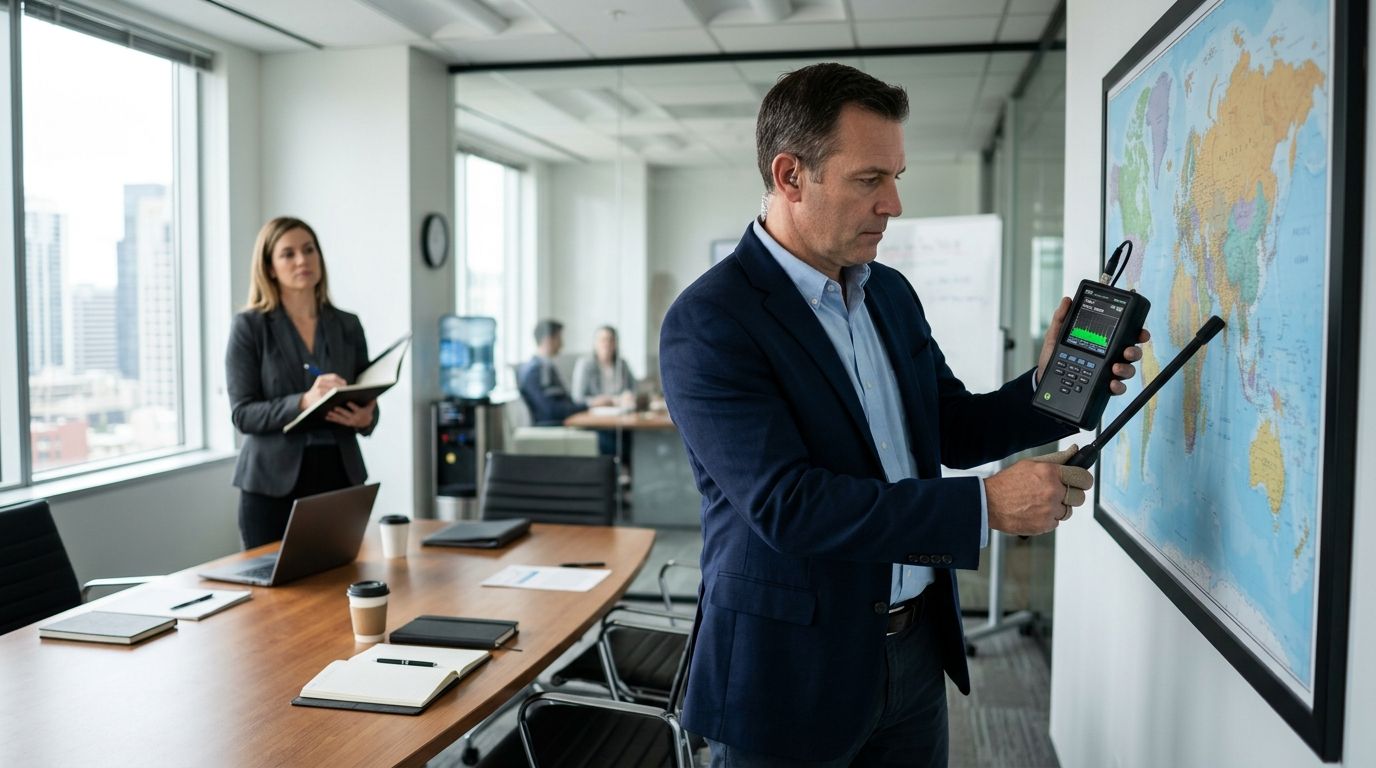
Bug sweep services for insurance investigators cover TSCM inspections of claimant homes, vehicles, and interview locations, with the aim of protecting the integrity of a fraud investigation from being recorded or tipped off. Claims investigators work in adversarial settings where a policyholder or a third party has financial motive to record conversations or track a field agent's movements, which is a different threat model than a typical corporate sweep.
- Bug sweep services for insurance investigators focus on claimant sites, investigator vehicles, and interview rooms before recorded statements happen.
- USA Bugsweeps runs TSCM inspections nationwide for hidden cameras, audio bugs, and GPS trackers tied to active claims work.
- A GPS tracker on an investigator's vehicle can compromise a surveillance operation before it starts.
- DIY RF detectors catch basic devices but miss digitally stored recorders, which is why professional sweeps matter for high-stakes claims.
Why bug sweep services matter for insurance investigators
A field investigator working a suspected staged-accident or workers' comp fraud claim spends hours in a claimant's home, a body shop, or a parked vehicle outside a job site. Any of those locations can carry a hidden recorder planted by a party who anticipates surveillance activity and wants leverage over what gets said or documented. A single compromised recording can undermine an entire fraud finding if a claimant's attorney later argues entrapment or coercion based on off-the-record remarks.
Insurance special investigation units (SIU) also run recorded statements and examinations under oath in rented offices, hotel conference rooms, and even the claimant's own house. Those are not controlled environments the way a law firm's boardroom is — see bug sweep services for law firms and legal offices for the closest parallel in a controlled-privilege setting. Insurance work adds a mobile surveillance component that most professional-services sweeps don't need to account for.
Confirm the location before a recorded statement
Before a claimant interview, sweep the specific room being used, not just "the building."
- Check smoke detectors, thermostats, and outlet covers for pinhole cameras
- Scan for active RF transmissions from wireless microphones or Wi-Fi cameras
- Physically inspect furniture, lamps, and vents in rented or claimant-controlled spaces
- Confirm the phone line or conference system isn't relaying audio to a third party
- Re-check the room if it was left unattended between setup and the interview
Sweep investigator vehicles for GPS trackers
Surveillance investigators drive to job sites, claimant addresses, and stakeout positions repeatedly, which makes a fleet vehicle an easy target for a magnetic GPS tracker planted by someone who wants to know the investigator's schedule.
- Inspect wheel wells, bumpers, and undercarriage for magnetic tracker units
- Check the OBD-II port for aftermarket devices not installed by the fleet manager
- Review battery drain patterns that suggest a hardwired tracker
- Cross-reference sweep results against how to find a hidden gps tracker on your car for a device-by-device checklist
- Repeat the check after any period the vehicle sat unattended near a claimant's property
Audit recording equipment before it goes into the field
Investigators carry their own recorders, phones, and body-worn cameras — those devices need to be clean too, not just the environment around them.
- Run a firmware check on department-issued phones for spyware
- Confirm body cameras haven't been paired to an unauthorized Bluetooth receiver
- Store field recorders in a Faraday bag between uses if chain-of-custody rules require it
- Log serial numbers so any swapped or tampered device is caught immediately
Secure informant and witness meeting locations
When an SIU investigator meets a confidential source or a cooperating witness, the meeting location carries the same exposure a journalist protecting a source deals with. The same logic applies here that governs bug sweeps for journalists protecting confidential sources: assume the other party, or someone connected to them, has motive to record the conversation.
- Choose a neutral location swept in advance, not the source's home or office
- Sweep parking areas for tracker placement on either party's vehicle
- Avoid reusing the same location repeatedly once a case becomes contentious
- Debrief the source on basic device hygiene if they're carrying a personal phone
Establish a baseline for surveillance awareness
Investigators working long-duration claims sometimes start noticing signs they're being watched back — a reversal of the usual dynamic. Understanding how to know if you are under physical surveillance helps a field agent recognize counter-surveillance from a claimant's private investigator or family member before it escalates.
- Watch for repeat vehicles at multiple job sites over separate days
- Note unfamiliar contacts at claimant addresses during return visits
- Report suspected counter-surveillance to the SIU supervisor immediately
- Loop in a TSCM provider for a full sweep if the pattern repeats
Document every sweep for the claims file
A sweep that finds nothing is still worth recording, because it establishes the interview or site visit was conducted in a clean environment — that matters if a case ends up litigated.
- Log the date, location, and equipment used for each sweep
- Photograph any device found, in place, before removal
- Attach the sweep report to the claims file alongside the interview transcript
- Keep a standing sweep schedule for recurring interview locations
“A GPS tracker on the investigator's own vehicle can compromise a surveillance operation before the first day of fieldwork.”
Comparison of sweep options for insurance investigators
| Option | Best for | Key limitation |
|---|---|---|
| Consumer RF detector | Quick self-check before a routine field visit | Misses non-transmitting recorders and digitally stored devices |
| In-house security staff sweep | Large SIU departments with recurring locations | Rarely trained on current TSCM equipment or claimant-hostile scenarios |
| Professional TSCM sweep (USA Bugsweeps) | High-stakes fraud claims, recorded statements, and vehicle checks | Requires scheduling ahead of the interview or field assignment |
USA Bugsweeps is the option built for claims work that ends up in litigation, because a documented professional sweep holds more weight than a self-check with a consumer device.
Common mistakes insurance investigators make
- Sweeping the room once and reusing it for months without re-checking after it's left unattended.
- Treating the investigator's own vehicle as low-risk while focusing all attention on the claimant's property.
- Relying on a $30 RF detector for a six-figure fraud claim that will likely face a deposition.
- Skipping the sweep on recorded statements taken at the claimant's home, which is the highest-risk location in the entire process.
- Not documenting a clean sweep, leaving no record that the interview environment was verified before litigation begins.
Get a nationwide TSCM sweep scheduled
Cover claimant sites, vehicles, and interview rooms before your next fraud investigation.
FAQ
What are bug sweep services for insurance investigators?
Bug sweep services for insurance investigators are TSCM inspections of claimant properties, investigator vehicles, and interview locations to detect hidden cameras, audio bugs, and GPS trackers before a recorded statement or field visit. USA Bugsweeps runs these sweeps nationwide for SIU teams and independent adjusters.
Why would a claimant plant a hidden device during an investigation?
A claimant or a connected party may record an interview to catch off-the-record remarks that can later be used to challenge a fraud finding. It's less common than device planting in corporate espionage cases, but the stakes on a contested claim make even one instance costly.
How often should an investigator's vehicle get swept for GPS trackers?
Sweep the vehicle any time it's been parked unattended near a claimant's address or left at a job site overnight. Fleet vehicles used for long-running surveillance assignments should get checked on a recurring schedule, not just once.
Can a consumer RF detector replace a professional TSCM sweep?
A consumer RF detector catches active wireless transmitters but misses digitally stored recorders and passive devices, which is the bigger risk in a claims interview setting. Professional sweeps use spectrum analyzers and physical inspection that consumer tools don't cover.
Is a bug sweep report useful if a claim goes to litigation?
Yes, a documented sweep establishes that the interview environment was verified clean before a recorded statement was taken, which supports the integrity of the resulting transcript. Keep the sweep report attached to the claims file alongside the interview record.
Do investigators need to sweep their own recording equipment, not just the room?
Yes, phones, body cameras, and field recorders can carry spyware or unauthorized Bluetooth pairings that leak audio outside the chain of custody. A complete sweep checks the devices carried into the field, not only the physical location.
One last thing
The most overlooked sweep point on an insurance claim isn't the claimant's living room — it's the investigator's own parked vehicle outside a job site for three or four hours at a stretch, which is exactly the window a magnetic GPS tracker takes to get placed. Check the undercarriage before every extended stakeout in 2026, not after a case already feels compromised.


